

Quick answer: Unpaid payroll tax is the most aggressively collected debt in the U.S. tax code. The IRS treats Form 941 trust-fund money — income tax and FICA you withheld from employees — as theft when you don’t remit it. The Trust Fund Recovery Penalty makes it personal: officers, directors, and even bookkeepers can be held individually liable for 100% of the unpaid trust-fund portion.
I’m Darrin Mish. Tampa tax attorney, 32 years in, more than $100 million in IRS debt resolved. What follows isn’t theory – it’s what I’ve actually watched work.
If you're running a business with employees, you've probably realized that managing irs payroll tax isn't just another administrative task. It's a significant responsibility that comes with serious legal obligations and potentially harsh penalties if things go wrong. Whether you're a first-time employer trying to navigate the complexities of tax withholding or a seasoned business owner who's fallen behind on deposits, understanding your obligations under federal tax law can save you from sleepless nights and financial hardship.
The truth is, payroll tax issues are among the most serious tax problems you can face as an employer. The IRS doesn't take kindly to businesses that fail to properly withhold, deposit, or report employment taxes, and they have powerful collection tools at their disposal. But before we dive into worst-case scenarios, let's start with the basics of what you actually owe.
What Exactly Is IRS Payroll Tax?
When we talk about irs payroll tax, we're actually referring to several different taxes rolled into one system. Think of it as a bundle of obligations rather than a single tax.
The Components of Employment Taxes
Your payroll tax obligations under federal law include multiple components that you need to calculate, withhold, and remit:
- Federal Income Tax Withholding – Money you withhold from employee paychecks based on their W-4 forms
- Social Security Tax – Currently 6.2% withheld from employees, plus an additional 6.2% you pay as the employer
- Medicare Tax – 1.45% from employees and 1.45% from employers on all wages
- Additional Medicare Tax – 0.9% on wages exceeding $200,000 (employee portion only)
- Federal Unemployment Tax (FUTA) – Employer-only tax to fund unemployment compensation programs
Notice something important here? Some of these taxes come entirely from your employees' wages (you're just the middleman), while others come directly from your business bank account. The IRS sees money you withhold from employee paychecks as trust fund taxes, and failing to remit those creates what's called trust fund recovery penalty exposure.

How the Federal Insurance Contributions Act (FICA) Works
FICA combines Social Security and Medicare taxes into what many people simply call "payroll taxes." For 2026, the Social Security wage base limit is $176,100, meaning you and your employees only pay Social Security tax on wages up to that amount. Medicare tax, however, applies to all wages with no cap.
Here's where it gets tricky for high earners: once an employee's wages exceed $200,000 in a calendar year, you need to start withholding the Additional Medicare Tax of 0.9%. You don't match this additional amount as the employer, but you are responsible for withholding it correctly.
Your Obligations as an Employer
Understanding what you owe is one thing. Knowing when and how to pay is where many employers stumble.
Withholding Requirements
According to IRS guidance on tax withholding, you must withhold federal income tax based on information your employees provide on Form W-4. This isn't optional. From the first paycheck you issue, you're required to calculate and withhold the appropriate amounts.
The withholding calculation considers:
- The employee's filing status
- Number of dependents claimed
- Any additional withholding requested
- Other adjustments specified on the W-4
You'll also need to withhold the employee's portion of FICA taxes from each paycheck. This happens simultaneously with income tax withholding.
Deposit Schedules and Deadlines
Here's where the irs payroll tax system becomes particularly demanding. You can't just collect taxes and send them to the IRS whenever it's convenient. The government wants its money on a strict schedule.
Your deposit schedule depends on the total tax liability you reported during a lookback period:
| Deposit Schedule | Lookback Period Liability | When to Deposit |
|---|---|---|
| Monthly | $50,000 or less | By the 15th of the following month |
| Semi-weekly | More than $50,000 | Wednesday-Friday paychecks: by following Wednesday; Saturday-Tuesday paychecks: by following Friday |
| Next-day | $100,000 or more accumulated in any deposit period | By the next business day |
The IRS strongly recommends using EFTPS for making these deposits electronically. In fact, all employment tax deposits must be made electronically, so paper checks aren't even an option anymore.
Quarterly and Annual Reporting
Beyond making timely deposits, you also need to file regular reports with the IRS. The primary form you'll deal with is Form 941, the Employer's Quarterly Federal Tax Return.
According to the official Form 941 instructions, you must file this form by the last day of the month following the end of each quarter:
- Q1 (January-March): Due April 30
- Q2 (April-June): Due July 31
- Q3 (July-September): Due October 31
- Q4 (October-December): Due January 31
Form 941 reports the total wages you paid, the federal income tax you withheld, and both the employer and employee portions of Social Security and Medicare taxes. It's essentially a reconciliation that shows the IRS you've been properly withholding and depositing throughout the quarter.
You'll also file Form 940 annually for Federal Unemployment Tax (FUTA), typically due January 31 of the following year.
Common Payroll Tax Problems and Red Flags
You might be thinking, "This doesn't seem too complicated. What's the big deal?" Well, the devil is in the details, and small mistakes can snowball into major problems faster than you'd expect.
Falling Behind on Deposits
This is the number one issue we see with business owners facing payroll tax problems. Cash flow gets tight, and you tell yourself you'll catch up next month. But next month comes with its own financial pressures, and suddenly you're quarters behind on your irs payroll tax obligations.
The IRS views this extremely seriously because you're holding money that belongs to your employees and the government. When you withhold taxes from employee paychecks but fail to remit them, you're essentially using government funds to finance your business operations.
Misclassifying Workers
Are your workers truly employees, or should they be classified as independent contractors? This distinction matters enormously for payroll tax purposes.
If you classify someone as an independent contractor (issuing them a 1099 instead of a W-2), you don't withhold or pay employment taxes for them. But if the IRS later determines they should have been classified as employees, you could be liable for:
- All the employment taxes you should have withheld and paid
- Interest on those unpaid amounts
- Penalties for failure to deposit and file
- Additional penalties for intentional misclassification
Filing But Not Paying
Some employers think they can avoid serious trouble by filing their Form 941 on time even if they can't afford to pay the full amount. While filing is certainly better than not filing, you're still accumulating penalties and interest on the unpaid balance.
The IRS assesses several types of penalties related to irs payroll tax:
- Failure to Deposit Penalty: 2% to 15% depending on how late the deposit is
- Failure to File Penalty: 5% per month, up to 25% of unpaid taxes
- Failure to Pay Penalty: 0.5% per month, up to 25% of unpaid taxes
- Trust Fund Recovery Penalty: 100% of the trust fund taxes personally assessed against responsible parties
That last one deserves special attention. The Trust Fund Recovery Penalty can be assessed personally against anyone the IRS determines was responsible for collecting or paying withheld taxes but willfully failed to do so. This means your personal assets could be at risk, not just business assets.
What Happens When You Fall Behind
Let's say you've missed several irs payroll tax deposits and you're getting nervous. What should you expect?
The IRS Collection Process
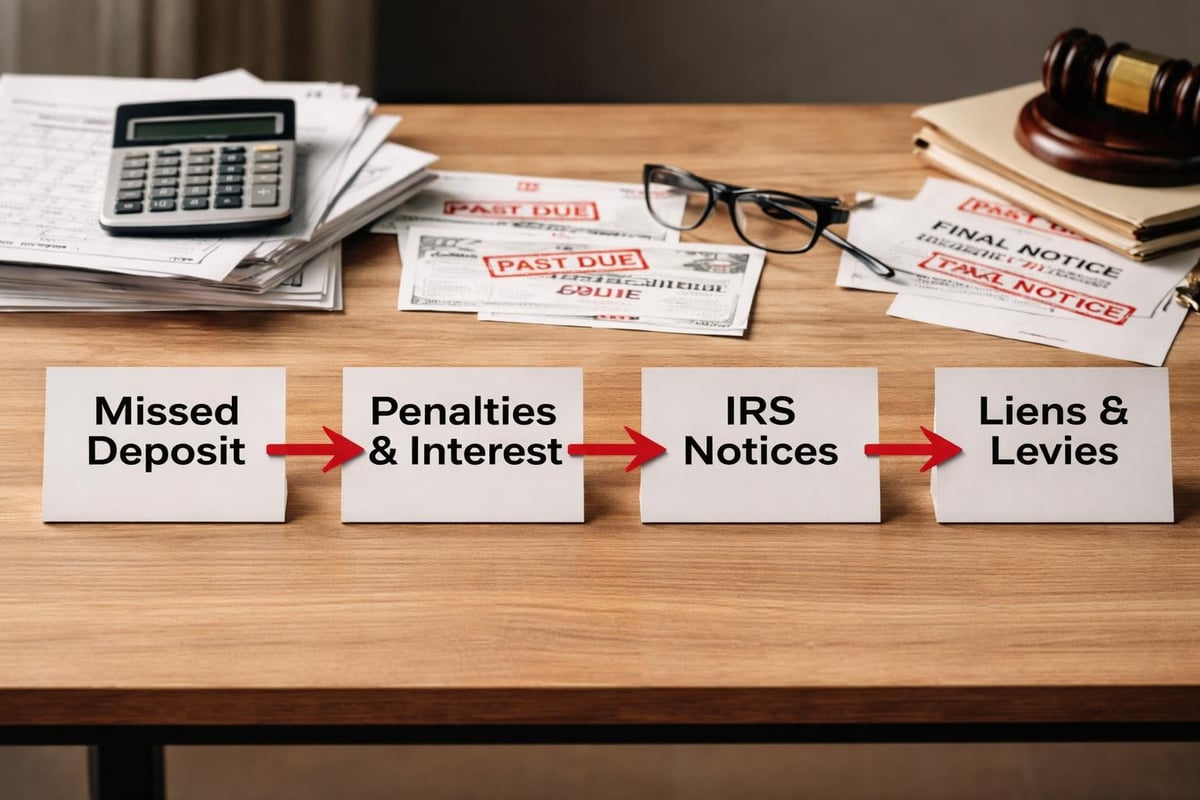
The IRS doesn't mess around with employment tax debt. Their collection process typically unfolds like this:
- Initial Notice: You'll receive a letter stating you owe unpaid employment taxes, penalties, and interest
- Follow-up Notices: Additional letters demanding payment, becoming increasingly urgent
- Notice of Intent to Levy: The IRS warns they'll begin seizing assets if you don't respond
- Actual Collection Actions: Bank levies, wage garnishments, or tax liens against your property
Throughout this process, interest continues accruing daily, and penalties pile up monthly. What started as a manageable problem can quickly become overwhelming.
Trust Fund Recovery Penalty Assessments
If the IRS determines you're a responsible party who willfully failed to pay trust fund taxes, they can assess the Trust Fund Recovery Penalty against you personally. This is no joke.
The IRS considers you a responsible party if you:
- Had authority to decide which bills the company paid
- Had authority to sign checks
- Had control over the company's finances
- Were an officer, director, or major shareholder
"Willfully" doesn't mean you intended to defraud the government. It simply means you knew about the unpaid taxes and either deliberately chose not to pay them or recklessly disregarded the obligation while paying other creditors.
Resolution Options for Unpaid Payroll Taxes
The good news? You have options even if you've fallen seriously behind on your irs payroll tax obligations.
Installment Agreements allow you to pay your tax debt over time through monthly payments. For businesses, the IRS typically requires you to remain current on all ongoing payroll tax obligations while paying down the past debt. Learn more about how installment agreements work for tax debt resolution.
Penalty Abatement might reduce or eliminate certain penalties if you have reasonable cause for your failure to comply. First-time penalty abatement is available if you have a clean compliance history for the previous three years. Explore penalty abatement options that could significantly reduce what you owe.
Currently Not Collectible Status temporarily suspends IRS collection activities if you can demonstrate that paying your tax debt would create financial hardship. However, interest and penalties continue accruing during this period.
Strategies to Stay Compliant
Prevention is always better than cure, especially when it comes to irs payroll tax issues.
Setting Up Systems for Success
The businesses that avoid payroll tax problems typically have robust systems in place:
- Segregate payroll tax funds immediately – When you process payroll, transfer the tax portion to a separate account so you're not tempted to use it for operating expenses
- Use payroll software or services – Modern payroll systems automatically calculate withholding, generate deposits, and prepare quarterly reports
- Set calendar reminders – Don't rely on memory for deposit deadlines; use automated reminders well in advance
- Reconcile monthly – Compare your books to your bank account to catch discrepancies before they become problems
According to the IRS guidance on depositing and reporting employment taxes, maintaining accurate records is just as important as making timely deposits.
Taking Advantage of Electronic Filing
Filing payroll taxes electronically offers multiple advantages beyond just convenience. You get immediate confirmation that the IRS received your return, you reduce errors through built-in validation, and you create an electronic trail for your records.
Many payroll software solutions integrate e-filing directly into their platforms, making quarterly reporting nearly automatic once you've set up your account properly.
Understanding Credits and Offsets
Did you know you might be able to reduce your irs payroll tax liability through legitimate credits? Small businesses investing in research and development can potentially claim the research credit against payroll tax.
Other credits that can offset employment taxes include:
- Work Opportunity Tax Credit for hiring from certain targeted groups
- Employee Retention Credit (though this was primarily a COVID-era benefit)
- Credit for small employer health insurance premiums
These credits don't reduce your filing or deposit obligations, but they can lower your overall tax burden when properly claimed on Form 941.
Special Situations and Considerations
Not every employer faces the same irs payroll tax situation. Your specific circumstances might create unique challenges or opportunities.
Seasonal Businesses
If you only have employees part of the year, you still need to file Form 941 for every quarter, even quarters where you had no payroll. You can check a box indicating you had no tax liability for that quarter, but the form still needs to be filed.
For FUTA purposes, seasonal employers may qualify for special treatment depending on their industry and employment patterns.
Household Employers
Do you employ a nanny, housekeeper, or caregiver in your home? The IRS guidance on household employment taxes explains that different rules apply to you. Instead of filing Form 941 quarterly, you report household employment taxes annually on Schedule H attached to your personal tax return.
You still need to withhold and pay Social Security and Medicare taxes if you pay a household employee $2,700 or more in 2026, and you'll owe FUTA tax if you pay $1,000 or more in any quarter.
Businesses in Financial Distress
What if your business is genuinely struggling and you're worried about meeting payroll tax obligations? First, understand that using withheld taxes to pay other business expenses is never the right answer, even if you're desperate.
If you anticipate problems, consider:
- Reducing your workforce to match your actual revenue
- Consulting with a tax professional immediately to understand your options
- Contacting the IRS proactively rather than waiting for them to come to you
- Exploring legitimate tax debt solutions before the situation becomes critical
The earlier you address potential problems, the more options you'll have available.
When Professional Help Makes Sense
Some irs payroll tax situations are straightforward enough to handle on your own, especially if you're a small employer with just a few employees and you've stayed current on all obligations. But certain red flags should prompt you to seek professional assistance:
- You've received an IRS notice about unpaid employment taxes
- You're being personally assessed for trust fund recovery penalties
- You've fallen multiple quarters behind on deposits or filings
- You're facing a payroll tax audit
- You're not sure whether you've properly classified workers
- The IRS has initiated collection actions like levies or liens
Working with a qualified tax attorney who specializes in IRS issues can make an enormous difference in the outcome of your case. An experienced professional understands how to negotiate with the IRS, which resolution options fit your specific situation, and how to protect your rights throughout the process.
With over 32 years of experience resolving IRS problems, specialized tax attorneys can often achieve outcomes that business owners can't negotiate on their own, including reduced penalties, manageable payment plans, or even settlement of tax debt for less than the full amount owed.
The Cost of Non-Compliance
Let's talk numbers for a moment. What does it actually cost when you fall behind on irs payroll tax obligations?
Penalty and Interest Calculations
Imagine you owe $50,000 in employment taxes and you're three months late on depositing:
| Component | Calculation | Amount |
|---|---|---|
| Original Tax Debt | – | $50,000 |
| Failure to Deposit Penalty (10%) | $50,000 × 10% | $5,000 |
| Failure to Pay Penalty (1.5%) | $50,000 × 0.5% × 3 months | $750 |
| Interest (8% annual, 3 months) | $50,000 × 8% × 0.25 | $1,000 |
| Total Amount Due | – | $56,750 |
That's an extra $6,750 in just three months. Now extend that timeline to a year or more with accumulating penalties, and you can see how quickly the situation spirals out of control.
Long-term Business Impact
Beyond the immediate financial costs, irs payroll tax problems can:
- Damage your business credit rating, making it harder to secure financing
- Create personal liability that follows you even if the business closes
- Result in tax liens that appear on your credit report and make it difficult to sell property or assets
- Lead to criminal prosecution in extreme cases of intentional evasion
- Prevent you from securing government contracts or professional licenses
These consequences extend far beyond just writing a check to the IRS. They can fundamentally impact your ability to operate and grow your business.

Looking Ahead: Staying on Track in 2026 and Beyond
As we move through 2026, tax law continues to evolve, and staying informed about changes to irs payroll tax requirements is essential for maintaining compliance.
Keeping Up with Tax Law Changes
The Social Security wage base adjusts annually, Medicare rates occasionally change, and new credits or deductions periodically become available. Subscribe to IRS updates, work with a qualified payroll provider, or maintain a relationship with a tax professional who stays current on these changes.
The IRS regularly offers webinars designed to help employers understand their obligations and avoid common mistakes. Taking advantage of these free educational resources can save you significant trouble down the road.
Building a Compliance Culture
If you have staff members who help with payroll, financial management, or human resources, ensure they understand the importance of payroll tax compliance. Create written procedures for:
- Calculating withholding for new and existing employees
- Processing payroll and segregating tax funds
- Making timely deposits according to your schedule
- Reconciling accounts monthly
- Preparing and filing quarterly returns
- Maintaining documentation for at least four years
When everyone on your team understands that irs payroll tax obligations are non-negotiable, you're far less likely to experience compliance failures.
Understanding Your Payment Options
The IRS offers multiple payment methods for employment taxes, but remember that all deposits must be made electronically. Whether you use EFTPS, your payroll service provider, or another approved method, confirm that your payments are being credited correctly and keep documentation of all transactions.
Many employers prefer automated deposit systems that pull funds from their account on the appropriate schedule, removing the risk of human error or forgotten deadlines.
Moving Forward with Confidence
Managing irs payroll tax obligations doesn't have to be overwhelming, but it does require diligence, accurate record-keeping, and a commitment to staying current. Whether you're processing your first payroll or you've been an employer for decades, the fundamentals remain the same: withhold accurately, deposit timely, and report completely.
If you're currently facing employment tax problems, remember that the situation typically gets worse the longer you wait to address it. The IRS has powerful collection tools, and payroll tax debt doesn't simply go away on its own. But with the right strategy and professional guidance, even serious tax problems can be resolved.
The key is taking action sooner rather than later, being honest about your situation, and working toward a sustainable solution that protects both your business and your personal financial future.
Understanding and managing your IRS payroll tax obligations is critical for any employer, and falling behind can create serious financial and legal consequences that extend beyond your business to your personal assets. If you're struggling with unpaid employment taxes, facing trust fund recovery penalties, or simply need guidance on staying compliant, the Law Offices of Darrin T. Mish, P.A. offers over three decades of experience helping businesses and individuals resolve even the most complex IRS problems. With free consultations available and personalized legal solutions tailored to your specific situation, taking that first step toward resolution is easier than you might think.
Frequently Asked Questions
What is the Trust Fund Recovery Penalty?
The TFRP under IRC Section 6672 lets the IRS pierce the corporate veil and assess unpaid payroll trust fund taxes personally against any responsible person who willfully failed to remit them. Once assessed, the liability is personal.
Who can be held liable for payroll tax under TFRP?
Any ‘responsible person’ the IRS deems to have had authority over payroll tax remittance: owners, officers, signatories on the bank account, bookkeepers, and sometimes accountants. Multiple people can be assessed for the same liability.
How do I defend against a Letter 1153 TFRP proposed assessment?
You have 60 days to file a written protest challenging the responsible person determination, the willfulness determination, or both. Strong defenses focus on showing you lacked authority, lacked knowledge, or relied on someone else.
What happens if my business cannot pay payroll taxes?
Stop accruing more debt immediately by becoming current on new payroll tax deposits. Then negotiate the back debt through an Installment Agreement, Offer in Compromise, or Currently Not Collectible status. The TFRP risk to officers and bookkeepers makes early action critical.
Can I settle TFRP debt through Offer in Compromise?
Yes. TFRP assessments are eligible for Offer in Compromise like other federal tax debts. Doubt as to collectibility is the most common ground.
How does payroll tax debt differ from income tax debt?
Payroll tax debt has the trust fund component (employee withholdings) which can be assessed personally against responsible parties under TFRP. Income tax debt is owed by the taxpayer who incurred it. Payroll tax cases are higher stakes for business owners.