

I’m Darrin Mish. Tampa tax attorney, 32 years in, more than $100 million in IRS debt resolved. What follows isn’t theory – it’s what I’ve actually watched work.
You know that feeling when you see an envelope from the IRS in your mailbox? Your heart skips a beat, right? Whether it's a simple notice or something more serious, dealing with any IRS issue can feel overwhelming. But here's the thing: understanding what you're facing and knowing your options can make all the difference between a quick resolution and a years-long struggle. Let me walk you through everything you need to know about identifying, addressing, and resolving IRS problems before they spiral out of control.
Understanding What Qualifies as an IRS Issue
Not every piece of mail from the IRS means you're in trouble. Sometimes it's just a routine notice asking for clarification. But how do you know when you're dealing with a genuine IRS issue that requires immediate attention?
An IRS issue typically involves a dispute, discrepancy, or enforcement action related to your tax obligations. This could range from a simple math error on your return to serious allegations of tax evasion. The key is recognizing the severity of what you're facing.
Common Types of IRS Issues
Let's break down the most frequent problems taxpayers encounter:
- Unpaid tax debt that has accumulated interest and penalties
- Unfiled tax returns from previous years
- Wage garnishments or bank levies already in effect
- Tax liens filed against your property
- Audit notices requesting documentation
- Penalty assessments for late filing or payment
- Identity theft affecting your tax account
Each of these situations requires a different approach. For instance, if you're dealing with tax liens that are preventing you from selling your home, you'll need to pursue lien release or subordination options.
Why Timing Matters When Addressing an IRS Issue
Here's something most people don't realize: the IRS operates on strict deadlines, and missing them can cost you thousands of dollars or eliminate your best options entirely.
When you receive an IRS notice, you typically have 30 days to respond. Some notices give you only 10 days before enforcement action begins. If you're facing an audit, you might have 30 to 90 days to provide documentation. Miss these windows, and you could lose your right to appeal or negotiate.

The Collection Statute Expiration Date (CSED) is particularly important. The IRS generally has 10 years from the date of assessment to collect a tax debt. Understanding this timeline can be crucial when developing a strategy to resolve your situation. However, certain actions can extend this period, so you need to be strategic about how you proceed.
| IRS Notice Type | Response Deadline | What Happens If You Miss It |
|---|---|---|
| CP504 (Intent to Levy) | 30 days | IRS can seize wages or bank accounts |
| CP2000 (Underreporter) | 30 days | Assessment becomes final |
| Audit Notice | Varies (30-90 days) | Proposed changes become final |
| Notice of Deficiency | 90 days | Lose right to petition Tax Court |
The Most Effective Ways to Resolve Your IRS Issue
You've got options, and some are better than others depending on your specific situation. Let me walk you through the proven strategies that actually work.
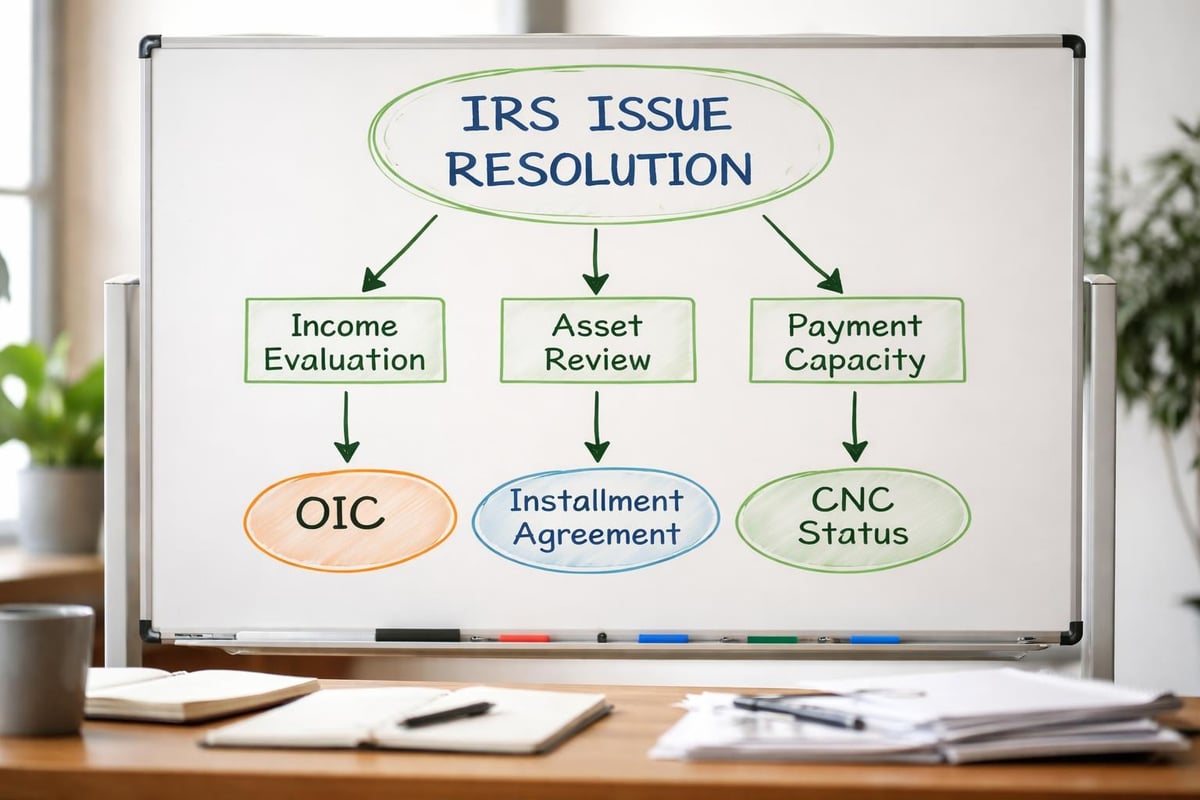
Offer in Compromise: Settling for Less
An Offer in Compromise (OIC) lets you settle your tax debt for less than the full amount owed. Sounds great, right? But the IRS only accepts about 40% of applications. You need to demonstrate that paying the full amount would create genuine financial hardship or that there's legitimate doubt about what you actually owe.
The IRS considers your income, expenses, asset equity, and ability to pay. They use Form 433-A (for individuals) or 433-B (for businesses) to calculate your reasonable collection potential. If you can explore IRS tax debt settlement options, this might be your best path forward.
Installment Agreements: Paying Over Time
If you can't pay your entire tax debt immediately but can afford monthly payments, an installment agreement might be your solution. The IRS offers several types:
- Guaranteed Installment Agreement: Available if you owe $10,000 or less
- Streamlined Installment Agreement: For debts up to $50,000, payable within 72 months
- Partial Payment Installment Agreement: Monthly payments that don't cover the full debt before the CSED expires
- Non-Streamlined Agreement: For larger debts requiring financial disclosure
The beauty of installment agreements is that they stop most collection actions once approved. However, interest and some penalties continue to accrue on the unpaid balance.
Currently Not Collectible Status
Sometimes you genuinely can't afford to pay anything toward your tax debt. If your monthly expenses exceed your income, you might qualify for Currently Not Collectible (CNC) status. The IRS temporarily stops collection efforts, though your debt continues to grow with interest.
This isn't a permanent solution, but it gives you breathing room when you're facing unemployment, medical emergencies, or other financial crises. Learn more about IRS Currently Not Collectible status and whether it might work for your situation.
Navigating IRS Programs Designed to Help Taxpayers
Did you know the IRS actually has programs specifically designed to help you resolve problems? It's true. They're not always easy to access, but they exist.
The Taxpayer Advocate Service
When you're stuck in bureaucratic quicksand with no way out, the Taxpayer Advocate Service (TAS) can be a lifeline. This independent organization within the IRS helps taxpayers experiencing economic harm or significant delays in resolving their IRS issue.
You might qualify for TAS assistance if:
- You're facing immediate threat of adverse action
- You've tried normal channels and gotten nowhere
- IRS systems, processes, or procedures aren't working
- Your problem is causing financial hardship
The TAS won't advocate for you to pay less tax, but they will ensure the IRS follows proper procedures and treats you fairly. They can be particularly helpful when dealing with identity theft or when IRS systems have made errors.
Industry Issue Resolution Program
For business owners, the Industry Issue Resolution Program provides another avenue. This program addresses common tax issues affecting entire industries by developing agreed-upon treatments for recurring problems. While it won't solve individual cases, it can provide clarity on how the IRS interprets tax law for specific business situations.
Protecting Yourself from IRS Scams
Not every call or email claiming to be from the IRS is legitimate. In fact, IRS impersonation scams have cost taxpayers millions of dollars over the years.
Red Flags That Signal a Scam
The IRS follows specific protocols when contacting taxpayers. They will never:
- Call demanding immediate payment using a specific method
- Threaten to bring in local police for non-payment
- Ask for credit card information over the phone
- Send emails about tax refunds or account issues
- Demand payment without giving you the chance to appeal
Real IRS communication almost always starts with a letter. If you receive a suspicious call or email, hang up or delete it. Then visit the official IRS contact page to verify whether you have an actual issue requiring attention.
When Professional Help Makes the Difference
Look, I get it. Hiring a tax attorney feels like an additional expense when you're already stressed about money. But consider this: the wrong move when dealing with an IRS issue can cost you tens of thousands of dollars or result in criminal charges in extreme cases.
What a Tax Attorney Brings to the Table
A qualified tax attorney understands the Internal Revenue Code, IRS procedures, and your legal rights. They can:
- Communicate with the IRS on your behalf, stopping those stressful phone calls
- Analyze your financial situation to determine the best resolution strategy
- Negotiate settlements that might not be available to you directly
- Represent you in Tax Court if your case requires litigation
- Protect your rights during audits or criminal investigations
If you're facing wage garnishment, you might benefit from understanding how to protect Social Security from garnishment and other income sources while working through your IRS issue.
Understanding Your Rights as a Taxpayer
You're not powerless when dealing with the IRS. The Taxpayer Bill of Rights guarantees you specific protections throughout the resolution process.
The Ten Fundamental Rights
- The Right to Be Informed: Clear explanations of what you owe and why
- The Right to Quality Service: Prompt, courteous, professional assistance
- The Right to Pay No More Than the Correct Amount: Challenge IRS positions
- The Right to Challenge the IRS's Position: Disagree and provide additional documentation
- The Right to Appeal: Take your case to an independent forum
- The Right to Finality: Know when the IRS can and cannot audit or collect
- The Right to Privacy: Proper notice before IRS contact with third parties
- The Right to Confidentiality: Protection of your tax information
- The Right to Retain Representation: Hire someone to represent you
- The Right to a Fair and Just Tax System: Expect the system to consider facts and circumstances
These aren't just nice ideas. They're enforceable rights. If the IRS violates them, you have recourse through appeals, the Taxpayer Advocate Service, or even federal court. The USA.gov resource on resolving tax disputes provides additional information on exercising these rights.
Penalty Abatement: Reducing What You Owe
Here's some good news: you might not owe as much as you think. The IRS assesses penalties for various violations, but many of these penalties can be reduced or eliminated through penalty abatement.
First-Time Penalty Abatement
If you have a clean compliance history (no penalties for the previous three years), you might qualify for first-time penalty abatement. This administrative waiver can eliminate failure-to-file, failure-to-pay, and failure-to-deposit penalties.
You don't need to prove reasonable cause, just demonstrate that you've been compliant in recent years. It's one of the easiest ways to reduce your IRS issue without complicated negotiations.
Reasonable Cause Abatement
For penalties not covered by first-time abatement, you can request relief based on reasonable cause. Valid reasons include:
- Natural disasters or fires affecting your records
- Serious illness or death in the immediate family
- Inability to obtain records despite reasonable efforts
- Erroneous advice from a tax professional or the IRS itself
Exploring IRS penalty abatement strategies can significantly reduce your total debt, making resolution more achievable.

Special Situations That Complicate IRS Issues
Some IRS problems involve unique circumstances that require specialized approaches. Let's look at a few scenarios that don't fit the standard resolution playbook.
Innocent Spouse Relief
What happens when your tax problem stems from your spouse's actions? If your spouse (or ex-spouse) understated income or claimed improper deductions without your knowledge, you might qualify for innocent spouse relief.
The IRS considers factors like whether you knew about the error, whether you benefited from the understatement, and whether it would be unfair to hold you responsible. IRS innocent spouse relief can completely eliminate your liability for tax, interest, and penalties attributable to your spouse's actions.
Injured Spouse Claims
Different from innocent spouse relief, an injured spouse claim protects your share of a tax refund when it would otherwise be seized to pay your spouse's separate debt (like student loans or back child support). You file Form 8379 to allocate the refund between spouses and protect your portion.
Tax Issues Related to Business Payroll
If you own a business and have fallen behind on IRS payroll tax obligations, you're facing one of the most serious IRS issues possible. The Trust Fund Recovery Penalty allows the IRS to hold business owners personally liable for unpaid payroll taxes, even if the business operated as a corporation or LLC.
The IRS takes payroll tax violations seriously because these are taxes withheld from employees that should have been remitted to the government. Resolving this type of IRS issue requires immediate action and often professional representation.
Creating a Long-Term Strategy for Tax Compliance
Resolving your current IRS issue is important, but preventing future problems is equally critical. Let's talk about building habits that keep you in the IRS's good graces.
Quarterly Estimated Payments
If you're self-employed or have significant non-wage income, making quarterly estimated payments prevents the accumulation of large tax debts. The IRS requires estimated payments if you expect to owe $1,000 or more when you file.
Calculate your expected annual income, determine your tax liability, and make payments by the quarterly deadlines:
| Quarter | Income Period | Payment Due Date |
|---|---|---|
| Q1 | Jan 1 – Mar 31 | April 15 |
| Q2 | Apr 1 – May 31 | June 15 |
| Q3 | Jun 1 – Aug 31 | September 15 |
| Q4 | Sep 1 – Dec 31 | January 15 (following year) |
Proper Record Keeping
Most tax problems start with poor documentation. Establish a system for tracking income, expenses, and deductions throughout the year. Digital tools make this easier than ever, but even a simple filing system works if you use it consistently.
Keep records for at least three years after filing (seven years for more complex situations). If you're ever audited, having organized records makes the difference between a smooth process and a nightmare.
Working with Professionals Proactively
Don't wait until you have an IRS issue to seek professional help. A good tax preparer or CPA can structure your finances to minimize tax liability legally and ensure compliance with all filing requirements.
For complex situations involving multiple income streams, business ownership, or international assets, getting help with IRS problems before they develop saves money and stress in the long run.
The Emotional Toll of Tax Problems and How to Cope
Let's talk about something that doesn't get discussed enough: the psychological impact of dealing with an IRS issue. Tax problems don't just affect your wallet. They affect your sleep, your relationships, and your mental health.
I've seen people describe IRS issues as more stressful than divorce or job loss. The uncertainty, the fear of losing everything, the shame of falling behind-these emotions are real and valid.
Managing Stress During the Resolution Process
First, take a breath. Your IRS issue is solvable. It might take time, but there's almost always a path forward. Here's what helps:
- Get organized: Collect all notices, returns, and financial documents in one place
- Create a timeline: Understand what's happened and what needs to happen next
- Set boundaries: Designate specific times to work on your tax issue, then step away
- Seek support: Talk to someone who understands, whether that's a professional or a trusted friend
- Focus on action: Each small step forward reduces anxiety
Remember, the IRS wants to resolve your issue too. They're not trying to destroy your life. They want their money, yes, but they're also willing to work with taxpayers who make genuine efforts to comply.
Moving Forward with Confidence
Dealing with an IRS issue isn't fun, but it's manageable when you approach it with the right information and support. Whether you're facing IRS tax debt, unfiled returns, or enforcement actions, understanding your options puts you back in control.
The worst thing you can do is ignore the problem. IRS issues don't age like fine wine. They get worse, more expensive, and harder to resolve. But with prompt action, knowledge of your rights, and professional guidance when needed, you can navigate this challenge and come out the other side with your finances intact.
Addressing any IRS issue requires understanding your options, acting within critical deadlines, and often seeking professional representation to navigate complex tax law. The Law Offices of Darrin T. Mish, P.A. has spent over 32 years helping taxpayers worldwide resolve everything from wage garnishments to complex tax debt situations. If you're facing tax problems and need experienced guidance, Law Offices of Darrin T. Mish, P.A. offers free consultations to evaluate your situation and develop a personalized resolution strategy that protects your financial future.