

The tax-relief industry loves to make IRS problems sound impossible without them. They're not. I'm Darrin Mish. I've been representing taxpayers before the IRS for 32 years. Let me explain how this actually works.
I'm Darrin Mish. Tampa tax attorney, 32 years in, more than $100 million in IRS debt resolved. What follows isn't theory – it's what I've actually watched work.
The IRS sends levy notices. You panic. Your bank account, your wages, maybe even your car. But here's what most taxpayers miss: if paying would genuinely leave you unable to afford rent or groceries, there's a status called Currently Not Collectible that can stop the collection machine in its tracks. The connection between irs levy hardship currently not collectible status isn't obvious from the threatening letters the IRS sends, but it's there in the Internal Revenue Manual, and I've used it hundreds of times.
You won't find "hardship" stamped across IRS forms in bright red letters. The agency calls it Currently Not Collectible or CNC status. Same idea: you prove you can't pay without creating genuine economic suffering, and the IRS backs off temporarily. Not forgiveness, just breathing room.
What Currently Not Collectible Status Actually Means
Currently Not Collectible status tells the IRS to stop active collection. The Taxpayer Advocate Service explains CNC status as a formal designation that your account gets coded in IRS systems to suspend levy action.
When your account goes CNC, several things happen:
- Levy activity stops: No new bank levies, wage garnishments, or asset seizures while the status holds
- Debt remains: Your balance doesn't disappear, and interest keeps accruing at the federal rate
- Statute runs: The 10-year collection statute continues ticking, which means time works in your favor
- Reviews happen: The IRS typically checks your financial situation every two years to see if you've recovered
The IRS doesn't advertise this option. You have to request it, and you have to prove you qualify. That means documentation-pay stubs, bank statements, rent receipts, medical bills, everything that shows your financial reality.

The Hardship Test the IRS Actually Uses
The IRS measures hardship through something called allowable living expenses. The Internal Revenue Manual outlines Currently Not Collectible guidelines that revenue officers follow when evaluating hardship claims.
Here's the formula: monthly income minus allowable expenses equals disposable income. If that number is zero or negative, you pass the hardship test. Sounds simple until you see what the IRS considers "allowable."
| Expense Category | IRS Treatment |
|---|---|
| Housing (rent/mortgage) | Capped at local standards, actual if lower |
| Utilities | National standard amount |
| Food, clothing, personal care | National standard per household size |
| Transportation | Operating costs plus ownership/lease payment |
| Health insurance | Actual documented premium |
| Out-of-pocket medical | Actual if verified and necessary |
| Court-ordered payments | Actual (child support, alimony) |
| Taxes | Current year withholding only |
| Credit card debt | Generally not allowed |
| Student loans | Usually not allowed unless in current repayment |
The standards shift every year. In 2026, a single person gets roughly $785 monthly for food, clothing, and personal care under national standards. A family of four gets about $1,763. These aren't generous numbers.
When IRS Levy Hardship Currently Not Collectible Status Works Best
I see three scenarios where pursuing CNC makes tactical sense. First, when you're temporarily broke but expect recovery. Job loss, medical crisis, business failure-something specific happened, you need time to stabilize, and you can't negotiate an installment agreement yet.
Second, when you're close to the collection statute expiration. If the IRS has five years left to collect and you genuinely can't pay, CNC lets the clock run while you're protected. After 32 years, I've watched millions in debt expire this way.
Third, when other resolution paths don't work. If you don’t qualify for the Fresh Start program or an Offer in Compromise and can't afford even minimum installment payments, CNC becomes the default protection.
What Happens to Levies Already Issued
If the IRS already levied your bank account or started garnishing your wages, CNC status can release those levies. You need to act fast-bank levies have a 21-day hold period before the funds transfer to the IRS.
Revenue officers have discretion to release levies when you demonstrate hardship. I've seen releases happen within 48 hours when the documentation was solid. Other times, it takes weeks of back-and-forth.
Wage garnishments stop once the IRS processes your CNC request and sends a release to your employer. That processing time varies-sometimes days, sometimes a month. The garnishment continues until the release arrives.
How to Request Currently Not Collectible Status
You start with Form 433-F (Collection Information Statement) or Form 433-A if you're self-employed. These forms dissect your financial life: income, assets, monthly expenses, everything the IRS needs to calculate disposable income.
Documentation you'll need:
- Three months of bank statements for all accounts
- Recent pay stubs or profit-and-loss statements
- Proof of monthly expenses (rent/mortgage statement, utility bills, insurance premiums)
- Medical bills if you're claiming health expenses
- Current year tax compliance (all returns filed, current withholding adequate)
That last point matters more than people expect. The IRS won't grant CNC if you're not filing current returns or paying current taxes. They view compliance as non-negotiable.
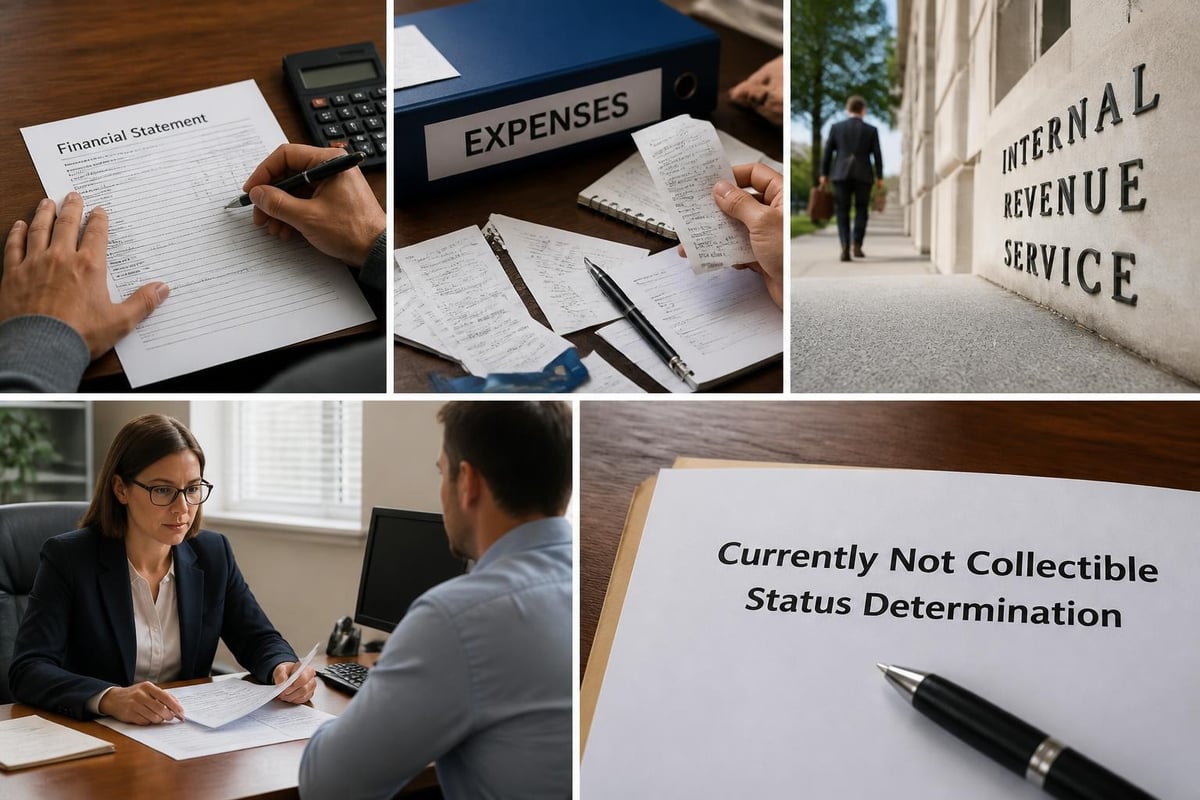
The Revenue Officer Interview
If you owe more than $25,000 or if your case already assigned to a revenue officer, expect a phone interview or in-person meeting. The officer walks through your financial statement line by line.
They'll question expenses that seem high. They'll ask why you need two cars. They'll push back on private school tuition or cable TV. Their job is to find disposable income you claim doesn't exist.
Stay calm. Answer directly. Have your documentation ready. If the officer says an expense isn't allowable, ask them to cite the specific IRM section. IRS Authority describes how CNC status determinations work through this review process.
What Life Looks Like in Currently Not Collectible Status
Your tax debt doesn't go away. Interest accrues at the current federal rate-about 7% in 2026. Penalties stop once you file all required returns, but failure-to-pay penalties can add up before you get CNC approved.
The IRS files a Notice of Federal Tax Lien if you owe more than $10,000. CNC status doesn't prevent liens or remove existing ones. The lien protects the government's interest in your assets and damages your credit. It stays until the debt resolves or the statute expires.
What you can expect:
- IRS computers periodically check your income through wage and information return matching
- Every two years (sometimes annually), the IRS reviews your account to see if your financial situation improved
- If your income increases significantly, the IRS can revoke CNC status and resume collections
- Tax refunds get seized and applied to your balance while in CNC status
Understanding how Currently Not Collectible interacts with other IRS actions helps you plan for reviews and potential status changes.
When the IRS Revokes CNC Status
Three triggers usually revoke Currently Not Collectible status. First, the IRS computer systems detect new income-W-2s, 1099s, business receipts reported by third parties. Second, you fail to file a return or pay current year taxes. Third, during a periodic review, you can't document continued hardship.
You get a letter explaining the revocation and stating that collections will resume. Sometimes you get 30 days to respond. Sometimes collections restart immediately if you've stopped filing returns.
If your financial situation genuinely hasn't improved, you can request continued CNC status. Same process: updated financial statement, current documentation, proof of ongoing hardship.
Currently Not Collectible vs. Other Payment Options
CNC isn't the only way to handle IRS debt, and it's not always the best option. For taxpayers facing levy action, comparing alternatives matters.
| Resolution Option | Monthly Payment | Immediate Protection | Debt Reduction | Statute Impact |
|---|---|---|---|---|
| Currently Not Collectible | $0 | Yes, once approved | No, interest accrues | Continues running |
| Installment Agreement | Based on balance/income | Yes, once accepted | No | Tolled during application |
| Offer in Compromise | Lump sum or short-term | Yes, during consideration | Yes, if accepted | Tolled during process |
| Partial Payment Installment | Small monthly amount | Yes, once approved | Possibly, if statute expires | Continues running |
Free Tax Update explains how CNC differs from other hardship programs and when each makes sense.
An installment agreement requires monthly payments but gives you more control. The IRS won't review your finances every two years and won't revoke the agreement unless you default. If you can afford $50 or $100 monthly, an agreement might beat CNC.
An Offer in Compromise can eliminate most of your debt, but you need to prove you'll never be able to pay the full amount. The acceptance rate runs about 35-40%. If you don't qualify for an Offer, CNC becomes the fallback.
Strategic Use of Currently Not Collectible Status
Some taxpayers use CNC strategically while pursuing other goals. You get CNC approved to stop immediate levy threats, then work on building an Offer in Compromise over the next six to twelve months.
Others use CNC to protect assets while negotiating. If you own a house with equity but your income is legitimately too low to make payments, CNC prevents the IRS from forcing a sale while you explore refinancing options or hardship withdrawals from retirement accounts.
I've seen taxpayers in CNC for seven or eight years, with the collection statute running the entire time. The debt eventually expired uncollected. That outcome requires genuine, sustained hardship-disability, chronic unemployment, medical catastrophe. The IRS doesn't forget about you.
Common Mistakes That Destroy CNC Applications
First mistake: inflating expenses. Revenue officers cross-reference your claimed rent against property records. They compare your utility bills against average usage. If your numbers don't match reality, you lose credibility and probably lose the request.
Second mistake: hiding assets or income. The IRS pulls wage transcripts showing every W-2 and 1099 filed under your Social Security number. They check DMV records for vehicle ownership. They see bank account interest reported on 1099-INTs. Omitting assets you thought were invisible just tanks your case.
Third mistake: staying in CNC too long without exploring alternatives. If you're in year three of CNC and your income has partially recovered, you might qualify for a partial payment installment agreement or an Offer. Staying passive costs you because interest keeps building.
Red flags that kill CNC requests:
- Claiming zero discretionary expenses while owning luxury vehicles
- Showing monthly expenses higher than monthly income but not explaining how you survive (usually means unreported income)
- Failing to file current year returns or pay current estimated taxes
- Owning significant assets with equity but claiming inability to borrow or liquidate
- Recent large purchases or transfers inconsistent with claimed poverty
The IRS Resolution Authority details administrative procedures revenue officers follow when they spot inconsistencies in financial statements.
How Long Does Currently Not Collectible Status Last
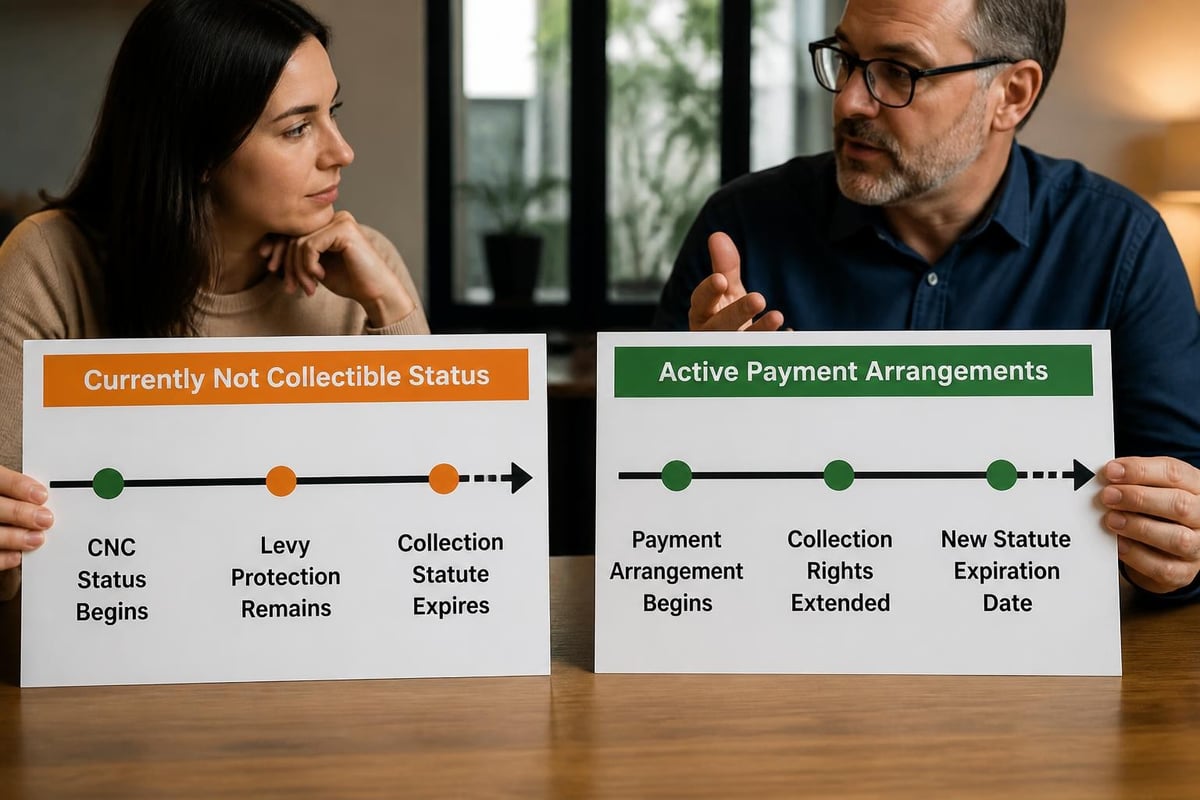
CNC status lasts until one of three things happens: your financial situation improves enough to make payments, you stop complying with current tax obligations, or the collection statute expires.
The 10-year collection statute starts on the assessment date-usually April 15 of the year after you were supposed to file, or the actual filing date if later. Tax Relief 101 explains how CNC preserves statute time while protecting you from enforcement.
Every action that suspends the statute adds time to the 10-year clock. Filing an Offer in Compromise can add 18 months. Installment agreement appeals can add six months. But CNC itself doesn't toll the statute-time keeps running.
What Happens When the Statute Expires
When the 10-year mark hits, the IRS legally cannot collect the debt anymore. It disappears from IRS systems. Liens release within 30 days of expiration. The debt becomes legally uncollectible.
I've represented taxpayers who survived on CNC status for most of the statute period. One client owed $180,000 from a failed business. Between disability and age, he had no realistic path to repayment. He maintained CNC for eight years, filed all current returns showing minimal Social Security income, and the debt expired in 2024. Cost him nothing but patience and compliance.
That outcome isn't common, but it's not rare either when the hardship is real and the taxpayer stays current with filing obligations.
The Psychological Weight of Currently Not Collectible Status
Living in CNC status feels like waiting for the other shoe to drop. Every two years, you wonder if this review will be the one that ends your protection. Every time your income increases-even slightly-you worry the IRS computers will flag your account.
But here's what I tell clients: if the hardship is genuine, stop apologizing for it. You're using a legal provision that exists precisely for your situation. The IRS built Currently Not Collectible into their procedures because they recognize that collecting from broke people is pointless.
The stress lessens when you understand what triggers reviews and what doesn't. A $2,000 annual raise doesn't automatically revoke CNC if your expenses increased proportionally. Getting married might change your household allowable expenses but doesn't necessarily end hardship status. Having a second child actually increases your standard expenses.
Managing Reviews and Documentation
Keep your documentation organized from the start. When the IRS sends a review letter (usually CP-71C), you'll have days or weeks to respond with updated financial information. If you scramble to gather documents, you risk missing the deadline and getting kicked out of CNC.
I recommend clients maintain a CNC file with:
- Current pay stubs or business income records
- Recent bank statements
- Updated bills for housing, utilities, insurance, and medical expenses
- Tax returns from the most recent filing season
- Any correspondence from the IRS regarding their case
When review time comes, updating that file takes an hour instead of a week. You respond quickly, maintain your status, and avoid renewed levy threats.
When to Fight for CNC vs. When to Walk Away
Not every levy threat justifies pursuing Currently Not Collectible status. If you owe $3,000 and can scrape together $50 monthly, just get an installment agreement. The administrative burden of proving hardship exceeds the benefit.
If you owe $125,000, earn $35,000 annually supporting two kids, and have no assets, CNC makes perfect sense. The gap between what you owe and what you can pay is unbridgeable through normal payment plans.
Reed Corporation’s guide on CNC status helps taxpayers evaluate whether hardship status fits their specific circumstances better than alternatives.
The cost-benefit calculation shifts based on the statute timeline. If you have nine years left on the collection period, CNC might protect you long enough for expiration. If you have two years left, the IRS is less likely to approve CNC because they'd rather push for quick payment arrangements.
Working with Revenue Officers on Hardship Cases
Revenue officers aren't your enemies, but they're not your advocates either. Their performance metrics reward revenue collected. Putting your account in CNC gives them zero credit toward their goals.
That doesn't mean they'll deny legitimate hardship. It means you need to prove your case beyond any reasonable doubt. Bring organized documentation. Answer questions directly. Don't volunteer information they didn't ask for. Don't argue about what expenses should be allowable-stick to what the IRM actually allows.
I've watched taxpayers talk themselves out of CNC approval by mentioning upcoming inheritances, potential job offers, or business ideas that might generate income. The revenue officer hears "future ability to pay" and denies the request. Keep your responses factual and present-tense.
What Happens If You Get Denied
The IRS sends a denial letter explaining why your Currently Not Collectible request failed. Common reasons include expenses exceeding allowable standards, unreported income the IRS discovered through third-party matching, or assets you could liquidate to pay the debt.
You can appeal the denial through the Collection Appeals Program. You have a limited window-usually 30 days from the denial letter date. The appeal goes to an Appeals Officer who reviews the revenue officer's decision.
Appeals Officers have more flexibility than revenue officers. They consider factors beyond strict financial formulas. I've won appeals by showing unusual circumstances that explain why allowable expenses don't capture the taxpayer's reality: special needs dependent with extraordinary medical costs, elderly parent requiring financial support, recent natural disaster damage not covered by insurance.
The appeal must include:
- Specific reasons why the denial was incorrect
- Supporting documentation for any disputed facts
- Citations to relevant IRM sections if the revenue officer misapplied standards
- Alternative resolution proposals if CNC remains denied
If you lose the appeal, collections resume. The IRS can issue new levy notices immediately. That's when you consider whether an installment agreement, even a financially painful one, beats ongoing levy risk.
Documentation the IRS Actually Cares About
Revenue officers see fabricated hardship cases daily. They've developed sharp instincts for inconsistent stories. Your documentation needs to tell a coherent, believable story about why you can't pay.
Bank statements matter most. They show where your money actually goes. If you claim $1,200 monthly rent but your bank statements show $800 checks to your landlord and $400 in restaurant charges, you just lost credibility.
Medical bills require careful documentation. The IRS allows out-of-pocket medical expenses, but you need to prove they're necessary and ongoing. A stack of emergency room bills from last year doesn't establish current hardship. Monthly prescriptions, regular specialist visits, and durable medical equipment create a stronger case.
Tax Cure’s hardship resource outlines the specific proof IRS revenue officers look for when evaluating economic hardship claims.
Proof of necessary expenses beats explanations. Don't tell the revenue officer your utility bills are high because your aging HVAC system runs constantly. Show them 12 months of utility bills demonstrating consistent high usage and quotes for HVAC replacement you can't afford.
The Asset Question
The IRS will ask about assets. Retirement accounts, real estate equity, vehicles, valuable collections-anything you could theoretically liquidate to pay your debt.
Here's the reality: the IRS can't force you to raid your 401(k) to pay taxes. But they can consider your ability to borrow against it when evaluating hardship. If you have $200,000 in a 401(k), the revenue officer might suggest you could take a loan and use those funds.
Your response needs to address why that's not viable. Maybe your employer's plan doesn't offer loans. Maybe you already maxed out available loan amounts. Maybe you're over 59½ and the revenue officer suggests distributions, but taking distributions would trigger taxes that worsen your financial situation.
Real estate equity gets similar treatment. If you have $80,000 equity in your home, the IRS assumes you could get a home equity loan or refinance with cash out. You need to show either that you tried and got denied due to credit issues, or that taking on new debt payments would exceed your available income.
IRS levy hardship currently not collectible status exists because sometimes people genuinely can't pay without suffering real economic damage, and the IRS has to acknowledge that reality. The key is proving your situation meets their standards with documentation that tells a consistent, credible story.
For 32 years, the Law Offices of Darrin T. Mish, P.A. has helped taxpayers navigate Currently Not Collectible applications, appeals, and the periodic reviews that follow. Whether you're facing immediate levy action or trying to understand if hardship status makes sense for your situation, let's talk about what's actually possible in your case and what documentation will move the needle with the IRS.