

Quick answer: If you have delinquent IRS taxes — you’ve filed but haven’t paid, or you haven’t filed at all — your options are still on the table: installment agreement, Offer in Compromise, Currently Not Collectible status, penalty abatement. The fastest move is filing every missing return, even if you can’t pay. Filing late stops the failure-to-file penalty clock and is the gateway to every other relief option.
I’m Darrin Mish. Tampa tax attorney, 32 years in, more than $100 million in IRS debt resolved. What follows isn’t theory – it’s what I’ve actually watched work.
If you've received threatening letters from the IRS about unpaid taxes, you're not alone. Millions of Americans struggle with irs delinquent taxes every year, and the consequences can be overwhelming. Maybe you filed your return but couldn't pay the full amount, or perhaps life got in the way and you missed filing altogether. Whatever the reason, the IRS doesn't just forget about money you owe. The good news? You have more options than you might think, and understanding how the IRS handles delinquent taxes is your first step toward getting back on solid ground.
What Are IRS Delinquent Taxes and How Do They Happen?
Let's start with the basics. IRS delinquent taxes are simply taxes that you haven't paid by the deadline. This includes any taxes owed from your annual return, quarterly estimated tax payments, or even payroll taxes if you're a business owner. The moment you miss a payment deadline, your tax debt becomes delinquent.
Here's how it typically unfolds:
- You file your tax return showing a balance due
- You can't pay the full amount by the April deadline
- The IRS sends you a notice demanding payment
- Interest and penalties start accumulating immediately
- Additional notices follow if you don't respond
The penalties add up fast. The failure-to-pay penalty is typically 0.5% of your unpaid taxes for each month or part of a month the tax remains unpaid, up to 25% of your unpaid taxes. On top of that, the IRS charges interest on both the unpaid tax and the penalties, compounded daily.
The Timeline of IRS Collection Actions
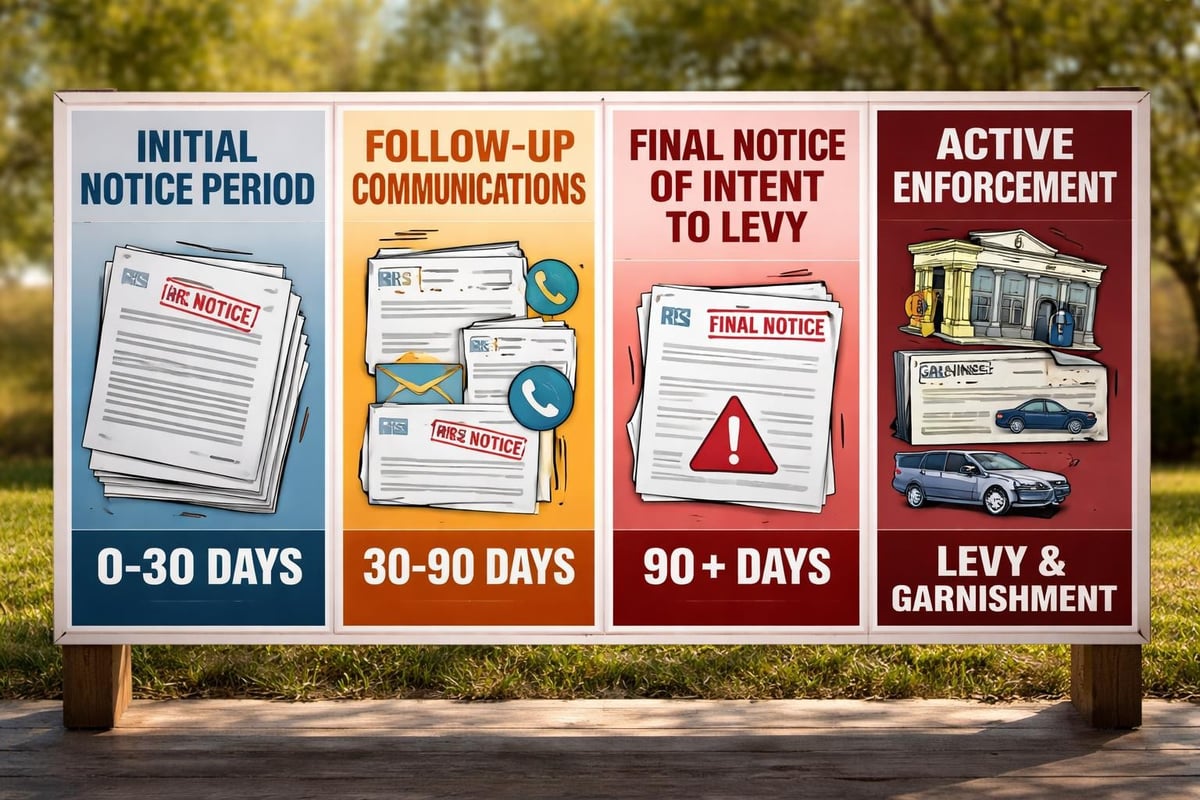
When you have irs delinquent taxes, the IRS follows a fairly predictable collection timeline. Understanding this progression helps you know when to act and what to expect next.
| Stage | Timeline | What Happens |
|---|---|---|
| Initial Notice | 3-4 weeks after filing | First bill (CP14 notice) sent |
| Follow-up Notices | 5-25 weeks | Additional reminder notices (CP501, CP503, CP504) |
| Intent to Levy | Around 30 weeks | Final Notice of Intent to Levy sent |
| Active Collection | 30+ weeks | Levies, liens, wage garnishment possible |
You might think ignoring the problem makes it go away. It doesn't. In fact, the IRS has up to 10 years to collect delinquent taxes from the date of assessment, and they use increasingly aggressive methods as time passes.
How the IRS Collects Delinquent Taxes
The IRS has extensive legal authority to collect what you owe, and they're not shy about using it. Understanding their collection methods helps you prepare and protect yourself.
Wage Garnishment
One of the most common collection methods is wage garnishment. The IRS can contact your employer directly and require them to send a portion of your paycheck to satisfy your tax debt. Unlike other creditors, the IRS doesn't need a court order to garnish your wages.
The amount they can take is substantial. For a single person with one dependent, the IRS might leave you with only about $800 per month (as of 2026), taking everything else. Even if you're receiving Social Security benefits, certain portions may be at risk, though there are protections you should understand.
Bank Levies and Asset Seizures
A bank levy is even more immediate. The IRS can freeze and seize funds from your bank account to satisfy your debt. You typically get one notice before this happens, and then your account is frozen for 21 days before the funds are sent to the IRS.
Beyond bank accounts, the IRS can seize:
- Your home or other real property
- Vehicles and personal property
- Business assets and equipment
- Retirement accounts (though this is less common)
- Future tax refunds
Federal Tax Liens
A federal tax lien is the government's legal claim against your property. Once the IRS assesses your tax and sends you a bill that you don't pay, they can file a Notice of Federal Tax Lien. This becomes public record and severely damages your credit score.
Tax liens attach to:
- Real estate you currently own
- Personal property like vehicles and equipment
- Property you acquire after the lien is filed
- Business property and assets
The lien makes it nearly impossible to sell property or refinance loans because the IRS gets paid first from any proceeds.
Passport Revocation: A Growing Concern
Here's something many taxpayers don't know about: if you owe seriously delinquent tax debt, the IRS can certify your debt to the State Department, which can then revoke or deny your passport.
What constitutes "seriously delinquent"? As of 2026, it's generally a tax debt over $62,000 (adjusted for inflation) that has a filed Notice of Federal Tax Lien and all administrative remedies have lapsed or been exhausted.
If you receive a CP508C notice, the IRS has already certified your debt. You won't be able to renew your passport, and if you're traveling internationally, you could face problems returning to the United States.

Your Rights When Dealing with IRS Delinquent Taxes
Don't let anyone tell you that you're powerless when facing the IRS. You have significant rights under federal law, and knowing them changes everything about how you handle your situation.
The Taxpayer Bill of Rights
The IRS must follow the Taxpayer Bill of Rights, which includes:
- The right to be informed about what you owe and why
- The right to quality service from IRS employees
- The right to pay no more than the correct amount of tax
- The right to challenge the IRS's position and be heard
- The right to appeal an IRS decision in an independent forum
- The right to finality in knowing when the IRS can collect
Collection Due Process Hearings
When the IRS files a lien or issues a levy, you have the right to a Collection Due Process (CDP) hearing. This is your chance to dispute the amount owed, propose alternative collection methods, or negotiate a payment arrangement. You must request this hearing within 30 days of receiving certain IRS notices.
During a CDP hearing, you can:
- Challenge whether you actually owe the tax
- Propose collection alternatives like an installment agreement
- Request an Offer in Compromise
- Assert that collection would create economic hardship
- Argue that the IRS failed to follow proper procedures
Resolution Options for IRS Delinquent Taxes
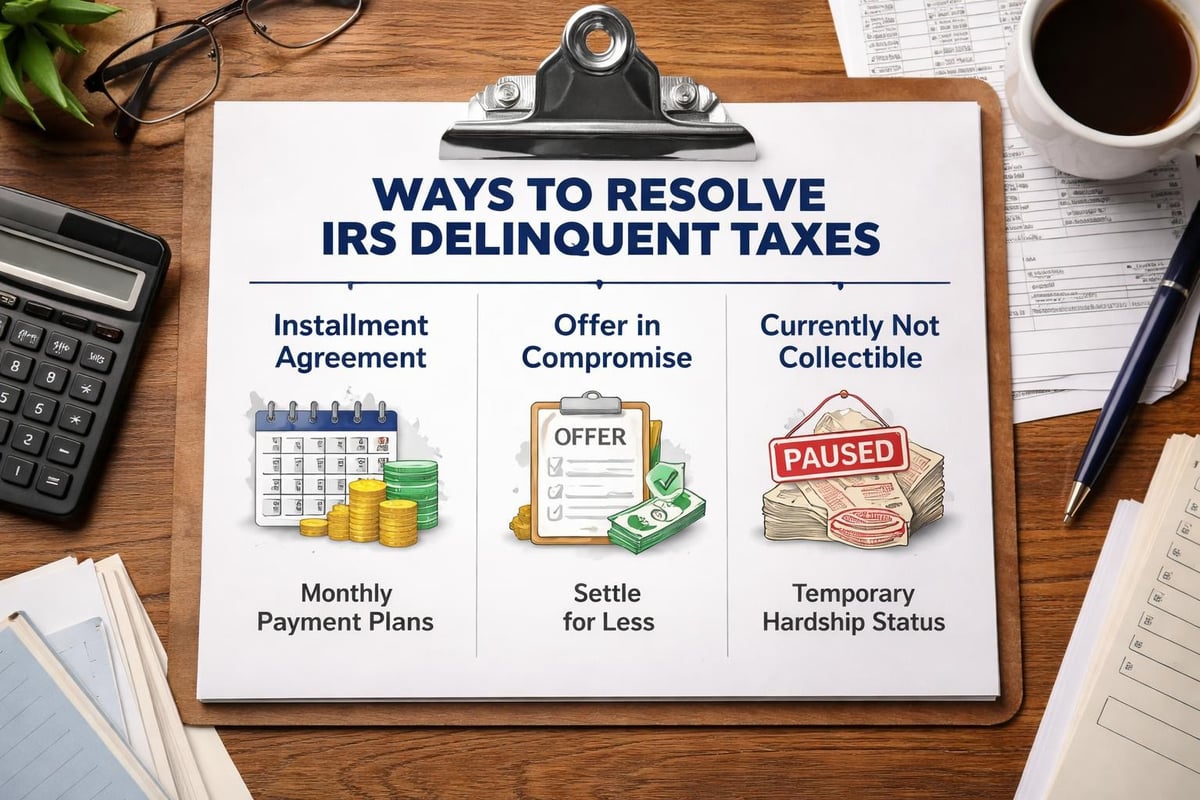
Now let's talk about solutions. You have several pathways to resolve irs delinquent taxes, and the right choice depends on your financial situation.
Installment Agreements
An installment agreement lets you pay your tax debt over time in monthly payments. If you owe less than $50,000, you can often set up a payment plan online through the IRS website. The process is relatively straightforward, and the IRS typically approves agreements as long as the payments will satisfy the debt before the 10-year collection statute expires.
There are different types:
| Agreement Type | Debt Amount | Requirements |
|---|---|---|
| Guaranteed | Under $10,000 | Pay within 3 years; filed all returns |
| Streamlined | Under $50,000 | Pay within 72 months; no financial disclosure needed |
| Partial Payment | Any amount | Financial disclosure required; may not pay full debt |
| Non-streamlined | Over $50,000 | Extensive financial documentation required |
Offer in Compromise
An Offer in Compromise allows you to settle your tax debt for less than you owe. Sounds great, right? The catch is that the IRS only accepts offers when you genuinely can't pay the full amount, even over time.
The IRS evaluates your:
- Monthly income and expenses
- Asset equity (home, vehicles, investments)
- Future earning potential
- Overall ability to pay
Most offers are rejected. The IRS approved only about 33% of offers submitted in recent years. However, when done correctly with proper documentation and legal guidance, an OIC can provide significant relief.
Currently Not Collectible Status
If you're facing genuine financial hardship, you might qualify for Currently Not Collectible (CNC) status. This temporarily halts all IRS collection activities, including levies and garnishments. The IRS essentially agrees that collecting from you right now would create undue hardship.
While in CNC status:
- Interest and penalties continue to accrue
- The 10-year collection statute keeps running
- The IRS may file a tax lien
- You must file all future returns on time
This isn't forgiveness, but it gives you breathing room to get back on your feet. Learn more about available tax debt solutions that might fit your circumstances.
Penalty Abatement: Reducing What You Owe
Beyond payment arrangements, you might qualify to reduce the actual amount you owe through penalty abatement. The IRS can remove or reduce penalties for reasonable cause, and this can save you thousands of dollars.
First-Time Penalty Abatement
If you've had a clean compliance history for the past three years, you may qualify for first-time penalty abatement. This administrative relief can remove failure-to-file, failure-to-pay, and failure-to-deposit penalties.
Requirements include:
- Filed all required returns (or filed an extension)
- Paid, or arranged to pay, any tax due
- No penalties for the prior three years
Reasonable Cause Abatement
Even if you don't qualify for first-time abatement, you might still get penalties removed for reasonable cause. This includes:
- Natural disasters or other catastrophic events
- Serious illness or death in the immediate family
- Inability to obtain records
- Reliance on incorrect written advice from the IRS
- Other circumstances beyond your control
The IRS has also provided penalty relief for certain tax years, particularly for returns affected by pandemic-related disruptions. It's worth exploring whether you qualify for any relief programs.
What Happens If You Do Nothing?
Let's be honest about the consequences of ignoring irs delinquent taxes. The IRS doesn't stop, and the situation only gets worse.
Recent reports suggest that the IRS may not be collecting all delinquent taxes efficiently, but that doesn't mean your debt will slip through the cracks. The agency has been increasing enforcement efforts and improving collection systems.
The Compound Effect
Think of tax debt like a snowball rolling downhill. It starts small but picks up speed and size quickly:
- Month 1: $10,000 in tax debt with minimal penalties
- Month 6: $10,500 with failure-to-pay penalties and interest
- Month 12: $11,200 and a federal tax lien filed
- Month 18: $12,000 and wage garnishment begins
- Month 24: $13,000 plus legal complications
Your financial situation becomes increasingly difficult to resolve. Bank accounts get levied. Credit scores plummet. Professional licenses can be jeopardized. Business operations may be disrupted.
The Role of Professional Representation
Can you handle IRS delinquent taxes on your own? Sometimes, yes. Should you? That depends on the complexity of your situation and how much you owe.
When to Seek Professional Help
Consider working with a tax professional if you:
- Owe more than $25,000 in back taxes
- Face wage garnishment or bank levy
- Received a Notice of Intent to Levy
- Need to negotiate an Offer in Compromise
- Have unfiled tax returns from multiple years
- Operate a business with payroll tax issues
Tax attorneys have unique advantages. Unlike enrolled agents or CPAs, conversations with tax attorneys are protected by attorney-client privilege. This means the IRS cannot compel your attorney to testify about your communications, which is crucial when sensitive financial information is involved.
What to Expect from Representation
Professional representation typically includes:
- Power of Attorney filing so your representative handles IRS communications
- Case analysis to determine your best resolution option
- Documentation preparation for payment plans or offers
- Negotiation with IRS representatives
- Appeals representation if needed
- Compliance planning to prevent future problems
The investment in professional help often saves you far more than it costs through reduced penalties, better payment arrangements, and peace of mind.
Preventing Future Tax Delinquency
Once you resolve your current tax issues, you'll want to avoid ending up in the same situation again. Prevention requires both practical steps and mindset shifts.
Adjust Your Withholding
If you're an employee, review your Form W-4 annually. Many people get surprised by a large tax bill because they're not having enough withheld from their paychecks. Life changes like marriage, divorce, having children, or taking a second job all affect your tax situation.
Use the IRS withholding estimator to ensure you're having the right amount taken out. It's better to get a smaller refund (or break even) than to owe thousands you can't pay.
Make Estimated Tax Payments
Self-employed individuals and those with significant income outside their regular job must make quarterly estimated tax payments. Missing these payments leads to penalties and a large bill at year-end.
Set up automatic transfers to a separate savings account each time you receive income. When quarterly payment deadlines arrive (April 15, June 15, September 15, and January 15), you'll have the money ready.
Keep Better Records
Poor recordkeeping contributes to many tax problems. Implement a simple system:
- Keep digital copies of all tax documents
- Track deductible expenses throughout the year
- Maintain separate business and personal accounts
- Save records for at least seven years
- Use accounting software or apps
File Even If You Can't Pay
Here's critical advice: always file your return on time, even if you can't pay. The failure-to-file penalty is 5% per month (up to 25%), while the failure-to-pay penalty is only 0.5% per month. Filing on time and requesting a payment plan is far better than not filing at all.
Understanding IRS Collection Statistics and Trends
The IRS's approach to collecting delinquent taxes has evolved significantly. Understanding current trends helps you anticipate what to expect in 2026 and beyond.
According to IRS enforcement statistics, the agency collected hundreds of billions in enforcement revenue in recent years. The IRS has been increasing its use of automated systems and expanding its compliance initiatives.
Automated Collection Systems
The IRS uses sophisticated levy programs that automatically issue levies without human intervention. The Federal Payment Levy Program can intercept federal payments, including Social Security benefits in certain circumstances. The State Income Tax Levy Program works with state governments to intercept state tax refunds.
These automated systems mean collection can happen faster than in previous years. The days of tax debt sitting uncollected for years are largely over.
Increased Funding and Enforcement
Recent legislation has provided the IRS with significant additional funding to modernize systems and hire more enforcement personnel. This means increased audit rates, faster collection actions, and more sophisticated debt collection methods.
For taxpayers with irs delinquent taxes, this translates to:
- Quicker progression from notice to enforcement
- More comprehensive asset discovery
- Better cross-referencing of financial information
- Increased likelihood of collection contact
Moving Forward with Confidence
Dealing with IRS delinquent taxes isn't pleasant, but it's also not insurmountable. Thousands of taxpayers successfully resolve their tax debts every year through payment plans, offers in compromise, and other resolution methods.
The key is taking action now rather than waiting for the situation to deteriorate. Each day you delay, interest and penalties accumulate, and the IRS moves closer to enforcing collection. Whether you choose to handle it yourself or work with a professional, acknowledging the problem and creating a plan is your path forward.
Remember that the IRS would generally prefer to work out a payment arrangement than to seize your assets. They want to collect what you owe, but they also understand that aggressive collection can make that impossible. When you proactively engage with the IRS and demonstrate good faith, you're much more likely to reach a reasonable resolution.
Your tax debt doesn't define you, and it won't last forever. With the right approach and appropriate help, you can resolve your IRS delinquent taxes and rebuild your financial stability. The sooner you start, the more options you'll have and the less you'll ultimately pay.
Resolving IRS delinquent taxes requires knowledge, action, and often professional guidance to navigate the complex collection process and identify the best resolution strategy for your unique situation. If you're struggling with tax debt, wage garnishment, liens, or other IRS enforcement actions, the experienced team at Law Offices of Darrin T. Mish, P.A. has helped thousands of clients achieve lasting tax relief through personalized solutions tailored to their financial circumstances. With over three decades of tax law experience and a commitment to client success, we offer free consultations to help you understand your options and take the first step toward financial freedom.
Frequently Asked Questions
When do I need a tax attorney instead of a CPA or enrolled agent?
When your case has criminal exposure, complex litigation posture, or attorney-client privilege as a strategic tool. For straightforward Installment Agreements, a CPA or EA is often the right choice. For audits, Trust Fund Recovery, Tax Court, or anything with potential criminal elements, the attorney premium is justified.
What does a tax attorney consultation cover?
A typical first consultation is 20 to 30 minutes, free, and covers your specific situation, your IRS letters and deadlines, your finances, available resolution options, expected fee range, and whether the firm is the right fit. There is no obligation to engage.
How much does a tax attorney cost?
Tax resolution cases typically range from $5,000 to $25,000 depending on complexity. Trust Fund Recovery defense and Tax Court litigation are higher. The fee is usually a small percentage of what is at stake when proper representation works.
Does hiring a tax attorney trigger an audit?
No. The IRS does not flag taxpayers because they hired representation. Having a Form 2848 Power of Attorney on file usually makes the case run more efficiently.
What is attorney-client privilege in tax cases?
Communications between you and your tax attorney are protected and cannot be compelled in litigation. Communications with a CPA generally have no such protection. The privilege is critical when criminal exposure is possible.
Can a tax attorney negotiate with the IRS for me?
Yes. Once a Form 2848 Power of Attorney is filed, the IRS communicates with your attorney instead of you. The attorney negotiates Installment Agreements, Offers in Compromise, penalty abatements, and represents you in audits and appeals.