

IRS problems aren't as complicated as they look once you see the structure. I'm attorney Darrin Mish. I've represented taxpayers before the IRS for three decades — in Florida, Colorado, Texas, and internationally. Here's the plain-English breakdown.
I'm Darrin Mish. Tampa tax attorney, 32 years in, more than $100 million in IRS debt resolved. What follows isn't theory. It's what I've actually watched work.
You've opened your mail and found IRS Letter 950 sitting there with "30-day letter" stamped across the top. Your stomach drops. The IRS examined your return, didn't like what they found, and now they're proposing changes. The letter tells you that you owe more tax, sometimes with penalties and interest stacked on top. You have 30 days to respond. That's not a suggestion.
The irs letter 950 30 day letter is the IRS field examiner's way of telling you the audit is over and here's what we think you owe. It's not a bill yet. It's a proposal. But treat this deadline like your appeal rights depend on it, because they do.
What Letter 950 Actually Says
Letter 950 arrives after a field examination, the kind where a revenue agent actually looks at your books and records. The letter includes an examination report explaining what the agent changed on your return and why. You'll see proposed tax, penalties, and interest calculated through the date of the letter. The numbers are often shocking.
The letter gives you three options, spelled out clearly:
- Agree with the findings and sign the agreement form (usually Form 870).
- Disagree and request a conference with the IRS Office of Appeals.
- Do nothing and wait for a statutory notice of deficiency (the 90-day letter).
That third option is almost always a mistake. Doing nothing means you've wasted your easiest shot at resolution.

The 30-Day Clock Starts Immediately
The clock starts the day the letter is dated, not when you actually open your mail. The IRS assumes you received it within a reasonable time. If you're traveling, if you moved and didn't update your address, if the letter sat in a pile on your desk for two weeks, none of that extends the deadline.
You have 30 days from the letter date to file a written protest if you disagree. The Internal Revenue Manual section on Letter 950 lays out exactly how examiners must prepare and deliver these letters. The IRM confirms that this letter serves as the formal opening of your appeal window.
Miss the 30 days and your options narrow. You can still disagree, but now you're waiting for a statutory notice of deficiency, which pushes you toward Tax Court. That's more expensive, more formal, and often unnecessary if you'd just handled the Letter 950 correctly.
Why the IRS Sends Letter 950 Instead of Just Billing You
The IRS could skip this step. They could just assess the tax and send you a bill. But tax law requires them to give you a chance to challenge the findings before assessment. This is your procedural due process, baked into the Internal Revenue Code.
Letter 950 is the field examination version of this notice. It's different from the standard CP2000 notice you'd get for a correspondence audit. Letter 950 comes after a more thorough examination, usually involving multiple tax years or complex issues like business expenses, depreciation, or basis calculations.
The agent who examined your return wrote a report. Letter 950 is the cover letter that delivers that report to you with a deadline attached. The report itself is often dense, filled with tax code citations and accounting adjustments that don't make sense unless you read tax regs for a living.
What Happens If You Agree
If you agree with the proposed changes, you sign Form 870 (Waiver of Restrictions on Assessment and Collection of Deficiency in Tax). This stops interest from piling up on the proposed assessment. The IRS processes the agreement, assesses the tax, and sends you a bill.
Signing Form 870 doesn't mean you can't later file a claim for refund if you discover the IRS was wrong. But it does mean you're accepting the assessment now and paying it. Most taxpayers who sign do so because the examination was clean and the proposed changes are correct.
The problem is that many proposed changes aren't correct. Revenue agents make mistakes. They misread documents, misapply regulations, or miss key facts. Signing away your appeal rights without a careful review is how you end up paying tax you don't actually owe.
How to Disagree: Filing a Formal Protest
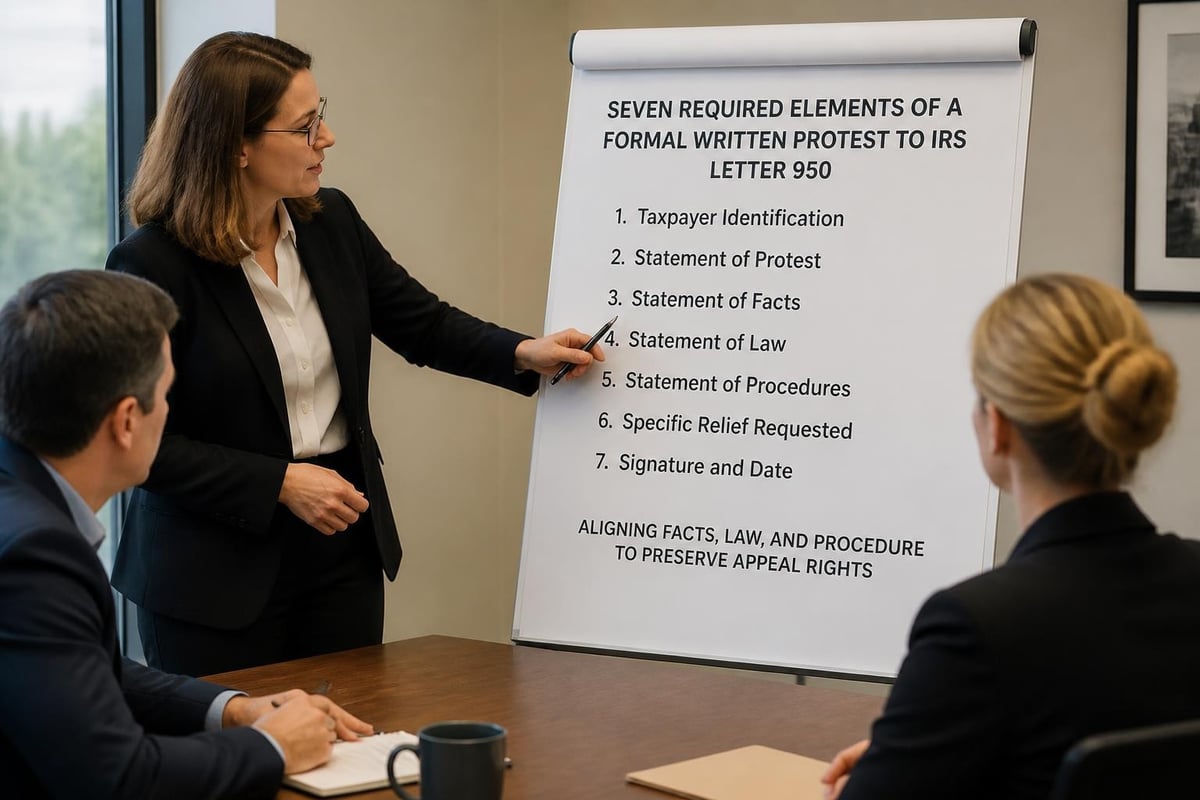
If you disagree with any part of the examination report, you file a written protest within 30 days. The protest must be formal if the proposed additional tax (including penalties) exceeds $25,000 for any tax period. Below that threshold, you can file an informal protest, which is just a letter stating your disagreement.
A formal protest includes:
- Your name, address, and daytime phone number
- A statement that you want to appeal the IRS findings to Appeals
- A copy of the letter showing the proposed changes (Letter 950)
- The tax periods or years involved
- A list of each proposed change you disagree with
- A statement of facts supporting your position, declared under penalties of perjury
- The law or authority supporting your position
That last part trips people up. You can't just say "I disagree because I think the agent is wrong." You need to cite tax law, regulations, court cases, or IRS guidance that supports your position. This is where most taxpayers without representation stumble.
Appeals Conference Is Not a Negotiation From Weakness
The IRS Office of Appeals is independent from the examination function. The appeals officer assigned to your case hasn't talked to the revenue agent who examined you. They review the case fresh. Their job is to settle cases based on the "hazards of litigation," meaning what would likely happen if the case went to Tax Court.
This is where good cases get resolved. If you have documentation the revenue agent ignored, if there's a tax court case on point that supports you, if the agent misapplied a regulation, Appeals will often concede the issue or settle somewhere in the middle. The key is presenting your case clearly, with the law and facts lined up.
Appeals conferences are informal. You can represent yourself. But you're sitting across from someone who reviews tax disputes all day, and you're arguing technical tax law. The officer is polite and professional, but they're not there to help you build your case.
What Happens If You Ignore Letter 950
Ignore the 30-day deadline and the IRS issues a statutory notice of deficiency, also called a 90-day letter. This is your last chance to challenge the proposed tax before it's assessed. You have 90 days (150 if the notice is addressed to you outside the United States) to petition the United States Tax Court.
The U.S. Tax Court guidance for petitioners walks through how to file a petition. You pay a filing fee, submit your petition, and the case moves into the Tax Court system. The IRS now has to prove its case. You're no longer just arguing at Appeals. You're in litigation.
Tax Court is a real court with real judges. Discovery, motions, trial. Most cases settle before trial, but getting there is expensive if you're paying an attorney to handle it. And if you lose, you're still on the hook for the tax, plus interest that's been running since the original return was due.
Miss the 90-day deadline and the IRS assesses the tax. Now it's a collection case. The irs letter 950 30 day letter was your early warning. The 90-day letter was your last warning. After assessment, you're dealing with liens, levies, and wage garnishments. Your options to challenge the underlying tax are nearly gone.
| Response Option | Deadline | Next Step | Cost |
|---|---|---|---|
| Agree (Form 870) | 30 days recommended | IRS assesses tax, sends bill | $0 + tax owed |
| Protest to Appeals | 30 days | Appeals conference | $0 (or attorney fees if represented) |
| Ignore Letter 950 | N/A | Statutory notice of deficiency (90-day letter) | $0 initially |
| Petition Tax Court | 90 days after statutory notice | Litigation | $60 filing fee + attorney fees |
| Ignore 90-day letter | N/A | Assessment, collection | Full tax + penalties + interest + collection costs |
Common Mistakes Taxpayers Make With the IRS Letter 950 30 Day Letter
The biggest mistake is waiting. You get the letter, you're busy, you tell yourself you'll deal with it next week. Three weeks pass. Now you're scrambling to write a protest with four days left. Protests written in panic are protests that lose.
Second mistake is agreeing without understanding what you're agreeing to. Revenue agents are good at their jobs, but they're not infallible. I've seen examination reports that disallowed legitimate business expenses because the agent didn't understand the industry. I've seen basis calculations that ignored prior year returns. Signing Form 870 to "get it over with" can cost you tens of thousands of dollars.
Third mistake is writing a protest that's all emotion and no law. "This is unfair" doesn't move Appeals. "The agent was rude" doesn't move Appeals. What moves Appeals is a clear statement of facts, supported by documents, tied to specific tax law that says you're right and the agent was wrong.
When to Handle It Yourself vs. Hire a Tax Attorney
If the proposed tax is small, the issue is simple, and you have clear documentation that the agent ignored, you can often handle the protest yourself. Write a clean letter, attach your documents, cite the relevant tax code section or regulation, and send it in.
But if the proposed tax exceeds $25,000, if the issue involves complex tax law, if you're missing documentation, or if you don't understand why the agent made the changes they made, you need a tax attorney. Not a CPA. Not an enrolled agent. An attorney who represents taxpayers in front of the IRS and knows how Appeals works.
The Law Offices of Darrin T. Mish has handled hundreds of examination appeals over 32 years. We know what Appeals officers look for in a protest. We know which arguments win and which waste everyone's time. We've seen every version of Letter 950, from small adjustment notices to multi-year examinations proposing six-figure assessments.

How Collection Due Process Fits In (And Why It's Not the Same Thing)
Some taxpayers confuse Letter 950 with collection due process (CDP) notices. They're different animals. Letter 950 comes during examination, before assessment. CDP notices come after assessment, when the IRS is about to levy your bank account or wages.
The Collection Due Process statute (26 U.S.C. §6330) gives you rights to challenge a levy. But that's after the tax is assessed. Letter 950 is your chance to stop the tax from being assessed in the first place. That's a much stronger position.
If you ignore Letter 950, ignore the 90-day letter, and let the tax get assessed, you'll eventually get a CDP notice if the IRS moves to levy. At that point you can request a CDP hearing using Form 12153, but your ability to challenge the underlying tax is limited. You had your chance at examination and Appeals. Now you're arguing collection alternatives, not whether you owe the tax.
The Taxpayer Advocate Service overview of CDP hearings explains these limitations clearly. CDP is a safety valve, not a substitute for handling Letter 950 correctly.
The Examination Report: What You're Actually Reading
Letter 950 references an attached examination report. This is the agent's written explanation of what they changed and why. The report includes:
- Income adjustments (unreported income the agent found)
- Deduction disallowances (expenses the agent rejected)
- Credit denials (credits the agent says you weren't entitled to)
- Penalties (accuracy-related penalties, failure-to-file, failure-to-pay)
- Calculations of additional tax and interest
Each adjustment should have an explanation. The quality of these explanations varies wildly. Some agents write clear, well-supported reports. Others write conclusory statements with no analysis. Your job is to figure out whether the agent got it right.
If the report cites a tax code section, read the statute. If it cites a regulation, read the regulation. If it references documents you provided, pull those documents and see if the agent interpreted them correctly. If you didn't provide documents because you didn't have them, figure out if you can get them now.
Penalties Make the Bill Worse
Examination adjustments almost always come with penalties. The most common is the accuracy-related penalty under 26 U.S.C. §6662, which adds 20% to the underpayment. If the agent thinks you substantially understated your income (by more than 10% or $5,000, whichever is greater), the penalty applies automatically unless you can show reasonable cause.
Reasonable cause means you acted in good faith and had reasonable basis for your position. If you relied on a tax professional who gave you bad advice, that can be reasonable cause. If you misunderstood a complex tax rule despite making a good-faith effort to comply, that can be reasonable cause. "I didn't know" usually isn't enough.
You can challenge penalties in your protest even if you agree with the underlying tax adjustment. Penalties are separate determinations. I've seen cases where the taxpayer owed the tax but Appeals abated the penalties based on reasonable cause. That saves 20% right there.
Real Scenarios Where Letter 950 Shows Up
Scenario one: You own a small business. You deducted $40,000 in vehicle expenses. The revenue agent examined your mileage logs and found they were incomplete. The agent disallowed $30,000 of the deduction. Letter 950 proposes additional tax of $9,000 plus a 20% accuracy penalty.
Scenario two: You sold rental property and reported a capital gain. The revenue agent says you calculated your basis wrong because you didn't reduce it for depreciation claimed in prior years. The agent recalculates your gain, and now you owe $15,000 more in tax.
Scenario three: You're self-employed and deducted home office expenses. The agent says your home office doesn't qualify because you also use the space for personal purposes. The agent disallows the deduction. You disagree because you have a dedicated office space used exclusively for business.
In each scenario, Letter 950 gives you 30 days to fight. The strength of your case depends on your documentation and the tax law. Vehicle expenses require contemporaneous mileage logs. Basis calculations require records of purchase price, improvements, and depreciation. Home office deductions require exclusive use of a dedicated space.
What Good Representation Looks Like at This Stage
A tax attorney handling an irs letter 950 30 day letter response starts by reading the examination report line by line. We compare the agent's findings to the tax code and regulations. We review your documentation. We figure out what the agent missed and what they got right.
Then we decide: Is this a case we can win at Appeals, or should we negotiate? Appeals officers respect well-prepared cases. If we can cite a Tax Court case directly on point, if we can produce documents the agent didn't consider, if we can show the agent misapplied the law, Appeals will often concede the issue entirely.
If the facts are mixed, we negotiate. We'll concede the weak issues and fight the strong ones. We'll propose a settlement based on the hazards of litigation. The goal is to resolve the case without going to Tax Court, but from a position of strength.
After 32 years representing taxpayers, I can usually tell within an hour whether a Letter 950 case will settle at Appeals or needs to go further. The decision depends on the facts, the law, and how well the examination report holds up under scrutiny. The IRS Fresh Start Program sometimes provides additional relief options for taxpayers once a case is resolved, but first you need to resolve the examination.
What to Send With Your Protest
Your written protest is only as good as the evidence attached to it. If you're arguing the agent disallowed legitimate expenses, attach the receipts, invoices, and bank statements that prove those expenses. If you're arguing basis in property, attach the settlement statement from the purchase, receipts for improvements, and depreciation schedules.
If you're citing a court case, attach a copy of the opinion with the relevant section highlighted. Appeals officers don't have time to hunt down your legal research. Make it easy. Quote the key language. Explain how it applies to your facts.
Organize everything. Number your exhibits. Reference them in the protest letter. "As shown in Exhibit A, the taxpayer paid $12,000 for equipment in 2024. The agent disallowed this expense because the invoice was not on company letterhead. However, the bank statement (Exhibit B) confirms payment, and the equipment is listed on the depreciation schedule (Exhibit C)."
Format Matters More Than You Think
Appeals officers read dozens of protests every week. A well-organized protest gets taken seriously. A rambling, multi-page screed with no clear point gets skimmed and rejected.
Use headings. Break your argument into sections. State the issue, state the facts, state the law, state your conclusion. One issue per section. If you're protesting three separate adjustments, write three separate sections.
Keep it professional. No ALL CAPS. No personal attacks on the revenue agent. No conspiracy theories about IRS targeting. Appeals officers tune that out immediately. Stick to facts and law.
Filing Extensions and Special Circumstances
If you need more time to prepare your protest, you can request an extension. The IRS sometimes grants a short extension if you ask before the 30-day deadline expires. But don't count on it. Extensions are discretionary.
If you're dealing with a serious illness, a death in the family, or a natural disaster, the IRS has procedures for granting relief from deadlines. You need to document the circumstances and request relief as soon as possible. The IRS Collection Process publication outlines some of these procedures, though it's focused more on collection than examination.
Special circumstances don't include "I was busy" or "I didn't understand the letter." Those won't get you an extension. The IRS expects you to handle your tax matters promptly or hire someone who can.
The Cost of Waiting vs. Acting Now
Every day you wait, interest accrues on the proposed assessment. Even though the tax isn't assessed yet, if you eventually agree or lose, the IRS calculates interest from the original due date of the return. That interest compounds daily. On a $20,000 assessment, you're looking at roughly $2,000 to $3,000 in interest per year at current rates.
Penalties add another 20% or more. If you wait two years to resolve this, you've added thousands of dollars to the bill. Acting fast doesn't just preserve your appeal rights. It stops the financial bleeding.
I've seen taxpayers sit on Letter 950 for weeks, trying to decide what to do. By the time they call, the 30-day window is almost closed. We can still file a protest, but now we're rushing, and rushed work is never as strong as work done with time to think.
When the Agent Got It Right
Sometimes the revenue agent is correct. You didn't have documentation for the expenses you claimed. You miscalculated depreciation. You reported a transaction wrong. It happens.
If the agent is right, don't waste time and money fighting. Sign Form 870, work out a payment plan if you can't pay the bill in full, and move on. Fighting a losing case just to delay the inevitable costs you more in the long run. For taxpayers starting a new business, understanding these examination procedures early can prevent problems later.
But before you concede, have someone knowledgeable review the report. You'd be surprised how often "the agent is right" turns into "the agent missed something important" once a tax attorney looks at it.
The irs letter 950 30 day letter is your best chance to fix an examination before it becomes an assessment, and an assessment before it becomes a collection nightmare. The 30-day deadline is real, and missing it costs you options. If you've received Letter 950 and you're not sure whether to agree, protest, or fight, the Law Offices of Darrin T. Mish can review the examination report and tell you where you stand. We've been resolving IRS disputes for more than three decades, and we offer free initial consultations to taxpayers nationwide. Let's talk: Law Offices of Darrin T. Mish, P.A.