

I'm Darrin Mish. For 32 years I've practiced federal tax litigation — routine audits, Tax Court cases, and everything in between. If you're facing an IRS issue, here's what you need to know first.
I'm Darrin Mish. Tampa tax attorney, 32 years in, more than $100 million in IRS debt resolved. What follows isn't theory. It's what I've actually watched work.
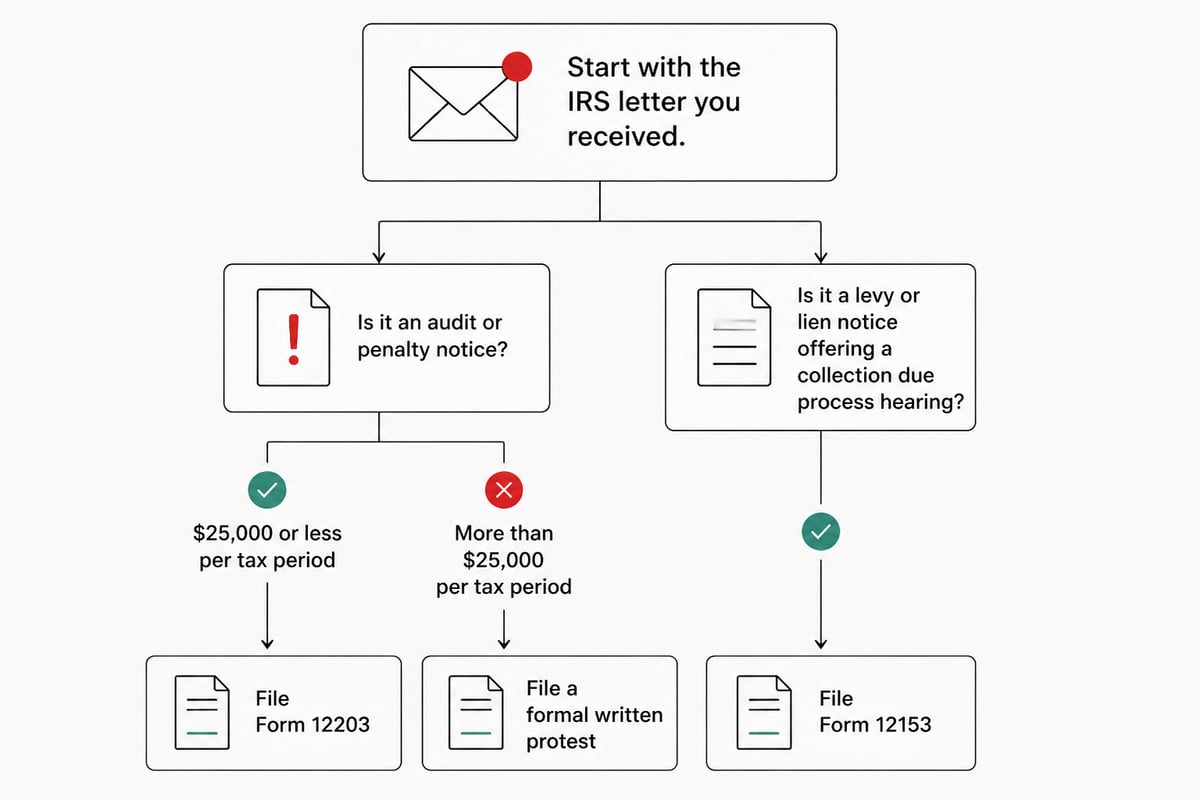
IRS Form 12203, Request for Appeals Review, is the short form you use to ask the IRS Independent Office of Appeals to look at a dispute when the amount in question is $25,000 or less for each tax period. If you owe more than that, or the dollar amount is over the limit, you write a formal protest instead. Either way, the IRS Form 12203 request for Appeals review is a deadline-driven filing, and missing the deadline is the most expensive mistake you can make.
What Form 12203 Actually Does
Form 12203 is a small case request. It tells the IRS you disagree with a proposed change to your return and want someone independent of the examiner to look at it. That someone is an Appeals Officer.
Appeals is a separate office from the examiners and collection staff who issued your notice. Its job is to resolve disputes without going to court, and it weighs the risk each side faces if the case ends up before a judge. That is why a case can settle there for less than the IRS first demanded.
The form is not a magic reset button. It does not stop interest from accruing on a balance you actually owe, and it does not erase a deadline you have already missed. It preserves your right to be heard, and that right has a clock on it.
When You Can Use Form 12203 and When You Can't
You can use Form 12203 when the total amount for any single tax period is $25,000 or less, and when the IRS has sent a letter that offers you an appeal opportunity. That includes many audit disputes, penalty disputes, and some collection matters.
Here is how the two paths compare:
| Situation | Total in dispute (per tax period) | What you file |
|---|---|---|
| Smaller audit or penalty dispute | $25,000 or less | Form 12203 or a short written request |
| Larger audit dispute | More than $25,000 | Formal written protest |
| Collection due process hearing | Any amount | Form 12153, not 12203 |
That last row trips people up. A notice of intent to levy or a notice of federal tax lien filing carries its own hearing right, and it uses a different form with a different deadline. Do not file Form 12203 for a collection due process hearing and assume you are covered.
The IRS publishes a directory of letters and notices that may offer an appeal opportunity, including collection-related notices. Check yours against it before you pick a form. The letter itself will also state the deadline and the type of request it accepts.
The Deadline Is the Whole Game
The deadline on your IRS letter controls everything, and it is usually 30 days from the date on the notice. Miss it and the IRS can assess the tax, and your appeal rights shrink fast.
Read the letter the day it arrives. Find the response date, circle it, and work backward. If you cannot gather your documents in time, file the request anyway and say you will supplement it. A filed request with a thin explanation beats a thorough one that arrives late.
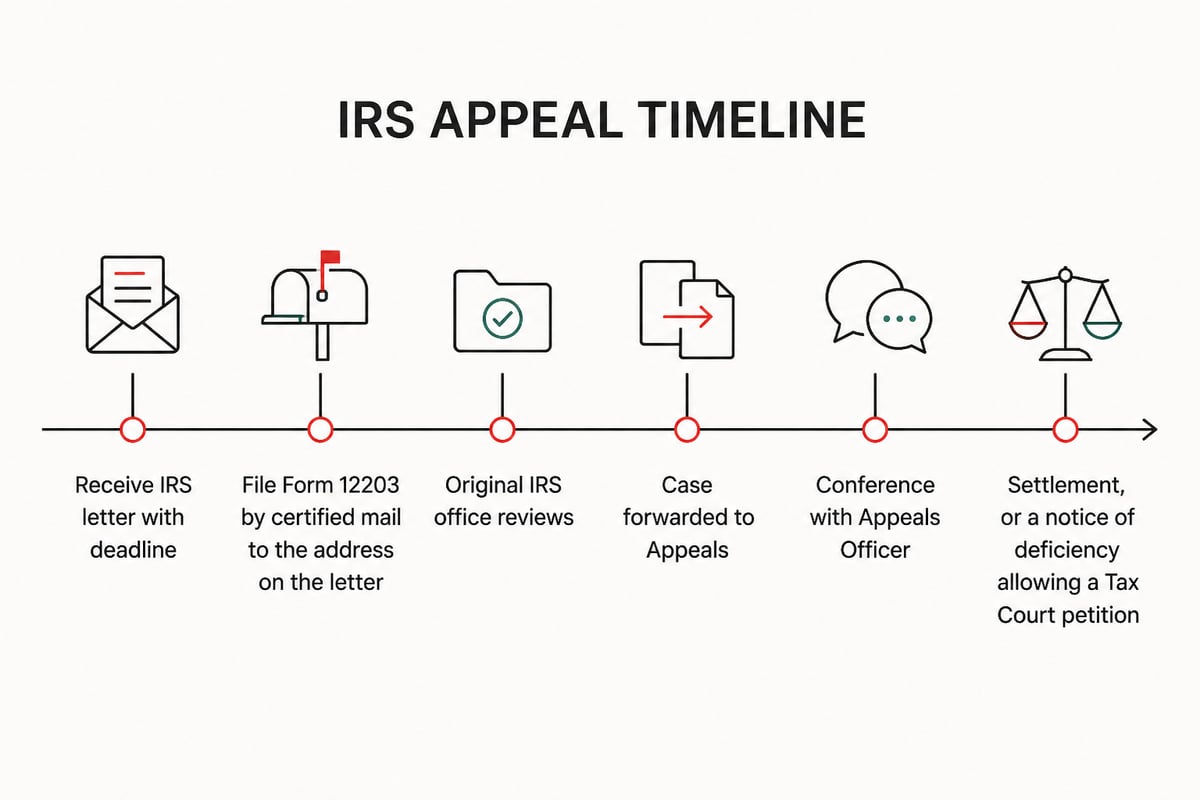
Some letters, such as a 90-day letter (a statutory notice of deficiency), work differently. That notice gives you a window to petition the U.S. Tax Court, and an Appeals request does not extend that window. If you hold one of those, the Tax Court deadline is the one that matters.
How to Fill Out Form 12203
The form asks for basic information and a short explanation of why you disagree. It is not long. The content of that explanation is what decides how your case starts.
You will need to supply:
- Your name, address, Social Security number or employer identification number, and daytime phone number
- A copy of the letter you received, or the date and symbol shown on it
- The tax periods and form types involved, such as Form 1040 for 2023
- The specific adjustments you disagree with
- The facts that support your position and the law you rely on
Be specific about what you disagree with. "The IRS is wrong" gets you nowhere. "The proposed disallowance of the $14,000 home office deduction ignores the exclusive-use records attached" gives an Appeals Officer something to work with.
Attach evidence. Receipts, bank statements, contracts, mileage logs, and prior-year returns all help. Appeals Officers decide on what is in the file, not on what you remember.
Sign the form. If you are filing for a business, an authorized person signs. If a representative files for you, they need a signed Form 2848 power of attorney on file, which is also how the IRS knows to talk to your attorney and not to you.
Where to Send It
Mail it to the address on the letter you received, not directly to Appeals. The IRS directs taxpayers to mail the request to the address on the letter explaining appeal rights, rather than sending it directly to the Independent Office of Appeals, per the IRS’s guidance on preparing a request for Appeals.
The office that issued the notice sees your request first. That sounds like a detour, and it is one, but it has a purpose. The examiner or collection employee gets a chance to reconsider, and sometimes the issue resolves right there.
Send it by certified mail with return receipt. Keep a full copy of everything. If the IRS later claims it never received your request, your postmark and receipt are your proof.

What Happens After You File
After you file, the office that handled your case reviews the request, and if it cannot resolve the dispute, it forwards your file to Appeals. The IRS lays out what to expect from the Independent Office of Appeals, including that the original office may first try to settle the issues.
Once your case lands with Appeals, an Appeals Officer reviews the file and contacts you to schedule a conference. Most are done by phone or in writing. They are informal, and you do not need to follow courtroom rules.
At the conference, the Officer wants three things from you: the facts, the law that supports you, and a realistic number. Appeals can settle based on the "hazards of litigation," meaning the chance each side would lose in court. A well-documented case with a real weakness in the IRS position often settles at a fraction of the original proposal.
Appeals cannot take new facts lightly, either. If you bring new evidence the examiner never saw, Appeals will usually send it back to the examiner for comment. That slows things down but does not hurt your case.
Form 12203 vs. a Formal Protest
If your dispute is over $25,000 for any tax period, Form 12203 is the wrong tool. A formal written protest is required, and it has stricter content requirements: your contact information, a statement that you want Appeals to review the case, the letter you are disputing, the adjustments you disagree with, the facts, and the law. You sign it under penalties of perjury.
The dollar threshold is counted per tax period. A $20,000 dispute for 2023 and a $20,000 dispute for 2024 each qualify for the small case route. A single $30,000 issue in one year does not.
When you are on the line, the safe choice is the more formal one. A protest can be written to meet every requirement and accepted either way, while a short-form request on a case that needed a protest can be sent back to you with the clock still running. If you are close to the threshold, do not guess.
Your Rights in an Appeal
You have the right to an Appeals Officer's independent review. The Taxpayer Advocate Service lists it among your taxpayer rights, including the right to appeal an IRS decision in an independent forum.
You also have the right to representation. You can bring an attorney, and once a signed power of attorney is on file, the IRS deals with that attorney. That matters if the disagreement is complicated or you would rather not sit across from an Appeals Officer yourself. For a longer walk through the process, our post on how tax appeals work covers the stages in more detail.
One practical point. Appeals discussions are not protected the way a conversation with your own lawyer is. Whatever you tell an Appeals Officer goes in the file. Attorney-client privilege covers what you tell your own attorney, which is one reason people with a messy fact pattern talk to counsel before they talk to Appeals.
Common Mistakes That Sink a Request
Most failed appeals trace back to a short list of errors:
- Missing the deadline. The response date on the notice is firm.
- Filing the wrong form. A collection hearing request on Form 12203, or a $60,000 dispute on a short form.
- Vague disagreement. No specific adjustments, no facts, no law.
- No documents. Claiming a deduction without a single receipt attached.
- Mailing to the wrong place. Sending it to Appeals when the letter says to send it to the examiner.
- Skipping the signature. An unsigned request can be rejected.
If you are disputing an audit report, you will often see Form 4549 attached to the notice. Our walkthrough of the Form 4549 examination report and what to do if you disagree shows how to read the proposed changes before you answer them. And if the examiner asks you to sign a statute extension during the process, read our piece on Form 872 statute extensions first, because what you agree to there affects how long the IRS has to assess.
When to Bring in an Attorney
Bring in an attorney when the amount is large, the facts are contested, or the issue could expose you to more than a tax bill. A civil audit dispute that touches on unreported income or a business with payroll problems can move in directions you do not want. If your case is still in the examination stage, IRS Audit Defense covers representation in correspondence, office, and field audits, which is often where an appeal gets won or lost before Form 12203 is even needed.
Business owners facing a dispute that could reach their personal assets sometimes also look at how their entities are structured. For general background on that subject, Tribal LLC describes an asset protection approach built around Native Business Enterprises. It is a separate topic from an IRS appeal, and it does nothing to resolve a tax assessment that already exists, so treat it as reading and not as a fix for a notice on your desk.
Once you hire counsel, all communication with the IRS runs through the firm, so you do not have to answer IRS calls and letters yourself.
Pull out your IRS letter today, find the response date, and write it on your calendar before you do anything else. If you want a lawyer to check which form fits, build the documentation, and carry the case to Appeals, Let’s talk through your IRS notice with the Law Offices of Darrin T. Mish, P.A. in a free consultation with no obligation.