

If you've got an IRS letter on your desk right now, you have a decision to make, and the clock matters. I'm Darrin Mish. I've spent 32 years helping people with exactly this kind of situation. Here's what you should do.
I'm Darrin Mish. Tampa tax attorney, 32 years in, more than $100 million in IRS debt resolved. What follows isn't theory. It's what I've actually watched work.
You filed your 2025 return in April. You expected a refund or at least no balance. Three months later, an envelope from Cincinnati arrives. CP11. The IRS says you owe money because they found a math error on your return. Now you're staring at an adjusted balance, wondering if you did the math wrong, if the IRS did, or if this is just the beginning of an audit.
It's not an audit. The IRS isn't questioning whether you're entitled to a deduction or credit. They're saying the numbers you entered don't add up the way you entered them. That's the critical difference. The irs cp11 math error notice is an administrative correction, not an examination. The IRS has the authority under Internal Revenue Code Section 6213(b)(1) to summarily assess tax when there's a computational or clerical error, and they can do it without sending you a formal notice of deficiency. You don't get audit rights. You get 60 days to ask them to undo it.
What the IRS CP11 Math Error Notice Actually Is
The CP11 is one of several notices the IRS uses to tell you they changed your return because of an error. "Math error" is a misnomer. It's not always arithmetic. It can be a mismatch between what you claimed and what third-party documents show. It can be a disallowed credit. It can be a forgotten schedule.
The IRS processes over 150 million individual returns every year. Most of those returns are checked by computer before a human ever sees them. The Automated Underreporter system cross-references your 1099s, W-2s, and 1098s against what you reported. The Dependent Database checks Social Security numbers on your dependents. The Earned Income Credit algorithms verify income thresholds. When something doesn't match, the system flags it. If the discrepancy fits the statutory definition of a math or clerical error, the IRS can change your return and send you a CP11.

You can read the IRS’s own processing guidance on CP11 notices in the Internal Revenue Manual if you want to see how the agency trains its employees to handle these. The manual is dry, bureaucratic, and illuminating. It tells you exactly how narrow the IRS's authority is supposed to be and how broadly they sometimes interpret it.
The Errors That Trigger a CP11
The statute defines about a dozen categories of error the IRS can correct without your consent. The ones I see most:
- Arithmetic mistakes. You added wrong. Subtracted wrong. Multiplied the wrong line by the wrong percentage. Truly math.
- Incorrect use of IRS tables. You used the wrong tax table for your filing status. You picked the wrong column. You interpolated a number that doesn't exist.
- Omitted required schedules. You claimed a credit but didn't attach the form that calculates it. You listed business income but didn't include Schedule C.
- Mismatch between return and third-party documents. Your W-2 shows $60,000 in wages; you reported $50,000. Your 1099-INT shows $1,200 in interest; you reported zero.
- Credit or deduction exceeded statutory limit. You claimed $3,000 per child for the Child Tax Credit when the limit is $2,000. You claimed 100% of a partially-deductible expense.
- SSN or dependent errors. You claimed a dependent whose Social Security number is invalid, belongs to someone else's return, or exceeds the age limit for the credit you claimed.
The Taxpayer Advocate Service has documented how the IRS's definition of "math error" has expanded over time. Congress keeps adding new categories. COVID relief legislation, for instance, gave the IRS math-error authority to correct Recovery Rebate Credit claims that didn't match IRS records. The result is that "math error" now covers things that aren't math and aren't really errors. Sometimes they're just data the IRS doesn't have yet.
Your Rights and Deadlines After Receiving the Notice
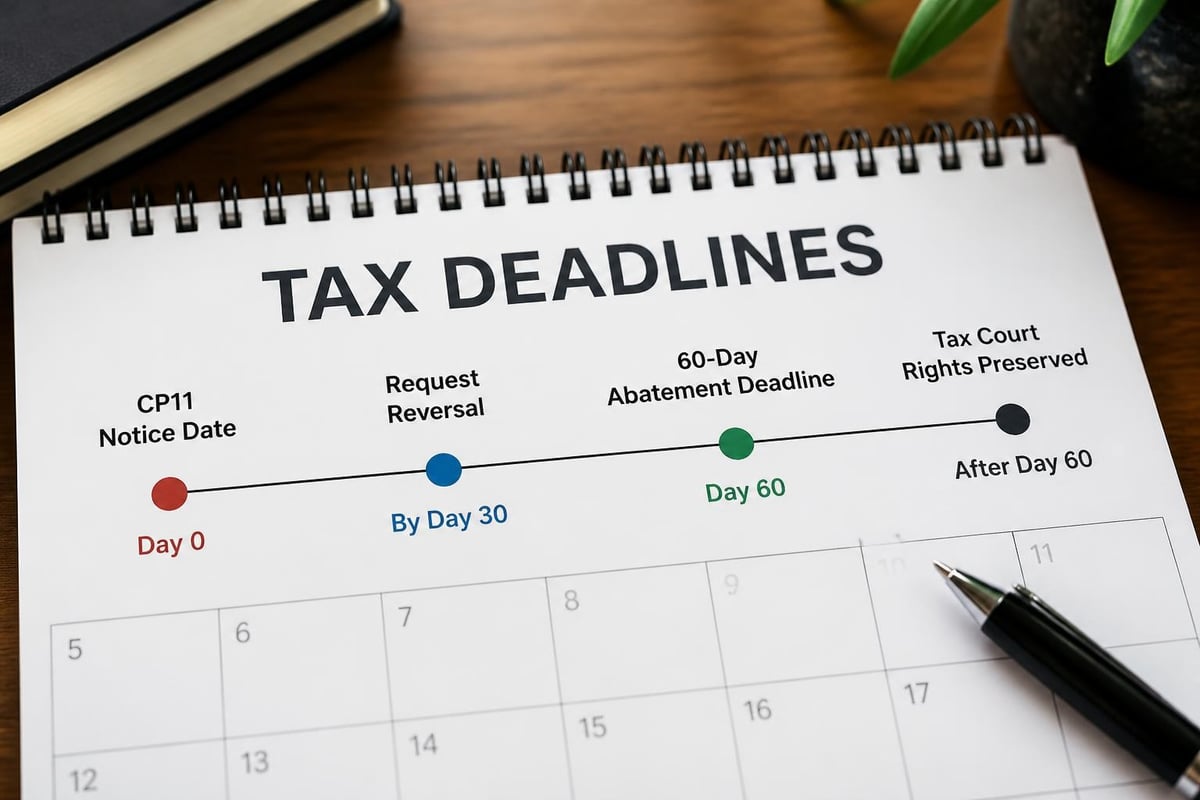
The irs cp11 math error notice comes with a 60-day clock. That's the window in which you can request abatement. Abatement means the IRS reverses the correction and puts your return back the way you filed it. Then, if the IRS still disagrees, they have to follow normal examination procedures: send you a notice of deficiency, give you petition rights in Tax Court, the whole process.
Sixty days from the date of the notice. Not the date you receive it. Not the date you open it. The date printed on the top of the notice. The IRS calculates that date using the rules in 26 CFR § 301.6213-1. If you miss the 60 days, you lose the right to abatement. The assessment stands, and your only remedy is to pay it and file a refund claim. Or don't pay it and deal with collection.
| Action | Result | Timing |
|---|---|---|
| Request abatement in writing within 60 days | IRS reverses adjustment; must follow deficiency procedures if they still disagree | Must be postmarked by day 60 |
| Do nothing | Assessment becomes final; IRS can begin collection (notices, liens, levies) | After 60 days |
| Pay the amount and file Form 1040-X | Treated as refund claim; different process, longer timeline | Anytime, but delays resolution |
You request abatement by writing to the IRS at the address on the notice. There's no special form. You explain why the IRS is wrong. You attach documentation. You keep a copy and send it certified mail. The IRS has specific math-error abatement procedures its examiners are supposed to follow. Once you request abatement, they're required to stop collection on that portion of the assessment while they consider your request. They don't always stop. But they're supposed to.
When the IRS Is Right and When They're Wrong
Sometimes the CP11 is correct. You fat-fingered a number. You forgot to report a 1099. You claimed a credit you don't qualify for. If the IRS is right, pay it. Don't waste 60 days hoping it goes away. The IRS charges interest on unpaid balances from the original due date of the return. Every day you wait costs you money.
But sometimes the IRS is wrong. Their computers misread a document. They didn't account for a corrected 1099. They applied a rule that changed after your tax year but before they processed your return. They simply made a mistake. I've seen CP11 notices that cited the wrong Code section. I've seen notices that "corrected" a return that was already correct.
The Taxpayer Advocate Service has criticized the quality and clarity of IRS math-error notices for years. Many CP11 notices don't adequately explain what the IRS changed or why. They reference line numbers that don't match the form you filed. They use jargon. They omit the comparison that would let you see exactly what the IRS thinks you did wrong. You're left guessing.
If you don't understand the notice, you can call the number on it. You'll wait on hold. The representative may or may not be able to explain it better than the notice did. Or you can pull your return, pull the notice, and reverse-engineer the math yourself. Find the line the IRS says they changed. Look at what you entered. Look at what they say it should be. Work backward until you see the discrepancy.
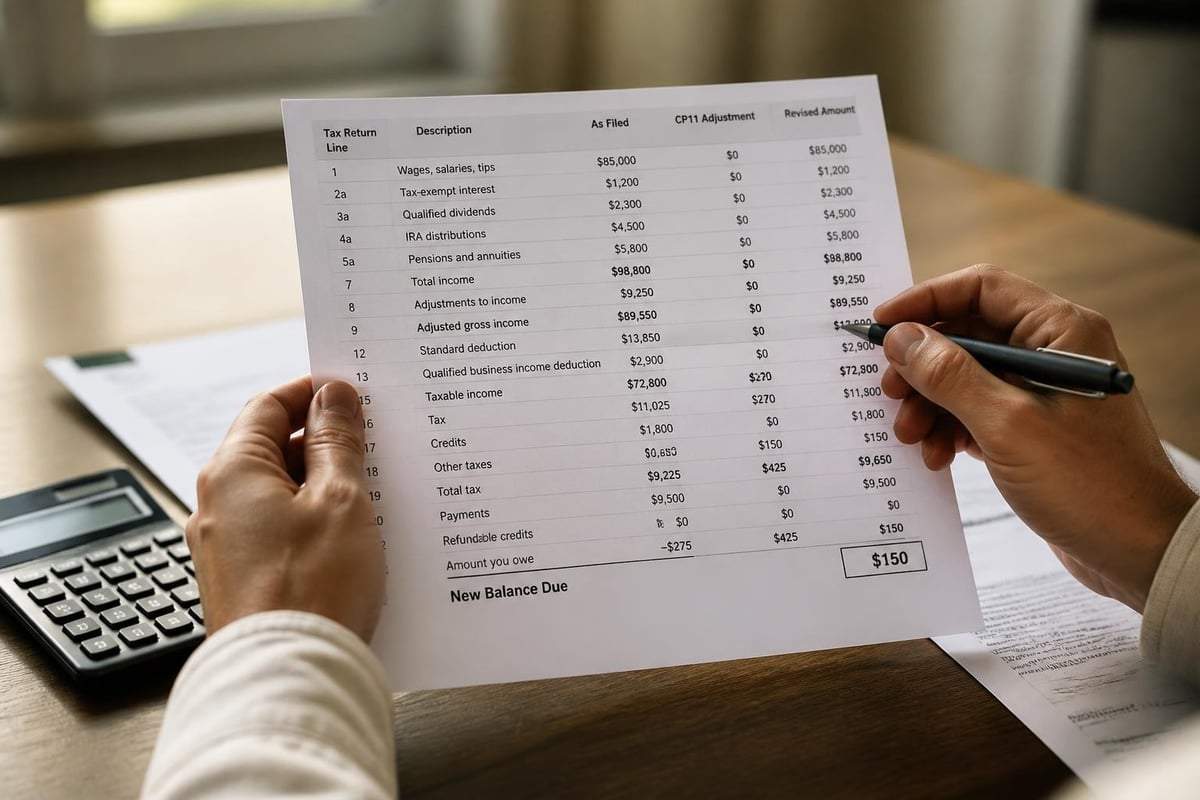
Common Scenarios and How to Respond
Every CP11 has a story. Here are the ones I see most often and what typically works.
The Missing or Mismatched 1099
You didn't receive a 1099-MISC for $5,000 of freelance income, so you didn't report it. The payer filed the 1099 with the IRS. The IRS computer added $5,000 to your income and recalculated your tax. You get a CP11 for the deficiency.
Your move: If the income is real and you just missed it, pay the bill. If the 1099 is wrong (it's someone else's income, it's a duplicate, it was corrected), get documentation. Request abatement. Attach proof the 1099 is incorrect. The IRS will usually abate if you have a corrected 1099-C or a letter from the issuer.
The Disallowed Dependent
You claimed your 17-year-old daughter for the Child Tax Credit. The IRS says she's 18 and doesn't qualify. You forgot her birthday is in January. She turned 17 on January 15, 2026, so she was 16 for all of 2025. But the IRS system only looks at year of birth and calculates age as of December 31. You get a CP11 disallowing the credit.
Your move: Request abatement. Attach a copy of her birth certificate or Social Security card with her date of birth. Explain the age calculation. The IRS will reverse the adjustment once a human reviews it. This is a common error the automated system makes.
The Stimulus Payment Mismatch
You claimed the Recovery Rebate Credit for a payment you never received. The IRS says you did receive it. You get a CP11 reducing your refund by the amount you claimed.
Your move: Check your bank records. If you genuinely didn't receive it, request abatement and attach bank statements showing no deposit. If you did receive it and forgot, pay the bill. The IRS has accurate records on this. Don't fight it if they're right.
The Amended Return You Never Filed
You filed an original return. The IRS processed it. Then they processed a second return with your name and SSN that you didn't file. Someone else filed a fraudulent return. The IRS "corrected" your legitimate return to match the fraudulent one. You get a CP11.
Your move: This is identity theft. Don't just request abatement. File Form 14039, Identity Theft Affidavit. Call the IRS identity theft hotline. Request abatement and flag the account for identity theft. This takes months to resolve, but you have to do it. Otherwise the fraudulent return stays on your record.
What Happens After You Request Abatement
You mail your request. The IRS receives it. Then nothing happens for weeks. Sometimes months. The IRS doesn't acknowledge receipt. They don't send you a confirmation number. They just put your request in a queue.
While it's pending, the IRS is supposed to suspend collection. They're not supposed to send you further notices about that balance. They're not supposed to levy your bank account or file a lien. In practice, the left hand doesn't always talk to the right. You might still get automated collection notices while your abatement request is pending. Don't panic. Respond to each notice with a copy of your abatement request and a note that it's pending.
If the IRS agrees with you, they'll send you a letter reversing the adjustment. If they still think you owe, they're required to send you a notice of deficiency under IRC § 6213. That notice gives you 90 days to petition the U.S. Tax Court. At that point, you're in examination territory, not math-error territory. You get audit rights. You can dispute the liability in Tax Court without paying first. That's why requesting abatement is so important. It forces the IRS to give you those rights.
If the IRS denies your request or just ignores it, the assessment stands. The IRS will start sending you collection notices. CP14 (initial balance due). CP501 (reminder). CP503 (second reminder). CP504 (intent to levy). Then levies, liens, and wage garnishment. The collection process is mechanical and predictable. It doesn't care whether the underlying assessment was right or wrong.
When to Bring in Representation
Most CP11 notices are straightforward. If the IRS is right, pay it. If you can see exactly what they changed and why they're wrong, request abatement yourself. You don't need a lawyer to write a letter that says "You adjusted line 30 from $2,000 to $0, but I'm attaching the 1099-INT that shows I did receive $2,000 in interest."
But some cases aren't straightforward. The IRS adjusted multiple lines. The notice doesn't explain the changes. You requested abatement and they denied it without explanation. The amount is large enough that paying it would cause real hardship. The notice involves a credit or deduction you're confident you qualify for but can't easily prove. At that point, you're not just dealing with math. You're dealing with tax law, procedure, and bureaucracy.
A tax attorney can force clarity. We know how to read the Internal Revenue Manual. We know which IRS employees have the authority to reverse an assessment and which ones are just reading a script. We know when an adjustment is based on a legitimate application of the Code and when it's based on a computer error. We can request abatement, escalate to a manager, file a Tax Court petition if the IRS issues a notice of deficiency, or negotiate penalty abatement and installment agreements if you end up owing.
Preventing Future CP11 Notices
The IRS sent you a CP11 because something on your return didn't match their records or their rules. Once you resolve this one, you don't want another. Here's how you avoid it.
Triple-check your math. Use software. Use a calculator. Don't hand-write numbers and assume you added correctly. One transposed digit can cost you weeks of back-and-forth with the IRS.
Match third-party documents exactly. If your W-2 says $68,432.17, enter $68,432.17. Don't round. Don't estimate. The IRS computer is looking for exact matches.
Attach required schedules. If the form instructions say "attach Schedule X," attach Schedule X. The IRS won't assume you meant to. They'll just disallow the item.
Verify dependent information. Social Security numbers. Dates of birth. Names spelled exactly as they appear on Social Security cards. One wrong digit disqualifies the dependent and triggers a CP11.
Report all income even if you don't have the form. If you did $5,000 of freelance work and never got a 1099, report the $5,000 anyway. Don't wait for the IRS to add it for you. That just creates a discrepancy.
The Tax Foundation has documented how complex the tax code has become and why errors are so common. The average taxpayer spends 13 hours preparing a return. Even professional preparers make mistakes. But most mistakes are avoidable with attention and cross-checking. Kiplinger’s list of common tax-return mistakes covers the errors that trigger 90% of CP11 notices. It's worth reading before you file.
The Bigger Picture: Math Errors and IRS Authority
The irs cp11 math error notice is a small piece of a larger question: how much power should the IRS have to change your return without giving you a hearing first? Normally, if the IRS disagrees with your return, they have to issue a notice of deficiency. You get 90 days to petition Tax Court. You can dispute the liability without paying first. That's a constitutional protection rooted in the Anti-Injunction Act and IRC § 6213.
Math-error authority is an exception. Congress carved it out because arithmetic errors are supposed to be objective and obvious. If you wrote "2 + 2 = 5," the IRS shouldn't have to give you a trial to tell you it's 4. But as the Taxpayer Advocate has pointed out, the exception has grown far beyond arithmetic. The IRS now uses math-error authority to enforce substantive tax positions. To disallow credits based on eligibility criteria. To second-guess information returns before verifying them. To assess tax on items that are genuinely disputable.
You still get 60 days to request abatement. But most taxpayers don't know that. They don't know they have the right to force the IRS into deficiency procedures. They get the CP11, assume it's final, and either pay it or ignore it. Both are mistakes.
| Step | Action | Outcome |
|---|---|---|
| 1. Receive CP11 | Read the notice; identify what the IRS changed | Understanding the adjustment |
| 2. Compare to your return | Pull your filed return; find the discrepancy | Determine if IRS is right or wrong |
| 3. If IRS is wrong | Request abatement in writing within 60 days | IRS must reverse or issue deficiency notice |
| 4. If IRS is right | Pay the balance or arrange installment agreement | Avoid collection actions (levies, liens) |
| 5. If denied or ignored | Respond to deficiency notice; petition Tax Court if needed | Preserve right to dispute without prepayment |
Recent proposals from industry analysts suggest Congress may tighten the definition of math error and require the IRS to provide clearer explanations. Until then, you're dealing with the system as it is: opaque, broad, and requiring you to act fast.
Practical Tools and Resources
If you're trying to calculate exactly when your 60 days expire, use a math-error abatement deadline calculator. It accounts for weekends, federal holidays, and the IRS's mailbox rule. The IRS counts the date of the notice as day zero. Day 60 is the last day they'll accept your request as timely. Postmark matters. Mail it certified.
You can also find a detailed breakdown of what each line on a CP11 means at TaxProc’s CP11 explainer. They track updates to the notice format and walk through examples. If you're low-income and need help you can't afford, Low-Income Taxpayer Clinics offer free or low-cost representation. They're independent from the IRS, funded by grants, and they handle CP11 disputes routinely.
If the issue is larger or more complex than a single notice, or if the IRS has already moved into collection, you're past the DIY stage. The IRS doesn't negotiate with taxpayers the way they negotiate with attorneys. They don't explain. They don't compromise. They just process. An attorney forces them to do more than process.
What You Actually Owe and What You Can Do About It
The irs cp11 math error notice tells you the IRS thinks you owe money. Whether you actually owe it depends on whether their adjustment is correct. If it is, you owe. If it's not, you don't. But proving they're wrong requires you to act within 60 days. After that, you owe it whether it's right or wrong, because the assessment is final and you've waived your deficiency rights.
You have options even if you do owe. The IRS isn't interested in whether you can pay, only whether you do pay. But there are programs. Installment agreements spread the balance over time. Currently Not Collectible status pauses collection if paying would cause hardship. An Offer in Compromise settles the debt for less than you owe if you qualify. Penalty abatement removes penalties if you have reasonable cause. None of those options make the underlying tax go away, but they make it manageable.
The IRS would rather have $200 a month for five years than spend $5,000 trying to levy your bank account and getting nothing because you closed it. They just won't offer you the $200-a-month deal until you ask. And they won't tell you that you can ask.
The irs cp11 math error notice is a mechanical letter from a massive agency, but it has real consequences. You have 60 days to challenge it if it's wrong and options to resolve it if it's right. For 32 years, I've helped taxpayers across the country navigate IRS notices, abatement requests, collection holds, and resolution plans when the math doesn't add up or the IRS doesn't listen. If you've received a CP11 or any IRS notice and you're not sure what to do next, let's talk. The Law Offices of Darrin T. Mish, P.A. offers free consultations, and we work with clients nationwide. Don't wait until the 60 days are gone.