

Most people I talk to about their IRS problem have already built the worst-case scenario in their head. The reality is usually much more manageable. I'm Darrin Mish, and I've been representing taxpayers before the IRS for 32 years. Here's what actually tends to happen.
I'm Darrin Mish. Tampa tax attorney, 32 years in, more than $100 million in IRS debt resolved. What follows isn't theory. It's what I've actually watched work.
An IRS jeopardy assessment is an immediate tax assessment the agency makes when it decides that waiting for the normal process would put collection at risk. It skips the usual notice-and-wait steps, and it can be followed fast by liens and levies. If you've received one, the clock is already running, so the details below matter.
What Is an IRS Jeopardy Assessment?
A jeopardy assessment is an assessment the IRS makes right away, without the normal waiting period, because it believes delay would endanger collection. According to IRM 4.15.1, the assessment can include the tax deficiency, interest, and additions to tax.
Normally, the IRS has to follow a sequence. It sends a notice of deficiency, gives you 90 days to petition the Tax Court, assesses the tax, then sends notice and demand for payment. A jeopardy assessment compresses all of that.
The agency assesses first and talks later. That reversal is the whole point, and it's why these cases feel so sudden.
The statute behind it for income, estate, gift, and certain excise taxes is 26 U.S.C. § 6861. It lets the IRS assess immediately and begin collection, even before the usual deficiency procedures play out.
What Triggers a Jeopardy Assessment?
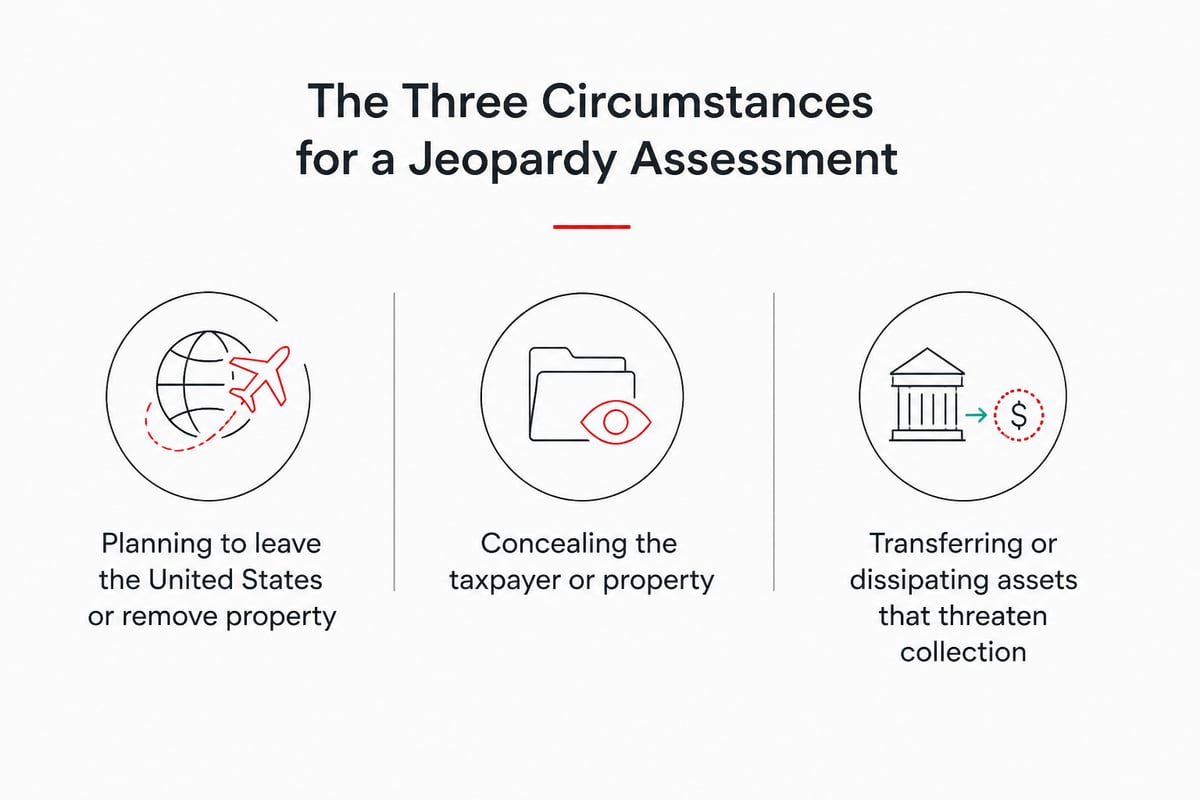
The IRS can issue a jeopardy assessment when it believes that delay would endanger collection, such as when a taxpayer plans to leave the country, conceals property, or transfers or dissipates assets. The agency's own manual, IRM 5.17.15, lists the circumstances it looks for:
- Plans to leave the United States or remove property from it
- Concealing yourself or your property
- Other acts that threaten collection, such as transferring or dissipating assets
That's the manual's language, and it's narrower than most people fear. A big tax bill alone doesn't qualify. An unpaid balance, even a large one, is handled through ordinary collection.
What the IRS needs is facts suggesting you're about to put the money out of reach. Selling a business and wiring the proceeds overseas while a large deficiency is pending is the kind of pattern that draws attention. So does draining accounts or retitling property to relatives after an audit begins.
The Approval Hurdles Inside the IRS
The IRS can't issue one casually. IRM 5.17.15 says jeopardy assessments require written approval by Counsel and approval by the Area Director. It also says objective facts must support both the jeopardy determination and the amount assessed.
That matters for your defense. A suspicion isn't enough, and neither is a guess at the number. If the file doesn't contain objective facts supporting both parts, you have something to argue.
How Is It Different From a Normal Assessment?
A normal assessment gives you time to respond, petition the Tax Court, and negotiate before the IRS collects. A jeopardy assessment removes most of that cushion. The comparison looks like this:
| Step | Normal assessment | Jeopardy assessment |
|---|---|---|
| Deficiency notice | Sent before assessment | Can be sent after assessment |
| Tax Court petition window | 90 days before assessment | Preserved, but after the fact |
| Payment demand | After assessment, standard timeline | Generally due within 10 days of notice and demand |
| Collection | Waits for appeal rights to run | Can start almost immediately |
For income, estate, gift, and certain excise taxes, the statute requires the IRS to mail a deficiency notice within 60 days after making the jeopardy assessment, if it hasn't already. So you keep your Tax Court rights. You just exercise them after the assessment instead of before.
If you're weighing Tax Court, my post on the small case procedure explains how that forum works.
What Deadlines Apply After You Receive One?
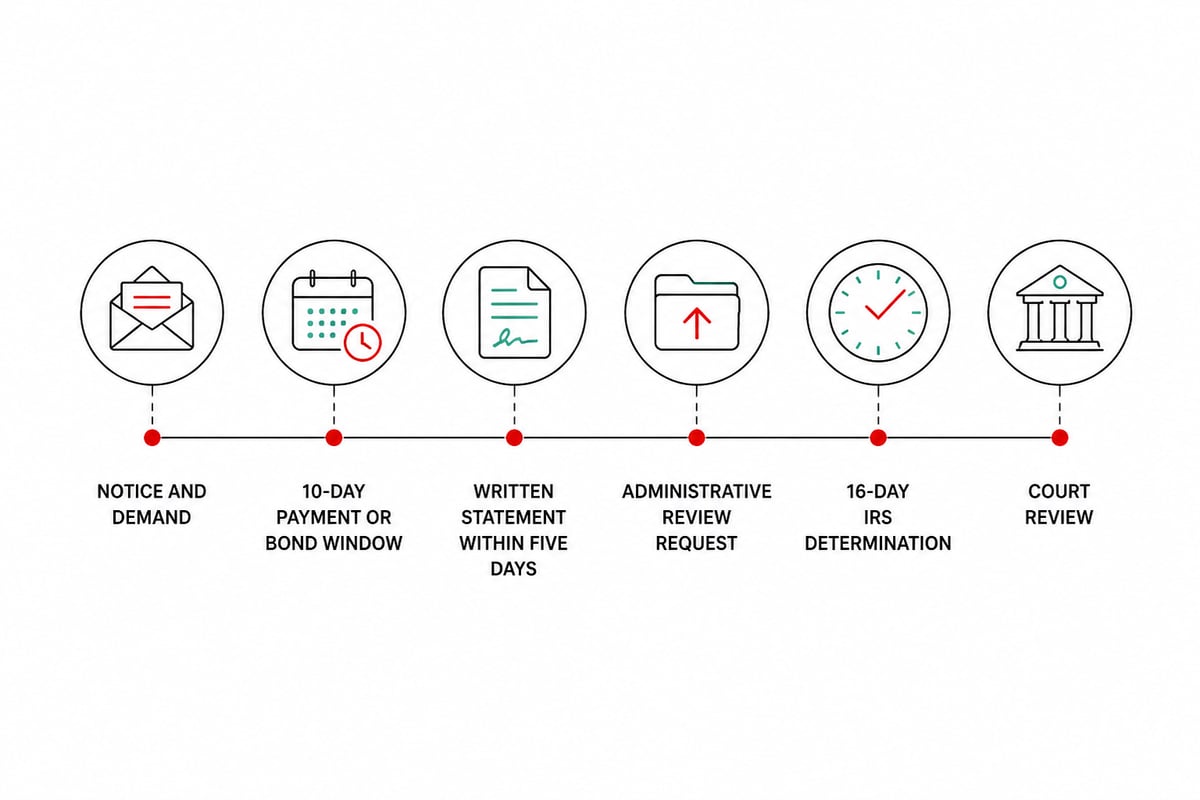
Several short deadlines apply, and the first is payment. Under 26 CFR § 301.6861-1, payment is generally due within 10 days after the IRS sends notice and demand, unless you file a bond before that period expires.
That bond is the safety valve. Posting an acceptable bond can stop collection of the assessed amount while you contest it. It has to be done inside the window, not after.
Here is the sequence worth tracking:
- Notice and demand arrives. Payment is generally due within 10 days, or you file a bond before the period ends.
- Written statement within five days. The IRS must send you a written statement of the information it relied on within five days of the assessment or levy.
- Deficiency notice within 60 days. If it wasn't already mailed, the IRS must send it within 60 days of the assessment.
- Administrative review. You can request review, and the IRS has a 16-day period to make its determination after receiving your request.
Write the dates down the day the envelope shows up. These periods don't pause because you were out of town or still gathering records.
How Can You Challenge an IRS Jeopardy Assessment?
You can challenge a jeopardy assessment through administrative review inside the IRS and, if that fails, through a court. Jeopardy assessments and levies are allowed only in limited circumstances, and you have the right to seek court review.
The first move is the administrative request. The IRS has 16 days to make its determination after receiving the request. Your request should attack the two things the IRS must prove: that collection is actually in jeopardy, and that the amount assessed is reasonable.
Gather proof that cuts against the trigger. If the allegation is that you're moving assets, document the legitimate reason for each transfer. If it's about leaving the country, show your ties here: a home, a business, family, a lease, a return ticket.
If administrative review doesn't resolve it, the Code lets you take the dispute to court. A judge can review whether the assessment was reasonable under the circumstances and whether the amount was appropriate. Courts don't rubber-stamp these.
Posting a Bond
A bond is often the cleanest way to stop immediate collection. It gives the IRS security while you fight the underlying tax. The catch is that you need real collateral or a surety, and you need to act inside the window. That's a conversation to have with counsel on day one, not day nine.
What Does Collection Look Like in Practice?
Once the assessment is made and the demand window closes without payment or a bond, the IRS can move to liens and levies right away. That can mean bank accounts frozen, receivables seized, or property targeted.
Bank levies can be a first strike, and they're painful because they hit operating funds. If this sounds familiar, read my guide on whether the IRS can take money from your bank account, and what to do when a levy lands.
Business owners face extra exposure. A levy on receivables can disrupt payroll quickly. If you run a company with IRS trouble, IRS problems for small business covers the issues that come up alongside this one.
None of this means you've lost. It means the timeline is short and the cost of waiting is high.
What Should You Do the Day You Get a Jeopardy Assessment?
Treat the notice as an emergency, stop moving assets, and get counsel involved immediately. The first 72 hours decide how much room you'll have later.
- Stop transfers. Don't sell, retitle, or move money while this is open. Even innocent moves look like the conduct the IRS is alleging.
- Calendar every deadline. The 10-day payment window, the five-day statement, the 60-day deficiency notice, and the 16-day review period.
- Pull your documents. Returns, bank records, property records, and anything showing why the IRS's assumptions are wrong.
- Ask for the file. The written statement of the information relied on tells you what the IRS thinks it knows.
- Don't call the IRS yourself. What you say to a revenue officer can be used against you, and you don't have attorney-client privilege with a CPA. You do with an attorney.
Once you retain the firm, it handles all communication with the IRS, so you stop fielding the calls, which matters when the agency is moving fast.

Does a Jeopardy Assessment Mean a Criminal Investigation?
Not by itself, but the two can overlap. A jeopardy assessment is a civil collection tool. It doesn't charge you with a crime.
The facts that justify one, though, such as concealed assets or plans to flee, can also interest criminal investigators. That's the reason to speak through an attorney from the start. I'm an attorney, not a CPA or enrolled agent, and that difference gives your conversations with me privilege that accountants don't provide.
If the IRS is looking at you more broadly, my post on how to tell if you’re being audited or investigated lists warning signs worth knowing.
Is Jeopardy Different From Termination Assessment?
Yes. A jeopardy assessment applies to a tax period that has ended. A termination assessment, covered by a separate provision of the Code, applies when the IRS ends a tax year early because it believes you're about to flee or hide assets. Both are fast, both cut procedural steps, and both come with review rights. The key point for you is that the timing rules differ, so you need to know which one you're facing before you calendar anything.
If the notice is unclear, that's worth a phone call to an attorney the same day.
How Does Professional Representation Help?
An attorney can file the administrative review request, prepare a bond, and build the factual record while the 16-day clock runs. That's work you can't do well alone under time pressure.
A useful early step is separating the two questions the IRS must prove: whether collection is truly in jeopardy, and whether the amount is right. They have different evidence and different weaknesses.
If your underlying debt is the larger problem, my IRS Tax Debt Resolution work covers installment agreements, Offers in Compromise, and currently not collectible status, which become options once the emergency phase passes. The firm offers a free, no-obligation consultation.
FAQ
How much can the IRS fine you?
It depends on the penalty. Failure-to-file, failure-to-pay, and accuracy-related penalties each follow separate statutory rates and caps under the Internal Revenue Code. In a jeopardy assessment, the IRS can include interest and additions to tax in the amount it assesses right away.
How to check IRS case status?
For an ordinary account, you can use your online account at IRS.gov or call the number on your notice. For a jeopardy assessment, don't rely on that alone. Your attorney can request the written statement of the information the IRS relied on and confirm where your administrative review request stands.
How to tell if the IRS is investigating you?
Warning signs can include contact from a revenue agent or special agent, requests for records about transfers or foreign accounts, and an assessment that skips normal steps. A jeopardy assessment is civil, but it can sit near a criminal inquiry. If you see these signs, stop talking to the IRS directly and speak with an attorney first.
Your next step is to write down every deadline on the notice today, then stop moving money or property until you've spoken with counsel. Law Offices of Darrin T. Mish, P.A. is a Tampa tax law firm that has represented taxpayers before the IRS for 32 years, and through IRS Tax Debt Resolution we can handle the debt side once the emergency passes. Let's talk about your notice and your options in a free consultation at Law Offices of Darrin T. Mish, P.A..