

I hear from people every week who think their tax problem is the end of the world. It usually isn't. I'm Darrin Mish. I've resolved over $100 million in tax debt for clients. Here's what you should know.
I'm Darrin Mish. Tampa tax attorney, 32 years in, more than $100 million in IRS debt resolved. What follows isn't theory. It's what I've actually watched work.
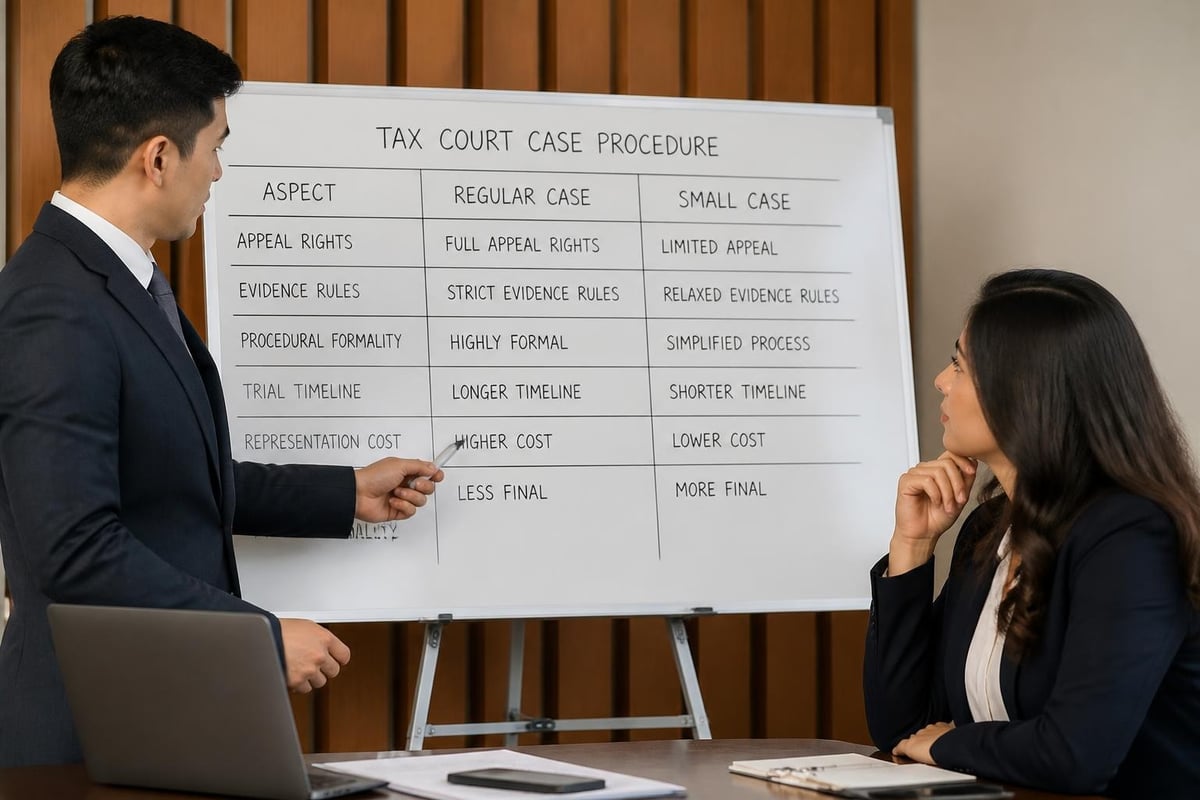
You got a Notice of Deficiency in the mail. The IRS says you owe money, you disagree, and you have 90 days to file a petition in Tax Court. That much you understand. What you might not know is that if the amount in dispute is under $50,000 per year, you can elect a streamlined track called the tax court small case procedure. Faster trial, relaxed evidence rules, less courtroom formality. But there's a price: the decision is final, no appeal, ever. That trade matters more than most taxpayers realize when they check the box.
What Tax Court Small Case Procedure Actually Means
The tax court small case procedure is an option Congress created under 26 U.S.C. § 7463 to give smaller disputes a faster resolution. You elect it when you file your petition. The court assigns an "S" designation, the case moves to a shorter docket, and you typically get a trial date within months instead of a year or more.
The courtroom atmosphere changes too. Judges can relax the Federal Rules of Evidence. You present documents, tell your story, and answer questions. Cross-examination happens, but it's usually less formal than a regular Tax Court trial. For someone who can't afford representation or whose case turns on straightforward facts, the informality looks appealing.
But here's what you give up: the statute explicitly prohibits any review by any other court, including the circuit courts of appeal. The Tax Court's decision is the last word. If the judge gets the law wrong, misapplies a regulation, or overlooks a fact you think is critical, you have no recourse. The case ends the day the opinion is entered.

The $50,000 Threshold and How It's Calculated
The jurisdictional cap is $50,000 in dispute for any one tax year. If you're contesting deficiencies across multiple years, each year is evaluated separately. Two years at $40,000 each? Both can proceed as S cases. One year at $60,000? That year must go through regular Tax Court procedures, though you could still elect small case treatment for other years in the same petition.
The "amount in dispute" means the deficiency the IRS asserts, not the total tax or the balance you already paid. Penalties and interest count separately under the rules, so a $45,000 deficiency plus $8,000 in penalties might push you over the limit for that year. Read the Notice of Deficiency carefully. The IRS breaks out each component.
You make the election on your petition, usually by checking a box and writing "small case" or "S case" on the first page. The U.S. Tax Court’s official rules spell out the mechanics. The IRS must consent if you're electing after the case has already been assigned as a regular case, but consent at the initial filing stage is automatic if you're within the dollar limit.
Why Taxpayers Choose the Small Case Track
Speed is the obvious reason. Regular Tax Court cases can stretch 18 months or longer from petition to trial. Discovery, motions, stipulations of fact. The small case docket collapses that timeline. Many S cases reach trial in six to nine months, sometimes sooner if the court has a judge traveling to your region.
The second reason is cost. Hiring a tax attorney to handle a full Tax Court case can run $10,000 to $30,000 or more depending on complexity. For a $15,000 deficiency, those economics don't work. The small tax case procedure was designed with self-represented taxpayers in mind. You can show up, present your records, and make your argument without needing to navigate the full procedural maze.
Third, the relaxed evidence rules help when your documentation isn't perfect. In a regular case, hearsay gets excluded, records need proper foundation, and an IRS revenue agent's testimony carries formal weight. In an S case, the judge has discretion. If you lost receipts in a flood but can reconstruct expenses with bank statements and credible testimony, the judge can weigh that evidence even if it wouldn't survive a formal objection in regular court.
The Trade You're Making
You're trading appellate rights for speed and simplicity. That trade makes sense when the facts are clearly in your favor, the law is settled, and you just need a neutral forum to show the IRS made a mistake. It makes much less sense when the case involves a novel legal question, a circuit split, or an issue where Tax Court precedent isn't firmly in your favor.
Here's a concrete example. Suppose the IRS disallowed your home office deduction because you occasionally use the space for personal tasks. The law on exclusive use is well settled. If you can show the room is dedicated to business and you have clean records, an S case works. The judge applies clear rules to straightforward facts.
Now suppose the IRS is challenging the characterization of a cryptocurrency transaction as a like-kind exchange under old law. The regulations are murky, court opinions differ across circuits, and your position is defensible but not bulletproof. If you lose the S case, you can't appeal to the Eleventh Circuit (where Florida taxpayers would normally go) or anywhere else. Recent appellate decisions have reaffirmed that circuit courts lack jurisdiction over S-case opinions. The decision stands forever.
How to Navigate the Petition and Election Process
You file your petition in Tax Court within 90 days of the date on your Notice of Deficiency (also called a CP3219N or statutory notice). The IRS explains this notice and the deadline on its website. Miss the 90 days and the Tax Court loses jurisdiction. No exceptions, no extensions, no excuses.
The petition is a simple pleading. You state the years in dispute, the IRS determinations you're contesting, and your version of the facts. Attach the Notice of Deficiency. Write "SMALL TAX CASE" at the top if you're electing S status. File the original with the court in Washington, D.C., and serve a copy on the IRS Office of Chief Counsel address listed in your notice.
| Step | Action | Deadline / Notes |
|---|---|---|
| 1. Receive Notice | CP3219N or statutory notice arrives by certified mail | 90-day clock starts from notice date |
| 2. Draft Petition | State facts, contest determinations, request S-case election | Use Tax Court forms or plain pleading |
| 3. File & Serve | Original to Tax Court, copy to IRS Chief Counsel | Within 90 days; proof of service required |
| 4. IRS Answer | IRS files response, case assigned to judge | Usually 45–60 days after petition |
| 5. Pretrial | Standing pretrial order, possible settlement discussions | Court may schedule status conference |
| 6. Trial | Informal hearing, evidence, testimony | Often same-day decision or opinion within weeks |
Once the petition is filed, the IRS Office of Chief Counsel (not the agent who audited you) takes over. They'll file an answer. The case gets assigned to a judge. You'll receive a standing pretrial order with deadlines for stipulations and witness lists. Follow those deadlines. Tax Court judges are busy, and missing a filing deadline can get your case dismissed or cost you the chance to introduce evidence at trial.

Settlement Still Happens in Small Cases
Just because you elected the small case procedure doesn't mean you're locked into trial. The IRS Appeals function and Chief Counsel's office still have authority to settle. In fact, many S cases settle before trial once the IRS attorney reviews the file and realizes the taxpayer has documentation or a legal argument the examining agent missed.
If you filed unfiled tax returns and the deficiency is based on a substitute return, showing actual income and deductions often leads to a quick concession. If the dispute is over a penalty abatement issue and you have reasonable cause, the IRS may agree to drop or reduce penalties before trial.
Settlement in Tax Court is formalized through a stipulated decision document. Both sides sign, the judge approves, and the case closes. The same finality rule applies. Once the decision is entered, it's over. Make sure any settlement terms are exactly what you agreed to before you sign.
What Happens at the Small Case Trial
Trials are usually held in cities around the country when a Tax Court judge rides circuit. You might travel to the nearest calendar location, or the case might be heard in your home city if the court schedules a session there. The U.S. Tax Court’s case procedure page lists trial calendars.
The trial itself is public but informal. The judge sits at a bench, you sit at a table, the IRS attorney sits at another. The judge explains the issue, asks who wants to go first, and the hearing begins. You're under oath. You present documents (bank records, receipts, invoices, contracts) and testify about the facts. The IRS attorney cross-examines you and can call the revenue agent or other IRS witnesses.
Burden of proof matters. In most tax cases, you bear the burden to prove the IRS determination is wrong. That means credible records, credible testimony, and a clear narrative. If the IRS disallowed a deduction, you need to show you paid the expense, it was ordinary and necessary for your business, and you have substantiation. If the IRS added income, you need to show that income was already reported, wasn't taxable, or the IRS calculation is incorrect.
Judges Can Issue Opinions or Bench Decisions
After the trial, the judge can rule from the bench or take the case under advisement and issue a written opinion later. Bench decisions are common in straightforward S cases. You walk out of the courtroom knowing the result. The written order follows within days.
When the case involves trickier facts or a legal question the judge wants to research, you'll get a written opinion weeks or months later. Either way, once the decision is entered, the case is over. Section 7463(b) makes S-case decisions non-precedential and non-reviewable. Other taxpayers can't cite the opinion as authority, and you can't appeal it.
The IRS can't appeal either. If you win, you win. The deficiency disappears, and the IRS is bound by the decision. That's one advantage of the finality rule: no years-long appellate battle even if you prevail.
When You Should Not Elect Small Case Procedure
Don't elect if the legal issue is unsettled and you might lose. I've seen taxpayers elect S-case treatment on a whim, lose on a question that's currently being litigated in the circuit courts, and forfeit their chance to get a better ruling on appeal.
Don't elect if the amount at stake justifies paying for representation and you want maximum procedural protection. Regular Tax Court procedure gives you full discovery, formal motions practice, and the ability to stipulate facts that narrow the issues. If your case depends on expert testimony (valuation disputes, for example), you want those experts properly qualified and their reports subject to the full procedural rules.
Don't elect if there's a chance you'll want to appeal. Once you check the small case box and the trial goes forward, appellate courts have no jurisdiction. You can ask the Tax Court to revoke S status before trial, but that requires the IRS's consent and the judge's approval. Better to elect correctly the first time.
Finally, don't elect if the IRS has leverage and you're likely better off negotiating outside of court. If you owe payroll taxes or have a wage garnishment already in place, sometimes resolving the underlying liability through an installment agreement or Offer in Compromise makes more sense than litigating. Tax Court doesn't have jurisdiction to stop collection during the case unless you meet narrow criteria.
Can You Switch After Filing?
Yes, but it's not automatic. If you initially filed as a regular case and want to convert to small case, you file a motion asking the court to redesignate the case. The IRS must consent, and the judge must approve. The Internal Revenue Manual section 35.1.3 describes how IRS attorneys evaluate these requests internally.
Going the other way (S case to regular) also requires consent and a court order, but you can usually get it if you request the change before the case is calendared for trial. Once a trial date is set, judges are less willing to grant redesignation because it disrupts the docket.
If you initially thought the case was simple and then discover it's more complex (maybe the IRS raises a new legal theory in its answer, or you uncover documents that complicate the facts), ask to revoke S status early. Don't wait until the pretrial conference.
Practical Tips If You're Proceeding Without a Lawyer
Organize your documents by issue. If the IRS disallowed three deductions, put each deduction's records in a separate folder with a summary page. Judges appreciate clarity. The easier you make it to follow your case, the better.
Prepare a short written statement of facts. Even though this is informal, handing the judge and the IRS attorney a one-page narrative with a chronology helps. "In 2023, I purchased equipment for $12,000. Here are the invoices. I used the equipment exclusively in my business. Here are the business records showing that use." Simple, clear, factual.
Anticipate the IRS's arguments. Read their answer to your petition. It tells you exactly what they plan to argue. If they say you lack substantiation, bring extra copies of receipts and explain where they came from. If they say the expense was personal, be ready to explain the business purpose.
Practice your testimony. You'll be nervous. Walk through the facts out loud before the trial. If you're claiming a home office deduction, be ready to describe the space, what you use it for, and why it qualifies. If you're disputing a 1099 the IRS added to your income, explain why that income was already reported elsewhere or wasn't taxable.
Bring three copies of everything: one for the judge, one for the IRS attorney, one for yourself. The courtroom doesn't have a copier. If you hand up a document mid-trial, you need enough for everyone.
What to Expect From the IRS Attorney
The IRS attorney is not the revenue agent who audited you. They're a lawyer from Chief Counsel's office, and their job is to defend the IRS's determination. They'll be polite, professional, and focused on the law. They're not trying to trick you, but they will cross-examine you and point out weaknesses in your case.
They'll also evaluate settlement. If your records are strong and the law supports you, many IRS attorneys will recommend concessions to their management. They don't want to waste trial time on a loser. Don't be afraid to talk settlement before trial. The worst they can say is no.
If the IRS attorney offers a settlement that's reasonable, consider it seriously. Going to trial always carries risk. Judges are human. Even a strong case can lose if you fumble a key fact or the judge interprets a regulation differently than you expect.
How the Tax Court Small Case Procedure Fits Into the Bigger Picture
Tax Court is one forum. It's not the only one. You can pay the deficiency, file a refund claim, and sue in federal district court or the Court of Federal Claims if the IRS denies the claim. Those forums allow jury trials (district court) and formal discovery. But they require you to pay first, which most taxpayers can't afford.
Tax Court is a pay-later forum. You can litigate before you pay. That's a huge advantage when you're facing a $50,000 deficiency and the IRS is threatening a levy. Filing the petition stops collection for the duration of the case.
Choosing the small case procedure within Tax Court is a second-level decision. You've already decided Tax Court is the right forum. Now you're deciding whether speed and simplicity outweigh appellate rights. For some taxpayers, the answer is obvious. For others, it's a close call that deserves careful thought.
The Role of Representation Even in Small Cases
You can represent yourself in an S case, and many taxpayers do. But just because the procedure is informal doesn't mean a lawyer is useless. We see the angles you don't. We know which facts the IRS will attack, which legal arguments judges find persuasive, and when a settlement offer is genuinely good versus a lowball.
For a $10,000 dispute, paying $5,000 in legal fees might not make sense. For a $45,000 dispute where the law is tricky and you risk losing everything, spending $8,000 to $12,000 for representation can be the best investment you make. Run the numbers. Weigh the risk. If you're not sure, talk to someone who’s handled these cases before.
Even limited-scope representation helps. Pay a lawyer to review your petition before you file it, or to coach you through trial prep and sit second chair at the hearing. You don't need full-service representation to get value.
Common Mistakes Taxpayers Make in Small Cases
Filing late. The 90-day deadline is absolute. The Tax Court rules don't give the judge discretion to extend it. Mail the petition certified, return receipt requested, at least a week before the deadline. Don't trust regular mail, and don't assume the postmark date controls if you're cutting it close.
Failing to serve the IRS. You must send a copy of your petition to the IRS Office of Chief Counsel at the address listed in your Notice of Deficiency. If you don't, the IRS can move to dismiss for lack of proper service. Include a certificate of service with your filing.
Ignoring the standing pretrial order. The court sends you a scheduling order with deadlines. Miss those deadlines and you can lose the right to call witnesses or introduce documents. Calendar every date the moment you receive the order.
Over-arguing legal theories. Judges have heard every argument about why the tax code is unconstitutional, why wages aren't income, and why the IRS lacks authority. Stick to facts. If you disagree with a regulation, cite case law or a statute, but don't veer into frivolous arguments. Judges penalize taxpayers for wasting the court's time.
Bringing emotion instead of evidence. The IRS doesn't care that you're struggling, that the agent was rude, or that you think the tax system is unfair. The judge's job is to apply the law to the facts. Lead with documents and testimony that prove the IRS determination is wrong. Save the hardship story for settlement discussions or a currently not collectible status request after the case.
Missing the Forest for the Trees
Small case procedure is a tool. It's not the solution to every IRS problem. If your real issue is that you can't pay the tax even if the IRS's number is correct, Tax Court won't help. You need an installment agreement, an Offer in Compromise, or currently not collectible status.
If you have multiple years of unfiled tax returns and the deficiency is just one piece of a bigger mess, filing a Tax Court petition without cleaning up the rest of your compliance can backfire. The IRS can still levy your bank account for other years while the case is pending.
If your spouse filed jointly and you're contesting tax on income that was really theirs, innocent spouse relief might be a better path than Tax Court. Different rules, different procedures, different outcomes.
Context matters. The tax court small case procedure is powerful when the facts are on your side, the amount in dispute is manageable, and you're willing to trade appellate rights for speed. It's a trap when you're fighting a legal battle you might lose and forfeit your only chance to appeal.
What Happens After the Decision
The court enters a decision. The IRS updates your account. If you won, the deficiency disappears. If you lost, the IRS will send you a bill and start the collection process if you don't pay or arrange terms.
You have the same collection options post-decision as you did before: installment agreement, Offer in Compromise, currently not collectible. Losing in Tax Court doesn't take those options away. It just means the amount you owe is now fixed and you can't dispute the liability anymore.
If you lost on a legal issue and you think the judge got it wrong, you're out of luck. No appeal. That's the deal you made when you elected small case status. The decision is final the day it's entered.
If you won, congratulations. The IRS is bound by the decision and can't reassess the same tax for the same year on the same issue. You're done.
The tax court small case procedure works when the facts are clean, the amount is under the limit, and you're willing to accept a final decision in exchange for speed. For many taxpayers, that trade makes perfect sense. For others, it's a costly mistake dressed up as convenience. If you're staring at a Notice of Deficiency and trying to decide whether to check the small case box, the answer depends on your specific facts, the strength of your records, and how much risk you're willing to accept. Law Offices of Darrin T. Mish, P.A. has handled Tax Court cases for 32 years, both small and regular docket, and we walk clients through this election decision every week. Let's talk before you file the petition and make sure you're choosing the right track.