

If you've got an IRS letter on your desk right now, you have a decision to make, and the clock matters. I'm Darrin Mish. I've spent 32 years helping people with exactly this kind of situation. Here's what you should do.
I'm Darrin Mish. Tampa tax attorney, 32 years in, more than $100 million in IRS debt resolved. What follows isn't theory. It's what I've actually watched work.
An IRS CP59 notice for an unfiled return means the IRS has no record of a tax return from you for a prior year, and it wants you to file that return or explain why you didn't need to. You have a short window to respond, and the response you choose matters more than the speed of it. This is a first notice, not a lawsuit. Still, don't let it sit in a drawer.
What Is a CP59 Notice, and Why Did the IRS Send One?
A CP59 is the IRS's first written request for a missing return. According to the IRS explanation of the CP59 notice, it means the agency has no record of a prior-year personal return from you, and you need to file immediately or explain why no return is required.
The letter usually goes out because of a mismatch. Your employer or a bank reported income under your Social Security number, and no return showed up to account for it. Computers find that gap. A person at the IRS may not have looked at your file at all.
That detail matters because it changes how you read the letter. The IRS isn't accusing you of fraud. It's asking a question. But the question comes with a deadline, and if you don't answer it, the next steps get less friendly.
Does a CP59 Mean the IRS Thinks I Never Filed?
Yes, the IRS thinks that, but the IRS can be wrong. A CP59 only means that no return posted to your account for the year listed. It doesn't tell you why.
There are a handful of common reasons you might get one even though you believe you filed:
- Your return was mailed but never processed, or it was rejected and you never saw the rejection.
- You used a wrong Social Security number, a misspelled name, or the wrong tax year.
- Someone used your identity to file, and the IRS flagged your real return as a duplicate.
- You really didn't file, and you weren't sure you had to.
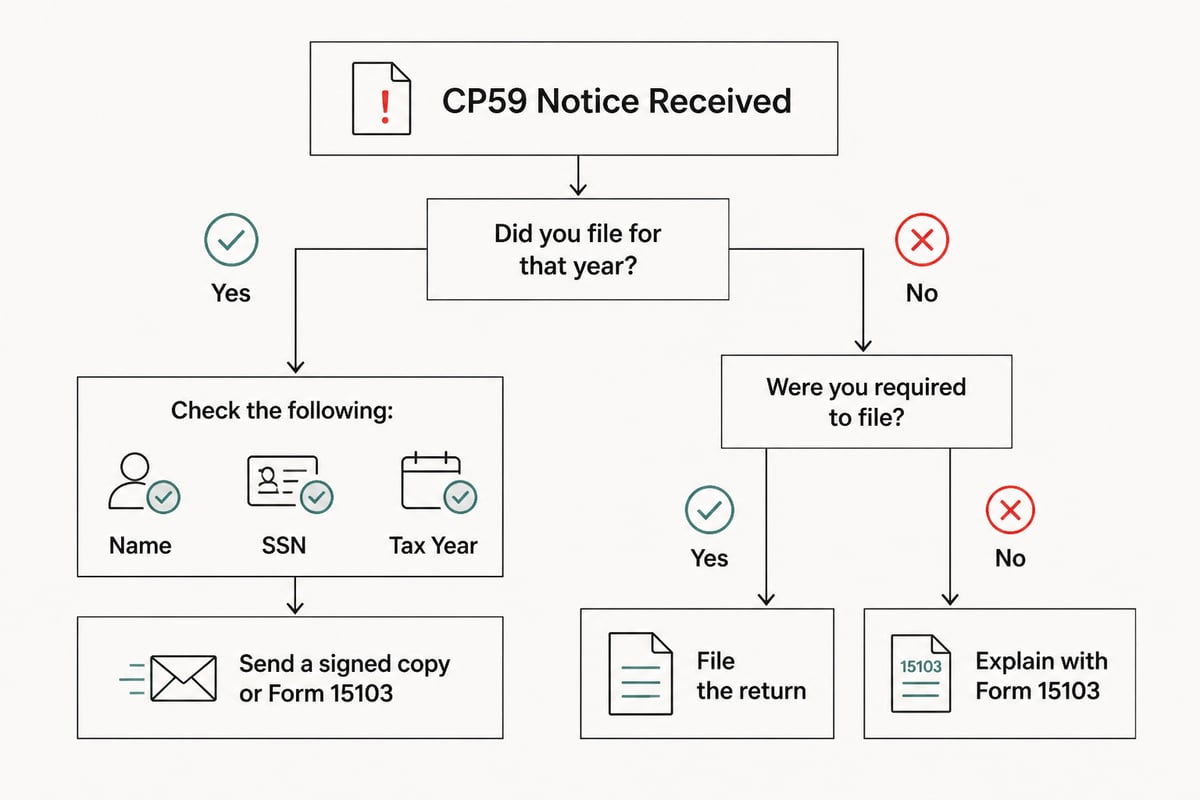
If you believe the notice is a mistake, the IRS says to complete and mail or fax Form 15103, Form 1040 Return Delinquency, using the instructions on the notice. If you did file and the IRS still shows nothing after more than eight weeks, check the name, taxpayer identification number, and tax year on your copy. Then send a signed and dated copy of the return and confirm it was never rejected.
What Should I Do After Getting an IRS CP59 Notice for an Unfiled Return?
Read the notice, identify the tax year, and decide which of three paths fits your situation. Everything else follows from that.
- Confirm the year and your details. Check the tax year, your name, and the last four digits of your Social Security number against what you know.
- Pull your records. Gather W-2s, 1099s, and any other income documents. If you've lost them, you can request wage and income transcripts from the IRS, which show what third parties reported under your number.
- Choose your response. File the return, prove you filed, or explain why you weren't required to file.
- Send it to the address on the notice. The IRS instructs taxpayers who received a notice to send the return to the address listed on it, per its guidance on filing past-due tax returns.
- Keep proof. Use certified mail. Keep a complete copy of everything.
If you owe, file anyway. The IRS says to file all past-due returns even if you can't pay the balance in full. Filing stops the penalty that grows fastest and opens payment options. I'll cover that below.
When Am I Not Required to File a Return?
You may not be required to file if your income for that year was below the filing threshold for your filing status and age. If that's your situation, you explain it in writing rather than filing.
Examples that come up in my practice:
- Your gross income for the year fell under the filing requirement, and you had no self-employment income above the minimum.
- You were a nonresident for the whole year and had no U.S. filing obligation.
- You were someone's dependent and your income was low enough that you didn't have to file.
- Your wages were reported under your Social Security number by mistake, or because of identity theft.
Be careful here. Self-employment income has a much lower trigger than wage income, and the IRS counts it differently. If you ran a side business, drove for a rideshare company, or got 1099 income, don't assume you were under the line. Check before you tell the IRS you had no requirement. A wrong explanation can make the problem worse than the original letter.
What Are the Penalties for Filing Late?
The failure-to-file penalty is generally 5% of the unpaid tax for each month or partial month your return is late, capped at 25%. The IRS lays that out on its failure to file penalty page, which also notes that reasonable cause may qualify you for relief.
A separate failure-to-pay penalty runs alongside it, plus interest on whatever you owe. The filing penalty is the bigger one. That's why filing quickly matters even when you can't write a check.
| Penalty or charge | How it generally works |
|---|---|
| Failure to file | 5% of unpaid tax per month or partial month, up to 25% |
| Failure to pay | A smaller monthly percentage on unpaid tax, plus interest |
| Interest | Accrues on unpaid tax and on penalties until paid |
Notice what's missing from that table: a penalty for filing a return that shows a refund. If the IRS owes you money, there's generally no failure-to-file penalty. The risk with a refund is a different one, which brings us to the clock.

What Happens If I Ignore a CP59 or Have Never Filed?
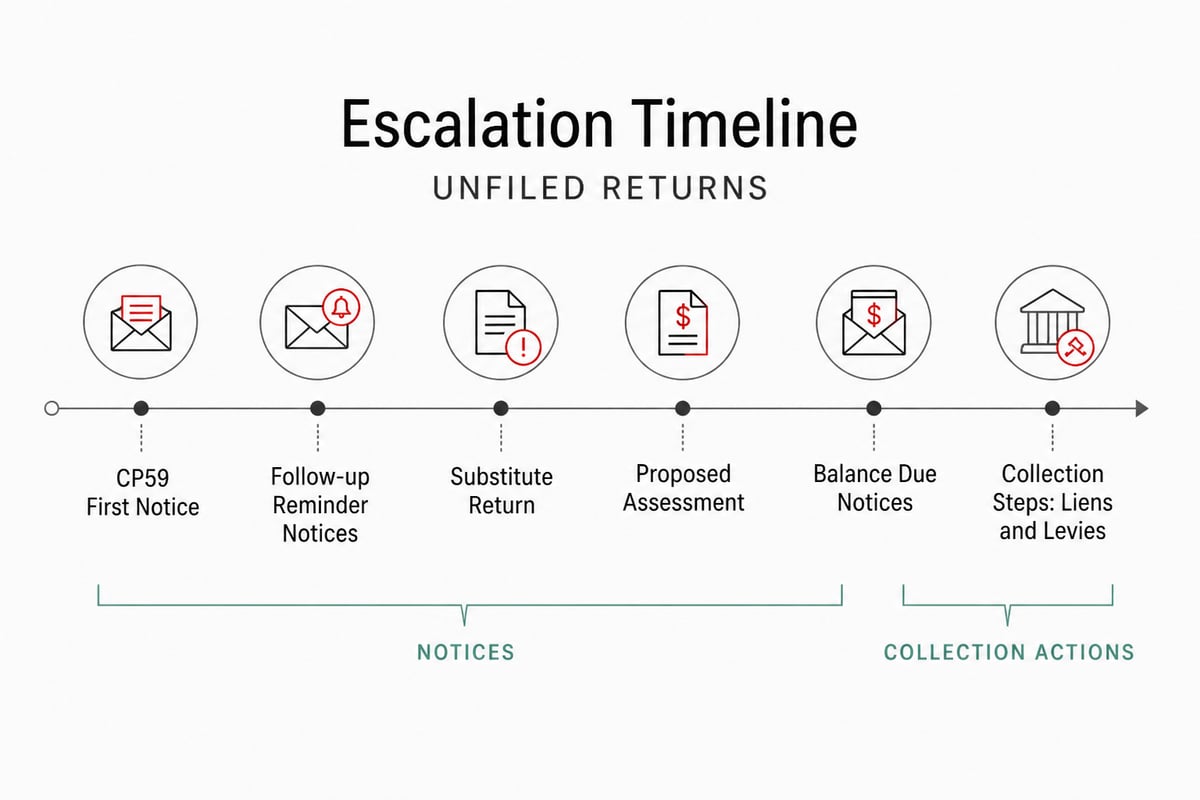
If you ignore a CP59, the IRS can send more notices, and it can file a substitute return for you, which tends to cost you money. Ignoring it is the one response I'd call a mistake every time.
The IRS says additional notices or actions may follow if you don't respond, as described in its overview of what to expect after a non-filer compliance alert notice. The usual progression runs from CP59 to follow-up reminders and, eventually, a proposed assessment based on the income reported to the IRS.
Here's the part that trips people up. A substitute return, which the IRS builds from third-party reports, gives you no deductions, no dependents, and often the least favorable filing status. The tax bill it produces is typically higher than what you'd owe if you filed yourself. Per the IRS's page on notices for past-due tax returns, filing an original return can correct a substitute return. I walk through how that works in my post on filing an original return after an SFR.
If you've never filed at all, the exposure grows with each year of silence. Unfiled years generally stay open for assessment, since the normal assessment period doesn't begin until a return is filed. I explain that in more detail in my piece on the statute of limitations for unfiled returns.
How Far Back Does the IRS Go for Unfiled Returns?
A CP59 only names one year, but the IRS can ask about more than that. Don't read the single year on the letter as the full picture.
Enforcement practice often looks back several years when deciding what to demand, but that's policy, not a legal cap, and the agency can pursue older years where there's significant income or fraud concerns. If you skipped more than one year, you need a plan before you answer, because what you send for one year can prompt questions about the others.
Two practical points:
- Start with the year on the notice, but know your other years. Pull transcripts for every year you suspect is open before you commit to anything.
- Current-year compliance comes first. If you're also behind on this year's return or estimated payments, that has to be fixed or the problem keeps regenerating. My article on filing the current return first explains the sequencing.
I cover the multi-year picture in what really happens with several unfiled years.
What If I Can't Afford to Pay the Tax I Owe?
Filing the return doesn't require you to pay it all at once. If you can't pay in full, you can request an additional 60 to 120 days to pay through the Online Payment Agreement application or by phone, with no user fee, and installment agreements and offers in compromise may be options. That's from the IRS guidance on filing past-due returns.
The order matters:
- File every required return first. The IRS won't set up a payment plan while returns are missing.
- Look at the total balance, including penalties and interest.
- Pick the payment route that fits your numbers: short-term extension, installment agreement, or, in some cases, an offer in compromise.
- Ask for penalty relief where you have a legitimate reason, such as illness or a documented event outside your control.
If you owe a large amount, don't guess. A bad installment agreement can be worse than none, because defaults restart collection. I've also written about why you should file even when you can’t afford to pay.
Do I Need a Tax Attorney for a CP59?
Many people can answer a single-year CP59 on their own. You probably need a tax attorney if you have multiple unfiled years, owe a significant amount, run a business, or have income you're worried about explaining.
The reason to use an attorney instead of a tax preparer comes down to one thing: privilege. Conversations with a tax attorney are protected by attorney-client privilege. A CPA doesn't give you that protection. If you've gone years without filing, you're going to say things about your income and your history. Say them to someone who can't be compelled to repeat them.
If you're in that position, my firm handles unfiled tax return preparation, including back filing and voluntary disclosure. Once you retain the firm, all communications with the IRS go through us, so you stop answering notices and phone calls yourself.
One more point, since the question comes up: a CP59 is a letter about taxes, not a criminal referral. Most non-filers who come forward on their own, with a plan, resolve this civilly. The risk rises when someone waits until the IRS finds them with unreported income and no explanation.
FAQ
Why do I have a verification of non-filing letter?
A verification of non-filing letter is a different document from a CP59. It's a letter the IRS issues on request, stating that it has no record of a return for a given year, and lenders or agencies sometimes ask for it. If you received a CP59 instead, the IRS is asking you to file or explain.
Why am I getting a letter from the IRS in 2026?
The IRS sends letters for many reasons, such as a mismatch, a missing return, a balance due, or a change to your account. The notice number in the corner tells you which one. Read the notice, note the response deadline, and respond in writing to the address on it.
Can I just ignore a CP59 if I think it's a mistake?
No. Even if you think the notice is wrong, you still have to answer it, with proof that you filed or a written explanation on Form 15103. Silence is treated as agreement that a return is missing, and the follow-up notices pile up.
Pull your wage and income transcripts for the year on the notice today, before you decide whether to file or dispute it. If the numbers don't add up, or you're staring at several unfiled years, Law Offices of Darrin T. Mish, P.A. can look at your file with you, so call to book your free consultation and let's talk about how to answer the IRS. We've handled unfiled returns for taxpayers across the country, and we can take the notices off your plate through unfiled tax return preparation.