

For an IRS LT16 letter, what to do comes down to three moves: file any missing tax returns, pay or arrange to pay what you owe, and respond before the deadline printed on the notice. The LT16 is a collection notice. It is serious, but it is not the final step, and you still have room to act.
Most people who call me about an LT16 have been ignoring mail for months. That's understandable. It's also the part that costs money. The IRS escalates in a predictable order, and the LT16 sits early enough in that order that you still hold most of your options.
What Is an IRS LT16 Letter?
An LT16 is a collection notice the IRS sends when you owe unpaid taxes, when its records show missing returns, or both. The IRS describes the LT16 as a letter sent to collect unpaid taxes and/or because it shows missing tax returns.
Here's what it is not. It is not a levy. It is not a lien. It is not a final notice of intent to seize anything. Those come later, and they carry formal appeal rights that the LT16 does not.
Think of it as the IRS saying: we've moved your file to collections, and we want a response. A revenue officer or a collection unit now has your account in front of them. Your job is to give them a reason to stop escalating.
The letter usually lists the tax years involved, the balance the IRS believes you owe, and a date by which to respond. Read the tax years first. They tell you whether this is about a balance, a missing return, or both.
Why the IRS Sent You One
The two usual triggers are an unpaid balance that survived several earlier notices and one or more unfiled returns.
On the balance side, you probably received a run of notices first. The sequence tends to go CP14, then CP501, CP503, and CP504. If you skipped past those, the LT16 is the IRS escalating. If you want to understand where the earlier notices lead, I wrote about what happens if you ignore an IRS CP504 notice.
On the filing side, the IRS may have no return on file for a year it expected one. Sometimes you really didn't file. Sometimes you did, and it was lost, rejected, or never processed. Sometimes a W-2 or 1099 was reported under your Social Security number and the IRS wants to know where the return is.
Either way, the notice means the same thing. Someone at the IRS wants this account resolved, and the clock is running.
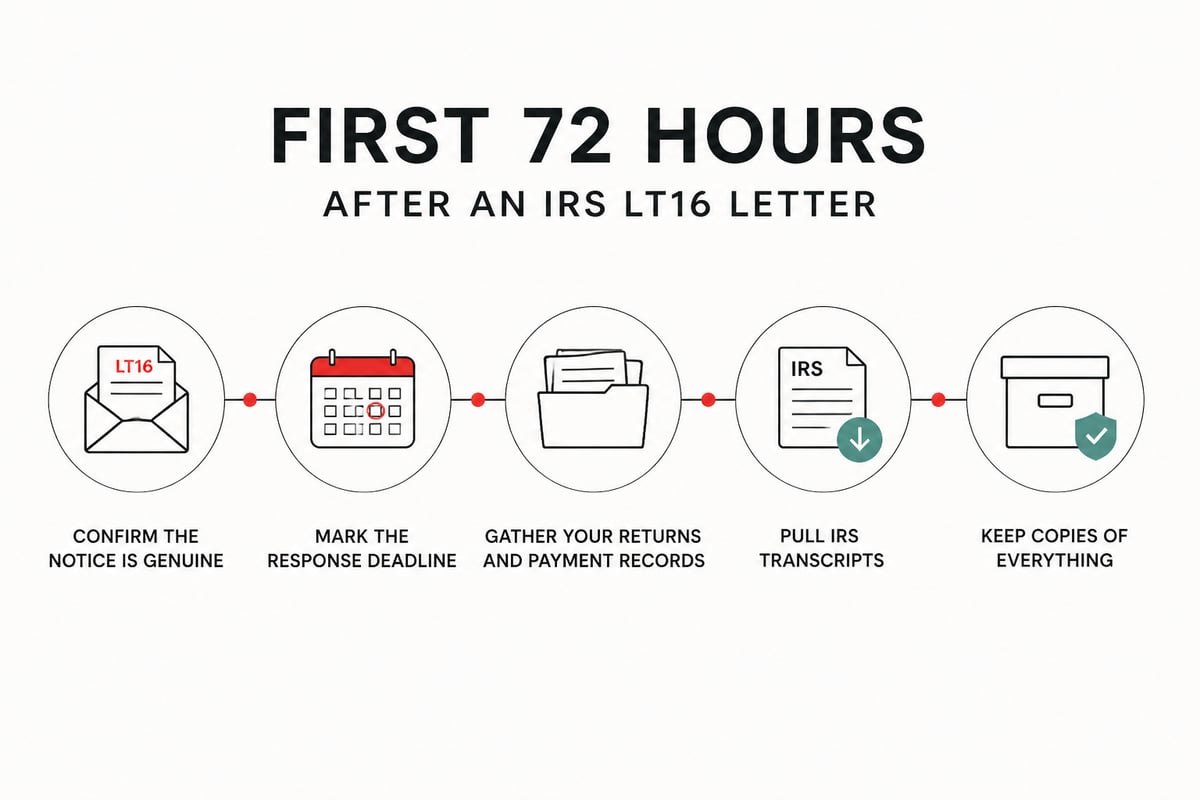
IRS LT16 Letter: What to Do in the First 72 Hours
The first step is to read the notice, confirm it is real, and write down the response deadline. Everything else follows from that.
Do these in order:
- Confirm the notice is genuine. Real IRS notices carry a notice number, a notice date, and your tax year. The IRS does not demand payment by gift card or threaten arrest by phone. Use the contact information printed on the notice, as the IRS advises in its guidance on what to do if you get a letter or notice.
- Mark the deadline. Put the response date on your calendar and set a reminder two weeks earlier.
- Pull your own records. Gather the returns you filed, proof of payments, and any prior IRS correspondence for the years listed.
- Check what the IRS has on file. Your online IRS account and tax transcripts show balances, filed returns, and payments the IRS has posted.
- Keep copies of everything. The IRS general guidance on notices tells you to keep copies and allow at least 30 days for a reply.
Don't call the IRS in a panic and start talking. People volunteer things on those calls that hurt them later. If the situation is more than a simple filing or payment, talk to an attorney before you talk to a collector. Conversations with an attorney are protected by privilege. Conversations with the IRS are not.
How to Handle Missing Tax Returns
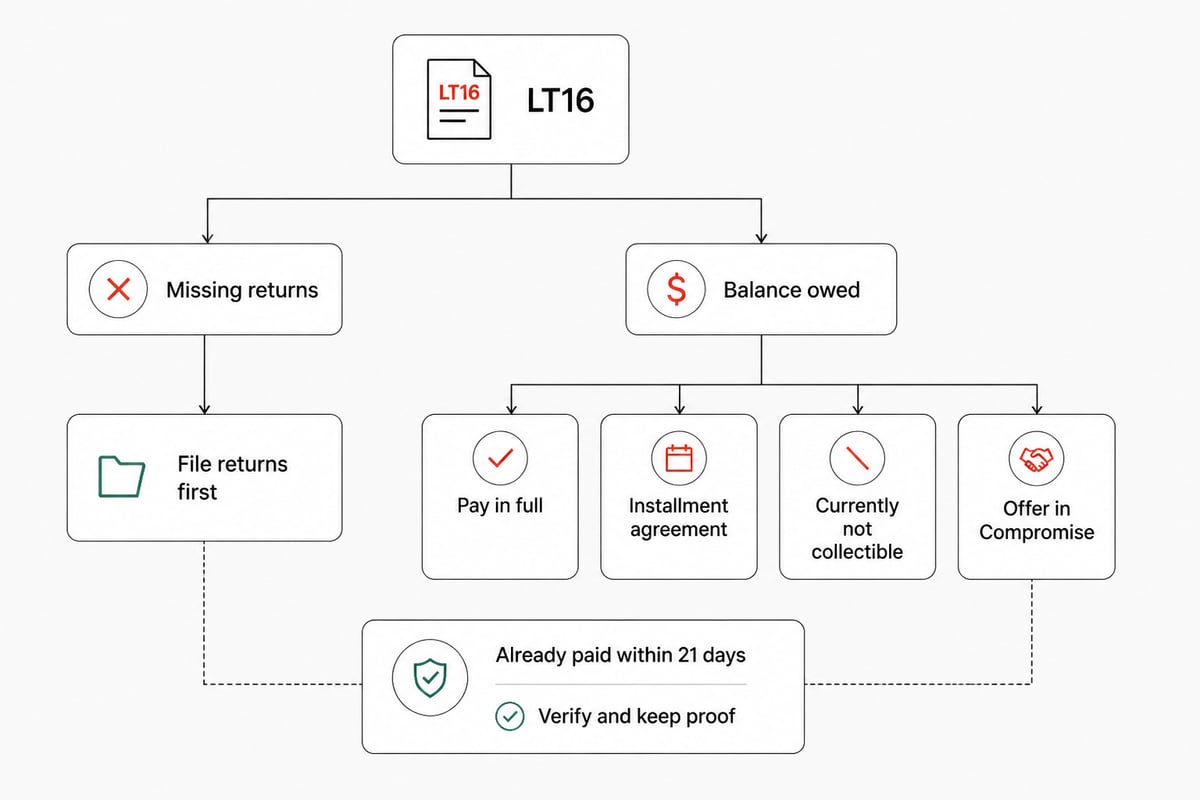
If the LT16 lists missing returns, filing them is the most important thing you can do, because the IRS will not grant a payment plan or most other relief until you are current. The IRS says taxpayers must be current on their tax filings to apply for an installment agreement.
The IRS also tells you to file missing returns as soon as possible. If you believe you already sent a return and it has been more than 10 weeks, the IRS advises sending a signed copy again.
Some practical points from 32 years of doing this:
- File what you can, accurately. A late return with real numbers beats an estimate. If you lack documents, you can request wage and income transcripts from the IRS to reconstruct what was reported.
- Do not let the IRS file for you. If you stay silent, the IRS can prepare a substitute return using only the income reported to it. That version includes no deductions, no dependents, and the wrong filing status. It almost always overstates what you owe.
- Expect more than one year. Several years of unfiled returns is common, and if you are behind by a long stretch, the situation needs a plan, not a guess.
If you've fallen behind on several years, my guide on unfiled tax returns and what to do walks through the process, and this piece on what really happens with unfiled returns over several years covers the consequences.
Your Options for the Balance You Owe
You have four realistic ways to deal with an unpaid balance after an LT16: pay in full, set up an installment agreement, ask for currently not collectible status, or negotiate an Offer in Compromise. Which one fits depends on your income, your assets, and how much you owe.
| Option | Who it fits | Main requirement |
|---|---|---|
| Pay in full | You have the cash or can borrow at a lower cost than IRS interest | None beyond the balance |
| Installment agreement | You can pay monthly over time | All returns filed |
| Currently not collectible | Paying would cost you basic living expenses | Financial disclosure to the IRS |
| Offer in Compromise | You can't pay the full amount and meet IRS formulas | Current filings and a full financial picture |
On payment plans, the IRS says taxpayers owing less than $50,000 may be able to apply online for an installment agreement. Larger balances usually involve more paperwork and sometimes a financial statement.
Don't assume you have to pick the plan the IRS offers first. A collector will happily propose a payment you can't sustain. Defaulting on an installment agreement is worse than never having one. If you're stretched thin, read what to do if you can’t pay the IRS before you commit to a number.
On settling for less, be skeptical of anything promising pennies on the dollar. Real forgiveness programs exist, and so do scams. The honest answer on an Offer in Compromise is that the IRS accepts it only when your numbers support it.
What If You Already Paid or Sent Your Return?
If you paid the balance in full recently, you may be able to disregard the notice. The IRS says payments can take up to 21 days to post, and that you can disregard an LT16 if you paid in full within the last 21 days.
Still verify. Check your IRS online account or request an account transcript and confirm the payment posted to the correct tax year. Misapplied payments are more common than people think, especially when a payment goes to the wrong year or the wrong form.
If you set up an installment agreement already and the letter arrived anyway, the two may have crossed in the mail. Send a short written note with your agreement details to the address on the notice and keep proof that you sent it.
When you write to the IRS, keep it factual. State the tax year, the notice number, what you did, and the date you did it. Attach copies, never originals. The IRS's own guidance on responding to a notice says to retain your correspondence and use the instructions on the notice if you disagree.
Penalties, Interest, and Why Waiting Costs Money
Every month you wait, the balance grows, because penalties and interest keep accruing until the debt is paid. A failure-to-file penalty and a failure-to-pay penalty can both apply, and interest compounds daily on the total.
That's the quiet reason delay hurts. The LT16 balance you see today is not the balance you will owe in six months.
There is a bright side. Penalties can sometimes be removed. First-time abatement is available when you have a clean compliance history for the prior three years. Reasonable cause can apply for illness, a disaster, or reliance on bad professional advice. Interest generally cannot be waived, but if the underlying penalty goes away, the interest on that penalty goes with it.
If penalties make up a large share of what you owe, it's worth finding out who handles those cases. I covered that in finding the right help for IRS penalty abatement.
What Happens If You Ignore the LT16
If you ignore an LT16, the IRS moves toward enforced collection: a Notice of Federal Tax Lien, a levy on your bank account or wages, or both. The LT16 itself does not seize anything, but ignoring it removes the easiest off-ramp.
The IRS has several ways to collect. Liens, levies, and wage garnishments are the common tools. Seizing a home is rare and usually a last resort.
The more common damage is quieter. A lien hits your credit and clouds the title on property you own. A levy empties a bank account with almost no warning. A wage levy takes most of each paycheck until you act.
Before a levy, the IRS must send a notice of intent to levy that gives you the right to a hearing. For a Collection Due Process hearing, IRS guidance says the written request must generally be made within 30 days of the date of the notice of intent to levy and right to a hearing. Miss that window and you lose leverage you can't get back. If you're curious how the pieces fit, here is what an IRS levy is and how it works, and what the agency can and can't take.
Writing a Response Letter to the IRS
A response letter should be short, factual, and tied to the notice, because the person reading it handles hundreds of files and wants to find your point fast. Skip the story about your hardship unless it changes the outcome.
Include these items:
- Your name, address, Social Security number or EIN, and the notice number and date
- The tax years the notice covers
- A plain statement of what you are doing: enclosing returns, disputing the balance, proposing a payment plan, or confirming payment
- Copies of supporting documents, labeled and in order
- A signature and the date
Send it to the address on the notice by certified mail with return receipt. Keep your own copy. If the notice gives a phone number and you prefer to call, write down the date, time, and name or badge number of the person you spoke with.
If you disagree with the amount owed, say so in writing and explain why. For a related situation involving a proposed adjustment, see this CP2000 sample response letter.
When an LT16 Means You Need an Attorney
You should bring in an attorney when you owe a large balance, have several unfiled years, run a business with payroll taxes, or have a revenue officer assigned to your case. A tax attorney can speak to the IRS for you, and what you say to the attorney stays privileged.
Some LT16 letters are simple. You file one overlooked return, the IRS closes the matter, and that's the end. Others are the visible edge of something bigger: a debt that has grown for years, income the IRS has not yet asked about, or exposure beyond what the letter shows. A letter with a short deadline and a long history behind it is where I tend to get called.
Our IRS tax debt resolution work covers installment agreements, Offers in Compromise, and currently not collectible status, and once you retain the firm, IRS communications go through us rather than to you. If you aren't sure what kind of professional you need, my piece on what kind of attorney you need for taxes lays out the differences.

FAQ
What is a Notice of Deficiency from the IRS?
A Notice of Deficiency is a statutory notice that tells you the IRS proposes to change your tax liability after an audit or review. It is different from an LT16 because it gives you a window to petition the U.S. Tax Court before the IRS can assess the additional tax. It is a separate track from collection notices, so don't confuse the two.
What would a letter from the IRS be?
Most IRS letters are one of a few types: a request for information, a notice of a proposed change, a balance-due notice, or a collection notice like the LT16. The notice number in the top right corner tells you which one it is.
Can the LT16 be wrong?
Yes. Payments get misapplied, returns get lost, and identity theft can create balances or missing-return flags you never caused. If the notice doesn't match your records, pull your IRS transcripts and respond in writing with copies of your proof before the deadline.
Start today by pulling your IRS account transcripts for every year the LT16 lists, so you know exactly what the IRS sees before you respond. If the numbers are large or the filing history is messy, bring in someone who handles this for a living, and the IRS Tax Debt Resolution team at Law Offices of Darrin T. Mish, P.A. can review your notice and walk you through your options in a free initial consultation. Let's talk, and get your free consultation on the calendar before the deadline on that letter arrives.