

Knowledge is protection when the IRS is involved. I'm Darrin Mish, a tax attorney in Tampa with 32 years of experience representing taxpayers nationwide. Here's what I want you to understand.
I'm Darrin Mish. Tampa tax attorney, 32 years in, more than $100 million in IRS debt resolved. What follows isn't theory. It's what I've actually watched work.
An IRS CP12 notice means the IRS found a math or calculation error on your return and changed it, so your overpayment or refund is different from what you expected. If you searched "irs cp12 notice overpayment changed," you are probably holding a letter with a new refund number and wondering whether you did something wrong. Usually you didn't. This is a correction notice, not a bill and not an audit, and in most cases you have a clear path forward.
What a CP12 Notice Actually Is
A CP12 is the IRS telling you it corrected your return and the overpayment now reads differently. The IRS explains in its CP12 guidance that the notice means a calculation error was found and the return was changed, so the refund may not match what you claimed.
Notice the words "calculation error." The IRS computer compared your return against its own math and the figures you reported, and something didn't line up. Maybe an addition was off. Maybe a credit was entered on the wrong line. Maybe a withholding number didn't match what your employer filed.
The word that matters is "overpayment." You paid in more than you owed, through withholding or estimated payments, and you claimed the difference back. The CP12 tells you the IRS agrees there is an overpayment, just not in the amount you expected. It can go up. It can go down. Sometimes it flips to a balance due, which is a different notice and a different conversation.
If you want to see the broader family of automated letters this comes from, I wrote about how IRS computer notices work and why most of them are routine.
Why the IRS Changed Your Overpayment
The IRS changes an overpayment for a handful of repeatable reasons, and most of them trace back to a number on your return that didn't match something the IRS already had. Here are the ones I see most.
- Arithmetic mistakes. Transposed digits, bad subtotals, a standard deduction figure that doesn't fit your filing status.
- Credit errors. A child tax credit or education credit claimed beyond the allowed amount, or an earned income credit figure that was miscalculated.
- Withholding mismatches. You reported more federal tax withheld than your W-2 or 1099 shows the IRS received.
- Estimated payment discrepancies. You claimed estimated payments the IRS has no record of, or recorded them in the wrong amount.
- Missing or mismatched forms. Income reported by a third party that never made it onto your return.
Software helps, but it doesn't catch everything. A number you typed in correctly can still conflict with what a payer reported to the IRS. The notice will list the specific lines it changed, and that list is where you start.
How to Read the Notice Line by Line
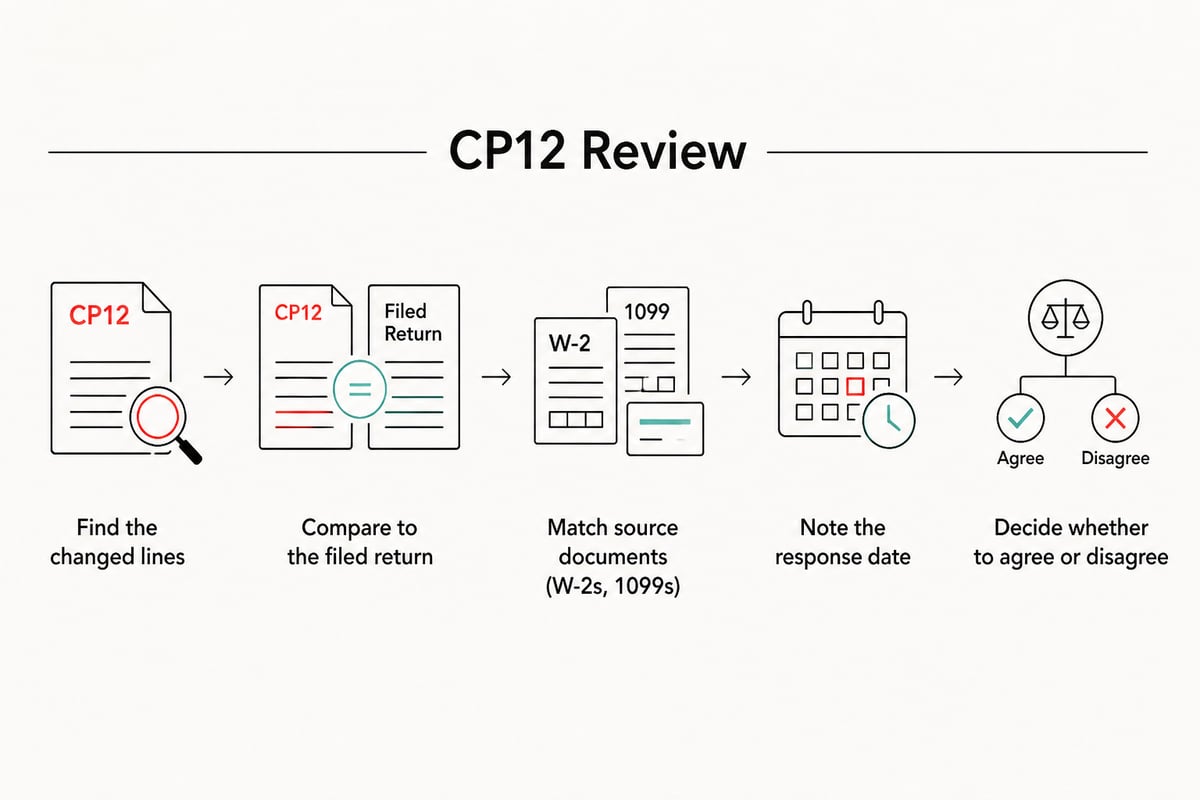
Read the notice against your filed return, line by line, before you decide anything. Pull your copy of the return and lay the two side by side.
- Find the changed lines. The CP12 identifies what the IRS adjusted. Circle each one.
- Compare to your return. Note the number you reported and the number the IRS substituted.
- Check the source documents. Match the figures to your W-2s, 1099s, and payment records.
- Find the response deadline. It is printed on the notice. Write it on your calendar today.
- Decide: agree or disagree. Everything else flows from that.
Be careful with that fourth step. The date on the notice controls, not the date you opened the envelope. If you mailed in an amended return recently, the amendment can cross paths with the notice, and that confuses things fast. A practical walkthrough from FreeTaxUSA covers comparing a CP12 to the filed return and gathering records before you pick up the phone.
If You Agree With the Change
If the IRS got it right, you do nothing. The IRS says no response is required when you agree with the changes, and you should expect your refund in four to six weeks, provided you don't owe other tax or debt.
That last clause carries weight. The IRS can apply your overpayment against other balances before it sends you a dime. Past-due federal taxes come first. Then other agency debts such as child support and certain federal obligations can be taken out of the refund. The notice will say if an offset applied.
Agreeing also means accepting the corrected figure going forward. If the IRS reduced a credit because you weren't eligible for it, make sure you don't repeat that claim next year. Repeated errors on the same credit are what draw closer attention. For a look at what draws that attention, see what triggers an IRS audit.
If You Disagree: The Irs CP12 Notice Overpayment Changed Playbook
When an IRS CP12 notice shows your overpayment changed and you think the IRS is wrong, you contact the IRS before the date printed on the notice and back up your position with documents. The IRS directs you to call the number on the notice if you disagree.
Here is how I'd approach it.
Gather proof before you call
You want paper that answers the exact change. If the IRS reduced your withholding, bring the W-2 or 1099 showing the right figure. If it cut a credit, bring the records that support eligibility. A phone agent can adjust a lot, but only when the documents back you up.
Respond in writing too
A call is fine for starting. Follow it with a written response and keep a copy. Send it by a method that gives you proof of delivery. I have watched taxpayers win arguments on the phone and lose them on paper because nothing was ever recorded.
Know what happens if you stay silent
Silence after a disagreement can cost you. The IRS says that if it does not receive supporting documents after you disagree, it may refer the case for audit, and audit staff may contact you within six to twelve weeks to explain the process and your rights. That guidance appears on the page for the related CP12G and CP12U versions, but the lesson carries: disagree, then prove it.

The 60-Day Rule and Your Tax Court Rights
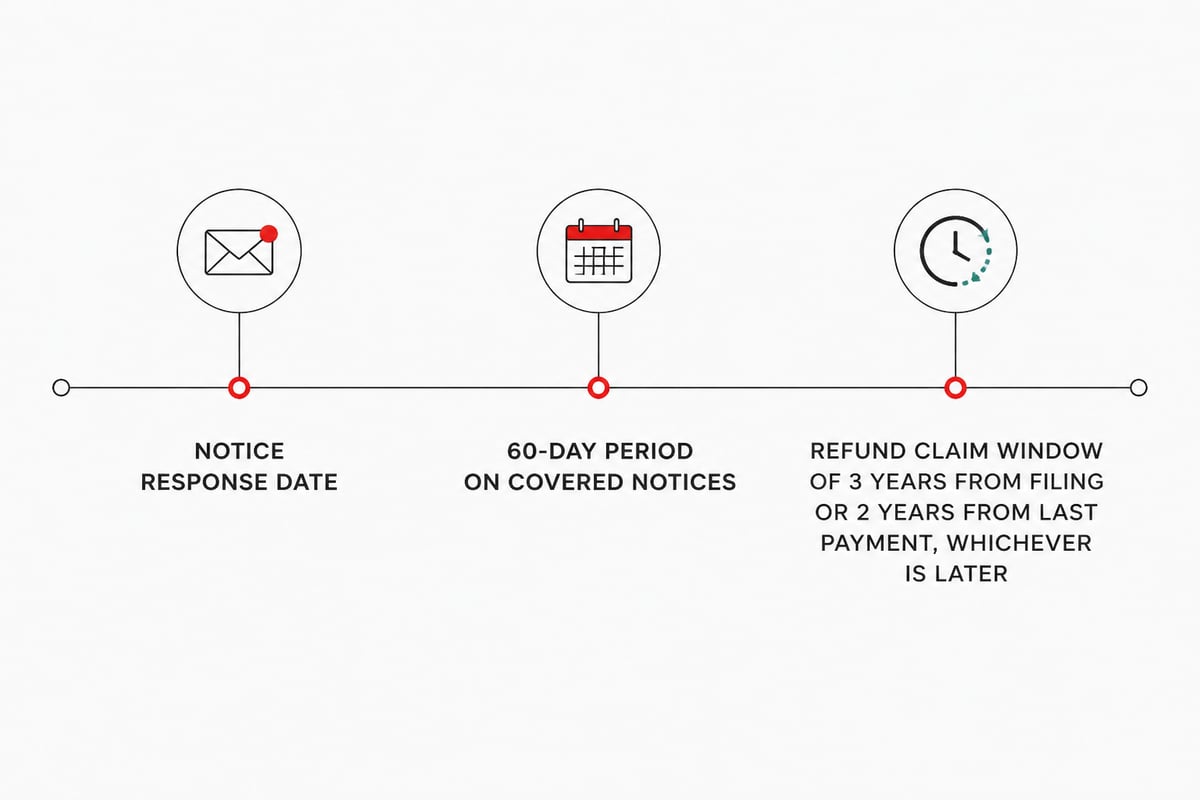
Some CP12-family notices carry a 60-day window, and missing it can cost you the right to challenge the change in Tax Court before you pay. The IRS states that if you miss the 60-day period on a covered notice, the change will not be reversed through that process, and you lose the right to appeal the decision in U.S. Tax Court before payment. You can still file a refund claim.
Read your own notice for which timeline applies. Some notices only give a response date. Others give a longer statutory period. If your notice says anything about Tax Court, treat that date as hard.
Refund claims have their own clock. The IRS generally requires a claim within three years of filing the return, or two years from the date of the last payment for that tax, whichever is later. If you filed on time and the deadline on the notice passed, you may still have a route. Don't assume it's gone, and don't assume it's open. Check the dates.
Amend, Dispute, or Both
A phone dispute works when the IRS made the error, and an amended return works when you did. They are different tools, and picking the wrong one wastes weeks.
| Situation | Best route | Why |
|---|---|---|
| IRS misread or mis-added a figure | Call or write in response to the notice | The error is on the IRS side, so documents fix it |
| You left off income or a form | Review the notice, then consider an amended return | The correction belongs on your return |
| You claimed a credit you shouldn't have | Accept the change and move on | Fighting it creates more risk |
| Unsure which side erred | Get a professional read before responding | A wrong move can lock in the error |
The IRS publishes its own guidance on when to file Form 1040-X, including situations involving an incorrect refund or additional tax due. Read it before you file. And don't file an amended return as a reflex. Mailing a 1040-X while a CP12 is pending can slow everything down.
Interest, Timing, and Why Your Refund Is Late
The IRS generally has about 45 days to issue an overpayment refund without paying interest, and overpayment interest stops when the refund goes out or is offset. The IRS interest page lays out that administrative period. If a CP12 resets or delays your refund, interest on the overpayment can still accrue under the rules, but the clock depends on the dates tied to your return.
Honestly, I tell clients not to build a plan around interest. What matters more is whether the corrected refund lands, whether it gets offset, and whether anything else on your account is coming due.
Refund timing can slip for many reasons, and I covered some of them in why tax refund waits get longer. A CP12 adds a layer on top of that. Plan for four to six weeks after the notice, and give it a bit more room before you start calling.
When a CP12 Is a Warning Sign
Most CP12 notices are a one-time correction. A few signal something larger. Watch for these.
- The notice reduces your refund sharply and also shows a balance due on another year.
- You receive more than one notice in a short stretch, such as a CP12 followed by a request for documents.
- The change involves self-employment income, payroll withholding, or a credit that depends on your household.
- You've ignored earlier IRS mail on the same tax year.
If any of that fits, stop treating it as a clerical hiccup. A refund the IRS cuts today can turn into a balance due tomorrow, and unpaid balances move through a predictable sequence of collection letters. You can see how that sequence works in this IRS collection notice sequence breakdown. The earlier you act, the more options you keep.
If the change did leave you owing, IRS Tax Debt Resolution covers representation through installment agreements, Offers in Compromise, and currently not collectible status. That's the route when the corrected return turns a refund into a bill you can't pay in one shot.
What to Keep and What to Do This Week
Keep the CP12, your filed return, the source documents, and every piece of correspondence in one folder. Photograph the envelope if the postmark matters to a deadline. Write down the date and time of every call, the agent's ID number, and what was said.
Then work through this short list:
- Compare the notice to your return today.
- Decide whether you agree.
- If you agree, track your refund and watch for offsets.
- If you disagree, assemble documents and respond before the stated date.
- If the notice mentions Tax Court or a 60-day period, treat that date as the deadline that matters most.
Don't send original documents. Send copies. And never ignore the notice because the dollar figure looks small. The deadline doesn't care how small the amount is.
If you want a second source for decoding other IRS letters, the Taxpayer Advocate Service keeps a directory of IRS notices with explanations. And for the wider picture on responding to any IRS letter, I laid out how to handle IRS notices step by step.
Pull your return and the CP12 side by side today and mark the response date before you do anything else. If the numbers don't add up, or the change leaves you owing money you didn't expect, I'd rather look at it with you before a deadline passes, and my firm takes over all communication with the IRS once you retain us. Let's talk: Schedule Your Free Consultation and we'll go through your notice together.