

After 32 years of IRS work — and more than $100 million in resolved tax debt — I've seen just about every version of the problem you're dealing with. I'm Darrin Mish, a tax attorney in Tampa. Here's what you should know.
I'm Darrin Mish. Tampa tax attorney, 32 years in, more than $100 million in IRS debt resolved. What follows isn't theory. It's what I've actually watched work.
An IRS 6020(b) substitute return for a business is a return the IRS prepares for you when you fail to file one, and it almost always costs you more than the return you would have filed yourself. You can usually fix it by filing your own accurate return before the assessment becomes final. The clock on that is short, so the details below matter.
What Is an IRS 6020(b) Substitute Return for a Business?
A 6020(b) substitute return is a return the IRS prepares and signs on your behalf under Internal Revenue Code section 6020(b) after you ignore notices to file. It applies to business returns as well as individual ones.
According to IRS Internal Revenue Manual 5.1.15, the IRS may prepare a substitute for return when it determines you must file but haven't, after it has notified you. The business forms covered include Forms 940, 941, 943, 944, 720, 2290, CT-1, and 1065. That list reaches payroll returns, excise tax returns, and partnership returns.
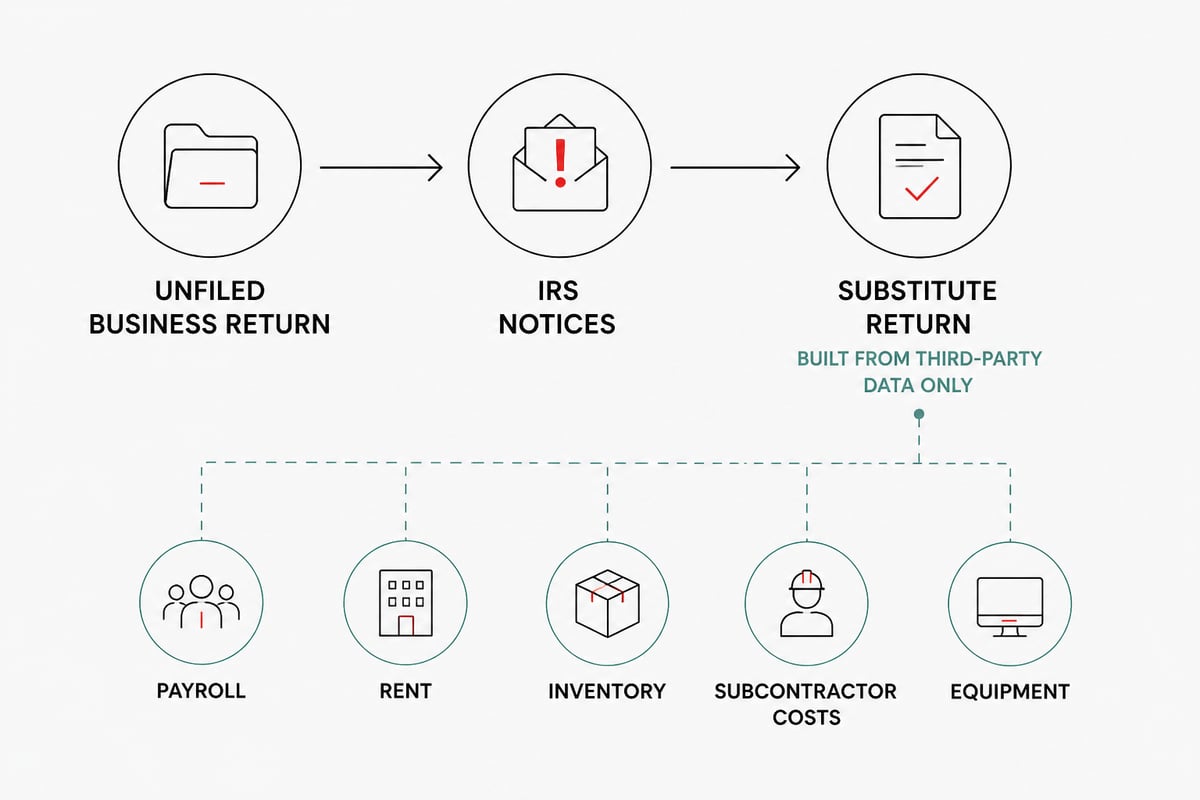
The IRS doesn't take this step casually, and it doesn't take it first. Letters come before it. Then more letters. If you ignored all of them, the IRS builds the return from whatever third-party data it has.
How the IRS Builds the Return Without Your Input
The IRS builds a substitute return from information other people reported about you, which means it sees your income and none of your costs. Bank deposits, Forms 1099, and information returns from customers all feed the calculation.
Here is the problem in one sentence. The IRS sees what came in and generally has no information about what went out.
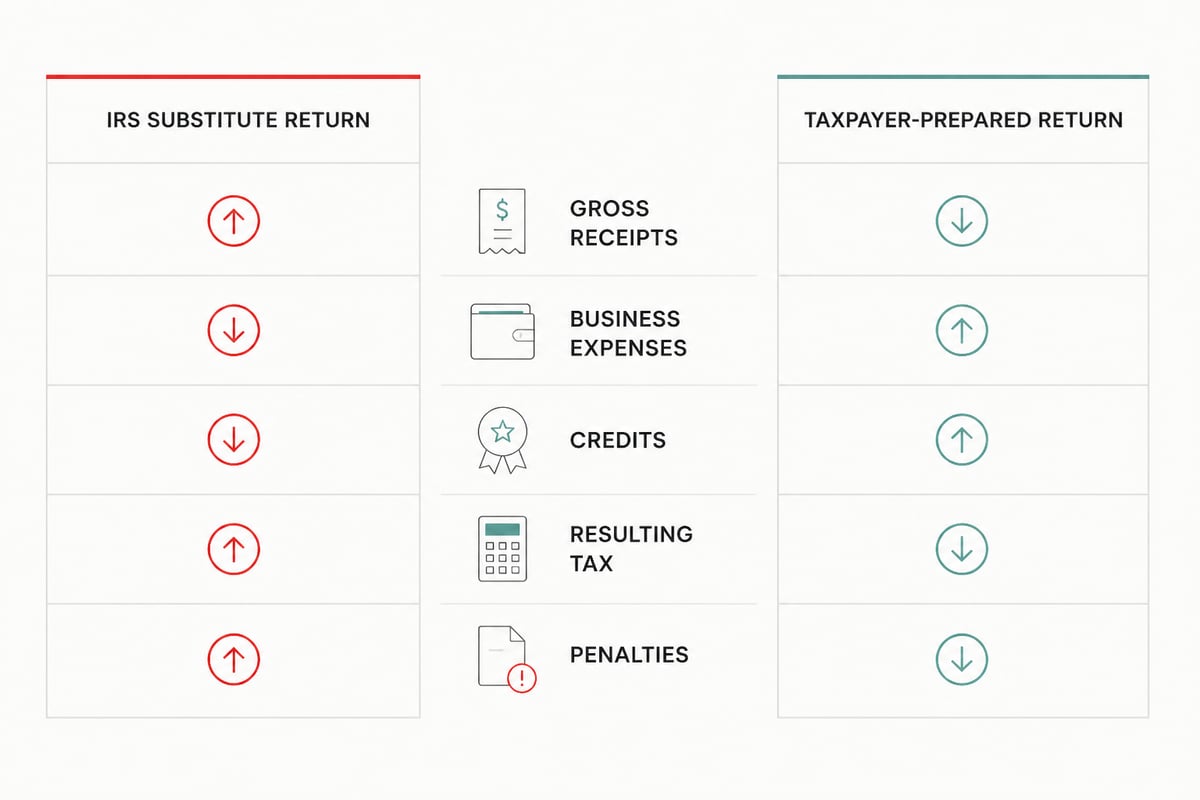
Per IRS Internal Revenue Manual 4.12.1, an IRS-prepared SFR may omit business expense deductions unless the IRS already has documentation supporting them, and the manual says the IRS is not legally required to allow those deductions on an SFR. The same manual says deductions and credits generally are not allowed on an SFR prepared under section 6020(b).
Think about what that does to a business. Payroll, rent, inventory, equipment, subcontractors. None of it shows up. The IRS taxes your gross receipts as if they were pure profit.
What makes a 6020(b) return valid
Not every IRS-generated document counts. IRS Internal Revenue Manual 8.17.4 says a valid section 6020(b) return must identify the taxpayer, contain enough information to compute your tax liability, and purport to be a return. An authorized IRS employee must sign it.
That signature requirement is where cases sometimes get interesting. A document that lacks the elements isn't a valid 6020(b) return, and that can change penalty and statute-of-limitations arguments. It's a technical fight, and you shouldn't try it without counsel.
The Notices You'll See Before and After
You will generally get a series of letters before an assessment, and the one that matters most is the statutory notice of deficiency, which opens a 90-day window. Missing the early letters is common. Missing that one is expensive.
The usual sequence looks like this:
- A reminder or delinquency notice. It asks you to file the missing return. The CP59 notice for an unfiled return is a common starting point.
- A follow-up with a deadline. It warns that the IRS may prepare the return for you.
- A proposed assessment. The IRS shows its calculation, usually with a response date.
- A notice of deficiency. This is the formal one, and it triggers your Tax Court rights.
On that last step, the IRS guidance on filing past due returns says a taxpayer receiving a CP3219N notice generally has 90 days to file the past-due return or petition the Tax Court. If you do neither, the IRS proceeds with its proposed assessment. The IRS manual section on notices of deficiency and SFR cases lays out how that process and your Tax Court opportunity work.
Ninety days can go quickly once you account for the time it takes to rebuild books for a year the business ignored.
What an IRS 6020(b) Substitute Return Business Assessment Costs You
When the IRS assesses tax on a substitute return, you owe the inflated tax plus penalties and interest, and the penalties are built to hurt. The tax is only the first layer.
For most business returns, the failure-to-file penalty is 5% of the unpaid tax for each month or partial month the return is late, up to 25%. Reasonable cause may excuse it, but "we got busy" doesn't qualify. Illness, a destroyed set of records, or reliance on a professional who failed you can.
Hypothetical example: the IRS builds a substitute return showing a large profit figure for a business whose real profit, after expenses, is much smaller. The IRS tax is calculated on the wrong number, then penalties pile on top of the wrong number. Every month of delay makes a bad figure worse.
Payroll cases are the sharpest version of this. Unpaid employment taxes can create personal exposure for owners and officers, a problem I cover in what happens when a business can’t pay employee taxes.
Why You Should File Your Own Return After an SFR
You should file your own return because a taxpayer-prepared return lets the IRS account for what the substitute left out. The substitute is a placeholder for the real thing.
The IRS says as much. Under its past due return guidance, filing a taxpayer-prepared return after an SFR can allow the IRS to account for deductions, credits, and exemptions the SFR may have omitted. That's the whole strategy in a line.
Done right, the order looks like this:
- Gather the records. Bank statements, payroll reports, invoices, receipts, loan documents. If records are gone, banks and payroll processors can often reproduce them.
- Prepare accurate returns. Every missing period, not just the one the IRS picked.
- File them before the assessment is final. After that, you're often fighting to reduce an assessment instead of preventing one.
- Deal with the balance. A corrected return still produces a bill, and the bill needs a plan.
This is also where mistakes get made. A return filed in a panic with guessed numbers can create a second problem. If you have several years open, what really happens with unfiled returns for several years is worth reading before you file anything.
Who Can Speak to the IRS for Your Business?
Only someone you formally authorize can discuss your business tax account with the IRS, and that authorization has to be on file. An officer or owner can speak for the business, and so can a representative holding a valid power of attorney.
The practical point is who you want on the phone. Owners tend to over-explain, volunteer information, and make promises the business can't keep. Once a firm is retained, all communication with the IRS runs through that firm, which takes you out of the line of fire.
There's a second reason to use an attorney. Conversations with a lawyer are protected by attorney-client privilege, which generally doesn't extend to conversations with a CPA. If your unfiled returns involve anything sensitive, that difference matters. For a sense of the different roles, see my post on business and tax attorneys and what each does.

Deadlines That Keep You Out of This Position
Most substitute return problems start with a missed due date followed by ignored mail, so knowing your actual deadline is the cheapest prevention you have. The date depends on your entity and year.
For a sole proprietor reporting on Schedule C, IRS Publication 334 (2025) says calendar-year 2025 returns are due April 15, 2026. Fiscal-year filers generally file by the 15th day of the fourth month after the fiscal year ends. Partnerships, corporations, and payroll returns run on their own calendars.
If a 2025 return was due in spring and never went in, you're already past the date. That doesn't mean it's over. It means the notices may be on their way, or already in a drawer. If you suspect you've missed a filing, my guides on unfiled tax returns and IRS problems for small businesses walk through the first moves.
The 6-Year Compliance Rule and Why It Matters Here
The IRS's six-year compliance rule is a policy under which the IRS generally expects you to file the last six years of returns, not every year you missed.
That policy matters a great deal if your business skipped many years. You may not need to rebuild a decade of books. But the IRS can ask for more, and it can pursue older years, so don't assume six is a guarantee. The facts of your case, including whether fraud is suspected, drive the answer.
Keep in mind that filing returns is separate from paying. A business with six years of returns on file can still owe real money. That's where programs like installment agreements and offers in compromise come in, and where an attorney earns the fee. If the balance is the problem, IRS tax debt resolution through the firm covers those options.
What to Do This Week
If you've received any IRS notice about a missing business return, act now, and in this order:
- Find the notices. Check every address the IRS may have, including old ones. Note every date and response deadline.
- Count the days. If you have a notice of deficiency, mark the 90-day deadline on a calendar and don't move it.
- Pull your records. Start with bank statements and payroll reports.
- Stop talking to the IRS yourself. Calls without preparation can lock in bad numbers.
- Get a lawyer before you file. The return is a sworn document, and the order of filing matters.
Fear makes people freeze. The IRS counts on that.
FAQ
Does the IRS allow business expenses on a substitute return?
Generally no. The IRS manual says deductions and credits generally aren't allowed on a section 6020(b) substitute return, and that the IRS isn't legally required to allow business expense deductions on one. You recover them by filing your own accurate return.
Can I fight a substitute return after the assessment?
Sometimes. You can file a corrected return, request reconsideration, or in some cases petition the Tax Court if you act within the notice window. Once the 90 days pass without action, your options narrow and the timing of what you file becomes critical.
Does a substitute return affect other tax benefits?
A 6020(b) assessment is separate from individual tax provisions and doesn't change them. If you're dealing with one, your focus belongs on filing accurate returns and meeting the 90-day deadline in your notice.
Your next step is to put your IRS notices in one pile and write down the date on each one, because that date decides how much room you have left. From there, the question is whether to file corrected returns, contest the assessment, or negotiate the balance, and that's a decision worth making with an attorney who has handled these cases for years. If a substitute return is already on the table, Let’s talk and we'll go through your notices together in a free consultation.