

Most people I talk to about their IRS problem have already built the worst-case scenario in their head. The reality is usually much more manageable. I'm Darrin Mish, and I've been representing taxpayers before the IRS for 32 years. Here's what actually tends to happen.
I'm Darrin Mish. Tampa tax attorney, 32 years in, more than $100 million in IRS debt resolved. What follows isn't theory. It's what I've actually watched work.
An IRS CP518 final reminder for an unfiled return means the IRS has no record of a return from you for a past year and is giving you one last friendly chance to file before it starts deciding what you owe on its own. If you already filed in the last few weeks, you can probably set it aside. If you didn't, you have a deadline and a decision to make.
This notice is serious but not a crisis. It is not a lien, a levy, or a garnishment. It is a warning that those things become possible later if the silence continues.
What the IRS CP518 final reminder for an unfiled return actually says
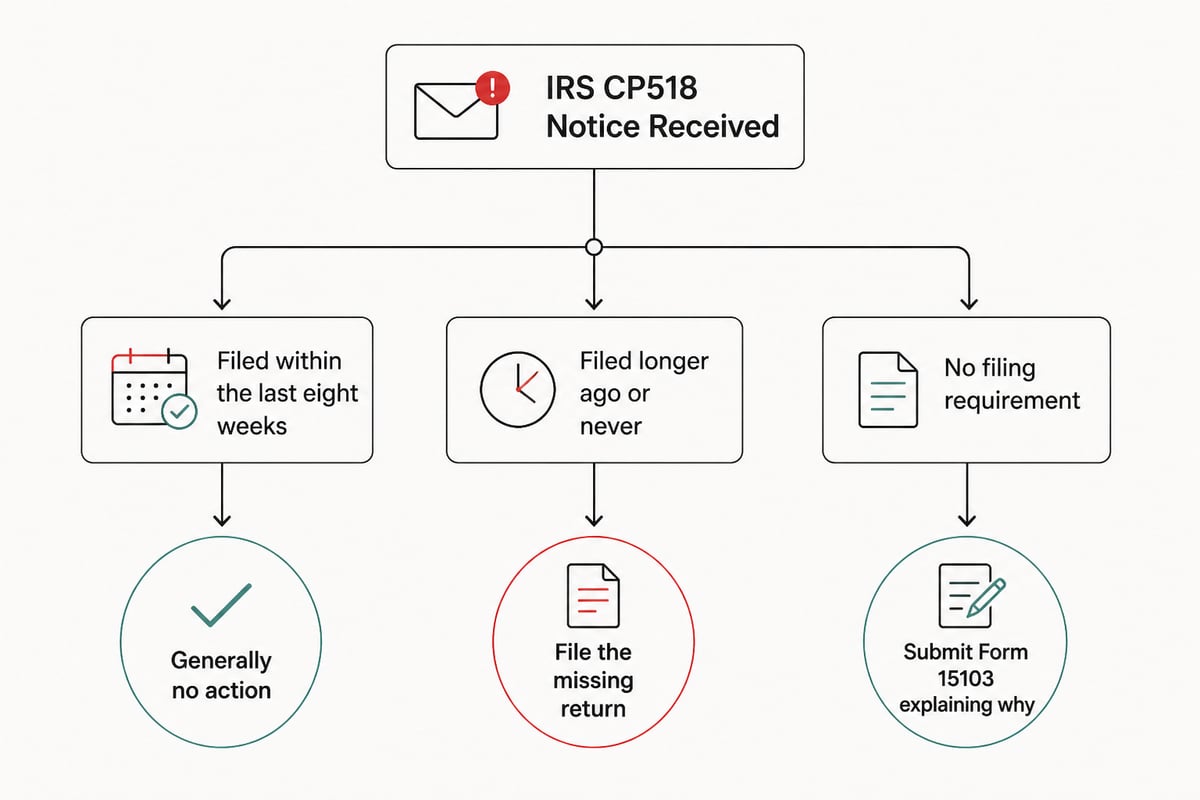
The CP518 is the IRS's final reminder that it has no record of a return for a prior year, and it asks you to either file that return or explain why you don't have to. Per the IRS's own page on understanding your CP518 notice, you respond by filing the return, or by submitting Form 15103 to explain why no return is required, and you follow the address printed on the notice.
Read the top of the letter first. It names the tax year the IRS says is missing. That one detail drives everything else.
The word "final" matters, and so does the word "reminder." The notice follows earlier contact, so you have already been asked before. Now you are being asked again, and the next step is not another letter asking nicely.
What the notice is not:
- A bill. It doesn't state a balance due.
- A seizure notice. Nothing is being taken.
- A criminal referral. Late filing, by itself, is a civil matter.
It is a paper trail the IRS is building, and you are the one who decides how it ends.
Do you need to respond to a CP518 at all?
You may not need to respond if you filed the return within the last eight weeks. The IRS says that if you filed within the last eight weeks, you generally don't need to do anything in response to the CP518. Notices and returns cross in the mail all the time, and processing takes time.
Before you relax, confirm three things:
- The tax year on the notice matches the return you actually filed.
- You have proof of filing, such as an e-file acceptance, a certified mail receipt, or a copy of the signed return.
- The filing really was within the last eight weeks.
If any of those fail, treat the notice as live. A return you filed for the wrong year, or one you prepared but never sent, doesn't help you.
Some readers get this notice because they genuinely had no filing requirement that year. Income below the filing threshold is the common reason. That is a legitimate answer, but it needs to be stated to the IRS in writing on the right form, which is covered below.
What happens if you ignore the notice
If you ignore a CP518, the IRS can calculate your tax for you, and its version is rarely kind. The IRS states that it may determine the tax due if you don't respond, that penalties and interest may continue to accrue, and that an unfiled return may delay a refund.
That calculated return is called a substitute for return, or SFR. The IRS builds it from the income reports it has on file: W-2s, 1099s, and similar forms. It leaves out your deductions, your dependents, and often your correct filing status. The resulting number is often higher than what you would have owed by filing yourself.
Then the IRS sends a notice of deficiency. You get a limited window to challenge it. Miss that window and the assessment stands, and collection begins: liens, levies, wage garnishment. I explain how that sequence plays out in the IRS collection notice sequence.
The good news is that an SFR is not the end. You can still file your own original return and replace it. The sooner you do, the less damage the SFR does. My post on filing an original return after an SFR walks through how that works.
How to respond: file the return or submit Form 15103
The right response depends on one question: did you owe a return that year? If yes, file it. If no, document why. Either way, the instructions on your notice control where the paperwork goes.
If you owed a return
File the complete, signed return for the year named on the notice. The IRS says a return filed because of an IRS notice should be sent to the location specified in that notice, not to the processing center you'd use for a routine filing. That detail trips people up. Mail it where the letter says.
You will need the forms for that specific year, not the current-year forms. Wage and income transcripts from your IRS online account can fill in gaps if you've lost a W-2 or 1099.
If you didn't owe a return
Complete Form 15103, the response form for return delinquency, and explain why you had no filing requirement. Be specific. "Income under the filing threshold" with the numbers behind it beats a vague statement. Keep a copy of everything you send.
If you're not sure which applies
Don't guess. Filing status, gross income, self-employment income, and dependent status all affect the threshold. A wrong guess here is how a one-year problem becomes a three-year problem. This is a good moment to get a lawyer's opinion before you answer the IRS in writing, because what you write becomes part of your record.
What does "delinquent return" mean, and what penalties apply?
A delinquent return is a tax return that was required by law and was not filed by its due date, including extensions. The label is administrative, but it triggers real consequences, mainly penalties.
The failure-to-file penalty is generally 5% of the unpaid tax for each month or partial month a return is late, up to a maximum of 25%, according to the IRS's page on the failure-to-file penalty. The same page says reasonable cause may qualify you for relief. A separate failure-to-pay penalty runs alongside it when you owe tax and haven't paid.
Here is the part that should change your behavior: the failure-to-file penalty is far heavier than the failure-to-pay penalty. Every month you wait to file costs more than every month you wait to pay. File first, even if the check has to come later.
| Penalty | Basic rate | Cap |
|---|---|---|
| Failure to file | 5% of unpaid tax per month or partial month | 25% |
| Failure to pay | Charged on unpaid tax for each month it remains unpaid | Stated on the IRS penalty page |
If you owe nothing, or you're due a refund, the failure-to-file penalty has nothing to attach to. That is why the notice scares people who owe no tax more than it should.

Can you file if you can't afford to pay?
Yes, and you should. The IRS advises filing all past-due returns even if you can't pay the full balance. The IRS guidance on filing past-due returns is blunt about this, and it matches what I tell clients across the desk.
Not filing because you can't pay is the most expensive mistake in this whole area. It piles on the heavier penalty, invites an SFR, and takes away your ability to ask for any payment arrangement. The IRS won't set up a payment plan for a year it has no return for.
If you can't pay in full, the IRS says you may request an additional 60 to 120 days to pay through its Online Payment Agreement application or by phone, with no user fee for that short-term request. Longer-term options exist too, including installment agreements and, in the right circumstances, an Offer in Compromise. For more, see my write-up on filing a return even when you can’t afford the tax.
I haven't filed in four years. What should I do?
Start with the most recent unfiled year the IRS is asking about, then work backward, and get every missing return in. A CP518 for one year is often the first visible sign of a larger gap. The IRS often looks back several years when it reviews old filings, though that is a practice, not a guarantee, and your facts can change it.
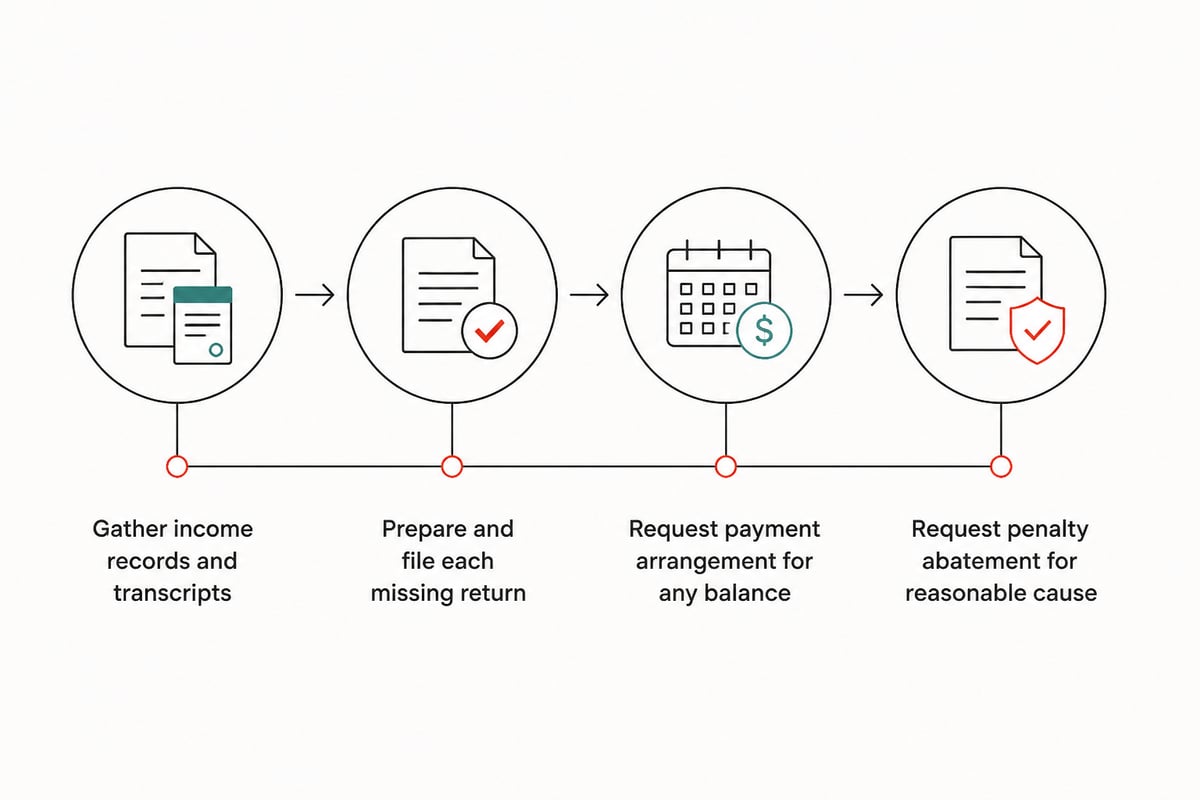
A workable order looks like this:
- Pull your transcripts. Wage and income transcripts show what the IRS already knows about you. Account transcripts show which years it considers unfiled.
- Gather what's missing. Bank statements, 1099s, receipts for business expenses, mortgage interest statements.
- Prepare returns oldest to newest, or newest first. Either works. What matters is that all of them go in, and that you answer the year named on the notice first.
- Send each return where the IRS directs. Use the address on the notice for the notice year.
- Deal with the balance after filing. Payment plan, abatement request, or a larger resolution.
Many people carry this for years because they imagine the worst. The reality usually comes out better than the dread. I cover the mechanics in my pieces on unfiled returns for several years and on whether the statute of limitations helps you. Short version on the second one: it doesn't start running until you file.
If the pile of years feels unmanageable, a professional can handle the preparation and the IRS contact together. That is what the firm's unfiled tax return preparation service is for, including voluntary disclosure where the situation calls for it.
What is the IRS collection phone number?
The number to call is the one printed on your CP518. Calling the number on the notice usually routes you to the unit that has your file, which beats calling a general line and starting over. Have the notice, your Social Security number, and the tax year in front of you when you call.
A few honest cautions about calling:
- Wait times can be long, and agents can only act on what's in your account.
- Anything you say can be noted in your file. Don't guess at income figures.
- A phone call is not a filing. It does not stop the clock on the notice's response date.
If your situation involves several unfiled years, self-employment income, or any chance of owing a lot, think before you call. Once you hire a lawyer, communications with the IRS run through the firm, and your conversations with your attorney are protected by privilege. A CPA can't offer you that.
Why is my return still processing after 21 days?
A return can sit in processing well past 21 days, and a delinquent return for a prior year often does. Paper-filed prior-year returns move slowly, and ones filed in response to a notice get routed by hand. Processing times vary, and back filings usually take longer than current-year e-filed returns.
Two practical points. First, if you filed in response to the CP518, the eight-week window the IRS mentions is the number to watch, not three weeks. Second, you can check what the IRS has on record through your online account and transcripts instead of waiting for mail.
If eight weeks pass and you keep getting notices for the same year, send proof of filing to the address on the latest notice and keep the mailing receipt.
FAQ
Can the IRS put me in jail for not filing?
Willful failure to file is a federal crime, but prosecution is uncommon and tends to involve patterns, large amounts, or evasion. Most people with a CP518 are in a civil process, and filing voluntarily before the IRS pursues you is the best protection. If you're worried about willfulness, talk to an attorney before you file anything.
Does a CP518 mean I'm being audited?
No. A CP518 is a filing-compliance notice, not an examination of a return you submitted. An audit looks at a return that exists. This notice is about a return the IRS can't find.
What if I never received the earlier notice?
It doesn't change what you need to do. The IRS sends notices to your last known address, and responsibility for responding doesn't hinge on whether the mail reached you. Respond to the CP518 you have now, and update your address with the IRS if it's out of date.
Pull your IRS transcripts today so you know exactly which years are open, because every response to a CP518 starts from that list. If years are piling up, the firm's unfiled tax return preparation service handles the back filing and any voluntary disclosure, and I'll tell you honestly what your exposure looks like before you commit to anything. Let's talk: Law Offices of Darrin T. Mish, P.A. offers a free initial consultation, so you can bring the notice and find out where you stand with no obligation.