

If you're reading this, something about your tax situation has you worried. That's fair — the IRS is intimidating until you know how the rules actually work. I'm Darrin Mish, a Tampa tax attorney. I've handled cases like yours for 32 years. Let me walk you through it.
I'm Darrin Mish. Tampa tax attorney, 32 years in, more than $100 million in IRS debt resolved. What follows isn't theory – it's what I've actually watched work.
Most IRS problems never cross into criminal territory. You owe money, the IRS sends letters, you work out payment arrangements or dispute the amount. Civil. Administrative. Fixable.
But when a special agent from Criminal Investigation knocks on your door – not a revenue agent, not a revenue officer, but a badge-carrying criminal investigator – you're in a different game. That's when you need a criminal tax lawyer, not just someone who handles collections. The stakes shift from "how much do I owe" to "am I going to prison."
What Separates a Criminal Tax Lawyer from a Tax Attorney
Not every tax attorney handles criminal cases. Most don't.
Civil tax work – Offers in Compromise, installment agreements, penalty abatement, audit defense – is a negotiation with the IRS over money. A criminal tax lawyer defends you against federal prosecutors trying to prove you committed a crime. Different training. Different courtroom. Different consequences.
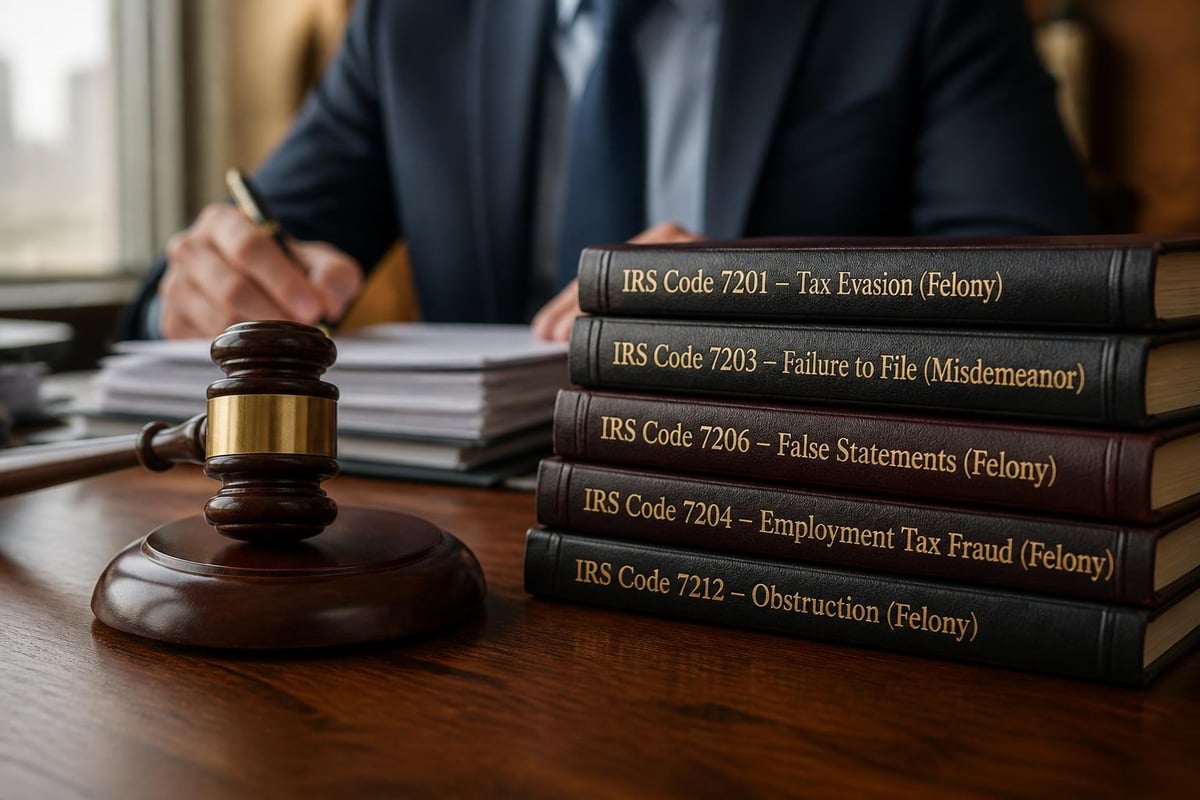
A criminal tax lawyer understands the elements of 26 U.S.C. § 7201 (tax evasion), § 7203 (willful failure to file), § 7206 (false return), and § 7212 (corrupt endeavor to impede the IRS). They know how the DOJ Tax Division decides which cases to prosecute and which to decline. They speak the language of mens rea, willfulness, materiality, and reasonable doubt – concepts that don't matter much when you're negotiating a lien release but matter entirely when a grand jury is weighing an indictment.
The IRS Criminal Investigation (CI) Division
IRS-CI doesn't handle routine tax debts. They investigate crimes.
When a revenue agent conducting a civil audit spots red flags – fabricated expenses, two sets of books, offshore accounts never disclosed – they refer the case to CI. CI special agents are federal law enforcement. They carry guns. They execute search warrants. They read Miranda rights.

According to the IRS-CI annual report, the conviction rate for cases CI prosecutes hovers near 90%. They don't investigate unless they believe they can prove a crime. If CI contacts you, hiring a criminal tax lawyer isn't optional. It's urgent.
When You Need a Criminal Tax Lawyer Right Now
You need a criminal tax lawyer the moment you learn you're under criminal investigation. Not after you've "explained yourself." Not after you've handed over documents. Now.
Special Agent Contact
If a special agent shows up at your home or business, you have one job: politely decline to answer questions and call a lawyer.
Special agents are friendly. Professional. They'll say they just want to "clear up a few things" or "get your side of the story." They're building a case. Every word you say can – and will – end up in an indictment.
You are not required to talk to them. You should not talk to them without a criminal tax lawyer present. Even truthful statements can be twisted. Even innocent explanations can provide the missing link prosecutors need.
Grand Jury Subpoena
A grand jury subpoena means prosecutors are seeking an indictment. You're a target, a subject, or a witness – and only a criminal tax lawyer can tell you which.
If you receive a subpoena for documents or testimony, do not comply without counsel. Do not ignore it. Both mistakes land people in worse trouble. A criminal tax lawyer can negotiate what you produce, assert privileges, and in some cases prevent you from walking into a perjury trap.
Search Warrant Execution
If federal agents execute a search warrant at your home or office, you're past the investigation phase. You're in the prosecution phase.
Do not interfere. Do not consent to anything beyond what the warrant requires. Do not answer questions. Call a criminal tax lawyer immediately, even if it's 3 a.m. What happens in the first hours after a search often determines the next five years of your life.
| Scenario | Civil Tax Lawyer | Criminal Tax Lawyer |
|---|---|---|
| IRS notice of balance due | ✓ | – |
| Revenue agent audit | ✓ | – |
| Wage garnishment or levy | ✓ | – |
| Special agent contact | – | ✓ |
| Grand jury subpoena | – | ✓ |
| Search warrant executed | – | ✓ |
| DOJ criminal referral | – | ✓ |
What Crimes Bring in a Criminal Tax Lawyer
The federal criminal tax code is narrower than most people think. The IRS doesn't prosecute everyone who owes money or files late. They prosecute willful, intentional conduct meant to defraud the government.
Tax Evasion (26 U.S.C. § 7201)
Tax evasion is the big one. It's a felony carrying up to five years in prison and $250,000 in fines.
To convict, prosecutors must prove three elements: (1) a tax deficiency existed; (2) you acted willfully to evade or defeat that tax; and (3) you committed an affirmative act of evasion – hiding income, inflating deductions, using nominees, keeping two sets of books, destroying records.
"Willfully" means you knew there was a legal duty and you intentionally violated it. Negligence isn't enough. Confusion isn't enough. The government has to prove you knew better and did it anyway.
Willful Failure to File (26 U.S.C. § 7203)
Failing to file a return when you're required to is a misdemeanor if it's willful. One year per count. $25,000 fine per count.
The IRS doesn't prosecute every non-filer. They prosecute high-income earners, repeat offenders, and people who actively hide from the system. If you haven’t filed in years and the IRS hasn't contacted you yet, a civil resolution is still possible. But once CI gets involved, you need a criminal tax lawyer.
Filing a False Return (26 U.S.C. § 7206)
Signing a tax return you know contains materially false information is a felony. Up to three years, $250,000 fine.
This includes underreported income, fabricated deductions, false W-2s, fake charitable contributions, inflated cost basis on sales, and hiding offshore accounts. It also applies to return preparers who knowingly file fraudulent returns for clients – a growing enforcement priority for IRS-CI in 2026.
Employment Tax Fraud
Business owners who withhold payroll taxes from employee paychecks and then pocket the money instead of paying the IRS face both civil penalties and criminal charges.
The Trust Fund Recovery Penalty is the civil tool – personal liability for unpaid taxes. But if you spent the money knowing it belonged to the IRS, that's embezzlement. That's a felony. That brings in both IRS-CI and sometimes the FBI.
How a Criminal Tax Lawyer Handles the Investigation Phase
Most criminal tax cases get resolved before trial. A good criminal tax lawyer works the case during the investigation – before prosecutors make a final charging decision.
Voluntary Disclosure
If you discover a tax problem before the IRS does, voluntary disclosure can sometimes prevent prosecution.
The IRS voluntary disclosure practice allows taxpayers to come forward, pay what they owe, and in most cases avoid criminal charges. But the window closes the moment CI starts an investigation or the IRS contacts you. And not every disclosure qualifies – if the conduct is too egregious, or if the government already has you in their sights, voluntary disclosure won't save you.
A criminal tax lawyer evaluates whether disclosure makes sense, negotiates the terms, and manages the process to minimize criminal exposure. Do this wrong and you've just handed the government a confession.
Proffer and Cooperation
Sometimes a criminal tax lawyer can negotiate immunity or reduced charges in exchange for cooperation – testimony against co-conspirators, return preparers, promoters, or financial institutions.
This is delicate work. Proffer agreements ("queen for a day" letters) allow you to provide information to prosecutors without it being used directly against you – but any lies or omissions destroy the agreement. A skilled criminal tax lawyer manages what you say, what you don't, and whether cooperation is even in your interest.
Pre-Indictment Advocacy
Before the DOJ decides to indict, a criminal tax lawyer can present a defense to the prosecuting attorney and the DOJ Tax Division.
This might include showing the alleged deficiency was overstated, that there's no proof of willfulness, that the taxpayer relied on professional advice, or that civil resolution is more appropriate than prosecution. According to DOJ criminal tax case procedures, Tax Division approval is required for most tax prosecutions. That approval isn't automatic. A well-argued defense memorandum can stop an indictment before it's issued.
What Happens If You're Indicted
If the DOJ proceeds with charges, the case moves to federal court. A criminal tax lawyer becomes your trial counsel.
Arraignment and Bail
You'll be arraigned, enter a plea (usually not guilty), and the court will set bail. Most white-collar defendants are released on bond. Flight risk and danger to the community are the concerns – not typical in tax cases unless there's a history of obstruction or international connections.
Your criminal tax lawyer will argue for release on your own recognizance or minimal conditions. Bail in tax cases is rarely the problem. The problem is what comes next.
Discovery and Motion Practice
The government must turn over all evidence – tax returns, bank records, witness statements, grand jury transcripts (if you testified), exculpatory material under Brady v. Maryland.
Your criminal tax lawyer will file motions to suppress evidence obtained through unlawful searches, dismiss counts that don't meet legal standards, sever improperly joined charges, and compel production of favorable evidence the government is withholding.
Plea Negotiations
More than 90% of federal criminal cases end in plea agreements.
A criminal tax lawyer negotiates charge reductions, agreed sentencing ranges, restitution amounts, and cooperation credit. The goal is to minimize prison time, fines, and supervised release conditions. The U.S. Sentencing Guidelines provide a starting range based on tax loss and offense level – but there's room to argue for departures and variances based on mitigating factors.
In tax cases, judges often weigh acceptance of responsibility, voluntary disclosure efforts, restitution paid before sentencing, and lack of criminal history. A criminal tax lawyer builds that mitigation case from day one.
Trial
If no acceptable plea is reached, your criminal tax lawyer takes the case to trial.
The government has the burden of proof beyond a reasonable doubt. Your lawyer will attack the government's case element by element – challenging tax loss calculations, cross-examining IRS agents, presenting expert testimony on tax law and accounting, and arguing lack of willfulness. You do not have to prove innocence. The government has to prove guilt. And in complex tax cases, juries can be skeptical of technical government theories.
Trials are expensive and risky. But sometimes they're the only option. A criminal tax lawyer will tell you when trial is worth the risk and when it's not.
How to Find the Right Criminal Tax Lawyer
Not every defense attorney handles tax. Not every tax attorney handles criminal. You need both.
Board Certification and Experience
Look for attorneys who are board certified in criminal trial law or tax law, or who have significant experience in federal tax prosecutions.
Ask how many criminal tax cases they've handled. Ask about their trial experience. Ask whether they've worked with DOJ Tax Division attorneys. Ask if they've defended cases in your district – local knowledge of judges and Assistant U.S. Attorneys matters.
A Tampa tax attorney with 32 years of experience handling IRS matters will have different expertise than a general criminal defense lawyer who's never dealt with a 26 U.S.C. § 7201 case. Find someone who speaks both languages.
Former Prosecutors and IRS Attorneys
Many criminal tax lawyers worked for the DOJ Tax Division, the U.S. Attorney's Office, or IRS Chief Counsel before entering private practice.
That insider knowledge – how cases are evaluated, what persuades Tax Division approval attorneys, what defenses actually work – can be invaluable. But experience alone isn't enough. You also want someone who'll fight, not just someone who knows the prosecutors.
National vs. Local Counsel
Tax crimes are federal. Your criminal tax lawyer doesn't have to be in your city – but they do need to be admitted in the district where your case is pending, or work with local counsel who is.
For strategy, negotiation, and motion work, location matters less. For trial, local credibility and relationships matter more. Many defendants hire a national criminal tax lawyer for overall case management and a local attorney for courtroom appearances.
| Factor | What to Look For |
|---|---|
| Board Certification | Criminal trial law or tax law |
| Experience | 10+ criminal tax cases handled |
| Trial Record | Actual federal trial experience |
| Former DOJ/IRS | Prior government service a plus |
| Local Admission | Licensed in your federal district |
| Fee Structure | Flat fee or hourly with clear cap |

What to Expect in Attorney Fees
Criminal defense is expensive. Criminal tax defense is more expensive.
A criminal tax lawyer typically charges either a flat fee for representation through trial or an hourly rate with a substantial retainer. Flat fees for a federal tax case range from $25,000 to $150,000 or more depending on complexity, number of counts, and whether the case goes to trial. Hourly rates run $400 to $750 per hour in most markets.
You get what you pay for. A cut-rate lawyer who doesn't understand tax will miss defenses, fail to challenge the government's loss calculation, and leave you with a longer sentence than necessary. This isn't the place to bargain shop.
Many criminal tax lawyers offer payment plans. Some accept credit cards. None work for free. And no, you can't pay them with the money the IRS says you owe – that's the tax debt that got you here in the first place.
How a Criminal Tax Lawyer Protects Your Future
A federal conviction for a tax crime follows you.
You'll have a criminal record. You may lose professional licenses – CPAs, attorneys, securities brokers, real estate agents. You'll face enhanced scrutiny on future tax returns. You may be barred from government contracts. You'll serve supervised release (federal probation) for up to three years after prison, with conditions that restrict travel, employment, and finances.
A criminal tax lawyer's job is to keep that from happening – or if it happens, to minimize the damage. That might mean fighting the case at trial. That might mean negotiating a plea to a misdemeanor instead of a felony. That might mean structured sentencing that avoids prison time entirely.
The earlier you bring in a criminal tax lawyer, the more options they have. Wait until after you've talked to the special agent? Harder case. Wait until after indictment? Even harder. Wait until the week before trial? You've tied your lawyer's hands.
The Overlap Between Civil and Criminal Tax Problems
Here's the part that surprises people: you can have both a civil tax debt and a criminal tax case at the same time.
The IRS civil side will still try to collect what you owe even while the criminal side is investigating whether to prosecute you. The two operate independently. A revenue officer doesn't care that you're under criminal investigation – they want their money. And the criminal side doesn't care that you've entered an installment agreement – they want a conviction.
A criminal tax lawyer will coordinate with civil counsel (or handle both if they're qualified) to make sure you don't create new criminal exposure while trying to resolve old tax debts. For example, filing delinquent returns during a criminal investigation can provide evidence prosecutors use against you. Paying restitution before sentencing can reduce your sentence. Entering an Offer in Compromise can demonstrate acceptance of responsibility. Timing and strategy matter.
Why You Can't DIY a Criminal Tax Case
You can represent yourself in civil tax court. People do it. It's not smart, but it's possible.
You cannot represent yourself in a federal criminal tax case. Not if you want to stay out of prison.
The federal rules of evidence, criminal procedure, and sentencing are complex. The DOJ has unlimited resources. The IRS has spent months or years building the case before you even knew you were under investigation. The prosecutors are career attorneys who've done this hundreds of times. The judge has no patience for defendants who don't know what they're doing.
A criminal tax lawyer levels that playing field. They know the law. They know the procedure. They know how to cross-examine an IRS revenue agent on tax loss calculations. They know how to challenge a summons enforcement action. They know what sentencing departures are available under U.S. Sentencing Guidelines for tax offenses.
You have one chance to get this right. Use it on a lawyer who knows what they're doing.
A criminal tax lawyer steps in when the IRS shifts from collecting money to building a case for prosecution – and at that point, every decision you make either helps you or buries you. For 32 years, the Law Offices of Darrin T. Mish, P.A. has defended taxpayers in civil and criminal tax matters nationwide, resolving more than $100 million in IRS debt and protecting clients from criminal exposure when the stakes are highest. If you're under investigation or facing charges, let's talk – Law Offices of Darrin T. Mish, P.A. offers free consultations and plain answers when you need them most.