

IRS problems aren't as complicated as they look once you see the structure. I'm attorney Darrin Mish. I've represented taxpayers before the IRS for three decades — in Florida, Colorado, Texas, and internationally. Here's the plain-English breakdown.
I'm Darrin Mish. Tampa tax attorney, 32 years in, more than $100 million in IRS debt resolved. What follows isn't theory. It's what I've actually watched work.
You've heard it a thousand times: save your tax records for seven years. Somebody's accountant said it, or a blog, or your uncle who got audited in 1998. The IRS 7 year rule floats around tax circles like gospel, but it's only half the story. Most people should keep most records for three years, not seven. The seven-year window applies to specific situations: employment tax records, bad debts, worthless securities, and certain losses. If you don't know which rule governs your paperwork, you're either hoarding receipts you don't need or tossing documents the IRS can still demand.
Why Everyone Thinks It's Seven Years
The confusion starts because nobody reads the statute. They hear "seven" and lock file boxes away like a time capsule. The IRS 7 year rule became shorthand for caution, not accuracy.
Here's what actually happens. The IRS has three years from the date you file a return to assess additional tax. That's the general statute of limitations under 26 U.S.C. § 6501. If you filed your 2023 return on April 15, 2024, the IRS usually has until April 15, 2027, to audit you and send a bill. Three years, not seven.
But Congress carved out exceptions. If you omit more than 25% of your gross income, the IRS gets six years. If you never filed, the clock never starts. If you filed a fraudulent return, there's no limit at all. The IRS overview of statutes of limitations lays this out plainly.

When the Seven-Year Clock Actually Applies
The IRS 7 year rule isn't a single rule. It's a cluster of provisions that all happen to land on seven years for different reasons.
Employment taxes. If you run a business and withhold payroll taxes, IRS Publication 583 tells you to keep those records for at least four years after the tax becomes due or is paid, whichever is later. But the safer practice, and what the IRS recommends for verification, is seven years. Payroll disputes drag out longer than income tax audits because the stakes involve trust fund recovery penalties that pierce the corporate veil and land on owners personally. I've seen payroll tax cases that pull records from six, seven, even eight years back.
Bad debts and worthless securities. If you claim a loss on a debt that went bad or stock that became worthless, the IRS gives you seven years from the original due date of the return to file an amended return claiming that deduction. You need records proving when the debt or security became worthless, which means you need to preserve the paperwork for the full seven-year span.
Casualty and theft losses. Same deal. Seven years to amend if you discover a loss you didn't claim initially.
The pattern: whenever you might file an amended return for a special deduction or loss, the IRS 7 year rule protects your ability to prove that claim years later.
What the Three-Year Rule Covers (Most of You)
If you're a W-2 employee with mortgage interest, some charitable deductions, and maybe a 1099-INT from your savings account, three years is enough. You filed accurately, the IRS has three years to question it, and you keep the supporting docs for that window.
After three years, the risk drops almost to zero. Audits past that point require one of the exceptions: big underreporting, fraud, or an unfiled return. For the average taxpayer who files on time and reports all income, three years of retention handles the exposure.
I tell clients to keep the return itself longer than three years (I keep mine indefinitely), but the receipts, bank statements, and miscellaneous backup? Three years covers it unless you claimed something unusual.
| Document Type | Retention Period | Why |
|---|---|---|
| W-2, 1099 forms, filed tax returns | Indefinitely (practical) | Proof of filing; retirement/Social Security verification |
| Receipts for routine deductions (mortgage interest, charity) | 3 years | Matches the general IRS assessment period |
| Records of bad debts, worthless stock | 7 years | Supports amended return claims under special rules |
| Employment tax records (Forms 941, W-2, payroll registers) | 7 years | IRS recommends 4+ years; 7 is the safe-harbor practice |
| Receipts for home improvements (basis adjustments) | Until you sell + 3 years | Needed to calculate capital gain at sale |
Three years is the floor. Seven is the ceiling for special cases. Most taxpayers live on the floor.

The New Seven-Year Push: Digital Assets
The IRS 7 year rule got a fresh coat of paint in 2024 when Treasury finalized regulations on broker reporting for digital asset sales. Starting with transactions in 2025 (reported in 2026), brokers like Coinbase and Kraken must issue Form 1099-DA and keep records for seven years.
Why seven? Because the IRS knows basis tracking for crypto is a disaster. You bought Bitcoin in 2019, moved it to three wallets, swapped it for Ethereum twice, and sold in 2025. The broker might not have full history. By requiring seven years of retention, the IRS gives itself time to cross-check your self-reported basis against whatever fragments the broker has.
The Treasury announcement on digital asset reporting and the final rule published in the Federal Register both cite the need for "accurate basis determination" across multiple years. Translation: the IRS expects to go back further when it audits cryptocurrency taxes.
If you trade crypto, the seven-year rule isn't optional anymore. It's regulatory. Keep every transaction record, every wallet transfer, every exchange confirmation for at least seven years from the sale date.
Why Accountants and Attorneys Default to Seven
Professional liability. That's the honest answer. The AICPA guidance on record retention encourages practitioners to retain client files and workpapers for periods that exceed the statutory minimum. Most firms adopt a seven-year policy because it covers every exception and leaves no gaps.
We do the same at our firm. Client files stay active for seven years after the last return or resolution, even if the statute of limitations is shorter. Why? Because disputes stretch. A levy notice in 2026 might reference a return from 2020. An offer in compromise digs into five years of financials. A penalty abatement request pulls transcripts from multiple years.
The seven-year habit isn't paranoia. It's a buffer against the IRS's ability to re-examine older years when new issues surface.
When the Clock Starts (and Stops)
You filed your 2023 return on April 15, 2024. The three-year statute runs until April 15, 2027. Simple. But if you filed early (say, February 10, 2024), the statute still starts on April 15, 2024, the due date. Early filing doesn't shorten your retention window.
If you filed an extension and submitted your return on October 10, 2024, the clock starts October 10, 2027. The statute runs from when you actually filed, not the original due date, if you filed after the due date.
Never filed? The statute never starts. The IRS can come after you in 2040 for a 2020 return if you never submitted one. That's why we push clients with unfiled tax returns to get compliant immediately. The exposure never closes.
Amended returns. If you file an amended return (Form 1040-X), the IRS has the later of three years from the original return or two years from when you paid the tax to assess more. Seven years becomes relevant if you're amending for a bad debt or worthless security, because the window to file the amendment stretches to seven years.
Collection Statute vs. Assessment Statute
People confuse two clocks: how long the IRS can assess tax and how long it can collect tax. The IRS 7 year rule governs certain record-retention best practices, but it doesn't control the collection statute.
Once the IRS assesses a balance (sends you a bill), it has ten years to collect. That ten-year period is the collection statute of limitations, and it's independent of the three- or seven-year retention rules. You still need to keep records proving you paid, proving the balance is wrong, or proving the statute expired, but the collection clock runs separately.
If the IRS assessed tax on April 15, 2020, it has until April 15, 2030, to collect through wage garnishment, bank levies, or liens. After ten years, the debt expires (with exceptions for bankruptcy, offers in compromise, and collection due process hearings that toll the statute).
The retention rule tells you how long to keep proof. The collection statute tells you how long the IRS can chase you. Different rules, different purposes.
What Happens If You Toss Records Too Early
You threw out your 2020 receipts in 2024 because you heard "three years" somewhere. Then in 2026, the IRS audits your 2020 return under the six-year rule because they think you underreported income by 30%. You can't prove your deductions. The IRS disallows them. You owe more tax, plus interest, plus penalties.
I've taken calls like this. The taxpayer is right, the deductions were legitimate, but they have no records. Bank statements gone. Receipts gone. The IRS doesn't care that you used to have them. They want them now. Without records, you lose.
This is where the IRS 7 year rule functions as insurance. Even if the statute is three years, holding records for seven covers the six-year underreporting exception and gives you breathing room if the IRS is slow to audit or if a related-year issue pops up.
Cost of storage vs. cost of losing deductions. A box in the attic costs nothing. A disallowed $15,000 deduction costs $3,300 in tax (22% bracket) plus penalties. Keep the records.
Special Cases: Basis, Property, and Long-Tail Assets
Some records you keep until you die (or your heirs do). If you bought a house, every receipt for a capital improvement adjusts your basis. When you sell in 2040, you need those 2025 receipts to prove your basis is higher than the purchase price. Keep them until sale, then for three more years after you report the sale.
Same with stocks, rental property, business assets. Basis records follow the asset, not the calendar. You bought stock in 2015, you need the purchase confirmation until you sell and file the return reporting that sale, plus three years after.
The IRS 7 year rule doesn't govern basis records. The rule is: keep them as long as the asset exists, plus the statute of limitations on the return where you report the disposition.
How We Handle This in Practice
When clients come in with audit notices or collection problems, the first question is always: do you have records? Half the time, the answer is "some." The other half, it's "I think so, maybe in a box."
We rebuild what we can. We pull IRS transcripts (wage and income transcripts, account transcripts, record of account transcripts). We subpoena third parties if needed. We reconstruct expenses from bank statements. But it's ugly, slow, and expensive compared to handing over an organized file.
The IRS 7 year rule isn't a legal mandate for most taxpayers, but it's a cheap insurance policy. Seven years of records, organized by year, stored digitally or in a box. When the IRS calls, you answer with facts, not apologies.
Digital vs. Paper: Does the Format Matter?
The IRS accepts digital records. Scanned receipts, PDFs of bank statements, photos of invoices. All valid, as long as they're legible and authentic. The IRS Publication 583 guidance doesn't require paper.
In fact, digital is better. It doesn't fade, doesn't get chewed by mice, doesn't flood in a hurricane. (We're in Tampa. We think about hurricanes.) Cloud storage, encrypted backups, a simple folder structure by year. That's the modern retention strategy.
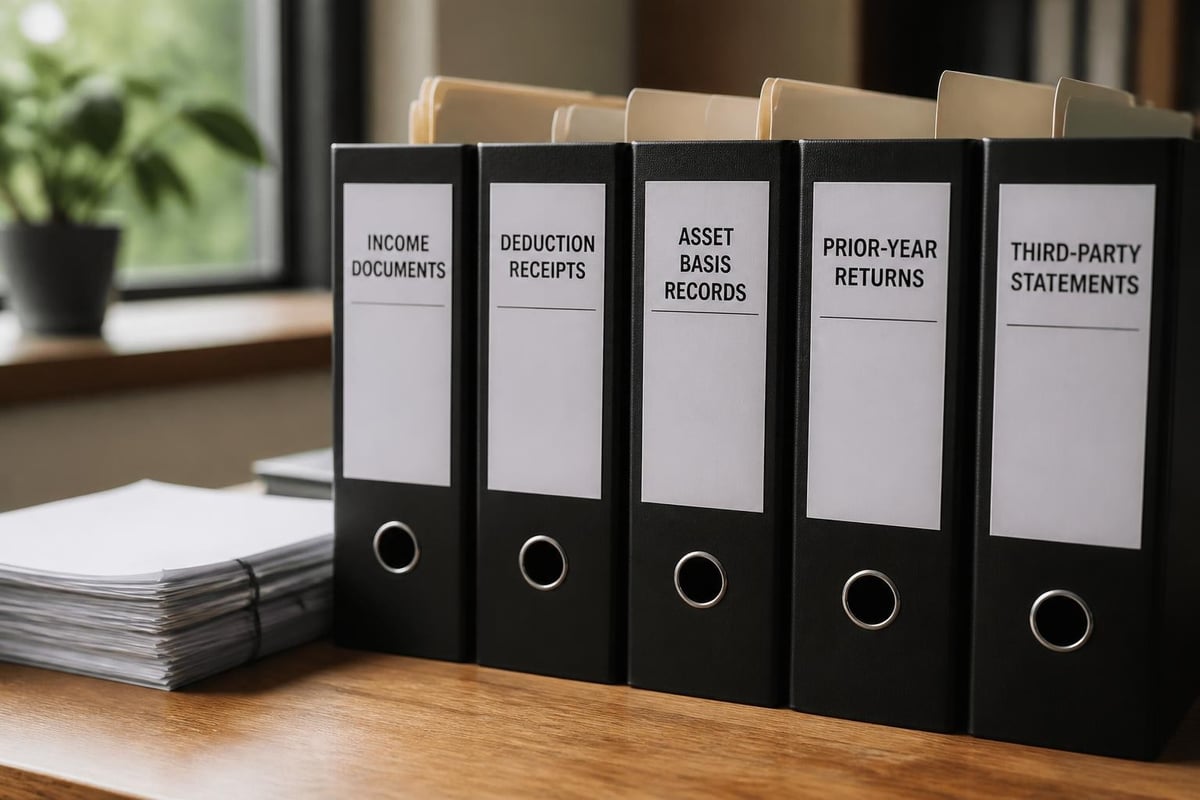
But you need a system. Throwing receipts into a Google Drive folder named "Taxes!!!" and hoping you can find them in 2029 isn't a system. Create a folder for each tax year. Subfolders for income, deductions, business expenses, and miscellaneous. Takes ten minutes a year, saves hours during an audit.
Myths That Won't Die
"If the IRS doesn't audit me in three years, I'm safe." Mostly true, but not always. The six-year rule for underreporting still applies. And if you never filed or filed fraudulently, there's no limit.
"I only need to keep receipts, not the return." Backward. Keep the return forever (or at least until you're collecting Social Security and need proof of earnings). The receipts can go after the statute runs.
"Electronic records aren't valid." Wrong. The IRS has accepted electronic records for decades. The only caveat: make sure they're accessible. If your accounting software shuts down in 2028 and you can't export the data, the records are useless.
"The IRS tells me when the statute expires." They don't. You have to track it. The IRS will happily try to collect or audit outside the statute if you don't object. Knowing when the clock expires is your responsibility, not theirs.
Balancing Paranoia and Pragmatism
Seven years is conservative. Three years is the statutory baseline. The right answer depends on your situation. W-2 employee, no business, no crypto, no unusual deductions? Three years is fine, maybe four to be safe. Business owner, payroll, rental property, digital assets, or recent large deductions? Seven years, no question.
The IRS 7 year rule isn't code. It's a best practice that grew out of the patchwork of statutes, regulations, and professional standards. It works because it covers the longest common statute and gives you margin for error.
I've never heard a client say, "I regret keeping those records too long." I've heard dozens say, "I wish I hadn't thrown that box away." The cost of keeping records is trivial. The cost of losing them can run into five figures.
If you want a single, safe answer that applies to everyone: keep tax records for seven years from the filing date, keep the return and W-2s indefinitely, and keep basis records for assets until you sell them plus three years after reporting the sale. That covers 99% of the scenarios the IRS will throw at you.
The IRS 7 year rule is a safeguard, not a sentence. Most taxpayers can get by with less, but the cost of keeping records longer is zero, and the cost of tossing them early can be devastating. If you're staring at a notice and the records are gone, or if you're not sure what applies to your situation, Law Offices of Darrin T. Mish, P.A. works with clients nationwide to reconstruct records, defend audits, and resolve tax debts. Let's talk-initial consultations are free, and 32 years of experience means we've seen your situation before.