

I’m Darrin Mish. Tampa tax attorney, 32 years in, more than $100 million in IRS debt resolved. What follows isn’t theory – it’s what I’ve actually watched work.
Have you ever opened your mailbox to find an envelope from the IRS and felt your stomach drop? You're not alone. Millions of Americans struggle with back tax debt every year, and the stress of dealing with unpaid taxes can feel overwhelming. Whether you forgot to file a return, couldn't afford to pay what you owed, or made an honest mistake on your tax forms, understanding how back tax debt works is your first step toward finding a solution. Let's walk through what you're facing and, more importantly, what you can do about it.
What Exactly Is Back Tax Debt?
Back tax debt is simply any tax you owe to the IRS from previous tax years that remains unpaid. It's that straightforward. When you file your tax return and discover you owe money, but you don't pay the full amount by the tax deadline (usually April 15), that unpaid balance becomes back tax debt.
But here's where it gets trickier. Back tax debt also includes situations where you didn't file a return at all. If you're required to file and you skip that responsibility, the IRS can file a substitute return on your behalf. They'll calculate what you owe based on their records, and trust me, they won't be claiming deductions or credits that could lower your bill.
How Back Tax Debt Accumulates
The moment your tax payment is late, the clock starts ticking on penalties and interest. The IRS doesn't just wait patiently for you to pay. Under the Internal Revenue Code, they're authorized to charge:
- Failure-to-pay penalty: Typically 0.5% of your unpaid taxes per month, up to 25%
- Interest: Compounded daily at the federal short-term rate plus 3%
- Failure-to-file penalty: If you didn't file, this is 5% per month, up to 25%
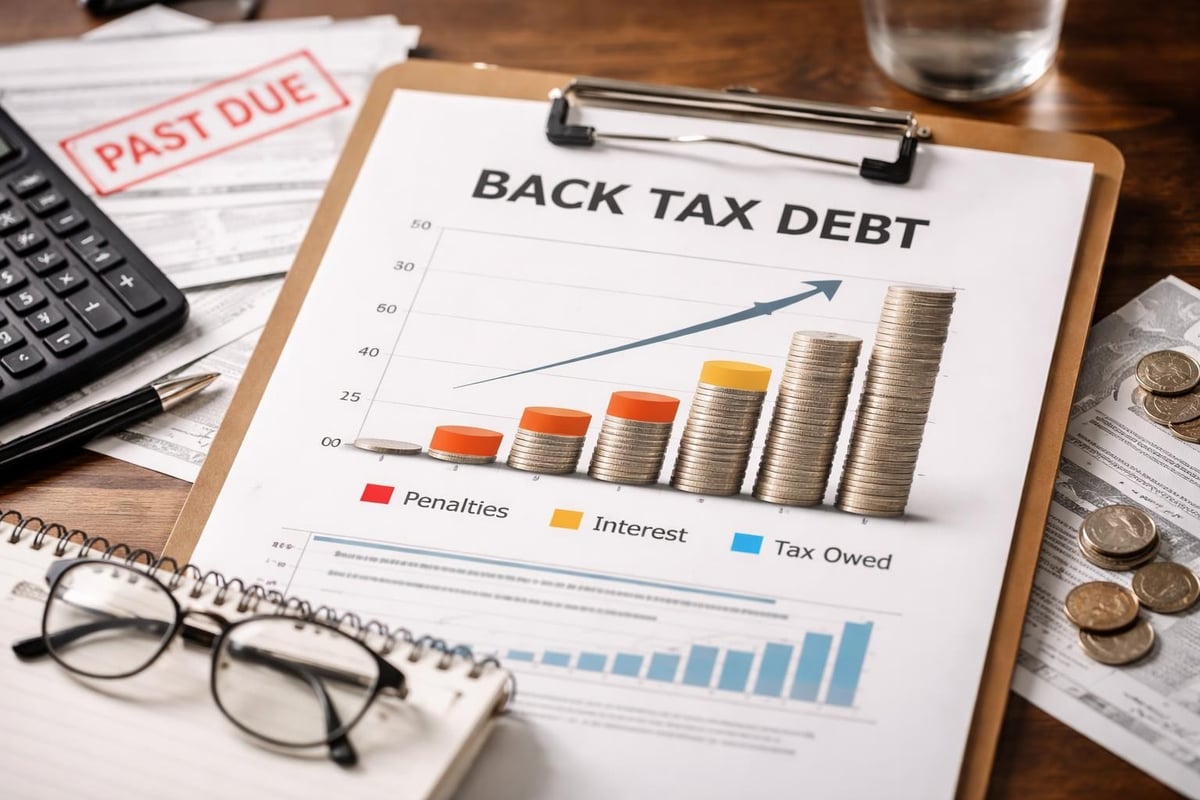
These charges compound faster than you might expect. A $10,000 tax debt can easily balloon to $15,000 or more within just a few years if left unaddressed. That's why dealing with IRS delinquent taxes sooner rather than later makes financial sense.
How the IRS Collects Back Tax Debt
You might wonder what happens if you just ignore those IRS letters. Unfortunately, the IRS has substantial collection powers granted by Congress, and they're not shy about using them.
The Collection Process Timeline
When you owe back tax debt, the IRS follows a predictable pattern:
- Initial notice: You'll receive a bill explaining what you owe
- Reminder notices: Multiple letters arrive over several months
- Final notice of intent to levy: This is your official warning
- Collection action: Bank levies, wage garnishments, or property seizures
The U.S. Department of the Treasury outlines legal authorities that give the IRS broad powers to collect what you owe. They can take money directly from your paycheck, freeze your bank account, or even seize your property.
Federal Tax Liens
One of the most serious consequences of unpaid back tax debt is a federal tax lien. This is the government's legal claim against your property when you neglect or refuse to pay your tax debt. The lien attaches to everything you own: your house, your car, your business assets, and even property you acquire after the lien is filed.
| Collection Method | What Happens | Impact on You |
|---|---|---|
| Wage Garnishment | IRS takes portion of paycheck | Reduced income, employer notification |
| Bank Levy | IRS freezes and seizes bank funds | Lost access to money, overdrafts |
| Federal Tax Lien | Public claim on your property | Credit damage, difficulty selling assets |
| Property Seizure | IRS takes and sells your assets | Loss of home, car, or business property |
A federal tax lien becomes public record. You can conduct an IRS tax lien lookup to see if one has been filed against you or anyone else. This public filing damages your credit score and makes it nearly impossible to sell property or obtain financing until the debt is resolved.
Tax Refund Interception
Here's something many people don't expect: if you owe back tax debt and you're due a refund from a current year return, the IRS will simply keep your refund and apply it to your outstanding balance. This process, known as tax refund interception, happens automatically. You won't see that refund check you were counting on because the IRS uses it to pay down what you owe from previous years.
Your Options for Resolving Back Tax Debt
Now for the good news. You're not trapped. The IRS offers several legitimate programs to help taxpayers resolve their back tax debt, and understanding these options is crucial to getting your financial life back on track.
Installment Agreements
Can't pay your entire tax bill at once? Most people can't. That's why the IRS offers payment plans called installment agreements. You make monthly payments until your back tax debt is paid in full. The IRS offers several types:
- Short-term payment plan: Pay within 180 days, no setup fee
- Long-term payment plan: Monthly payments over time, small setup fee
- Guaranteed installment agreement: For debts under $10,000, automatically approved if you meet criteria
- Streamlined installment agreement: For debts up to $50,000, simplified approval process
The beauty of an installment agreement is that it stops most aggressive collection actions. Once you're in an approved payment plan, the IRS typically won't levy your bank account or garnish your wages, as long as you keep making your monthly payments.

Offer in Compromise
What if you simply can't afford to pay your full back tax debt, even over time? An Offer in Compromise (OIC) might be your answer. This program allows you to settle your tax debt for less than the full amount you owe. Sounds too good to be true? It's real, but it's not easy to qualify.
The IRS only accepts an OIC when they determine that the amount you're offering is the most they can expect to collect from you within a reasonable period. They look at your:
- Income and future earning potential
- Expenses and necessary living costs
- Asset equity (what your property is worth minus what you owe on it)
According to IRS data, they approve roughly 40% of OIC applications. The key is submitting a complete, accurate application that demonstrates genuine financial hardship. Many taxpayers benefit from working with professionals who understand how to settle IRS debt through this complex process.
Currently Not Collectible Status
Sometimes your financial situation is so dire that you can't pay anything toward your back tax debt right now. If you can demonstrate that paying would create genuine hardship (you can't meet basic living expenses), the IRS may place your account in Currently Not Collectible (CNC) status.
This doesn't erase your debt. The back tax debt still exists, and interest continues to accumulate. But the IRS temporarily stops collection activities. They're essentially acknowledging that you can't pay right now, and attempting to collect would be futile. This gives you breathing room to get back on your feet financially.
Penalty Abatement
Here's an option many taxpayers don't know exists: you can request that the IRS remove or reduce penalties on your back tax debt. The actual tax amount stays, but those hefty penalties that have been piling up? Those might be negotiable.
The IRS considers penalty abatement for several reasons:
- Reasonable cause: You had a good reason for not paying (serious illness, natural disaster, death in family)
- First-time penalty abatement: You have a clean compliance history for the past three years
- Statutory exception: The IRS gave you incorrect written advice
Even if you still owe the underlying tax, removing penalties can significantly reduce your total back tax debt. Understanding IRS penalty abatement options can save you thousands of dollars.
Understanding Your Rights and Protections
Did you know you have rights as a taxpayer, even when you owe back tax debt? The Taxpayer Bill of Rights guarantees certain protections, and knowing these can make a significant difference in how you navigate the resolution process.
Collection Due Process Rights
Before the IRS can levy your property or wages, they must send you a Final Notice of Intent to Levy and give you the right to a Collection Due Process (CDP) hearing. This is your opportunity to:
- Propose alternatives to levy (like a payment plan)
- Challenge whether you actually owe the debt
- Raise collection issues
You have 30 days from the date of the notice to request this hearing. Don't ignore this opportunity. It's a powerful protection that can prevent aggressive collection actions while you work toward a resolution.
Protection from Scams
Unfortunately, when people face back tax debt, scammers come crawling out of the woodwork. The Federal Trade Commission warns about tax relief scams that target vulnerable taxpayers. Here's what to watch for:
- Promises to settle your debt for "pennies on the dollar" without reviewing your finances
- Upfront fees before any services are provided
- Guarantees of acceptance into IRS programs
- Pressure to pay immediately without giving you time to think
Legitimate tax professionals will review your complete financial situation, explain your realistic options, and work within IRS guidelines. They won't make promises they can't keep.
When Professional Help Makes Sense
At what point should you consider getting professional assistance with your back tax debt? Here's my honest take: if you owe more than $10,000, if the IRS has already begun collection actions, or if you're confused about your options, professional help is worth considering.
What Tax Attorneys Do Differently
You might be wondering what sets a tax attorney apart from other tax professionals. Attorneys bring several advantages:
- Attorney-client privilege: Your communications are protected
- Representation in court: If your case goes to Tax Court, you need an attorney
- Legal strategy: They understand the law and can develop comprehensive defense strategies
- Negotiation power: The IRS often takes attorney representation more seriously
The Law Offices of Darrin T. Mish, P.A. has been helping clients resolve complex tax situations for over 32 years. Based in Tampa but serving clients globally, they understand the nuances of IRS tax debt settlement and have the experience to navigate even the most complicated back tax debt cases.

Special Considerations for Different Types of Back Tax Debt
Not all back tax debt is created equal. The type of tax you owe can significantly impact your resolution options and the IRS's approach to collection.
Payroll Tax Debt
If you own a business and have unpaid payroll taxes, you're facing one of the most serious types of back tax debt. The IRS views payroll taxes (money withheld from employees' paychecks) as "trust fund" taxes. You're holding that money in trust for the government, and failure to pay is treated very seriously.
The IRS can pursue responsible individuals personally through the Trust Fund Recovery Penalty. This means if you're an owner, officer, or person responsible for payroll, you can be held personally liable even if the business is a corporation or LLC. Understanding IRS payroll tax issues requires specialized knowledge.
Self-Employment Tax Debt
Are you self-employed? Then you know you're responsible for both the employee and employer portions of Social Security and Medicare taxes. When these go unpaid, they quickly become substantial back tax debt. The self-employment tax rate for 2026 is 15.3% on net earnings, so if you've had a few good years without paying estimated taxes, you could be looking at a significant balance.
Income Tax Debt vs. Other Tax Types
| Tax Type | Special Considerations | Collection Priority |
|---|---|---|
| Income Tax | Most common, various resolution options | Standard |
| Payroll Tax | Trust fund penalties, personal liability | High priority |
| Self-Employment Tax | Higher rates, quarterly payments required | Standard |
| Estate Tax | Property involved, complex valuations | Varies |
Bankruptcy and Back Tax Debt
Can you discharge back tax debt in bankruptcy? It's complicated, but the short answer is: sometimes. Under specific circumstances outlined in the Bankruptcy Code, certain income tax debts can be discharged in Chapter 7 or Chapter 13 bankruptcy.
To qualify for discharge, the tax debt must meet several criteria:
- The tax return was due at least three years ago
- You filed the return at least two years ago
- The tax assessment is at least 240 days old
- The return was not fraudulent
- You're not guilty of tax evasion
Even if your income tax debt qualifies for discharge, payroll taxes almost never do. The Department of Justice provides guidance on tax debt collection that continues even after bankruptcy proceedings.
The Statute of Limitations on Collection
Here's something that gives many taxpayers hope: the IRS doesn't have forever to collect your back tax debt. Generally, the IRS has 10 years from the date of assessment to collect. This is called the Collection Statute Expiration Date (CSED).
After 10 years, if the IRS hasn't collected the debt and the statute hasn't been extended, the debt essentially disappears. They can no longer legally collect it.
However, certain actions extend this 10-year period:
- Filing for bankruptcy (adds time the case is pending plus 6 months)
- Requesting an Offer in Compromise (adds time it's pending plus 30 days)
- Filing a Collection Due Process appeal (adds time it's pending)
- Living outside the United States for at least 6 months
Some taxpayers try to "wait out" the statute, but this strategy is risky. The IRS can and does take aggressive collection action during those 10 years, and the penalties and interest continue mounting.
Taking Action Today
If you're dealing with back tax debt, taking action now rather than later always works in your favor. Every month you wait, more interest accrues. Every notice you ignore brings you closer to enforcement action.
Your first step should be gathering your tax information. Pull together:
- All IRS notices you've received
- Copies of unfiled tax returns (if applicable)
- Recent pay stubs and bank statements
- List of monthly income and expenses
- Information about assets you own
Many taxpayers benefit from exploring tax debt solutions with someone who can objectively review their situation and recommend the best path forward.
Free Consultations Matter
Don't let fear of costs prevent you from seeking professional advice. Many tax attorneys, including those at reputable firms, offer free consultations to review your situation. This initial conversation can help you understand your options without any financial commitment.
During a free consultation, you can learn:
- Exactly what you owe and how it accumulated
- Which resolution options you might qualify for
- What the IRS is likely to do next if you don't take action
- Whether you need professional representation or can handle it yourself
The Reality of Living with Back Tax Debt
Let's be real for a moment. Living with back tax debt hanging over your head affects more than just your finances. It impacts your mental health, your relationships, and your ability to plan for the future. Every phone call from an unknown number makes your heart race. Every piece of mail creates anxiety.
But here's what I want you to understand: back tax debt is a problem with solutions. You have more options than you might realize, and the IRS, despite its fearsome reputation, is required to work within legal frameworks that include taxpayer protections and resolution programs.
Thousands of taxpayers resolve their back tax debt every year through legitimate IRS programs. Some pay it off through installment plans. Others qualify for reduced settlements through Offers in Compromise. Still others receive temporary relief through Currently Not Collectible status while they get back on their feet.
The path forward exists. The question is whether you're ready to take that first step and face the problem head-on.
Dealing with back tax debt doesn't have to be a journey you take alone. Whether you owe a few thousand or hundreds of thousands, understanding your options and taking action now prevents the situation from getting worse. The Law Offices of Darrin T. Mish, P.A. has spent over three decades helping taxpayers across the globe resolve their IRS problems, from wage garnishments to complex tax liens. If you're ready to explore your options and work toward a real solution, Law Offices of Darrin T. Mish, P.A. offers free consultations to help you understand what's possible and create a plan tailored to your specific situation.