

I’m Darrin Mish. Tampa tax attorney, 32 years in, more than $100 million in IRS debt resolved. What follows isn’t theory – it’s what I’ve actually watched work.
Let's be honest – discovering you owe the IRS and back taxes can feel overwhelming. Maybe you forgot to file, couldn't afford to pay, or life just got in the way. Whatever the reason, you're not alone. Thousands of Americans find themselves in this situation every year, and the good news is that there are proven ways to resolve it. Understanding how the IRS handles back taxes, what penalties you'll face, and what options you have can make all the difference between mounting debt and a fresh financial start.
What Are Back Taxes and How Do They Happen?
Back taxes are simply taxes you haven't paid from previous years. They could be from unfiled returns, underpayment, or a combination of both. The IRS doesn't forget about unpaid taxes, and they continue to grow with interest and penalties until you address them.
You might owe the IRS and back taxes for several reasons:
- Unfiled tax returns from one or more years
- Insufficient payment when you filed your return
- Math errors or miscalculations on your original return
- Unreported income that the IRS discovered through third-party reporting
- Disputed deductions that the IRS disallowed during an audit
The moment you miss a filing deadline or fail to pay your full tax liability, the clock starts ticking. Interest compounds daily, and penalties stack up monthly. What might have been a manageable amount can quickly balloon into a serious financial burden.
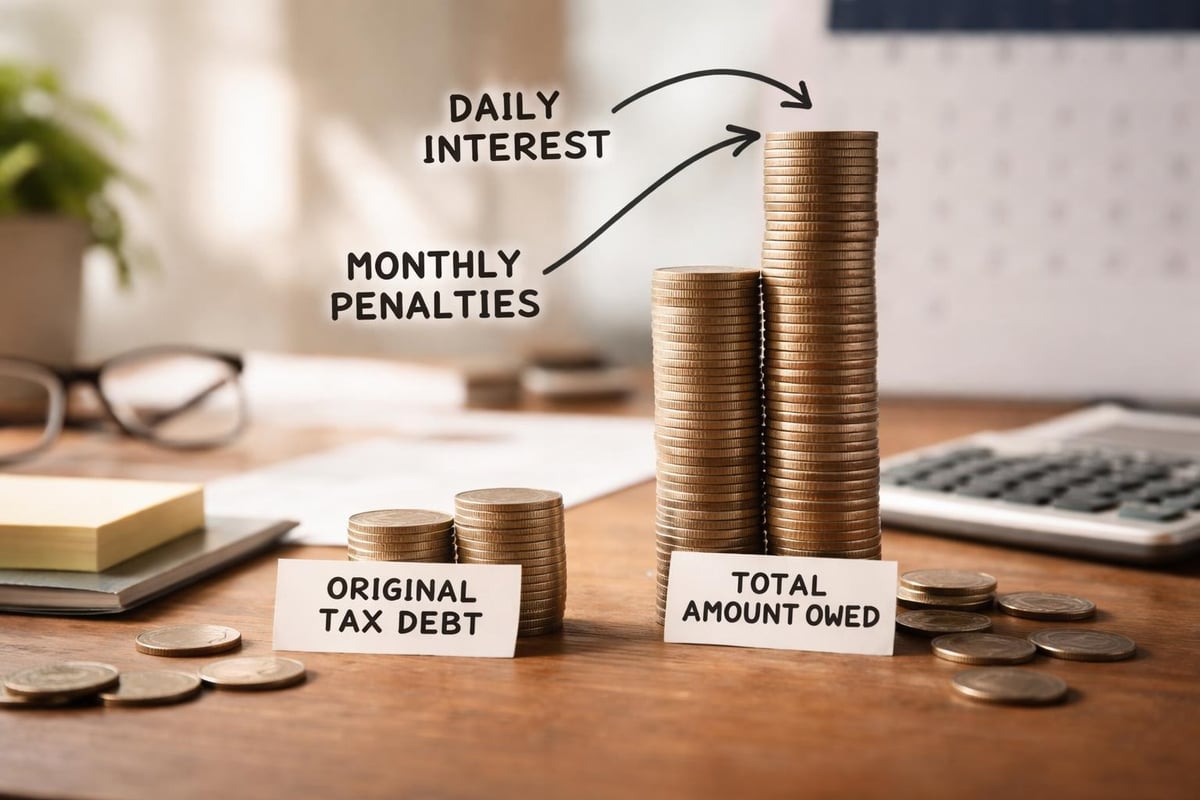
The Real Cost of IRS and Back Taxes
When you owe back taxes, you're not just dealing with the original amount. The IRS adds two main types of penalties that can significantly increase your debt.
Failure-to-File Penalty
This penalty hits hard at 5% of your unpaid taxes for each month (or part of a month) that your return is late, up to a maximum of 25%. If you're more than 60 days late, there's also a minimum penalty. The message is clear: file your return even if you can't pay.
Failure-to-Pay Penalty
Even if you file on time, not paying results in a penalty of 0.5% of your unpaid taxes per month, also maxing out at 25%. This penalty applies from the original due date until you pay in full.
| Penalty Type | Rate | Maximum | When It Applies |
|---|---|---|---|
| Failure-to-File | 5% per month | 25% | Return filed late |
| Failure-to-Pay | 0.5% per month | 25% | Taxes not paid by due date |
| Combined (both apply) | 5% per month | 25% | Late filing + late payment |
| Interest | Federal short-term rate + 3% | No maximum | All unpaid balances |
Interest compounds daily based on the federal short-term rate plus 3 percentage points. You can find current rates through the IRS guidance page, which updates quarterly.
What Happens When You Ignore IRS and Back Taxes
Ignoring your tax debt won't make it disappear. In fact, the IRS has extensive collection powers that most creditors can only dream about. Here's what typically happens if you don't address your situation.
First, you'll receive a series of increasingly urgent notices. The IRS starts friendly enough with a CP14 notice informing you of your balance. If you don't respond, the letters escalate. Eventually, you'll receive a Final Notice of Intent to Levy, which is your last warning before serious collection action begins.
The IRS can then:
- File a federal tax lien against your property, damaging your credit
- Levy your wages, taking a portion of each paycheck
- Seize your bank accounts without prior court approval
- Intercept tax refunds and apply them to your debt
- Revoke your passport if you owe more than $62,000 (2026 threshold)
Understanding IRS liens is crucial because once filed, they become public record and can affect your ability to sell property, get loans, or even rent an apartment.
Filing Missing Returns: Your First Step
Before you can resolve your IRS and back taxes situation, you need to get compliant. This means filing all missing returns, typically going back at least six years if you want to pursue certain resolution options.
Gathering Your Documents
Start by collecting W-2s, 1099s, and other income documents. If you don't have them, you can request transcripts from the IRS. The process for requesting old tax returns is straightforward, though it takes time to receive the documents.
You'll need:
- Wage and income transcripts showing reported income
- Account transcripts showing payment history
- Return transcripts if you previously filed
- Documentation for deductions and credits you're claiming
Preparing Accurate Returns
Take your time preparing these returns. Don't rush just to get them filed. Accurate returns prevent additional problems down the road. If your situation is complex – multiple years, significant income, or complicated deductions – working with a tax professional makes sense.

IRS and Back Taxes: Payment Options That Work
Once you're current with filing, it's time to address payment. The IRS offers several programs designed to help taxpayers resolve their debt, and choosing the right one depends on your financial situation.
Short-Term Payment Plan
If you can pay your balance within 180 days, you can request a short-term payment plan. There's no setup fee if you arrange direct debit payments. This option works well if you're expecting money soon – maybe from a bonus, contract work, or selling an asset.
Long-Term Installment Agreement
Can't pay within 180 days? An installment agreement lets you make monthly payments. If you owe less than $50,000 in combined tax, penalties, and interest, you can set this up online. The IRS will calculate your minimum payment based on your total debt divided by the remaining time on the collection statute.
Learning about IRS payment plan taxes helps you understand what monthly commitment you're making and how it affects your finances.
Offer in Compromise
This program allows you to settle your tax debt for less than the full amount, but it's not easy to qualify. The IRS looks at your reasonable collection potential – what they could realistically collect from you over the remaining statute period.
They examine:
- Your income and expenses
- Your assets and their equity
- Your future earning potential
- Special circumstances affecting your ability to pay
Only about 30-40% of offers submitted are accepted, so accuracy in your application is critical.
Currently Not Collectible Status
If you're experiencing genuine financial hardship where paying anything would prevent you from meeting basic living expenses, the IRS may temporarily suspend collection. This doesn't eliminate your debt, but it stops aggressive collection actions while you get back on your feet.
The IRS currently not collectible status provides breathing room, though interest continues to accrue.
Understanding Your Rights and Protections
When dealing with IRS and back taxes, you have rights under the Taxpayer Bill of Rights. These aren't just suggestions – they're enforceable protections.
You have the right to:
- Quality service from IRS representatives
- Pay no more than the correct amount of tax
- Challenge the IRS's position and be heard
- Appeal IRS decisions in an independent forum
- Finality – knowing when the IRS can no longer collect
The Collection Statute Expiration Date (CSED) is particularly important. Generally, the IRS has 10 years from the date of assessment to collect a tax debt. After that, the debt expires. However, certain actions can extend this period, including:
- Filing for bankruptcy
- Submitting an Offer in Compromise
- Living outside the United States for six months or more
- Signing a waiver extending the statute
| Action | Effect on Collection Statute |
|---|---|
| Bankruptcy filing | Suspends statute during case + 6 months |
| Offer in Compromise | Suspends while pending + 30 days |
| Collection Due Process hearing | Suspends while pending |
| Innocent spouse relief request | Suspends for that liability |
| Living abroad | Extends statute by time absent |
Penalty Abatement: Reducing What You Owe
Even if you can't reduce the tax itself, you might qualify to reduce or eliminate penalties. First-time penalty abatement is one of the most underutilized IRS programs.
If you have a clean compliance history for the previous three years, you can request abatement of failure-to-file, failure-to-pay, and failure-to-deposit penalties for a single tax year. You don't need to prove hardship – just a clean record.
For other situations, you can request penalty relief based on:
- Reasonable cause – circumstances beyond your control prevented compliance
- Statutory exception – written IRS advice led to the penalty
- Administrative waiver – first-time abatement or other IRS programs
Understanding IRS penalty abatement can save you thousands of dollars, particularly if you owe multiple years with stacked penalties.
Special Situations: When Back Taxes Get Complicated
Some situations add complexity to resolving IRS and back taxes. Let's look at a few scenarios that require special attention.
Innocent Spouse Relief
If your spouse (or ex-spouse) made tax errors that resulted in debt, you might not be responsible. The IRS offers three types of relief for spouses who should not be held liable for errors they didn't know about and had no reason to know about.
The requirements for IRS innocent spouse relief are specific, and timing matters. You generally must request relief within two years of the IRS's first collection attempt.
Business Tax Debt
Business owners face additional complexity, especially with payroll tax debt. The IRS views unpaid payroll taxes – money withheld from employees – as trust fund taxes, and they pursue them aggressively.
If you have a corporation or LLC, the IRS can assess the Trust Fund Recovery Penalty against responsible persons, making you personally liable for the business debt. Understanding IRS payroll tax obligations is essential for business owners.
Tax Liens and Their Impact
A federal tax lien gives the IRS a legal claim against all your property. It affects your credit score, appears in public records, and can prevent you from selling assets. However, you might qualify for lien withdrawal, subordination, or discharge depending on your circumstances.
Negotiating With the IRS: Do You Need Professional Help?
Can you handle IRS and back taxes on your own? Sometimes, yes. Setting up a simple payment plan for a single year of debt probably doesn't require professional assistance. But more complex situations benefit from experienced representation.
Consider professional help if:
- You owe multiple years of back taxes
- The amount exceeds $25,000
- You're facing levy or lien action
- You want to pursue an Offer in Compromise
- You have unfiled returns spanning several years
- You're dealing with business tax debt or payroll issues
- You disagree with IRS assessments
Tax attorneys, CPAs, and enrolled agents can all represent you before the IRS. Tax attorneys have additional benefits, including attorney-client privilege and experience with legal proceedings if your case requires litigation.
When seeking help for IRS tax debt, look for professionals with specific experience in tax resolution, not just general tax preparation.
Preventing Future Back Tax Problems
Once you resolve your current IRS and back taxes situation, you want to stay compliant going forward. Here's how to prevent future problems.
Adjust Your Withholding
If you consistently owe at tax time, you're not having enough withheld from your paycheck. Use the IRS withholding calculator to determine the right amount, then submit a new W-4 to your employer.
Make Estimated Payments
Self-employed individuals and those with income not subject to withholding need to make quarterly estimated payments. Mark these dates on your calendar:
- April 15 (for income January through March)
- June 15 (for income April through May)
- September 15 (for income June through August)
- January 15 of the following year (for income September through December)
Keep Good Records
Maintain organized records of income, expenses, and deductions throughout the year. Don't wait until tax season to gather everything. Digital tools make this easier than ever.
File Even If You Can't Pay
The failure-to-file penalty is significantly higher than the failure-to-pay penalty. Always file your return on time, even if you can't pay the full amount. You can then set up a payment arrangement for what you owe.
State Back Taxes: A Separate Challenge
While we've focused on federal IRS and back taxes, don't forget about state obligations. Most states have their own tax agencies with collection powers similar to the IRS. If you owe federal back taxes, there's a good chance you have state debt too.
State tax agencies can:
- File their own liens
- Levy wages and bank accounts
- Suspend professional licenses
- Intercept state refunds and lottery winnings
Some states are actually more aggressive than the IRS in collections. Handle both federal and state obligations simultaneously to get a complete resolution. Tax professionals familiar with IRS tax debt relief programs typically also handle state tax issues.
The Collection Statute: Understanding When Tax Debt Expires
The IRS has 10 years from the date of assessment to collect your tax debt. This is governed by Internal Revenue Code Section 6502. Understanding this timeline is crucial for planning your resolution strategy.
The statute begins on the date the IRS assesses the tax, not when you filed or when you owed it. For most taxpayers, assessment happens when you file your return or shortly after. If you never filed, the IRS can assess tax based on a substitute for return, starting their 10-year clock.
Strategic considerations include:
- Avoiding actions that extend the statute
- Understanding how much time remains
- Choosing resolution options that don't unnecessarily extend collection time
- Knowing when to wait versus when to act
However, relying on the statute running out is risky. The IRS can take significant collection action during those 10 years, and certain actions extend the deadline.
Dealing with IRS and back taxes doesn't have to be a nightmare, but it does require prompt, informed action. Whether you pursue payment arrangements, penalty abatement, or other resolution strategies, addressing the issue sooner rather than later saves you money and stress. The Law Offices of Darrin T. Mish, P.A. has over 32 years of experience helping taxpayers across the globe resolve complex tax situations. With personalized legal solutions and free consultations, they can evaluate your specific situation and develop a strategy that works for your circumstances. Don't let back taxes control your financial future – explore your options with Law Offices of Darrin T. Mish, P.A. today.