I’m Darrin Mish. Tampa tax attorney, 32 years in, more than $100 million in IRS debt resolved. What follows isn’t theory – it’s what I’ve actually watched work.

When you’re facing financial difficulties, whether it’s unpaid debts, medical bills, or tax issues, one of the most frightening prospects is having your bank account frozen or your income seized through garnishment. Understanding which accounts are protected from creditors can provide crucial peace of mind and help you protect your financial resources during difficult times. While many types of income and accounts can be subject to garnishment, federal and state laws provide important protections for certain accounts and funds, ensuring that individuals maintain access to essential resources for basic living expenses.
Understanding Garnishment and How It Works
Garnishment is a legal process that allows creditors or government agencies to collect debts by taking money directly from your bank account or wages. When a creditor obtains a court judgment against you, they can request a garnishment order that requires your bank to freeze your account or your employer to withhold a portion of your paycheck. Once your financial institution receives a garnishment order, they must comply by freezing the funds in your account, making them inaccessible to you until the matter is resolved.
The garnishment process typically begins when you fall behind on payments for debts such as credit cards, medical bills, personal loans, or unpaid taxes. After attempts to collect the debt fail, the creditor may file a lawsuit and obtain a judgment against you. With this judgment in hand, they can then pursue garnishment of your accounts or wages. However, not all funds are fair game for creditors – federal and state laws provide important protections for certain types of income and accounts.
Federal Benefits That Cannot Be Garnished
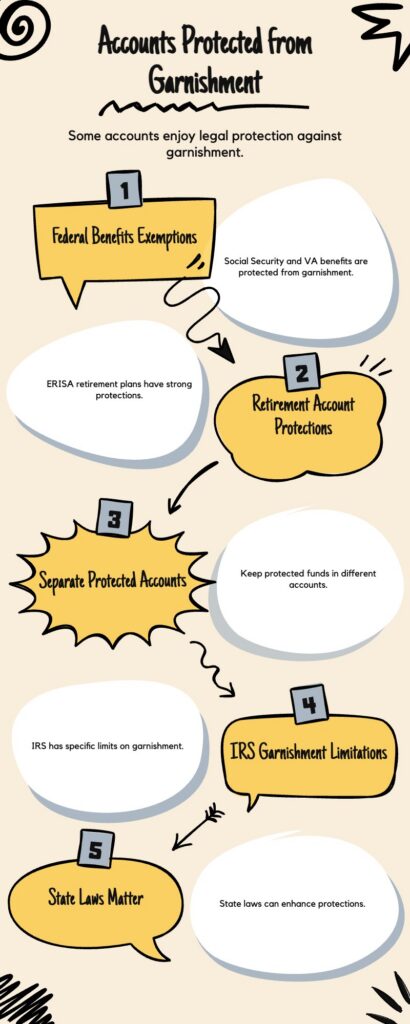
The federal government provides robust protections for various types of benefit payments, recognizing that these funds are often essential for recipients’ basic survival and well-being. Under federal law, the following types of benefits are generally exempt from garnishment by private creditors:
Social Security Benefits
Social Security retirement, disability (SSDI), and Supplemental Security Income (SSI) benefits receive strong protection under federal law. The Social Security Act explicitly states that these benefits are exempt from “execution, levy, attachment, garnishment, or other legal process.” This protection applies whether you receive benefits via direct deposit to your bank account or on a Direct Express prepaid debit card.
Financial institutions are required to follow specific procedures when they receive a garnishment order for an account that receives Social Security deposits. Banks must review the account history and automatically protect an amount equal to two months’ worth of federal benefit payments that were deposited in the preceding two months. This “protected amount” cannot be frozen or turned over to creditors.
However, there are important exceptions to this protection. Social Security benefits can be garnished for:
- Federal tax debts (the IRS can take up to 15% of your monthly benefit)
- Child support or alimony obligations (up to 50-60% depending on circumstances)
- Court-ordered restitution for federal offenses
Supplemental Security Income (SSI) enjoys even stronger protection and generally cannot be garnished for any reason, even for child support or federal taxes.
Veterans’ Benefits
Benefits administered by the Department of Veterans Affairs (VA), including disability compensation, pension payments, and survivor benefits, are protected from garnishment by private creditors under federal law. These protections recognize the sacrifices made by military service members and their families.
Like Social Security benefits, VA benefits can be subject to garnishment for specific government debts, including federal taxes and court-ordered child support or alimony. The VA may also offset benefits to recover overpayments or certain other debts owed to the federal government.
Other Protected Federal Benefits
Federal law extends garnishment protection to numerous other government benefit programs, including:
- Railroad Retirement benefits – Both retirement and unemployment/sickness benefits for railroad workers
- Federal Employee Retirement System (FERS) benefits – Retirement payments for federal civil service employees
- Civil Service Retirement System (CSRS) benefits – Retirement benefits for certain federal employees
- Military retirement pay and survivor benefits – Annuities for retired service members and their survivors
- Federal student assistance – Grants and loans for education
- FEMA disaster assistance – Emergency payments following natural disasters
- Black lung benefits – Payments to miners suffering from occupational lung disease
Retirement Accounts and Garnishment Protection
Retirement savings represent another category of accounts that generally enjoy substantial protection from creditors, though the extent of protection varies depending on the type of account and applicable laws.
ERISA-Protected Retirement Plans
Employer-sponsored retirement plans covered by the Employee Retirement Income Security Act (ERISA) receive the strongest protection from creditors. These include:
- 401(k) plans
- 403(b) plans for employees of non-profit organizations
- Defined benefit pension plans
- Profit-sharing plans
- Employee Stock Ownership Plans (ESOPs)
ERISA’s “anti-alienation” provisions generally prohibit creditors from accessing funds held in these accounts, regardless of the amount. This protection applies both inside and outside of bankruptcy proceedings. Crucially, the protection extends only to funds that remain in the account, once you take a distribution and deposit it into a regular bank account, those funds become vulnerable to garnishment.
There are limited exceptions to ERISA protection. Retirement accounts can be accessed through:
- Qualified Domestic Relations Orders (QDROs) – Court orders dividing retirement assets in divorce or for child support/alimony
- Federal tax levies – The IRS can levy ERISA-protected accounts for unpaid federal taxes
- Criminal restitution orders – Court-ordered payments to crime victims
It’s worth noting that solo 401(k) plans for self-employed individuals may not qualify for ERISA protection, and their protection from creditors may depend on state law.
Individual Retirement Accounts (IRAs)
IRAs, including traditional IRAs, Roth IRAs, SEP-IRAs, and SIMPLE IRAs, do not receive the same blanket federal protection as ERISA-covered plans. However, they do enjoy certain safeguards:
In Bankruptcy: Federal bankruptcy law protects up to $1,512,350 (as of 2025, adjusted for inflation every three years) across all of your IRA accounts. Additionally, funds rolled over from an employer-sponsored plan into an IRA often receive unlimited protection in bankruptcy proceedings.
Outside Bankruptcy: Protection from creditors outside of bankruptcy depends on state law and varies significantly. Some states provide unlimited protection for IRAs, while others protect only amounts “reasonably necessary” for retirement or impose specific dollar limits. A few states offer minimal protection.
Like other retirement accounts, IRAs remain vulnerable to federal tax levies and court orders for child support or alimony. Additionally, inherited IRAs (except those inherited by a spouse and rolled into their own IRA) generally do not receive federal bankruptcy protection.
Other Income Sources Protected from Garnishment
Beyond federal benefits and retirement accounts, several other types of income receive protection from garnishment under federal or state law:
Workers’ Compensation
Benefits received for work-related injuries or illnesses are generally exempt from garnishment by private creditors in most states. These benefits are designed to replace lost wages and cover medical expenses resulting from workplace accidents, and laws recognize that garnishing these funds would defeat their purpose.
Unemployment Benefits
Most states protect unemployment compensation from garnishment by private creditors. However, unemployment benefits can typically be garnished for child support obligations, and in some cases, tax debts. The level of protection may depend on whether you keep unemployment funds in a separate account or commingle them with other money.
Child Support and Alimony Payments
Money received for child support or spousal support (alimony) is generally protected from garnishment by creditors other than those seeking to enforce support obligations. These funds are intended to support dependents and are therefore given special protection.
Disability Payments
Private disability insurance payments may be protected from garnishment depending on your state’s laws. Some states fully exempt disability benefits, while others provide limited protection. Public disability benefits, such as those from Social Security or workers’ compensation, receive broader protection as discussed earlier.
Life Insurance and Annuity Proceeds
Many states provide protection for life insurance proceeds and annuity payments, recognizing their role in providing financial security to beneficiaries. The extent of protection varies by state, with some states offering unlimited protection and others imposing caps or limitations.
How to Protect Your Accounts from Garnishment
Understanding which accounts cannot be garnished is only the first step. Taking proactive measures can help ensure your protected funds remain safe:
Keep Protected Funds Separate
One of the most important steps you can take is keeping exempt funds in separate accounts from non-exempt money. When you commingle protected benefits with regular wages or other non-exempt income in the same account, the entire balance can become vulnerable to garnishment in some situations. Financial institutions may have difficulty determining which funds are protected, potentially leading to your entire account being frozen.
Consider opening a dedicated account exclusively for Social Security, VA benefits, or other protected income. Don’t deposit wages, business income, or other non-exempt funds into this account. This separation makes it much easier to demonstrate that the account contains only protected funds if a garnishment order is received.
Understand Your Bank’s Procedures
When a bank receives a garnishment order, federal regulations require specific procedures for accounts receiving federal benefit payments via direct deposit. Banks must:
- Review the account history for the previous two months
- Calculate the total federal benefit payments deposited during that period
- Protect an amount equal to the sum of those deposits (up to two months’ worth)
- Notify you within three business days that a garnishment order was received
Understanding these protections can help you quickly identify if your bank has improperly frozen protected funds. If protected money is wrongly garnished, you have the right to challenge the garnishment and seek return of the funds.
Respond Quickly to Garnishment Notices
If you receive notice of a garnishment or lawsuit, don’t ignore it. Respond promptly by:
- Filing appropriate exemption claims with the court
- Providing documentation showing the source of your income (such as Social Security award letters or VA benefit statements)
- Requesting a hearing to challenge the garnishment if necessary
- Seeking legal assistance to protect your rights
Time limits for responding to garnishment orders are often short, so quick action is essential.
Consider Direct Express or Prepaid Cards for Federal Benefits
The Direct Express card program, offered through the U.S. Department of the Treasury, provides a prepaid debit card option for receiving federal benefits. Funds loaded onto Direct Express cards are completely exempt from garnishment by judgment creditors, offering an additional layer of protection beyond traditional bank accounts.
Special Considerations for IRS Tax Levies
While many accounts and income sources are protected from private creditors, the Internal Revenue Service (IRS) has broader authority to collect unpaid tax debts. The IRS can levy most types of accounts and income, including:
- Bank accounts (checking, savings, money market accounts)
- Wages and salary
- Retirement accounts, including 401(k)s and IRAs
- Investment accounts
- Business assets and accounts receivable
However, even the IRS faces some limitations. Certain amounts are protected from wage levies based on your filing status and dependents, ensuring you retain enough income for basic living expenses. Additionally, some income sources, such as certain welfare benefits and workers’ compensation, may be partially or fully protected from IRS levies.
If you’re facing an IRS levy or garnishment, several options may be available to resolve your tax debt and stop collection actions:
- Installment agreements – Monthly payment plans to pay off tax debt over time
- Offer in compromise – Settling tax debt for less than the full amount owed
- Currently not collectible status – Temporary suspension of collection when you cannot afford to pay
- Penalty abatement – Reduction or elimination of penalties added to your tax bill
The Law Offices of Darrin T. Mish, P.A. has extensive experience helping individuals facing IRS levies and garnishments. With over 25 years of experience in tax law, our firm can evaluate your situation, explain your options, and work to protect your assets while resolving your tax issues. We understand the stress and fear that comes with IRS collection actions, and we’re committed to providing empathetic, expert guidance to help you regain financial stability.
State-Specific Variations in Garnishment Protection
While federal law provides baseline protection for certain types of income and accounts, state laws can offer additional protections or impose different rules. Exemption laws vary significantly from state to state, affecting:
- The portion of wages protected from garnishment
- Protection for bank account balances
- Exemptions for specific types of property
- The process for claiming exemptions
For example, some states protect a specific dollar amount in bank accounts, while others protect an amount based on your income or expenses. Several states provide “head of household” exemptions that protect a larger portion of wages for individuals supporting dependents.
Because state exemption laws can be complex and vary considerably, consulting with a knowledgeable attorney in your jurisdiction is essential for understanding the full scope of protections available to you.
Common Mistakes That Can Cost You
Even with strong legal protections in place, certain actions can inadvertently put your protected funds at risk:
Commingling funds: As mentioned earlier, mixing exempt and non-exempt income in the same account can jeopardize protection for all funds in the account.
Transferring protected funds: Moving Social Security or other protected benefits from your bank account to another person’s account or converting them to cash can eliminate protection.
Ignoring garnishment orders: Failing to respond to garnishment notices or assert your exemptions means you forfeit your right to challenge improper garnishments.
Large account balances: Keeping more than two months’ worth of federal benefit payments in your account may leave the excess vulnerable to garnishment, as banks are only required to automatically protect two months’ worth of deposits.
Voluntary payments: Making voluntary payments to creditors from protected accounts can be interpreted as waiving your exemption rights for those funds.
When Professional Help Is Essential
Navigating garnishment issues, especially when dealing with tax authorities or multiple creditors, can be overwhelming. Seeking professional legal assistance is particularly important when:
- You’re facing an IRS levy or tax garnishment
- Your bank has frozen an account containing protected benefits
- You need to claim exemptions or challenge a garnishment in court
- You’re considering bankruptcy as a solution to overwhelming debt
- You’re unsure whether your income or accounts qualify for protection
Tax professionals and attorneys who specialize in debt collection defense can provide invaluable guidance, ensuring your rights are protected and helping you identify the best strategies for your specific situation.
Taking Action to Protect Your Financial Future
Understanding which accounts cannot be garnished is a critical component of financial protection, but knowledge alone isn’t enough. Taking proactive steps to organize your finances, respond quickly to collection actions, and seek professional guidance when needed can make the difference between losing essential funds and maintaining financial stability during difficult times.
If you’re facing wage garnishment, bank levies, or other collection actions, particularly from the IRS – don’t wait until your accounts are frozen or your paycheck is seized. The Law Offices of Darrin T. Mish, P.A. offers free consultations to individuals struggling with tax problems and garnishment issues. Our experienced team can review your situation, explain the protections available to you, and develop a strategy to resolve your tax debt while safeguarding your essential income and assets.
Remember, garnishment protections exist to ensure that individuals can maintain basic living standards even while working to resolve their debts. By understanding your rights, organizing your finances appropriately, and seeking timely assistance when needed, you can protect your financial resources and work toward a more stable future.