

I’m Darrin Mish. Tampa tax attorney, 32 years in, more than $100 million in IRS debt resolved. What follows isn’t theory – it’s what I’ve actually watched work.
When you filed a joint tax return with your spouse, you probably didn't think you'd be held responsible for their mistakes or deception. Unfortunately, the IRS generally holds both spouses jointly and severally liable for any tax debt on a joint return. This means they can come after either of you for the full amount owed. But what happens when you had no idea your spouse was underreporting income, claiming fraudulent deductions, or simply not paying what was owed? That's where tax innocent spouse relief comes into play, offering a potential lifeline for taxpayers who shouldn't bear the burden of their partner's tax problems.
What Is Tax Innocent Spouse Relief and Who Qualifies?
Tax innocent spouse relief is a provision under Internal Revenue Code Section 6015 that allows you to be relieved of responsibility for paying tax, interest, and penalties if your spouse (or former spouse) improperly reported items or omitted income on your joint tax return. Think of it as a legal shield that protects you from the financial consequences of actions you didn't know about and couldn't have reasonably prevented.
The concept might seem straightforward, but the reality is far more complex. Not everyone qualifies, and the IRS scrutinizes these requests carefully. You need to meet specific criteria that demonstrate you truly were an "innocent" party in the tax situation.
The Basic Requirements for Relief
To qualify for tax innocent spouse relief, you must satisfy several key conditions:
- You filed a joint return that has an understatement of tax due to erroneous items of your spouse
- You can establish that when you signed the joint return, you didn't know and had no reason to know about the understatement
- Taking all facts and circumstances into account, it would be unfair to hold you liable for the tax debt
- You apply for relief within two years after the IRS first began collection activities against you
That last point often catches people off guard. The two-year window starts ticking when the IRS takes specific collection actions, not when you discover the problem. Missing this deadline can permanently close the door on relief, which is why understanding the relief options available from the IRS becomes crucial for protecting your financial future.
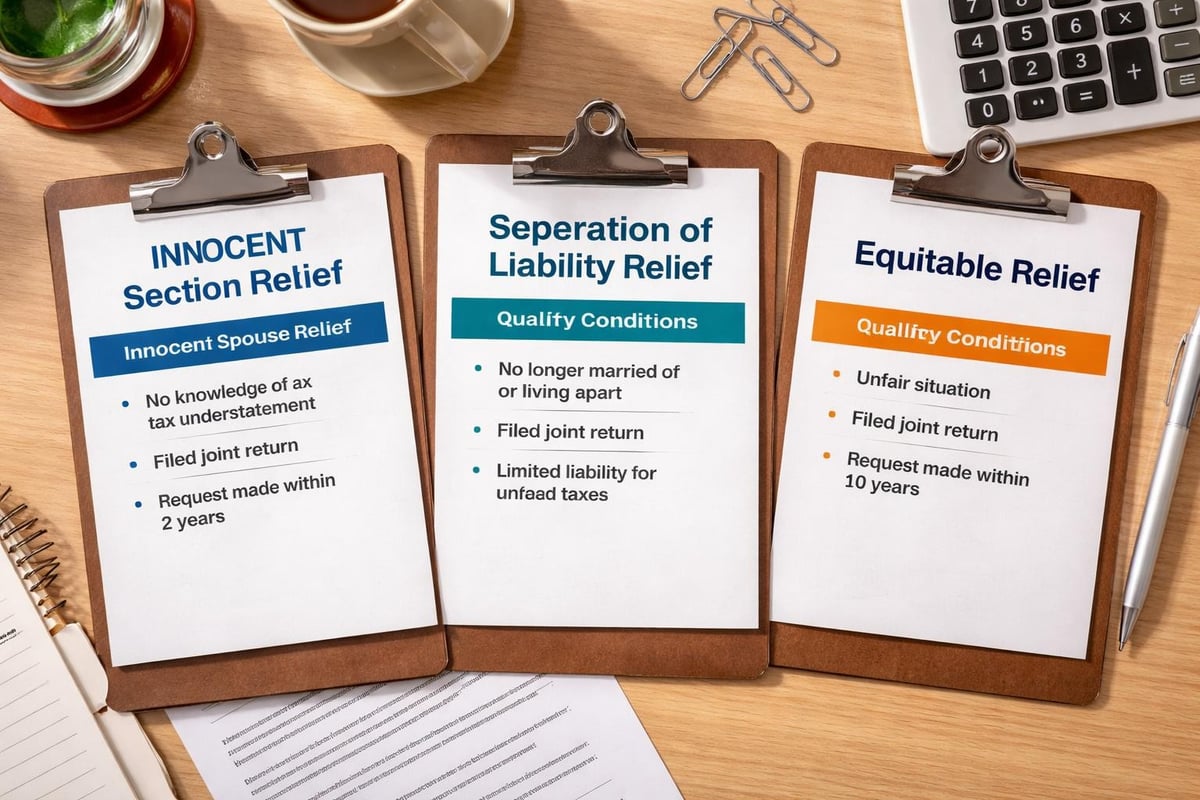
The Three Types of Relief Available Under IRC 6015
You actually have three different paths to pursue relief, and understanding which one fits your situation can make all the difference in your case outcome.
Traditional Innocent Spouse Relief
This is what most people think of when they hear the term. Traditional innocent spouse relief applies when your spouse understated tax on your joint return. Maybe they failed to report business income, claimed deductions they weren't entitled to, or inflated expenses. The IRS provides detailed guidance on innocent spouse relief eligibility that walks through specific scenarios where this type of relief applies.
The key here is the "knowledge test." You must prove you didn't know, and had no reason to know, about the understatement when you signed the return. The IRS will look at your education level, involvement in financial matters, and whether any "red flags" should have alerted you to problems.
| Relief Type | What It Covers | Key Requirement | Time Limit |
|---|---|---|---|
| Traditional Innocent Spouse | Tax understatements | No knowledge of errors | 2 years from first collection action |
| Separation of Liability | Allocates liability between spouses | Must be divorced, separated, or not living together | 2 years from first collection action |
| Equitable Relief | Unpaid tax or understatements | Doesn't qualify for other types but unfair to hold liable | 2 years from first collection action OR within time for collection |
Separation of Liability Relief
This option lets you allocate the tax debt between you and your spouse based on who actually earned the income or claimed the improper deductions. You need to be divorced, legally separated, widowed, or have lived apart for at least 12 months before applying.
Think of it this way: if your ex-spouse ran a side business and didn't report that income, separation of liability relief would assign that portion of the tax debt to them, not you. However, if the IRS can prove you knew about the unreported income, they can still hold you responsible for that portion.
Equitable Relief
Equitable relief is the catch-all option when you don't qualify for the other two types but it's still fundamentally unfair for the IRS to hold you responsible. This might apply when the tax was actually reported correctly but never paid, or when you miss the strict requirements for traditional innocent spouse relief but still deserve protection.
The IRS examines several factors when considering equitable relief, including whether you received a significant benefit from the unpaid tax, whether you've since divorced or separated from your spouse, and whether you'd face economic hardship if held liable. Understanding how to navigate complex IRS issues often requires professional guidance, especially with equitable relief cases.
How to Apply for Tax Innocent Spouse Relief
Ready to pursue relief? You'll need to file Form 8857 (Request for Innocent Spouse Relief) with the IRS. Don't let the form's seemingly simple appearance fool you. The information you provide and how you present your case can determine whether the IRS grants or denies your request.
Gathering Your Documentation
Before you even touch Form 8857, start collecting evidence that supports your claim. You'll want:
- Copies of the joint tax returns in question showing what was actually filed
- Financial records demonstrating your level of involvement (or lack thereof) in financial decisions
- Documentation of your spouse's income and activities that you weren't aware of
- Evidence of abuse or control if your spouse dominated financial matters or threatened you
- Proof of your own financial situation showing hardship if held liable
The Form 8857 instructions from the IRS provide detailed guidance on completing the application, but many taxpayers benefit from professional help given what's at stake.
What Happens After You File?
Once you submit Form 8857, the IRS will review your request and typically contact your spouse or former spouse for their side of the story. This can create awkward or even dangerous situations, especially in cases involving domestic abuse. You can request that the IRS not disclose certain information to your spouse, though this must be specifically indicated on the form.
The IRS may request additional information or schedule an interview to discuss your case. They're looking for consistency in your story and evidence that genuinely supports your claim of innocence. Processing times vary, but expect to wait several months for a determination.

Common Reasons the IRS Denies Relief
Understanding why requests get denied helps you avoid these pitfalls in your own application. The IRS rejects many tax innocent spouse relief requests, often for preventable reasons.
Knowledge or Reason to Know
This is the number one killer of innocent spouse claims. If the IRS determines you knew or should have known about the tax problem, they'll deny your request. What counts as "reason to know"? Courts have found that lavish expenditures inconsistent with reported income, your own financial sophistication, or direct involvement in the business generating unreported income can all demonstrate you should have known something was wrong.
A real-world example: A physician married to a business owner claimed she had no knowledge of her husband's unreported income. However, she had access to bank accounts, signed loan applications showing higher income than what was reported, and benefited from the unreported income through an improved lifestyle. Her relief was denied because she had "reason to know" even if she didn't have actual knowledge.
Failure to Meet Technical Requirements
Missing the two-year deadline is an automatic denial for traditional innocent spouse relief and separation of liability relief. Some taxpayers don't realize the clock is ticking or misunderstand when it starts. The deadline generally begins when the IRS takes a collection action specifically against you, such as initiating tax garnishments or filing a federal tax lien.
Other technical failures include:
- Not actually filing a joint return (you can't claim innocent spouse relief on separate returns)
- The tax debt arising from your own income or deductions, not your spouse's
- Transferring assets between you and your spouse in a fraudulent scheme to avoid taxes
Significant Benefit Received
Even if you didn't know about the tax problem, the IRS can deny relief if you significantly benefited from the unpaid taxes or understatement. What counts as a "significant benefit"? It goes beyond normal support and living expenses. Luxury items, vacations, investments in your name, or other benefits that exceeded what you would normally have enjoyed can count against you.
The IRS applies a facts-and-circumstances test here. If your spouse used the unreported income to gamble or support an addiction, and you received no benefit, that strengthens your case. If that money paid for a second home in your name or luxury cars you drove, that weakens it considerably.
Special Circumstances That Strengthen Your Case
While many factors can work against you, certain circumstances significantly improve your chances of obtaining tax innocent spouse relief.
Abuse and Spousal Control
If your spouse abused you physically, emotionally, or financially, this weighs heavily in favor of granting relief. The IRS recognizes that abuse victims may be coerced into signing returns, prevented from questioning financial matters, or threatened if they don't comply.
Documentation becomes critical here. Police reports, protective orders, medical records, or statements from counselors and domestic violence advocates can substantiate your claims. Legal guidance on complex tax matters often includes addressing these sensitive issues while protecting your rights.
Divorce or Separation
Being divorced or separated from your spouse at the time you request relief tends to support your claim, particularly for equitable relief. The IRS views you as less likely to benefit from denying relief when you're no longer together, and the unfairness of holding you liable becomes more apparent.
Additionally, if your divorce decree assigned the tax liability to your ex-spouse, while this doesn't bind the IRS, it does support your equitable relief claim by showing another legal authority recognized the unfairness of holding you liable.
Economic Hardship
Would paying the tax debt create serious financial hardship for you? This factor matters most for equitable relief claims. The IRS considers whether you'd be unable to meet basic living expenses if required to pay the debt. Supporting documentation might include:
- Current income and expense statements
- Medical bills or ongoing treatment costs
- Proof of disability or inability to work
- Evidence of other debts and financial obligations
If you're already struggling with unpaid taxes and IRS debt, demonstrating that additional liability would push you into genuine hardship strengthens your case substantially.
How Tax Innocent Spouse Relief Interacts with Other IRS Programs
You might be wondering whether pursuing innocent spouse relief affects your eligibility for other IRS resolution options. The good news is that these programs can work together, though timing and strategy matter.
Offers in Compromise
If you're granted partial innocent spouse relief but still owe some tax debt, you might qualify for an Offer in Compromise to settle your remaining tax debt for less than the full amount. The IRS will only consider your portion of the liability when evaluating your offer.
However, you generally can't have both an innocent spouse relief request and an Offer in Compromise pending simultaneously for the same tax debt. You'll need to resolve one before pursuing the other, which is why strategic planning with an experienced tax attorney becomes essential.
Payment Plans and Currently Not Collectible Status
While your innocent spouse relief request is pending, the IRS may still pursue collection. You can request a payment plan for the disputed liability or ask for Currently Not Collectible status if you can't afford payments. If your relief is ultimately granted, any payments you made may be refunded.
Keep detailed records of all payments made during the relief process. If you're granted full relief, you'll want to ensure the IRS properly credits or refunds those amounts.

What to Do If Your Request Is Denied
Receiving a denial letter from the IRS doesn't necessarily mean the end of the road. You have appeal rights that can give you a second chance at obtaining relief.
The Appeals Process
You have 30 days from the date on your denial letter to request an appeal with the IRS Office of Appeals. This gives you the opportunity to present your case to a fresh set of eyes who weren't involved in the initial determination. Many cases that were initially denied get approved on appeal.
During the appeals process, you can submit additional evidence you didn't provide initially, clarify misunderstandings, or present legal arguments about why the denial was incorrect. Having professional representation often makes a significant difference at this stage, as experienced IRS debt lawyers understand what Appeals Officers look for and how to frame arguments effectively.
Tax Court Petition
If your appeal is unsuccessful, you can petition the United States Tax Court within 90 days of the IRS's final determination. Tax Court provides a formal legal proceeding where you can challenge the IRS's decision before a judge. This represents your last opportunity to obtain judicial review of your innocent spouse claim.
Tax Court cases involve formal rules of procedure and evidence. While you can represent yourself, the complexity of innocent spouse law, as explained by the Legal Information Institute’s overview of the innocent spouse rule, makes professional representation highly advisable.
Mistakes to Avoid When Seeking Relief
After helping countless taxpayers navigate the innocent spouse relief process, certain mistakes appear repeatedly. Avoiding these can dramatically improve your chances of success.
Waiting Too Long to Apply
That two-year deadline isn't a suggestion. The IRS strictly enforces it for traditional innocent spouse relief and separation of liability relief. Many taxpayers wait years after discovering the problem, assuming they can apply whenever they're ready. By the time they file Form 8857, it's too late.
If you're even considering innocent spouse relief, file the form as soon as possible. You can always supplement your application with additional information, but you can't undo a missed deadline.
Providing Inconsistent Information
The IRS will compare what you say on Form 8857 with what's in other documents, what you told them in interviews, and what your spouse says. Inconsistencies raise red flags and damage your credibility.
Be thorough and honest in your application. If something doesn't look good for your case, explain the circumstances rather than omitting it. The IRS will likely discover it anyway, and finding out you withheld information is worse than addressing an unfavorable fact head-on.
Not Understanding What "Innocent" Really Means
Tax innocent spouse relief doesn't mean you did nothing wrong in your life or your marriage. It specifically means you didn't know about the tax understatement or unpaid taxes and shouldn't be held responsible for them. You can have been involved in other aspects of the finances, made other mistakes, or even had a contentious divorce and still qualify for relief.
What matters is your knowledge and involvement in the specific tax problems at issue. Stay focused on those facts rather than trying to prove you were perfect or that your spouse was terrible in every way.
Working with Tax Professionals on Your Case
Given the complexity of tax innocent spouse relief and the stakes involved, should you handle this yourself or hire help? While you can certainly file Form 8857 on your own, professional guidance offers significant advantages.
When Professional Help Matters Most
Consider getting professional assistance if:
- Substantial money is involved – The more you owe, the more a successful relief claim saves you
- Your case involves complex facts – Multiple tax years, business income, or sophisticated tax strategies make the analysis more complicated
- You've been denied before – Appeals and Tax Court require strategic legal arguments
- Your spouse is uncooperative or hostile – Protection of your interests becomes critical
- Time is running short – Approaching deadlines demand efficient, correct action
An experienced tax attorney understands the nuances of Publication 971 from the IRS on innocent spouse relief and how courts have interpreted the law in thousands of cases. They can identify which type of relief fits your situation, gather the strongest evidence, and present arguments that resonate with IRS examiners.
Questions to Ask Before Hiring Help
Not all tax professionals have experience with innocent spouse cases. When considering representation, ask:
- How many innocent spouse cases have you handled in the past year?
- What's your success rate with these cases?
- Will you personally handle my case or delegate it to a junior attorney or staff member?
- What's your fee structure, and what's included?
- How will you communicate with me throughout the process?
The right professional relationship can make the difference between relief and continued liability. Scheduling a tax return consultation allows you to discuss your specific situation and understand your options before committing to representation.
How Long Does the Process Take?
Patience becomes essential when pursuing tax innocent spouse relief. The IRS doesn't rush these determinations, and for good reason. They're examining complex factual situations and making decisions that permanently affect tax liability.
Typical Timelines
From filing Form 8857 to receiving an initial determination, expect six months to a year under normal circumstances. Complex cases involving multiple tax years, substantial documentation, or disputes about facts can take even longer.
If you appeal a denial, add another six to twelve months for the Appeals process. Tax Court cases can extend even longer depending on court schedules and case complexity.
During this time, collection activity may continue unless you request a Collection Due Process hearing or the IRS agrees to suspend collection. The uncertainty can be stressful, which is why having professional support throughout the process provides not just legal help but peace of mind.
Factors That Speed Up or Slow Down Your Case
Complete, well-documented initial applications move faster than bare-bones filings that require the IRS to request additional information repeatedly. Organizing your evidence, providing detailed explanations, and anticipating questions leads to quicker determinations.
Conversely, cases involving domestic abuse require additional review by specially trained IRS personnel. While this may extend the timeline slightly, it ensures your case receives appropriate consideration from reviewers who understand these sensitive situations.
Understanding your rights under tax innocent spouse relief can literally save you from decades of financial hardship caused by someone else's actions. The law recognizes that fairness sometimes requires looking beyond the joint return and evaluating each spouse's actual knowledge and responsibility. If you're facing tax debt from a joint return and believe you shouldn't be held liable, exploring your relief options is essential. With over 32 years of experience helping taxpayers resolve complex IRS problems, Law Offices of Darrin T. Mish, P.A. provides the experienced guidance you need to pursue innocent spouse relief effectively. Reach out today for a free consultation to discuss your specific situation and protect your financial future.