

There's the version of tax resolution the late-night commercials sell you. Then there's how it actually works. I'm Darrin Mish, a Tampa tax attorney. I've spent 32 years on the inside of these cases. Here's the real version.
I'm Darrin Mish. Tampa tax attorney, 32 years in, more than $100 million in IRS debt resolved. What follows isn't theory. It's what I've actually watched work.
The Automated Collection System doesn't wait for you to be ready. You get a letter, then a phone call, and suddenly you're expected to make financial decisions on the spot with a revenue officer who has your entire tax history on screen. Most people freeze, overshare, or commit to payment plans they can't actually afford. Understanding irs automated collection system phone call tips can mean the difference between manageable resolution and years of financial damage.
ACS is the IRS unit that handles straightforward collection cases. Not the big-dollar investigations, not criminal cases, just regular taxpayers who owe and haven't responded to notices. The phone calls are part of their standard protocol, and they follow scripts that give them enormous leverage if you don't know what you're doing.
What the Automated Collection System Actually Is
The IRS routes collection cases based on dollar amount, complexity, and compliance history. If you owe less than about $250,000 and your case doesn't involve fraud or extensive non-filing, you land in ACS. Cases above that threshold or with complicating factors go to Revenue Officers in the field. ACS handles everything by phone and mail from centralized call sites.
ACS revenue officers work remotely now, scattered across time zones, all accessing the same computer systems. They're trained to secure immediate payment or establish payment agreements. Their performance metrics reward closures, not taxpayer comfort.
The Taxpayer Advocate Service has documented significant service problems with IRS phone lines, including ACS. Wait times are long, callbacks are inconsistent, and you may reach different officers on subsequent calls with no continuity. That fragmentation is why documentation matters so much.

Confirming You're Actually Talking to the IRS
Scammers impersonate ACS constantly. Real IRS calls come after you've already received written notices. The IRS will never demand immediate payment via gift cards, cryptocurrency, or wire transfer. They won't threaten arrest or deportation over the phone.
When someone claims to be from ACS, ask for their name, badge number, and callback number. Hang up and verify that callback number against official IRS contact methods. Real revenue officers expect this and won't pressure you to stay on the line.
Check your recent mail. ACS sends Notice CP501, CP503, or CP504 before calling. If you haven't received any written notices, the call is almost certainly a scam. The IRS doesn't initiate contact by phone for new issues.
If the call feels wrong, it probably is. Say you need to consult a tax professional and end the conversation. You have that right, and legitimate IRS employees won't penalize you for using it.
What to Say and What Not to Say
ACS officers are skilled at extracting financial information quickly. They'll ask about your income, bank accounts, assets, and monthly expenses. Every answer you give narrows your negotiation options later. You're not required to provide detailed financial disclosure on the first call.
Here's what works: "I understand I owe. I need time to review my records and options. Can you send me written confirmation of the balance and my appeal rights?" That's it. Polite, compliant, non-committal.
What doesn't work: Volunteering that you just refinanced your home, that your spouse has a 401(k), or that you could probably scrape together $10,000 if you had to. ACS officers are trained to use your own statements against you in calculating payment capacity.
Financial Disclosure Timing
The IRS can compel financial disclosure eventually, but you control the timing on the first call. If you agree to a payment plan, you'll submit Form 433-F (Collection Information Statement). If you request an Offer in Compromise, you'll submit Form 433-A. Both require full disclosure. But you don't owe that information in a surprise phone call.
Say: "I need to gather documentation before I can discuss financials."
Don't say: "I'm broke, but I could borrow from my parents."
Don't say: "Business has been slow, but we've got $50,000 in receivables due next month."
Don't say: "My credit cards are maxed, but my credit's still good enough to get a new one."
You're handing them collection roadmaps.
Payment Plans and What ACS Will Push
ACS officers want full payment or a short installment agreement. They'll calculate what you can afford based on IRS formulas, not your actual budget. Those formulas allow for housing, food, transportation, and minimal other expenses. They don't care about your kid's braces or your student loans.
The IRS offers three main payment structures:
| Plan Type | Terms | Requirements |
|---|---|---|
| Short-term (120 days or less) | No setup fee, no formal agreement | Balance under $100,000 |
| Streamlined installment | Up to 72 months, minimal financial review | Balance under $50,000 |
| Standard installment | Longer terms, full financial disclosure | Any balance, requires Form 433-F |
ACS will push the shortest term you can theoretically afford. If their formula says you have $1,500 per month in disposable income, they'll propose a payment that clears your debt in under six years. Whether that leaves you unable to pay rent is not their concern.
You can propose a different payment amount, but you'll need to back it up with actual financials. And once you're in a payment plan, you're expected to stay current on all future tax filings and payments. One missed payment or new balance can default the entire agreement.
Requesting Alternatives to Phone Negotiations
You don't have to resolve everything on the call. If the ACS officer is pushing for immediate commitment, ask them to mail you a summary of what's owed and your payment options. You have the right to review that in writing before agreeing to anything.
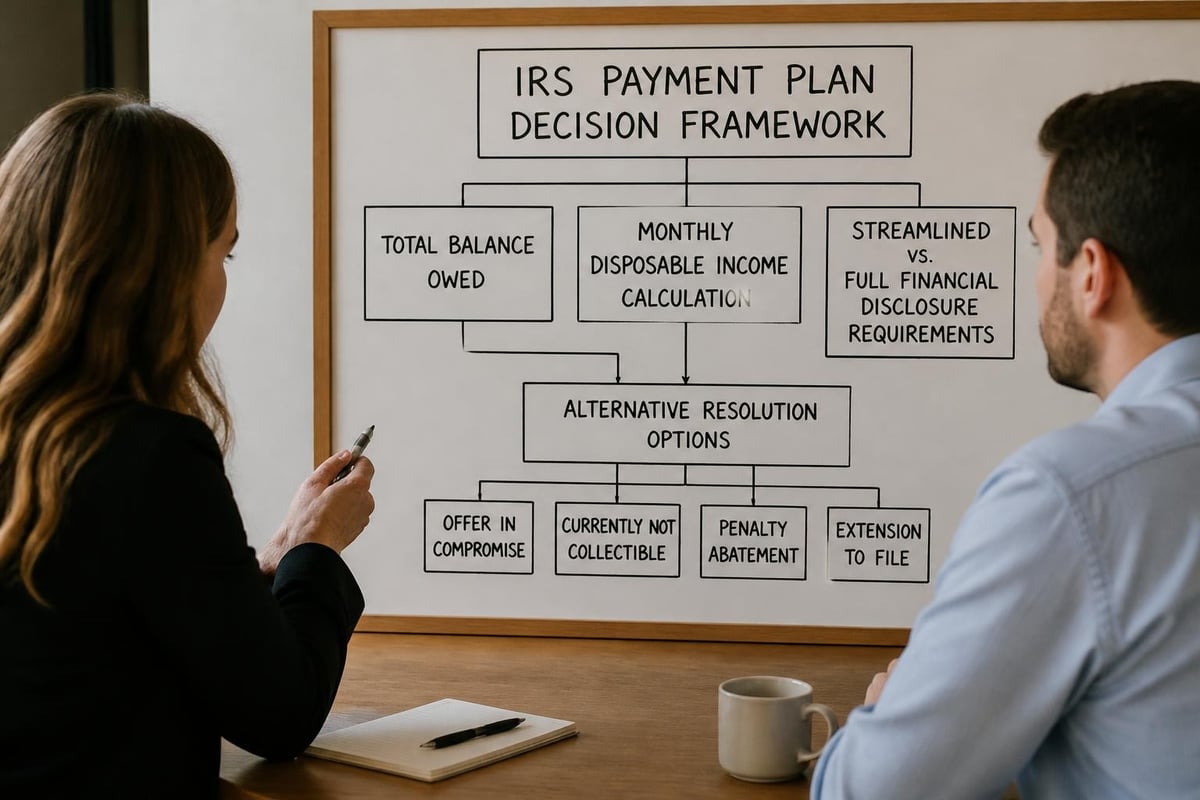
If you need more than a payment plan, if you're looking at Offers in Compromise or Currently Not Collectible status, say so. ACS can process those requests, but they'd rather lock you into payments. Tell them: "I may qualify for an Offer. I'm going to consult representation and submit the application."
That usually ends the negotiation phase of the call. They'll note your account and set a follow-up date. You've bought time without committing to payments you can't sustain.
Using a Power of Attorney to Stop the Calls
If you have a tax attorney or enrolled agent, get a Power of Attorney (Form 2848) on file immediately. Once that's processed, ACS is required to contact your representative instead of you. The calls stop.
Processing takes two to four weeks. Until then, when ACS calls, you say: "I'm represented. My attorney is [name]. You need to contact them at [number]. I'm not discussing this without my representative." They'll ask you to confirm your representative's details, note the account, and move on.
If they keep calling after your POA is on file, document it. That's a violation of your rights. The Taxpayer Advocate Service categorizes collection cases based on factors including representation status, and continued direct contact can be grounds for advocacy intervention.
Having representation also changes the tone of negotiations. ACS officers know attorneys and enrolled agents understand the rules, the timelines, and the appeals process. They're less likely to push aggressive positions that won't survive scrutiny.
Documenting Every Interaction
Write down the date, time, name, and badge number of every ACS officer you speak with. Note what they asked, what you said, and what they promised or threatened. This isn't paranoia. It's protection.
ACS officers rotate, and there's limited case continuity. The officer who told you in March that you had 60 days to submit financial documents may not be the one who calls in May threatening levy action. Your notes are your proof of what was agreed.
Keep copies of everything you mail to the IRS. Send via certified mail with return receipt. ACS loses paperwork regularly. If you can't prove you sent it, it doesn't exist in their system.
If an officer makes a statement that contradicts IRS policy, note it verbatim and verify it against the Internal Revenue Manual section on ACS procedures. You may need that documentation if you end up in Appeals or before the Taxpayer Advocate.
What to Document
- Date and time of call
- Officer's name and badge number
- Specific dollar amounts discussed
- Payment proposals made by either party
- Deadlines given
- Threats or warnings issued
- Any mention of liens, levies, or garnishments
- Follow-up actions required
This record becomes critical if you later claim the IRS didn't follow procedure or if you need to reconstruct why you made certain decisions.
When the IRS Threatens Levies or Liens
ACS can issue levies and file liens, but there's a process. You get written notice before enforcement. Notice of Federal Tax Lien (if they're filing a lien) or Final Notice of Intent to Levy (if they're seizing assets or wages). Both give you appeal rights.
If an ACS officer threatens immediate levy on the phone, ask: "When was the final notice mailed, and what's my Collection Due Process appeal deadline?" Real threats come with specific dates. Vague warnings are pressure tactics.
You have 30 days from the date of a levy notice to request a Collection Due Process hearing. That hearing pauses enforcement and gives you a chance to propose alternatives. The hearing officer is independent of ACS and can override their decisions if you present a viable resolution plan.
Liens are different. They don't seize anything, they just attach to your property and trash your credit. The IRS files liens on balances over $10,000 if you don't respond to notices. Once filed, a lien stays public record even if you later pay in full, though you can request withdrawal under certain conditions.
Levy Priorities
The IRS follows a hierarchy when choosing what to levy:
- Bank accounts (easiest, one-time grab)
- Wages (continuous income stream)
- State tax refunds (automated intercept)
- Accounts receivable (if you're self-employed)
- Real property (rare, high effort)
If ACS mentions levy, they're usually eyeing your bank account or paycheck. That's where the immediate pain lives. Real estate seizure is exceedingly rare and reserved for extreme cases with significant equity and non-responsiveness over years.
How Call Center Technology Affects Your Experience
The IRS, like many large organizations, uses technology to route and manage high call volumes. While the IRS operates its own call centers, the challenges they face-long hold times, disconnections, and inconsistent information-mirror issues in commercial call center operations. Understanding how call center outsourcing works in the private sector can give you insight into why your ACS experience may feel fragmented or impersonal.
Modern call routing systems prioritize efficiency over continuity. You rarely speak to the same officer twice. Each interaction starts from scratch unless you lead with your documentation. That's why keeping detailed notes and having a clear ask for every call matters more than building rapport with individual agents.

The Value of Professional Representation
Taxpayers who handle ACS calls alone typically end up in payment plans calculated on IRS formulas that don't account for real-world expenses. Those plans default at high rates, triggering new penalties and restarting the collection cycle. Representation changes that pattern.
An attorney can negotiate based on realistic budgets, pursue alternatives like Offers in Compromise or Currently Not Collectible status, and handle the procedural complexity while you focus on your business or job. The cost of representation is usually a fraction of what you'd lose to an unsustainable payment plan or enforced collection.
If you're dealing with unfiled tax returns, representation becomes even more critical. ACS won't negotiate seriously until you're compliant with filing. An attorney can prepare and file those returns strategically, minimizing assessed tax and positioning you for the best possible resolution.
And if your balance includes penalties, an attorney can pursue penalty abatement based on reasonable cause, first-time abatement, or procedural errors. ACS officers rarely volunteer those options. They're trained to collect what's assessed, not reduce it.
Understanding Your Collection Statute Expiration Date
The IRS has ten years from the date of assessment to collect a tax debt. That's your Collection Statute Expiration Date (CSED). After that, the debt is legally uncollectible. ACS officers know your CSED and will sometimes use it to pressure immediate payment: "You only have four years left, so we need higher monthly payments."
But the CSED can be extended by certain actions. Filing for an Offer in Compromise extends it by the time your offer is pending plus 30 days. Requesting a Collection Due Process hearing extends it by the time your case is in Appeals. Filing bankruptcy extends it by the time you're in bankruptcy plus six months.
Understanding when your CSED will expire informs your negotiation strategy. If you're close to expiration and can't afford IRS payment terms, running out the clock may be a legitimate strategy. But you need precise calculation, and ACS won't help you with that.
What Happens If You Ignore ACS Calls
Ignoring ACS doesn't make them go away. It accelerates enforcement. The calls turn into levy notices, wage garnishments, and bank seizures. Your paycheck gets reduced by 70% or more. Your bank account gets frozen. Your clients or customers receive levy notices telling them to remit your receivables directly to the IRS.
And once enforcement starts, your negotiation leverage evaporates. You're calling ACS to beg for levy release, and their starting position is: "Pay in full or prove you can't pay anything."
If you can't handle the call when it comes, at minimum, send a written response acknowledging the debt and requesting time to arrange payment or consultation. That buys you weeks and shows responsiveness, which can slow enforcement timelines.
Working with Taxpayer Advocate Service
If ACS isn't following procedure, if you're facing immediate economic hardship from their collection actions, or if you've exhausted normal channels without resolution, the Taxpayer Advocate Service (TAS) can intervene. TAS is independent within the IRS and has authority to issue Taxpayer Assistance Orders that pause collection.
You typically need to show systemic failure or significant hardship. "They're being pushy" doesn't qualify. "They're garnishing my wages and I can't pay rent" does. "I submitted financial documents three times and they keep saying they never received them" does.
TAS won't get you out of paying what you owe, but they can force ACS to follow proper procedure, give you reasonable time to respond, and consider alternatives you've proposed in good faith. They're one of the few IRS offices that actually sides with taxpayers when the system breaks down.
IRS Automated Collection System Phone Call Tips for Self-Employed Taxpayers
If you're self-employed, ACS looks at your business income and expenses differently than wage earners. They'll ask about gross receipts, cost of goods sold, and whether you're current on estimated tax payments. They'll want to see profit and loss statements, not just personal income.
The IRS allows necessary business expenses, but their definition of "necessary" is narrow. They won't accept your full marketing budget or the cost of that industry conference in Hawaii. They'll ask why you need two vehicles, whether you can downsize your office space, whether you can cut staff.
If you've been making estimated payments sporadically or not at all, that's a red flag. ACS will require you to start making quarterly payments as a condition of any installment agreement. Miss one, and the agreement defaults.
Self-employed taxpayers also face payroll tax issues more frequently, particularly trust fund penalties if they have employees. Those debts are treated more aggressively because they involve taxes withheld from employee wages. ACS doesn't negotiate lightly on trust fund recovery penalties, and personal liability follows you even through bankruptcy in many cases.
Knowing When to Stop Talking and Call an Attorney
You've crossed into attorney territory when:
- ACS mentions criminal investigation or fraud
- The balance is over $50,000
- You have unfiled returns for multiple years
- You're facing immediate levy or garnishment
- You disagree with the assessed amount
- You need Currently Not Collectible status or an Offer in Compromise
- You're considering bankruptcy for tax problems
At that point, every word you say to ACS can hurt you. Stop talking. Get representation. Let someone who deals with this daily handle the negotiation.
Even if your case seems straightforward, if you feel overwhelmed or unsure, consultation costs nothing and could save you years of bad payments. The IRS counts on taxpayer anxiety to drive fast, unfavorable agreements. Representation disrupts that.
Most irs automated collection system phone call tips boil down to this: document everything, commit to nothing immediately, and know when you're out of your depth. The IRS builds these systems to pressure you into decisions that favor collection speed over taxpayer sustainability. For 32 years, I've watched taxpayers dig themselves into payment plans they can't keep and enforcement actions they didn't have to face. If you're staring at ACS calls and notices, let's talk. The Law Offices of Darrin T. Mish, P.A. handles these cases nationwide, and the first conversation is free.