

I'm Darrin Mish. For 32 years I've practiced federal tax litigation — routine audits, Tax Court cases, and everything in between. If you're facing an IRS issue, here's what you need to know first.
Tax attorney Darrin Mish put this one-page guide together from official sources. Save it, print it or share it with someone who needs it.
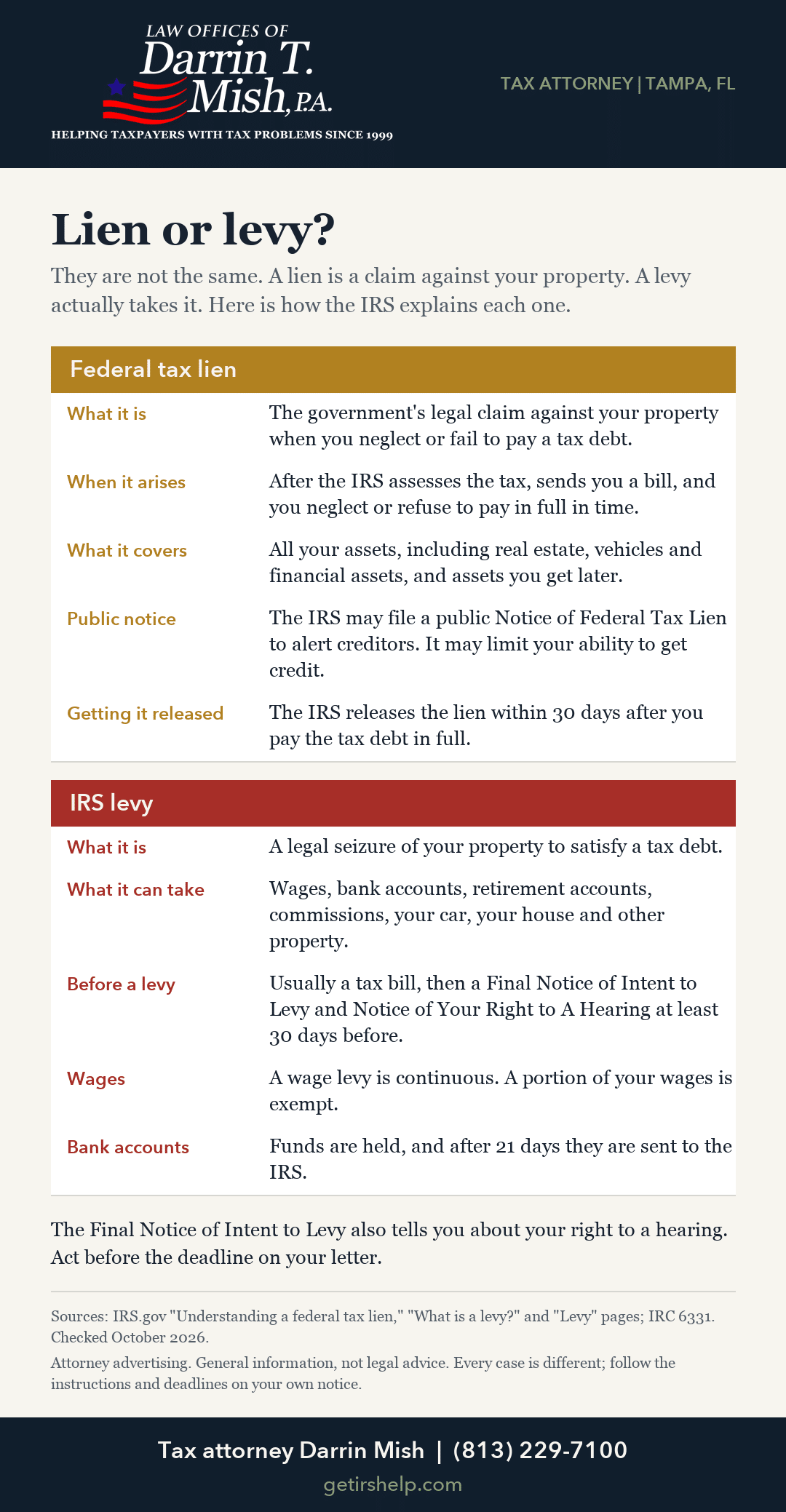
What the infographic says
Lien or levy? They are not the same. A lien is a claim against your property. A levy actually takes it. Here is how the IRS explains each one.
Federal tax lien
- What it is: The government's legal claim against your property when you neglect or fail to pay a tax debt.
- When it arises: After the IRS assesses the tax, sends you a bill, and you neglect or refuse to pay in full in time.
- What it covers: All your assets, including real estate, vehicles and financial assets, and assets you get later.
- Public notice: The IRS may file a public Notice of Federal Tax Lien to alert creditors. It may limit your ability to get credit.
- Getting it released: The IRS releases the lien within 30 days after you pay the tax debt in full.
IRS levy
- What it is: A legal seizure of your property to satisfy a tax debt.
- What it can take: Wages, bank accounts, retirement accounts, commissions, your car, your house and other property.
- Before a levy: Usually a tax bill, then a Final Notice of Intent to Levy and Notice of Your Right to A Hearing at least 30 days before.
- Wages: A wage levy is continuous. A portion of your wages is exempt.
- Bank accounts: Funds are held, and after 21 days they are sent to the IRS.
The Final Notice of Intent to Levy also tells you about your right to a hearing. Act before the deadline on your letter.
Sources
- https://www.irs.gov/businesses/small-businesses-self-employed/understanding-a-federal-tax-lien
- https://www.irs.gov/businesses/small-businesses-self-employed/what-is-a-levy
- https://www.irs.gov/businesses/small-businesses-self-employed/levy
Checked October 2026.
If you have a question about your own situation, call tax attorney Darrin Mish at (813) 229-7100.
Attorney advertising. General information, not legal advice. Every case is different; follow the instructions and deadlines on your own notice.