

If you're reading this, something about your tax situation has you worried. That's fair — the IRS is intimidating until you know how the rules actually work. I'm Darrin Mish, a Tampa tax attorney. I've handled cases like yours for 32 years. Let me walk you through it.
I'm Darrin Mish. Tampa tax attorney, 32 years in, more than $100 million in IRS debt resolved. What follows isn't theory. It's what I've actually watched work.
An IRS CP2100 notice means you filed information returns, usually 1099s, with names and taxpayer ID numbers that don't match IRS records. If you got an IRS CP2100 B notice backup withholding letter, you now have a short window to contact each listed payee and start withholding 24% if they don't fix the problem. Ignore it and the withholding becomes your bill, not theirs.
Stay calm. This notice is about paperwork errors, not an audit of you. But the deadlines are real, and missing them gets expensive.
What Is a CP2100 Notice?
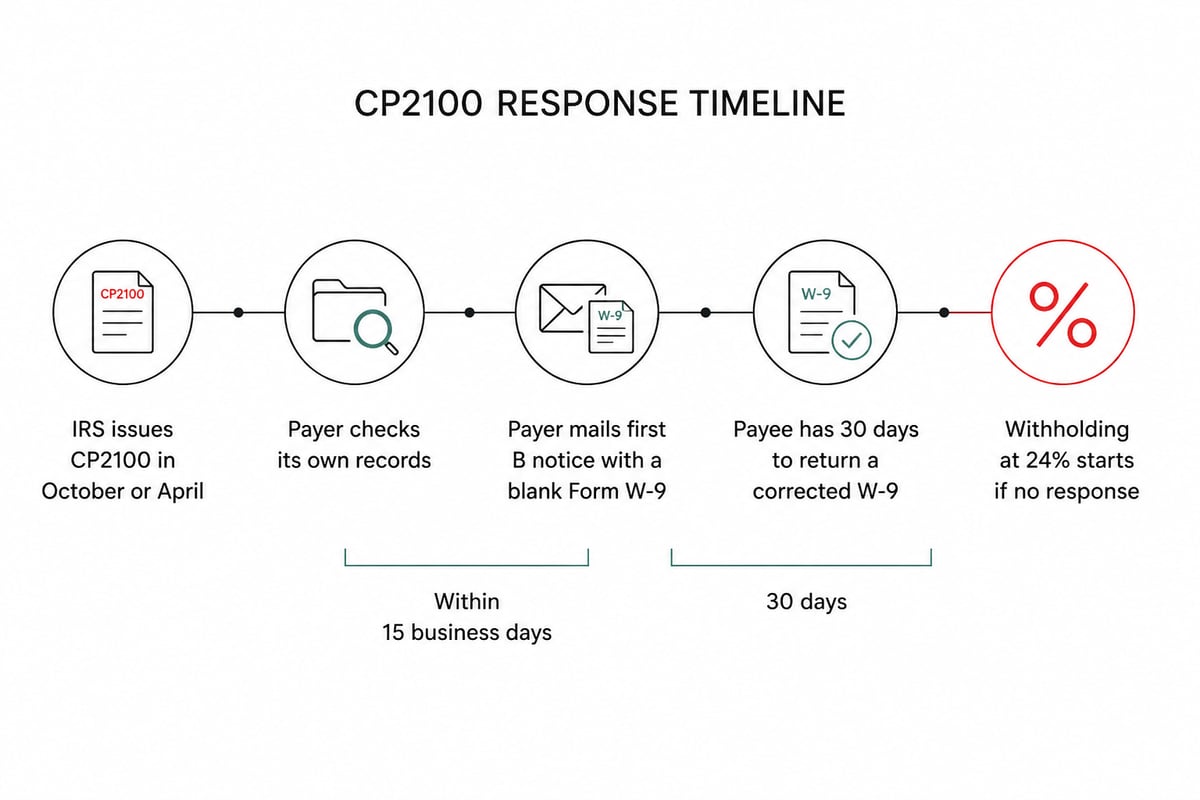
A CP2100 is a notice the IRS sends to a payer, meaning a business or individual who filed information returns, listing payees whose name and taxpayer identification number (TIN) don't match IRS records. The IRS sends CP2100 and CP2100A notices twice a year, in October and the following April, according to the IRS explanation of these notices.
You'll see two versions. The difference matters.
- CP2100: Sent to filers with 50 or more information returns containing errors, per the IRS Backup Withholding B program page. It comes with a printed list of mismatched payees.
- CP2100A: Sent to filers with fewer than 50 errors. The IRS doesn't send a list this way. You get a notice telling you the same job needs doing.
Either way, the instruction is the same. Fix the mismatches or start withholding.
The notice is not a penalty. It's a trigger. What you do in the next several weeks decides whether it stays a clerical chore or turns into a liability.
What Is Backup Withholding According to the IRS?
Backup withholding is a flat 24% of certain payments that a payer must hold back and send to the IRS when the payee hasn't given a correct TIN or the IRS says the TIN is wrong. The 24% rate applies to payments made to a payee subject to withholding, as the IRS describes it.
It covers more than most people expect:
- Payments to independent contractors on Form 1099-NEC
- Interest and dividends
- Rents, royalties, and prizes
- Payment card and third-party network transactions reported on Form 1099-K
Think of it as the IRS making sure income gets taxed somewhere. If a payee's identity can't be matched, the government wants a deposit up front.
The withholding comes out of the payee's payment. But the legal duty to collect it and send it in sits with you.
What a B Notice Is and Why the IRS Cares
A B notice is the letter you send to a payee after the IRS tells you their name and TIN don't match; it is the payer's required step under the backup withholding rules. The notice you received from the IRS is the CP2100. The notice you send out is the B notice. Mixing those up is the most common mistake I see.
The IRS has procedures for the first and second B notice, and the Internal Revenue Manual lays out the timing and mechanics. You don't need to memorize it. You do need to understand that it's a sequence with deadlines, and each step has to happen on time.
Here's why the IRS cares. Every unmatched 1099 is income it can't tie to a taxpayer. Backup withholding is its fallback.
How Do I Respond to an IRS CP2100 B Notice for Backup Withholding?
Respond by checking your records against the list, mailing a first B notice with a blank Form W-9 to each payee who still has a real mismatch, and starting 24% withholding if the payee doesn't send back a signed W-9 in time. Work through it in this order.
- Compare the list to your own files. Many mismatches are typos on your end. A transposed digit in a TIN or a missing suffix on a business name is common. If your records show a correct name and TIN that you simply entered wrong with the IRS, fix it and move on.
- Look for payees who have already sent you a W-9. If the signed Form W-9 on file has a different TIN than what you reported, correct it going forward and document it.
- Mail the first B notice. For each remaining payee, send a copy of the notice language and a blank Form W-9. Send it promptly after receiving the CP2100, since the timing is tight and missing it creates problems.
- Calendar the response window. The payee gets 30 calendar days to return a signed W-9 with a correct name and TIN.
- Start withholding if they don't respond. Begin withholding once the response window closes without a valid W-9, and keep going until they fix it.
Keep copies of every mailing, with dates. If the IRS ever questions you, that file is your defense.
Certified mail isn't required for the first B notice. I still like proof of mailing.
When Backup Withholding Actually Starts
Backup withholding starts when the payee fails to return a signed Form W-9 after a first B notice, or when the IRS tells you the payee is under the second B notice rules. The rate is 24% of each reportable payment from that point forward.
Practically, that means a contractor you pay $5,000 gets $3,800, and you send $1,200 to the IRS. You report what you collected on Form 945, Annual Return of Withheld Federal Income Tax, as the IRS directs. Deposit it on schedule, using the same system you use for other federal tax deposits.
You also give the payee the paperwork showing how much was withheld, so they can claim credit on their own return.
Stop withholding only when the payee provides a certified correct TIN. A promise over the phone doesn't count.
The Second B Notice Is a Different Animal
A second B notice applies when a payee you already notified shows up on another CP2100 within three calendar years. The rules get stricter, and the payee can't simply send a new W-9 to make it go away.
For a second notice, the payee generally must provide proof of the correct name and number, such as a Social Security Administration letter for an SSN or an IRS letter for an EIN. A Form W-9 alone won't do it.
You can't accept a fresh W-9 and call it done. That tends to catch small-business payers off guard.
If the payee cannot produce proof, you keep withholding. It's unpleasant for the payee, but the rule leaves you no discretion.

What Happens If You Ignore the Notice
If you ignore a CP2100 B notice and skip the withholding, the IRS can hold you liable for the tax you should have withheld. That is the real exposure. You may owe the 24% out of your own pocket, plus penalties and interest.
Here's the logic. The law treats the payer as the responsible party for collecting backup withholding. The payee never gave you the money, but you never took it from them either. The IRS doesn't much care. It wants the deposit.
There are also information-return penalties for incorrect TINs, and they stack by return. A payer with a long list of bad 1099s can find the numbers adding up fast.
Payers who get pulled into this often end up with a bigger problem, an unpaid balance with the IRS. If you've reached the point of balances and collection letters, our guide on what happens if you ignore an IRS CP504 notice shows where the path leads. The IRS has easier ways to collect. Liens, levies, bank account seizures. Better to deal with it now.
Common Mistakes Payers Make With This Notice
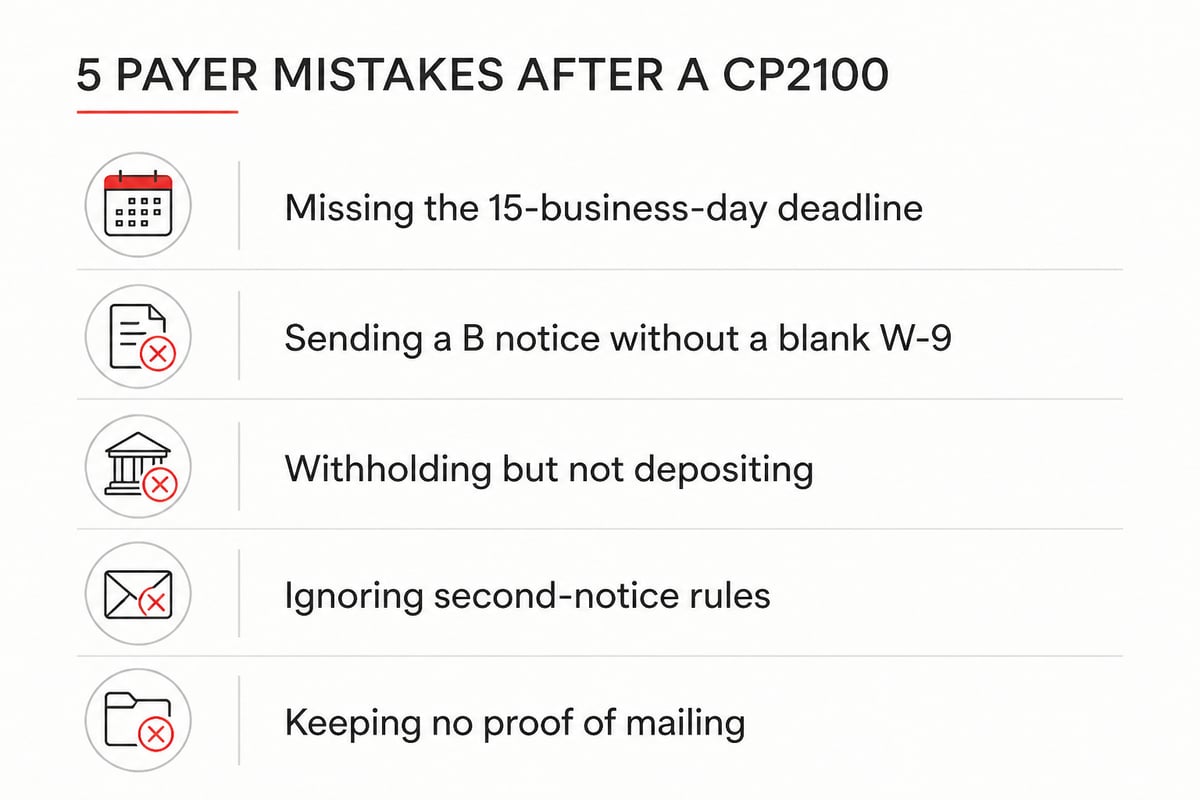
Most payers get hurt by process mistakes, not by the original mismatch. These are the ones I see most.
- Treating the CP2100 as a payee problem. It's addressed to you because you carry the compliance duty.
- Sending the B notice without a blank W-9. The payee needs the form to fix the record.
- Missing the 15-business-day mark. Pushing it back a week feels harmless. It isn't.
- Withholding but not depositing. Money you collected for backup withholding belongs to the IRS. Using it for payroll or operating costs creates a separate, worse problem.
- Forgetting the second-notice rules. A W-9 won't clear a repeat offender.
- Not keeping proof. If you can't show the mailing date, you can't show you met the deadline.
Withholding mistakes can also invite scrutiny. The IRS cross-checks deposits against Form 945, and a pattern of errors tends to get noticed. If you've never looked at how this intersects with other filings, our piece on withholding tax and what it is covers the basics.
How to Keep the Next CP2100 From Arriving
You can prevent most CP2100 notices by collecting a signed Form W-9 before the first payment and checking the name and TIN against it every time you file. It's boring, and it works.
- Get the W-9 first. No W-9, no check. Make it part of onboarding for every contractor and vendor.
- Use the TIN Matching Program. Registered payers can check names and TINs against IRS records before filing. Mismatches caught in advance are mismatches you never have to chase.
- Match legal names exactly. A contractor's trade name belongs in one box and the legal name in another. Mixing them is a classic source of errors.
- Update records yearly. People marry, businesses change entities, and numbers get reissued.
- File accurately and on time. Corrections go on a corrected return, not a new one.
Sloppy payer files rarely stay sloppy in one place. If your 1099s have errors, your payroll and deposit records deserve a second look too. Our article on how to handle IRS notices walks through a sensible first-response routine.
When a CP2100 Turns Into a Bigger Tax Problem
A CP2100 turns serious when you've already missed the withholding window and the IRS starts assessing the tax against you. That's the point where it stops being a clerical task and becomes a balance due.
Expect this sequence: a notice assessing the amount, then demand letters, then collection steps if you don't respond. Our IRS collection notice sequence breakdown shows how fast those escalate. Unpaid backup withholding is treated like payroll-type tax debt, and the IRS takes it seriously because the money was supposed to be held for the government.
If you're in that position, the options look like any other tax debt. Depending on your finances, a payment plan, an Offer in Compromise, or penalty relief may apply. The firm's IRS Tax Debt Resolution work covers installment agreements, Offers in Compromise, and currently not collectible status for exactly this kind of balance. For a second perspective on how resolution firms approach these cases, CLAW Tax Group also handles payer and payee tax debt matters.
Attorney-client privilege matters here. Conversations with a tax attorney are protected, and conversations with a return preparer generally are not. If there's any chance the IRS thinks you knowingly skipped the withholding, that difference can matter a great deal.
Can I Track Anything Online, or Speak to a Live Person at the IRS?
You can't track a CP2100 response online the way you'd track a refund. The notice isn't a refund or a case with a status page. Your proof lives in your own mailing records and your Form 945 deposits.
Reaching a live person is the hard part. The phone number on the notice is the right place to start, and the IRS phone lines are often slow. Call early in the morning, have the notice in front of you, and keep the call to the payer-side questions. Do not discuss anything beyond what you're prepared to document. If a call starts drifting toward your wider tax history, stop and get advice first.
If a payee is the one disputing the mismatch, the fix is a corrected W-9 from them, not a call from you to the IRS. You can't resolve a payee's identity issue on their behalf.
FAQ
Is a CP2100 notice the same as a CP2000?
No. A CP2100 is about mismatched names and TINs on information returns you filed, and the problem sits with payees. A CP2000 proposes changes to a tax return based on income the IRS says you didn't report. Our guide on getting a CP2000 notice explains that one.
Do I have to withhold if the payee says the IRS is wrong?
Not yet, if you're still inside the response window and the payee returns a signed W-9 with a correct name and TIN. After the window closes without a valid W-9, you have to begin 24% withholding. A payee's disagreement with the IRS doesn't pause your duty.
How long do I keep the records?
Keep copies of the CP2100, your B notices, mailing proof, signed W-9s, and Form 945 deposits for several years. Longer is fine.
Pull your CP2100 out today, check the date on it, and count 15 business days forward on a calendar before you do anything else. If the clock has already run out, or if the IRS has started billing you for the 24% you didn't withhold, Law Offices of Darrin T. Mish, P.A. is the place to talk it through, and a free consultation means you can find out where you stand before you spend a dollar. Our IRS Tax Debt Resolution work covers payment plans and settlements when a payer ends up with the balance, and once you retain the firm, all communications with the IRS go through us. Let's talk, and we'll get you an answer you can act on.