

The tax-relief industry loves to make IRS problems sound impossible without them. They're not. I'm Darrin Mish. I've been representing taxpayers before the IRS for 32 years. Let me explain how this actually works.
I'm Darrin Mish. Tampa tax attorney, 32 years in, and I've resolved IRS debt for clients across the country. What follows isn't theory. It's what I've actually watched work.
An IRS CP63 notice means the IRS is holding your refund because its records show you haven't filed one or more required returns. The refund stays frozen until you file the missing return or prove you didn't need to. With an irs cp63 refund held unfiled returns situation, the fix is usually simple, but the clock matters, and the way you respond matters more.
What Does a CP63 Notice Actually Mean?
A CP63 notice means the IRS has stopped your current refund because it believes you have at least one past-due return and may owe additional tax. According to the IRS explanation of the CP63 notice, the agency holds the refund because its records show one or more unfiled returns and it believes tax may be owed on them.
Read that again. The IRS isn't saying you owe money. It's saying it thinks you might, and it's keeping your money as leverage until the question is answered.
The notice is not a bill. It is not a levy. It's a hold, and a hold can be lifted.
Here's how the IRS usually gets there. Your employers, banks, brokers and clients send the IRS W-2s, 1099s and similar forms under your Social Security number. The IRS matches those documents against the returns you filed. When income shows up for a year and no return does, the system flags it. Then you file a new return claiming a refund, and the system stops it cold.
Why the IRS Holds a Refund Over Unfiled Returns
The IRS holds the refund because it would rather resolve the missing return than send you money while a possible balance sits unreported. The agency's internal guidance, the Internal Revenue Manual, describes holds involving an unfiled return within the five years before the current tax year when third-party income information exists and the account carries a specified liability indicator.
Translate that into plain English. The IRS can see income reported about you, no return to match it, and a flag on your account. That combination triggers the freeze.
Several situations commonly produce a CP63:
- You skipped a return years ago and never caught up.
- You filed, but the IRS never processed it or lost it.
- You mailed a paper return that crossed with the notice.
- Someone reported income under your Social Security number that you don't recognize.
- You weren't required to file for that year, but the IRS doesn't know that yet.
Notice that the last three have nothing to do with you dodging anything. Mistakes and identity problems trigger this too. Don't assume the notice means the IRS thinks you're a criminal. It doesn't. It means a computer found a gap.
What an IRS CP63 Refund Held for Unfiled Returns Means for Your Money
When the IRS holds a refund for unfiled returns, your refund stays frozen until the missing return or an explanation reaches the IRS, and the IRS may apply some or all of it to tax you owe. The IRS says the refund remains on hold until it receives all past-due returns or an explanation showing you weren't required to file.
Then comes the part that surprises people. If the return you file shows tax due, the IRS may use all or part of the held refund to pay that balance. If you can't pay the rest in full, the IRS notes you may qualify for an online payment plan.
So the refund isn't always lost. It's often redirected. Say you're owed $3,200 this year and the old return you file shows $2,000 due. The IRS keeps $2,000, and you get $1,200 plus a smaller balance problem than you feared.
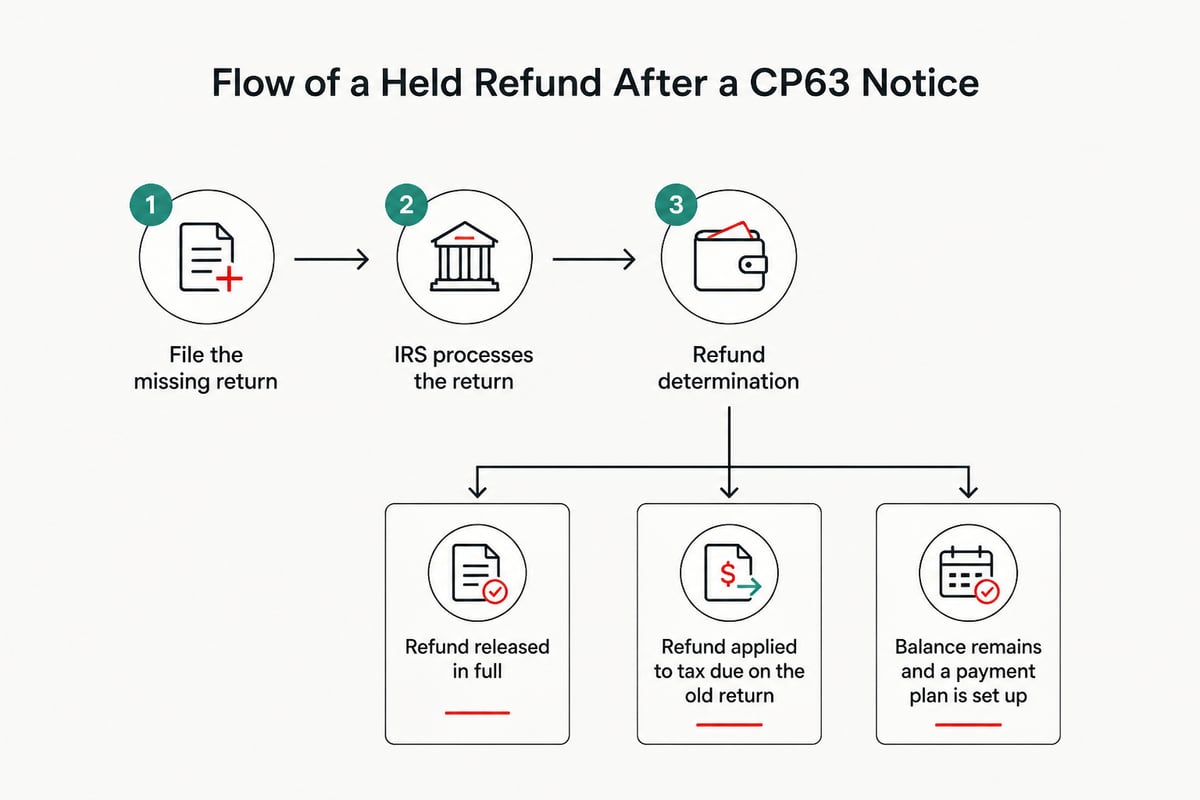
There's a flip side. If the old return shows you owed nothing, or even that you're owed a refund too, the hold lifts and everything gets paid. I've seen clients dread a CP63 for months and then discover the missing year was a net zero. That's the most common good outcome, and you only find it by filing.
How Long Does the IRS Hold the Refund?
The IRS holds the refund until you resolve the unfiled return, and the Internal Revenue Manual says it may release the refund automatically if the unfiled-return issue isn't resolved within six months of the refund return's filing date or due date, whichever is later. That language comes from IRS internal processing guidance, and it is not a promise to you.
Don't plan around it. That six-month figure describes how a system is supposed to behave, not a guaranteed release date for your case. Cases get stuck, notices get lost, and a hold can run well past six months.
What I tell clients: assume the refund stays frozen until you act. If it releases on its own, treat that as a bonus, not a strategy. And a release doesn't make the unfiled year disappear. The IRS still has the gap in its records, and it will keep chasing it.
What to Do When You Get a CP63
Respond promptly, start by checking whether you already filed, and match your action to which of four situations you're in. The IRS tells taxpayers to file the missing return or explain why you filed late, weren't required to file, or already filed. Here's how I walk people through it:
- Read the notice for the tax years listed. The CP63 names the specific year or years the IRS says are missing. Don't guess.
- Check your own records. Pull your copies, your e-file confirmations, and your IRS online account transcripts for those years.
- If you already filed, check the timing. Per the IRS, if you filed within the last eight weeks, no action is needed. If more than eight weeks have passed, or you disagree with the notice, call the number on the notice or write to the address on it.
- If you didn't file and were required to, file now. Prepare accurate returns for each missing year and send them to the address on the notice.
- If you weren't required to file, say so in writing. Explain why, such as income below the filing threshold, and include any proof.
- Keep proof of everything. Certified mail receipts, fax confirmations, e-file acknowledgments. Keep them.
One caution. Do not file rushed returns just to make the notice go away. A return with guessed numbers can create a bigger problem than the one you're solving. Get your income documents first. If you need them, request wage and income transcripts from the IRS, which show what third parties reported under your Social Security number.
If you're staring at several missing years, our unfiled tax return preparation service handles back filing and voluntary disclosure, so the returns go in accurate and in the right order.

Filing Late, Missing Records, and Old Years
You can file late returns without perfect records, and the IRS does not require you to have every document before you start. It does expect the returns to be honest and complete, and transcripts fill most gaps.
Missing a W-2 from an employer that closed? The wage and income transcript shows what that employer reported. Missing business records? You can reconstruct income and expenses from bank statements, invoices and credit card records. It takes work. It's still doable.
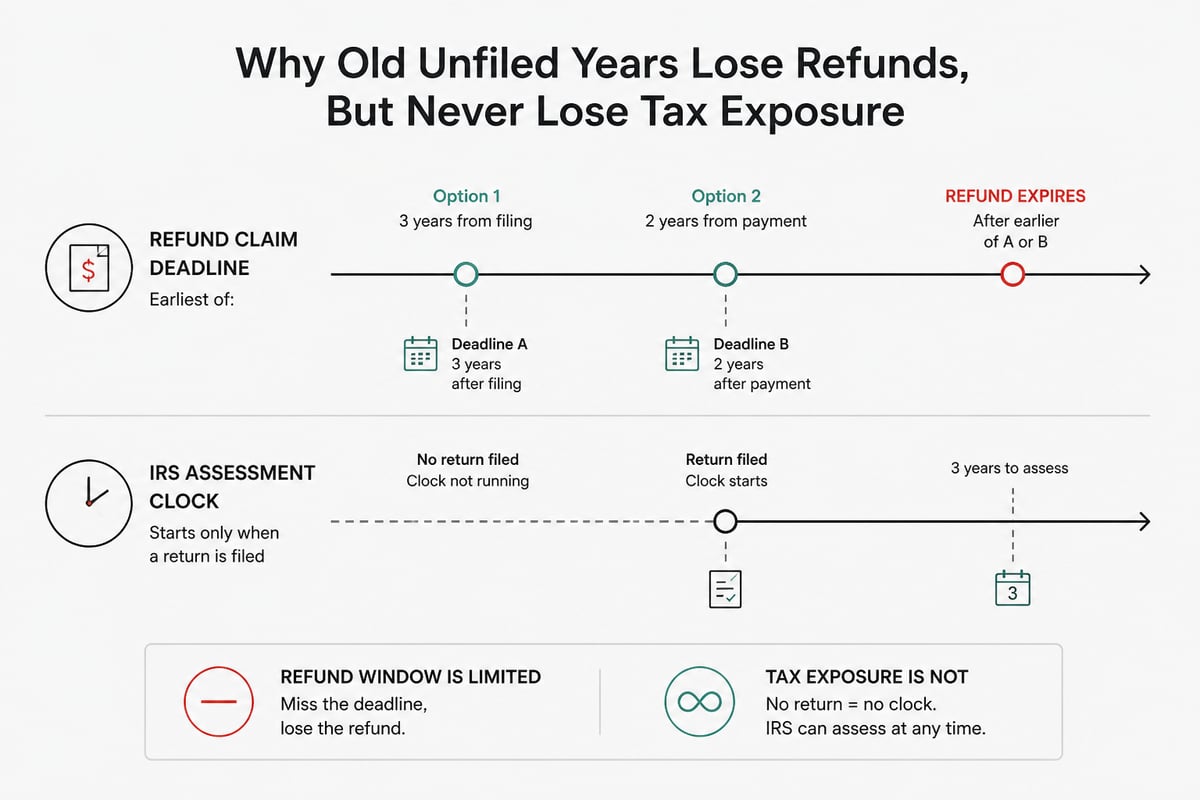
How far back does this go? For enforcement purposes, the IRS generally focuses on the last six years of non-filing, and we cover that in detail in our guide to the statute of limitations on unfiled tax returns. Be careful with that, though. There is no statute of limitations that protects you when a return was never filed. The assessment clock doesn't start until a return is filed.
Refunds work differently from balances, and they carry a deadline. A federal income tax refund claim is generally due by the later of three years from filing the return or two years from paying the tax, with special exceptions. If a missing year would have produced a refund and you wait too long, that money can expire. A CP63 tied to an old year can be a signal to move before a refund window closes.
What Happens If You Ignore a CP63
If you ignore a CP63, the refund stays frozen, and the IRS can move on to calculating your tax for you. The IRS describes that next step in its explanation of the CP2566R notice, which covers what may happen after a CP63 if the IRS doesn't receive a response, including an IRS-calculated tax assessment and ways to respond.
That IRS-calculated number is the problem. When the IRS builds a return for you, it uses only the income third parties reported. It gives you no deductions beyond the standard ones, no business expenses, no credits you didn't claim, and the least favorable filing status available. The result is almost always higher than what you'd owe if you filed yourself.
The IRS also sends other past-due return notices beyond the CP63. Ignore those too and you can move toward penalties, interest, and eventually collection action like liens, levies and wage garnishments.
The IRS has easier ways to collect than to chase a stubborn non-filer. But easy doesn't mean gentle. Penalties for failure to file and failure to pay build every month, and interest compounds on top. A year of delay costs real money.
When a CP63 Calls for an Attorney
A CP63 calls for a tax attorney when you have multiple missing years, a possible large balance, business income, foreign accounts, or any worry about how the IRS reads your history. A single missing W-2 year with a small refund? Plenty of people handle that alone.
Here's where the line falls:
- Several years unfiled. The order and presentation of back returns matters.
- Self-employment or business income. Reconstructing records is harder and the stakes are higher.
- Income you can't explain. That can point to identity theft or an employer error.
- A balance you can't pay. You'll want a plan before the returns hit, not after.
- Anything that feels like it could look willful. Talk to counsel before you file, not after.
One more difference matters. What you tell an attorney is protected by attorney-client privilege. What you tell a CPA generally is not. If your unfiled years involve facts you'd rather not hand to the IRS, that protection counts. Once the firm is retained, all communications with the IRS go through us, which keeps you off the phone with an agent who is reading your file while you improvise.
You can also read our broader walkthrough on what to do about unfiled tax returns, and see how our unfiled tax returns practice approaches back filing in practice.
Frequently Asked Questions
Is a CP63 notice a bill?
No. A CP63 is a refund hold notice, not a balance due. Any tax owed comes only after the missing return is filed or the IRS calculates it for you.
Will I get my refund back if I file the missing return?
Often yes, but not always in full. If the return you file shows tax due, the IRS may apply the held refund to that amount before sending you the difference.
What if I already filed the return the notice mentions?
Check the timing. If you filed within the last eight weeks, the IRS says no action is needed. After eight weeks, call the number on the notice or write to the address listed, and have proof of filing ready.
Can I just ignore it if the refund is small?
You can, but you shouldn't. The unfiled return stays on your record, penalties and interest keep running on any tax due, and the IRS may calculate a worse number for you. A small refund doesn't make the underlying problem small.
How far back should I file?
Start with the years named in the notice, then review whether other years are unfiled. Compliance is usually measured over the most recent six years, but the right answer depends on your income and history, which is where counsel earns the fee.
Pull your IRS online account transcripts today and write down every year the CP63 lists, because that list is your starting map. If those years need back filing, our unfiled tax return preparation service handles the returns and any voluntary disclosure, and the Law Offices of Darrin T. Mish, P.A. has the ratings to back that work, including an Avvo rating of 9.9 and a Martindale-Hubbell AV Preeminent rating. Let's talk, and the Law Offices of Darrin T. Mish, P.A. will give you a free, no-obligation read on where you stand and what comes next.