

IRS problems aren't as complicated as they look once you see the structure. I'm attorney Darrin Mish. I've represented taxpayers before the IRS for three decades — in Florida, Colorado, Texas, and internationally. Here's the plain-English breakdown.
I'm Darrin Mish. Tampa tax attorney, 32 years in, more than $100 million in IRS debt resolved. What follows isn't theory. It's what I've actually watched work.
Can the IRS take my inheritance? Yes, if you owe back taxes, the IRS can reach inherited money once it becomes yours. It can also reach it earlier in one narrow situation: if the person who died owed the IRS, the estate pays that debt before you see a dollar. The inheritance isn't off limits. But collection takes steps, and you have time to act.
Does the IRS Tax an Inheritance Itself?
Generally, no. The IRS says an inheritance isn't included in your gross income, so you generally don't report the cash or property you receive as income on your return. You can read the IRS explanation of gifts and inheritances directly.
There's a catch worth knowing. Income the inherited property produces later, such as interest on an account or rent from a house, can be taxable to you. The inheritance is clean. The earnings afterward are not.
Federal estate tax is a separate animal. It's charged to the estate, not to you, and only when the estate is large enough. An estate generally has to file Form 706 when the decedent's gross estate, adjusted taxable gifts, and specific gift-tax exemption exceed the filing threshold for the year of death, per the IRS estate tax FAQ. Most families never hit it.
When Can the IRS Take Your Inheritance?
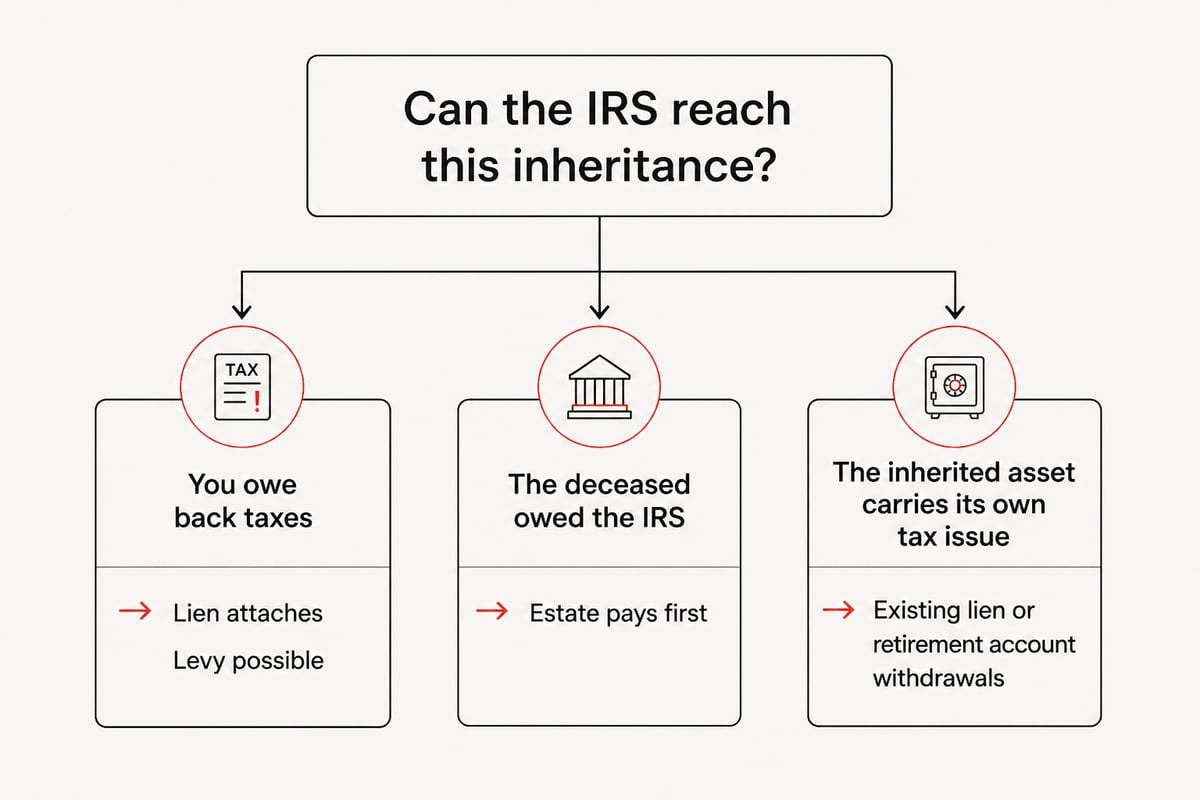
The IRS can take an inheritance in three situations: you owe it money, the decedent owed it money, or you inherited an asset that carries its own tax problem.
Here is how each one plays out.
- You owe back taxes. Once the money lands in your name, it's just another asset. A federal tax lien attaches to everything you own and everything you later acquire, and an inheritance is something you later acquire.
- The decedent owed the IRS. Unpaid income tax, penalties, and interest are debts of the estate. The executor has to pay them before distributing to heirs. Pay out first and the executor can end up personally liable.
- The asset itself is the problem. Inherited property with an existing federal lien, or an inherited retirement account that triggers income tax when you withdraw, creates a bill you didn't expect.
That first situation is the one most readers worry about, and it's the one with the most room to maneuver. The IRS has easier ways to collect. Liens, levies, wage garnishments. A seizure of your inheritance is possible but it isn't the first move.
What Happens If You Owe Back Taxes and Inherit Money?
If you owe the IRS and inherit money, the IRS can file a lien and, after proper notice, levy the funds, usually by taking them from your bank account once the money arrives.
The sequence matters. The IRS sends a bill, then a series of notices, and before a levy it generally has to issue a Final Notice of Intent to Levy and give you the right to a hearing. Those notices exist whether or not you've inherited anything. An inheritance doesn't speed up the paperwork. It does make you a more attractive target, because the IRS's collection system looks for assets, and a fresh deposit is one.
You can read more on how that works for accounts in our guide on whether the IRS can take money from your bank account. The short version: a levy on a bank account freezes what's there at that moment, and the funds are released to the IRS after a waiting period.
Timing is your friend. If you know a payout is coming and you owe back taxes, the worst move is to say nothing and hope the IRS doesn't notice.
Does the IRS Know If You Get an Inheritance?
Not automatically, but there are several ways it finds out.
The IRS doesn't get a notice when a check from an estate clears. Here's where it can learn about it:
- The estate files a return. A large estate files Form 706, and the executor reports beneficiaries on certain forms.
- Income from inherited assets. Interest, dividends, and rental income get reported to the IRS on 1099s under your Social Security number.
- A sale. When you sell inherited property, you have to figure out its basis to calculate any gain or loss, and the sale itself is reported.
- A lien search or asset review. If you already have an open collection case, a revenue officer can look at your finances, deposits, and property records.
- Foreign money. If the inheritance comes from abroad, reporting rules can apply. See our post on reporting a foreign inheritance.
Don't assume you're invisible. Don't assume you're being watched, either. Just don't lie on a financial statement. That turns a collectible debt into a criminal problem.
What Is the First Thing You Should Do When You Inherit Money?
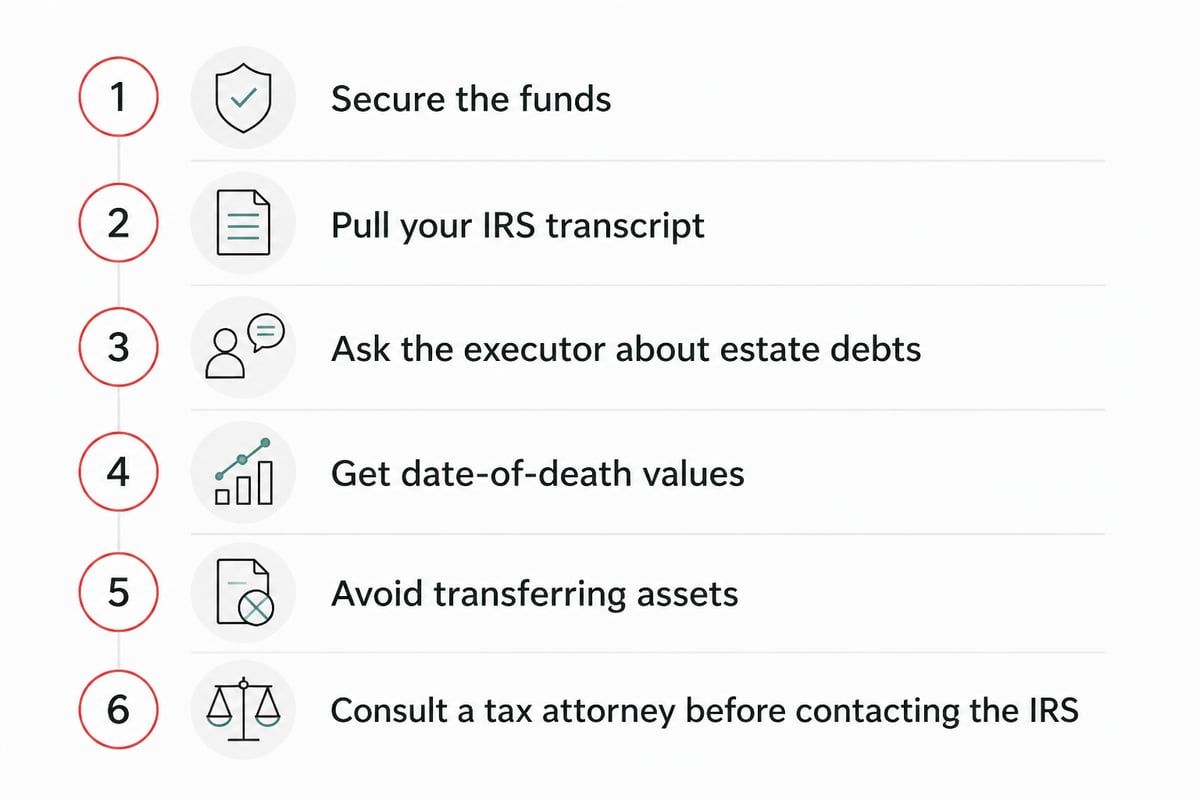
Put the money somewhere safe and stop spending it until you know what you owe and to whom.
Then work through this list:
- Find out whether you have an open tax balance. Pull your IRS account transcript. If you have unfiled returns, address those too. An unfiled return keeps the IRS's options wide open.
- Ask the executor about estate tax debts. If the decedent owed the IRS, you want to know before distributions, not after.
- Get the date-of-death value of inherited assets. The basis of inherited property is generally its fair market value on the decedent's date of death, and an alternate valuation date may apply if the estate files Form 706 and elects it. That basis often wipes out much of the gain when you sell.
- Don't move money to relatives to hide it. The IRS can unwind transfers made to dodge collection.
- Talk to a tax attorney before you sign anything with the IRS. Everything you say to an attorney is privileged. That isn't true for a conversation with a CPA.
Can You Protect an Inheritance From the IRS?
Some protection exists, but far less than people hope, and most of it has to be in place before the IRS files a lien.
Exempt property is the narrow category. The IRS can't levy certain things, and our breakdown of what the IRS can and can’t take covers the exemptions in detail. Inherited cash isn't on that list once it's yours.
A few legitimate planning points:
- Disclaiming the inheritance. Under federal law, a qualified disclaimer, made in writing within nine months of death and before you accept any benefit, can treat you as if you never received the property. But there's a trap. A federal tax lien attaches to your rights in the property, and a disclaimer may not defeat an existing federal tax lien. Disclaim and the IRS may still reach it.
- Trusts the decedent set up. A properly drafted discretionary trust can keep a beneficiary's share out of reach of creditors in many cases, but a trust can't shield you from a lien against your own interest the way people assume. The rules vary and the drafting is everything.
- Resolve the debt first. The cleanest protection is not hiding the money. It's eliminating the debt it would otherwise cover.
That last point deserves attention, because it flips the question. Inherited money can be the tool that settles the problem instead of the target of it.

Can You Use an Inheritance to Settle Tax Debt?
Yes, and it can help or hurt you depending on the program you're in.
If you've applied for an Offer in Compromise, the IRS looks at your assets and your ability to pay. A large inheritance changes that picture. An inheritance you receive during or soon after the process counts toward what the IRS thinks you can pay, so an offer built on "I can't afford much" falls apart when you've just inherited $200,000. Our post on how long an Offer in Compromise takes explains the timeline and why disclosing changes in your finances matters.
Installment agreements work differently. You can often use part of an inheritance to cut the balance, which lowers your monthly payment and stops penalties and interest from compounding as fast. Paying down a tax debt with inherited money is frequently smarter than spending it elsewhere while the IRS keeps adding interest.
If your debt is large, the better question is whether paying all of it makes sense. A properly structured resolution through IRS Tax Debt Resolution can mean using part of the inheritance to settle on terms the IRS accepts, rather than writing a check for the full balance plus penalties. That decision depends on your income, your assets, and how old the debt is. I don't make it by rule of thumb.
What About Taxes on Inherited Property You Sell Later?
Selling inherited property can create a tax bill, but the stepped-up basis keeps it small more often than not.
Because basis generally resets to fair market value at the date of death, you owe capital gains tax only on appreciation after that date. Sell a house for what it was worth the day your parent died and the gain may be near zero. When you sell inherited property you have to determine its basis to calculate any gain or loss, so keep the appraisal or the Form 706 valuation.
Retirement accounts are the exception to the clean-inheritance rule. A traditional IRA or 401(k) isn't taxed when you inherit it, but withdrawals are ordinary income to you. Take a large lump sum and you can land in a high bracket and generate a balance you can't pay. That's a common way people with a clean record end up owing the IRS.
And the gift question comes up often. Parents ask whether they can hand a child $50,000 without tax. The gift tax belongs to the giver, not the receiver. For 2026 the annual gift-tax exclusion is $19,000 per recipient. Give more and the giver files a gift tax return, but that usually reduces a lifetime exemption instead of triggering a payment. Gifts also don't hide assets from a lien against the giver.
What If the Person Who Died Owed the IRS?
You aren't personally responsible for a dead relative's tax debt, but the estate is, and the IRS gets paid before most heirs do.
The gross estate includes the decedent's property interests before reductions for debts, mortgages, or administration expenses, per the IRS estate tax explanation. That means a house with a mortgage still counts at full value for the estate tax calculation, though the debts can come out later as deductions.
If the estate is short, you might receive less than you expected, or nothing. But you don't owe the difference out of your own pocket. The exception is when you served as executor and distributed assets while a tax debt was unpaid. Then the IRS can come after you personally.
If a spouse's old tax debt is the issue, a different remedy may apply. Our post on innocent spouse relief for an ex’s IRS debt walks through when that relief is available.
FAQ
What assets cannot be seized by the IRS?
Certain items are exempt from a levy, including some basic household goods, tools of your trade up to a set value, and certain benefits such as unemployment, workers' compensation, and some disability payments. The list is short, and inherited cash isn't on it.
Can I give my daughter $50,000 tax free?
Yes, in the sense that she owes no tax on a gift. You, as the giver, may need to file a gift tax return for the amount above the $19,000 annual exclusion for 2026, but that typically uses part of your lifetime exemption instead of creating a tax payment. If you owe the IRS, a gift made to put assets out of reach can be reversed.
Should I tell the IRS about my inheritance if I owe back taxes?
You don't have to announce it. But you can't hide it on a financial disclosure, and any installment agreement or Offer in Compromise application requires accurate information about your assets. Misstating them is far more dangerous than the debt itself.
Pull your IRS account transcript this week so you know exactly what you owe before any inheritance reaches your bank account. If the balance is large, or a lien or levy notice is already in your mailbox, I'll tell you plainly where you stand and which options fit, and once you retain the firm every communication with the IRS runs through us, so Let’s talk and Schedule Your Free Consultation with the Law Offices of Darrin T. Mish, P.A. We work with clients nationwide, and what you tell us stays protected by attorney-client privilege.