

If you're reading this, something about your tax situation has you worried. That's fair — the IRS is intimidating until you know how the rules actually work. I'm Darrin Mish, a Tampa tax attorney. I've handled cases like yours for 32 years. Let me walk you through it.
I'm Darrin Mish. Tampa tax attorney, 32 years in, more than $100 million in IRS debt resolved. What follows isn't theory. It's what I've actually watched work.
Yes, you can sell a business that owes the IRS. The tax debt doesn't block the sale, but it does get paid out of the money, usually at closing, before you see a dollar. Selling a business with IRS tax debt works when you deal with the debt before you sign anything, not after a buyer's lawyer finds it.
Can You Legally Sell a Business That Owes the IRS?
You can legally sell a business that owes the IRS, and the sale itself is not what the IRS cares about. What the IRS cares about is whether it gets paid from the proceeds or whether the debt stays attached to the assets.
Here's the mechanism. Unpaid tax can lead to a Notice of Federal Tax Lien and/or an IRS levy, according to the IRS. If a lien has been filed, it attaches to everything the business owns, including equipment, inventory, receivables, and goodwill. A buyer who purchases those assets takes them subject to the lien unless the IRS agrees to release or discharge it.
Nobody serious will close over that. Title companies and buyer's attorneys run lien searches. They will find it.
So the real question isn't whether you can sell. It's how the debt gets cleared at the closing table, and whether you control that process or the IRS does.
What Kind of IRS Debt Do You Have?
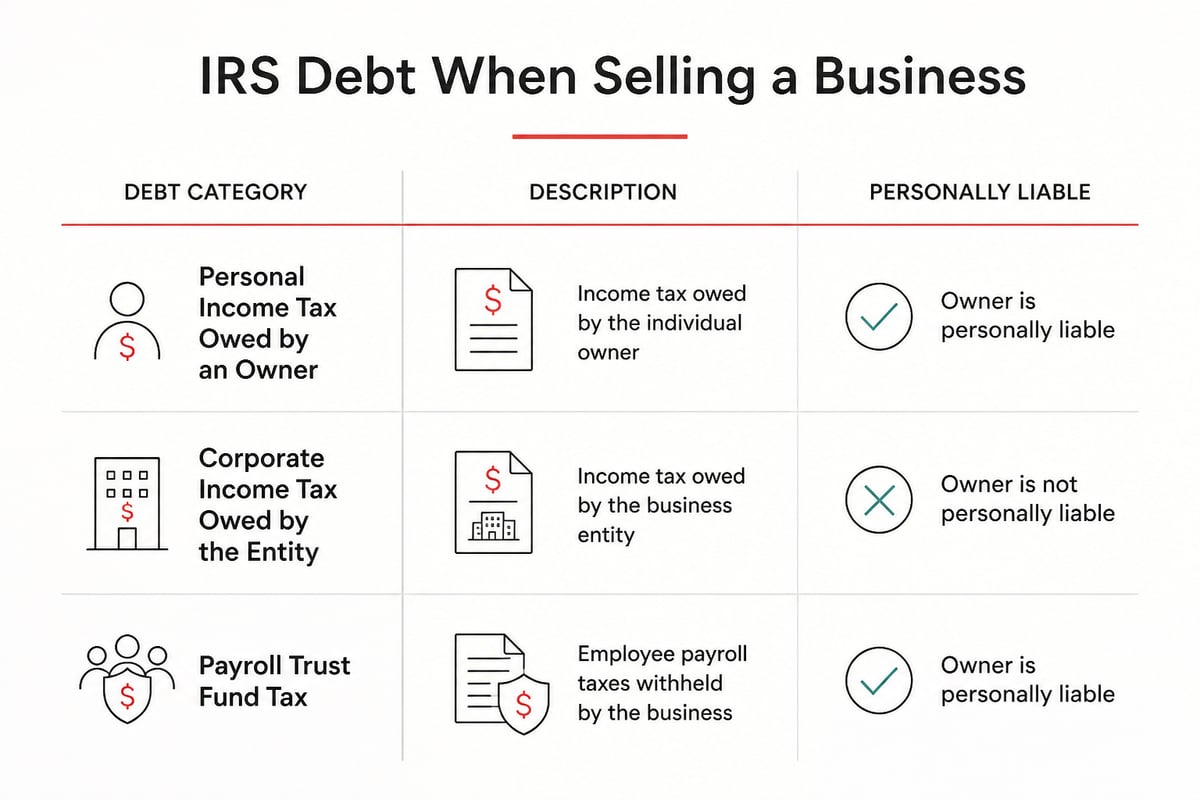
The kind of IRS debt you have changes almost everything about how a sale goes, so figure that out first. Three categories matter most.
- Income tax owed by you personally. If you run a sole proprietorship, LLC, or S corporation, business profit flows to your personal return. The debt is yours, and the business assets may still be exposed.
- Corporate income tax owed by the entity. The debt belongs to the company. In an asset sale, the company sells and pays the IRS from the proceeds.
- Payroll tax debt. This is the dangerous one. Withheld employee taxes are held in trust for the government, and the IRS can pursue responsible individuals personally through the Trust Fund Recovery Penalty. I've written about the small business payroll tax problem in detail.
Payroll debt gets priority attention from the IRS. Revenue officers move faster on it, and a pending sale is the kind of thing that makes them move faster still.
How a Tax Lien Affects the Sale
A federal tax lien affects the sale by clouding title to the business assets, which means a buyer cannot get clean ownership until the lien is released, discharged, or subordinated. This is where most deals stall.
A lien arises when you owe, the IRS assesses the tax, sends a demand, and you don't pay. The public notice is what makes it visible to everyone else. Once it's filed, your lender, your landlord, and any prospective buyer can see it.
You have a few options, and they are not interchangeable:
- Pay the lien from the sale proceeds and get a release. The IRS must release the lien within 30 days after the debt is satisfied. This is the cleanest path.
- Request a certificate of discharge. This removes the lien from specific property being sold, even if you don't pay the full debt, as long as the IRS gets what it's entitled to from the proceeds.
- Request subordination. The IRS agrees to let another creditor, like a buyer's lender, move ahead of it.
- Withdraw the lien. Different from release, and sometimes available after you enter a payment plan. The difference matters for your credit and future borrowing, and I break it down in lien withdrawal versus release.
If your debt exceeds what the business will sell for, the discharge route gets complicated. That is a conversation to have with a tax attorney before you list the business, not after you have a signed letter of intent.
Selling a Business With IRS Tax Debt: How the Closing Works
At closing, the IRS gets paid from the sale proceeds first, through an escrow or closing agent who sends a payoff directly to the IRS before you receive anything. This is the standard way selling a business with IRS tax debt actually plays out.
The sequence usually runs like this:
- You get a current payoff figure from the IRS. Interest keeps running, so the number changes daily.
- The purchase agreement names the IRS payoff as a closing condition.
- The closing agent wires the payoff to the IRS from the buyer's funds.
- The IRS issues a lien release, generally within 30 days of payment in full.
- You receive whatever remains.
Interest matters here. For the fourth quarter of 2026, the IRS underpayment rate is 7% per year for individuals and businesses, and it compounds daily. A slow sale costs you money in a very literal way.
Penalties pile on too. The IRS says the late-payment penalty rate can climb from 0.5% to 1% per month after it issues a final notice of intent to levy. If you already received one of those notices, the clock is not on your side.
Payoff letters expire. Get a fresh one close to the closing date.
Asset Sale vs. Stock Sale When You Owe the IRS
An asset sale is usually the safer structure for a seller with IRS debt, because the proceeds flow through a controlled closing and the IRS can be paid from them. A stock or membership-interest sale is harder.
In a stock sale, the buyer takes the entity along with all its liabilities, including the tax debt. Buyers hate that, and they should. The IRS can still pursue the entity after the sale, which means the buyer inherits the problem. Most buyers will either refuse, demand a steep price cut, or insist you pay the IRS in full first.
In an asset sale, the buyer picks the assets it wants and leaves the entity, and its debts, behind. Here's the catch for you. If the entity is a shell with a tax bill and no assets after closing, the IRS looks to the proceeds, and to you personally if payroll tax is involved.
Neither structure makes the debt vanish. They just change where it lands.
Can You Sell Before the IRS Files a Lien or Levy?
You can, and in many ways that is the best moment to sell, but you cannot use a sale to move assets out of the IRS's reach. Trying that creates a much bigger problem than the original debt.
Selling a business at a fair price to an unrelated buyer, then paying the IRS from the proceeds, is ordinary. Selling to a relative for a dollar, transferring assets into a new entity, or draining the account right before a sale is a different thing. The IRS can treat those moves as fraudulent transfers and pursue the assets, the buyer, or you.
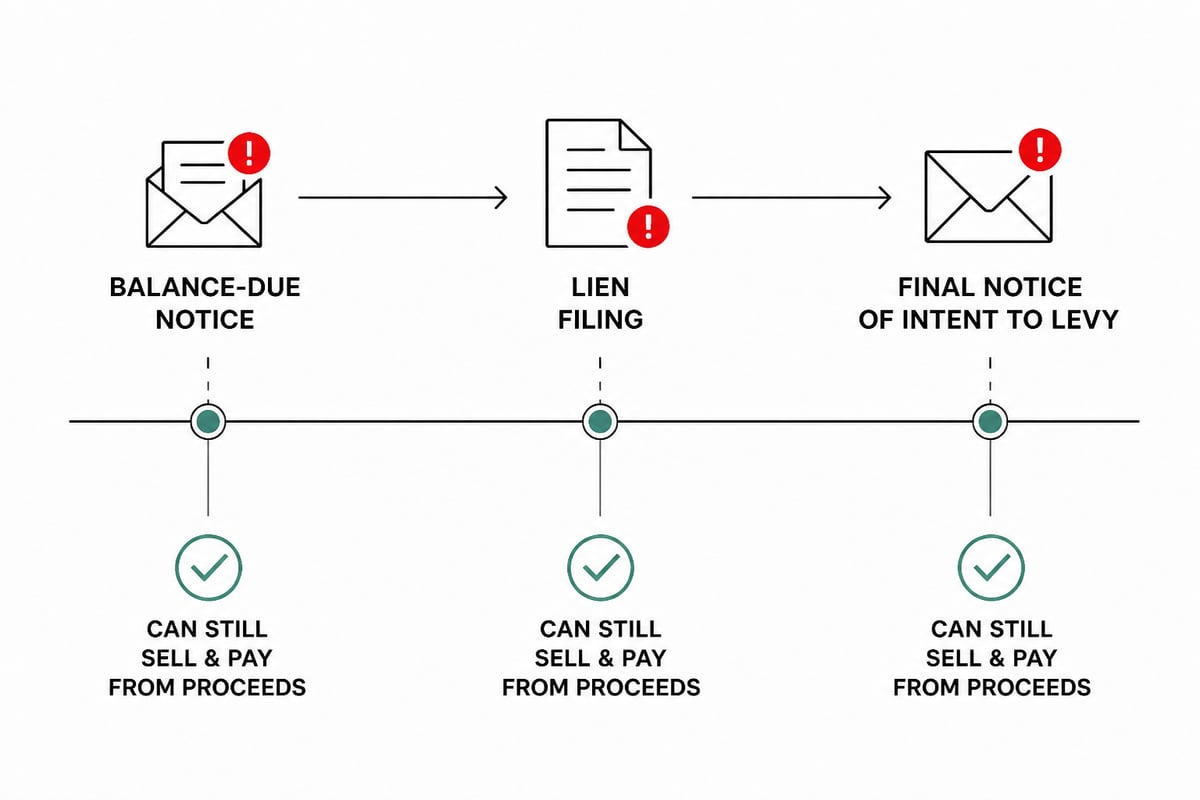
I also want to be plain about timing. An IRS notice isn't the end. Collection runs in stages. Before a levy, the IRS must send a final notice and give you a chance to request a hearing. You have more time than your anxiety is telling you, but not unlimited time.
Taxes You Owe on the Sale Itself
The sale creates its own tax bill, separate from the old debt, and you need to plan for it before the money arrives. Gains are taxed based on what you sold and how long you held it.
Long-term capital gains on assets held more than a year are taxed at 0%, 15%, or 20%, depending on your taxable income. Most business owners with a meaningful sale land at 15% or 20%. But a business sale rarely produces one clean capital gain. Part of the price is often allocated to inventory, equipment depreciation recapture, and receivables, which are taxed as ordinary income at higher rates.
Allocation of the purchase price is negotiated between you and the buyer and reported on IRS Form 8594. It can swing your tax bill by thousands. Don't sign a purchase agreement without checking it.
Two more points people ask about:
- Paying off business debt is generally not deductible as a principal payment. Repaying a loan isn't an expense. Interest on business loans often is, and certain tax penalties are not.
- Sale proceeds and old debt interact. If you owe the IRS, the proceeds may go to the IRS first, but you still owe tax on the gain. Budget for both, or you will end up with a new balance on top of the old one.
If part of your debt gets settled for less than owed, forgiven debt can create its own tax consequences. I cover that in debt settlement and taxes.

What If the Sale Won't Cover the Debt?
If the sale won't cover the debt, you still have real options, and the sale is not your only lever. The IRS is focused on what it can collect.
The IRS offers Simple payment plans for individuals and businesses, and business taxpayers can contact the IRS at 800-829-4933 or the number on their notice. A payment plan can help while you market the business properly instead of dumping it in a hurry.
Beyond that:
- Offer in Compromise. Settles the debt for less than owed when full collection is doubtful. The IRS looks hard at your assets, and a business you are about to sell counts.
- Currently not collectible status. Pauses collection when paying would leave you unable to cover basic living costs.
- Selling in stages. Sell the equipment or location that carries the best value, pay the lien, and keep operating.
My firm handles all of these through IRS tax debt resolution, and the right one depends on your numbers, not on a template.
Mistakes That Wreck a Sale
A few errors come up again and again, and every one of them is avoidable.
- Hiding the debt from the buyer. It will surface in a lien search or due diligence, and you lose trust and leverage at the worst moment.
- Ignoring IRS notices while negotiating. The IRS doesn't pause because you have a letter of intent.
- Letting the CPA or broker run the IRS side. Conversations with a CPA are not protected by attorney-client privilege. Conversations with a tax attorney are.
- Skipping the payroll tax. Trust fund liability follows you personally even after the company is gone.
- Taking a verbal estimate of the payoff. Get it in writing, from the IRS, with a good-through date.
Once you hire counsel, all communication with the IRS runs through counsel, which keeps you from saying something to a revenue officer that you can't take back. My article on what happens in your first 30 days with a tax attorney walks through that process.
Other Pieces of Your Exit Plan
A sale rarely hinges on tax alone. Buyers inspect the physical business, and problems there cut the price or kill the deal just as fast as a lien does.
If your business operates from a building in Florida, a failed structural or safety review can derail closing. For milestone inspections and building recertification, Souffront Construction and Engineering offers structural engineering and concrete restoration services. And for a UK-based business with premises to sell, Logic Fire and Security provides fire detection and electronic security installation and maintenance, which buyers often want documented. Fixing these before listing keeps the IRS payoff from being squeezed by a renegotiated price.
FAQ
How do you sell a business?
You value it, prepare financials and tax records, find a buyer, negotiate a purchase agreement, complete due diligence, and close. With IRS debt in the picture, add one step at the front: get a current payoff figure and a plan to clear any lien at closing.
Can the IRS sell your debt?
The IRS does not sell tax debts the way credit card issuers do. It can seize and sell your property after a levy.
Is capital gains tax 15% or 20%?
It depends on your taxable income. Long-term gains are taxed at 0%, 15%, or 20%, and most business owners selling at a meaningful price fall into 15% or 20%. Portions of the sale allocated to depreciation recapture or inventory can be taxed as ordinary income at higher rates.
Your next step is to pull your IRS account transcripts and find out exactly what you owe, in which tax years, before you speak to a broker or a buyer. If the number is real, the way you handle it will decide how much of the sale you keep, and IRS Tax Debt Resolution is where my firm starts with owners in your position. I'm an attorney, so what you tell me is privileged, and the first conversation is free and carries no obligation, so let’s talk through your sale and your options, and get your free consultation on the calendar.