

Knowledge is protection when the IRS is involved. I'm Darrin Mish, a tax attorney in Tampa with 32 years of experience representing taxpayers nationwide. Here's what I want you to understand.
I'm Darrin Mish. Tampa tax attorney, 32 years in, more than $100 million in IRS debt resolved. What follows isn't theory – it's what I've actually watched work.
You've got IRS debt crushing you from one side and creditors circling from the other. You're Googling whether bankruptcy can make the tax debt disappear, and you're finding conflicting answers because the truth is complicated. A bankruptcy tax attorney operates in the narrow space where bankruptcy law and tax law intersect, and that overlap creates opportunities most people miss.
Not all tax debt survives bankruptcy. Not all of it disappears either. The rules depend on the type of tax, how old it is, whether you filed returns, and which bankruptcy chapter you choose. Get it wrong and you'll emerge from bankruptcy still owing the IRS everything you owed before.
What a Bankruptcy Tax Attorney Actually Does
A bankruptcy tax attorney holds active licenses in both fields. They're admitted to practice bankruptcy law in federal court and they're qualified to represent you before the IRS. That dual credential matters because bankruptcy judges don't solve tax problems, and the IRS doesn't care about your bankruptcy discharge unless the debt qualifies.
Most bankruptcy attorneys file your petition and assume all tax debt is priority debt that survives. Most tax attorneys avoid bankruptcy court entirely because it's outside their practice area. You need someone who can analyze your tax transcripts, apply the discharge tests, and structure your bankruptcy to maximize what gets wiped out.
The typical client comes in owing $60,000 to creditors and $40,000 to the IRS. They assume the credit card debt will discharge but the tax debt won't. Sometimes they're wrong on both counts.

The Five Rules That Determine If Tax Debt Disappears
Income tax debt can discharge in Chapter 7 bankruptcy only if it passes all five tests. Miss one and you're stuck with the full balance.
The discharge requirements:
- Three-Year Rule: The tax return was originally due at least three years before you filed bankruptcy (including extensions)
- Two-Year Rule: You actually filed the return at least two years before the bankruptcy petition
- 240-Day Rule: The IRS assessed the tax at least 240 days before you filed bankruptcy (or hasn't assessed it yet)
- Return Filed: You actually filed a return for that year (substitutes for return filed by the IRS don't count)
- No Fraud: You didn't file a fraudulent return or willfully attempt to evade the tax
All five. Not three out of five. Not "mostly compliant." All five or the debt survives.
For 2020 taxes, the return was due April 15, 2021 (or October 15, 2021 if you extended). The three-year clock started from that date. If you filed bankruptcy in November 2024, those 2020 taxes wouldn't qualify. File in May 2026 and they clear the three-year hurdle.
But if you never filed your 2020 return, or if the IRS filed a substitute return for you, that debt never discharges no matter how old it gets. Tax problems don't age out when you skip filing.
Chapter 7 vs. Chapter 13: Different Tools for Different Situations
Chapter 7 wipes out qualifying tax debt immediately. You get a discharge in about four months, and any tax debt that met all five tests disappears. Tax debt that doesn't qualify remains, but at least your credit card debt, medical bills, and personal loans are gone, freeing up cash flow to attack the IRS balance.
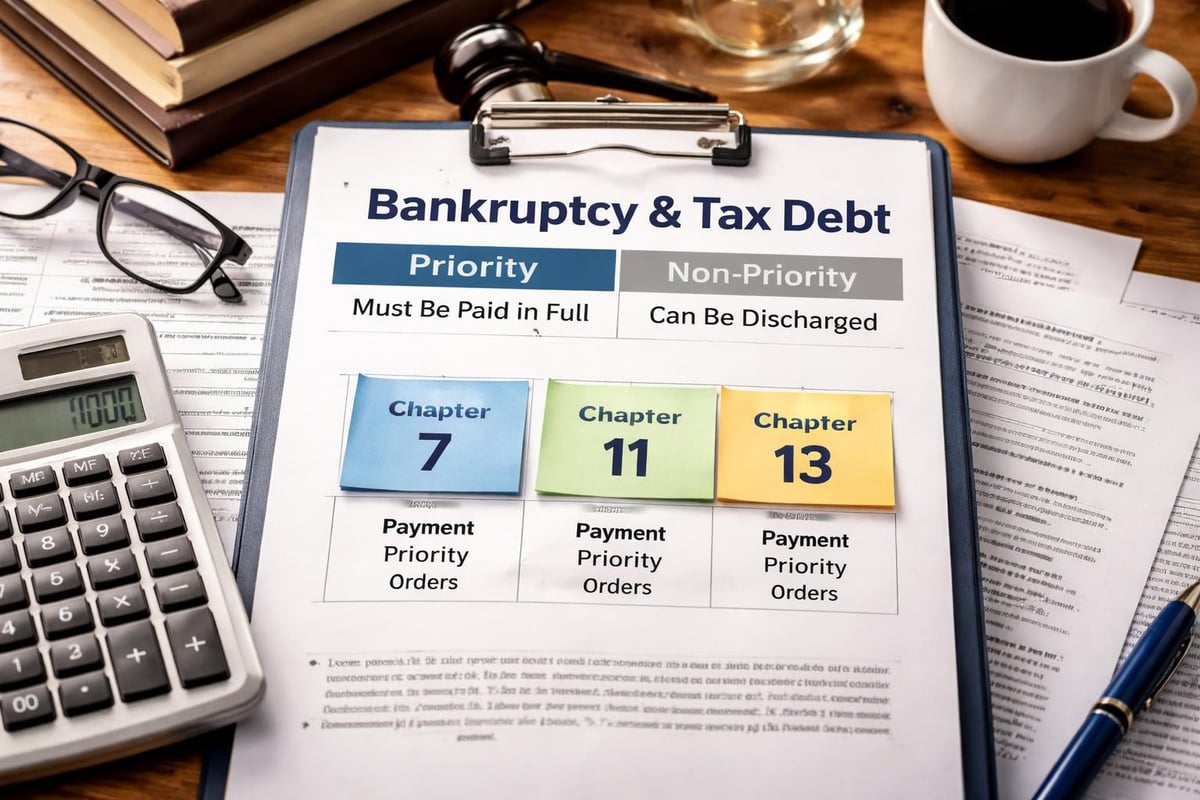
Chapter 13 creates a three-to-five-year repayment plan. Priority tax debt (recent taxes that don't meet the discharge tests) gets paid through the plan, typically without additional interest or penalties. Non-priority tax debt (older debt that would discharge in Chapter 7) gets lumped with general unsecured debt and you might pay pennies on the dollar.
| Feature | Chapter 7 | Chapter 13 |
|---|---|---|
| Duration | 4 months | 3-5 years |
| Tax Debt Treatment | Discharged if qualified; survives if not | Priority debt paid in full; non-priority treated as unsecured |
| Means Test | Must pass income limits | Available to anyone with regular income |
| Asset Protection | Exemptions only | Can keep non-exempt assets by paying value into plan |
The choice depends on your income, how much of your tax debt qualifies for discharge, and whether you need to stop IRS wage garnishments immediately.
Chapter 13 stops IRS collection activity the day you file. The automatic stay prevents the IRS from levying your bank account, garnishing wages, or filing new liens while you're in the plan. You make one monthly payment to the trustee who distributes it to creditors according to priority rules.
When Chapter 11 Makes Sense for Tax Debt
Chapter 11 is business bankruptcy, but individuals can file it too. You see it when someone has tax debt exceeding Chapter 13's debt limits or when they own a business with substantial tax liabilities.
The debt limits for Chapter 13 in 2026 are $465,275 in unsecured debt and $1,395,875 in secured debt. If your tax debt alone exceeds the unsecured limit, Chapter 13 isn't available. Chapter 11 has no debt ceiling.
A bankruptcy tax attorney structures Chapter 11 plans to pay priority tax debt over time while discharging old income tax and potentially restructuring secured tax liens. It's more expensive and complicated than Chapter 7 or 13, but it's the only option for high-balance tax debtors who need bankruptcy protection.
Which Tax Debts Never Discharge
Some tax obligations survive every bankruptcy chapter no matter how old they are. The Bankruptcy Code explicitly excludes them from discharge.
Non-dischargeable tax debts:
- Trust fund taxes (the employee withholding portion of payroll taxes)
- Taxes you collected from others (sales tax, excise tax)
- Penalties on non-dischargeable taxes assessed within three years
- Tax debt from fraudulent returns
- Tax debt where you willfully evaded payment
The trust fund recovery penalty destroys small business owners in bankruptcy. When your company fails to pay over employee withholding, the IRS assesses the trust fund portion personally against you as a responsible person. That debt never discharges because you were holding someone else's money.
Sales tax follows the same rule. You collected it from customers, you held it in trust for the state. Bankruptcy doesn't let you keep money that was never yours to begin with.
Tax Liens Survive Discharge
Here's what confuses people: even when the underlying tax debt discharges, a recorded tax lien survives bankruptcy. The lien is a property right the IRS acquired before you filed. Bankruptcy wipes out your personal obligation to pay, but it doesn't eliminate the government's claim against your property.
Practically, this means you can't be forced to pay the debt after bankruptcy, but if you sell property with a lien attached, the IRS gets paid from the proceeds. The IRS put a lien on your property before bankruptcy? That lien stays.
A bankruptcy tax attorney negotiates lien subordination or discharge in some cases, particularly in Chapter 13 plans where you pay the secured portion and discharge the unsecured portion. But you can't ignore the lien and assume bankruptcy made it vanish.
The Timing Game: When to File Bankruptcy
Filing bankruptcy one month too early can cost you tens of thousands of dollars. The three-year, two-year, and 240-day clocks don't care about your urgency.
I see people file in January when waiting until May would have allowed three more tax years to discharge. They save their house from foreclosure but trap themselves with tax debt that could have been eliminated.
A bankruptcy tax attorney maps out your tax timeline before filing. They pull your IRS transcripts, identify which years qualify for discharge now, which years will qualify if you wait, and calculate whether waiting makes sense given your other creditor pressures.
Strategic timing considerations:
- Will waiting allow more tax years to meet the three-year test?
- Have you filed all returns, or do you need to file before the two-year clock starts?
- Has the IRS assessed all taxes, or are some years still under audit?
- Are creditors about to foreclose, forcing you to file before optimal tax timing?
Sometimes you can't wait. The foreclosure sale is scheduled, your wages are being garnished at 70%, or the bank account levy cleaned you out. You file bankruptcy when you must, not when it's perfect.
But if you have six months of breathing room, using it to let another tax year cross the discharge threshold can save you more than any other single decision.
Unfiled Returns Kill Your Discharge
The two-year rule requires that you filed the return at least two years before bankruptcy. Not that it was due two years ago. That you actually filed it.
If the IRS filed a substitute for return (SFR) on your behalf because you didn't file, that doesn't count. The tax debt from an SFR never discharges. Ever. Even if the tax is twenty years old.
A bankruptcy tax attorney makes you file all missing returns before filing bankruptcy. You file them, wait two years, then file bankruptcy. Those debts can now potentially discharge if they also meet the three-year and 240-day tests.
Filing bankruptcy with unfiled returns is malpractice. You waste the bankruptcy discharge on debts that could never qualify, and you miss the opportunity to eliminate them by simply filing returns first.
Penalty and Interest Treatment in Bankruptcy
Penalties on dischargeable taxes discharge if they were assessed more than three years before bankruptcy. Penalties on non-dischargeable taxes never discharge.
Interest on any tax debt stops accruing when you file bankruptcy. The automatic stay prevents new interest from accumulating on pre-petition tax debt, even priority tax debt that survives the discharge.
For someone in Chapter 13 paying off $50,000 in priority taxes over five years, stopping interest can save $15,000 to $20,000. The IRS typically charges 7-8% per year. Five years of compounding adds up. Bankruptcy freezes that clock.

The Offer in Compromise Alternative
Before rushing into bankruptcy, a bankruptcy tax attorney evaluates whether an offer in compromise (OIC) better serves your situation. An OIC settles your tax debt for less than you owe based on your ability to pay.
| Solution | Best For | Timeframe | Impact on Credit |
|---|---|---|---|
| Chapter 7 Bankruptcy | Multiple debt types, qualifying old tax debt | 4 months | Stays on credit 10 years |
| Chapter 13 Bankruptcy | Regular income, need time to pay priority taxes | 3-5 years | Stays on credit 7 years |
| Offer in Compromise | Only tax debt, no other dischargeable debt | 6-24 months | No credit report impact |
If your only debt is to the IRS and you qualify for an OIC based on doubt as to collectibility, you might settle for 10-20 cents on the dollar without the credit damage of bankruptcy. But if you're also drowning in credit card debt, medical bills, and personal loans, bankruptcy wipes out all of it simultaneously.
The analysis requires looking at your complete financial picture, not just the tax debt in isolation. Getting help from experienced counsel means someone actually runs the numbers on both options.
Combining Bankruptcy with IRS Resolution Tools
Sometimes you file bankruptcy to discharge old tax debt and simultaneously negotiate an installment agreement for recent tax debt that didn't qualify. You're using bankruptcy as a partial solution, not a complete one.
Post-bankruptcy, you owe $25,000 in priority taxes that survived discharge instead of $90,000 total. Now an installment agreement is affordable at $500/month for five years. Before bankruptcy, at $1,800/month for five years, it was impossible.
A bankruptcy tax attorney coordinates both proceedings. They ensure the bankruptcy doesn't accidentally trigger IRS collection activity on debt that should have been stayed, and they set up post-bankruptcy payment plans that you can actually maintain.
State Tax Debt Complicates Everything
Everything discussed so far applies to federal income tax. State tax operates under different rules in bankruptcy.
Most states follow federal discharge rules for income tax, but some don't. Florida has no state income tax, but if you moved to Florida from New York or California with state tax debt following you, that debt may or may not discharge depending on the state's specific laws.
State trust fund taxes (sales tax, employer withholding) never discharge, same as federal. But state income tax discharge requirements vary. Some states require four years instead of three. Some states don't allow discharge at all.
A bankruptcy tax attorney licensed in your state knows these variations. They don't assume state tax debt follows federal rules. They research your specific state's treatment in bankruptcy and plan accordingly.
The Taxpayer Advocate Won't Help You in Bankruptcy
People ask whether the Taxpayer Advocate Service can help with tax debt in bankruptcy. They can't. Once you file bankruptcy, the automatic stay prevents the IRS from taking any collection action, which means there's nothing for the Advocate to stop or negotiate.
The Advocate helps with IRS procedural issues, not bankruptcy discharges. They might help before you file bankruptcy if the IRS is creating systemic problems. After you file, it's a bankruptcy matter. Understanding when different forms of help apply prevents wasted effort.
Professional Licensing Issues for Business Owners
If you're a professional with a state license (CPA, attorney, contractor, real estate agent), bankruptcy can trigger disciplinary review. Your licensing board may require disclosure of bankruptcy filings, and some boards view it as evidence of financial irresponsibility.
A bankruptcy tax attorney discusses these consequences before filing. Sometimes Chapter 13 carries less stigma than Chapter 7 because you're repaying debts rather than discharging them. Sometimes you structure the bankruptcy to avoid specific triggers in your professional rules.
Doctors, dentists, and other professionals with substantial tax debt often face this dilemma. The tax debt is crushing the practice, but bankruptcy could threaten their license. The answer involves careful timing, choosing the right chapter, and sometimes paying more than the minimum to satisfy licensing board concerns.
Post-Bankruptcy IRS Compliance
Bankruptcy gives you a fresh start, but the IRS watches you closely afterward. File bankruptcy in 2026 and fail to file your 2027 return on time? The IRS will assess penalties faster and show less flexibility than they would with someone who never filed bankruptcy.
The bankruptcy discharge eliminated your past debt, but you're now expected to stay current on all future obligations. Miss estimated payments, file late, or underpay and you'll find yourself back in IRS collection status faster than someone without a bankruptcy history.
Post-bankruptcy tax compliance means:
- Filing all returns on time, even if you can't pay in full
- Making estimated payments if you're self-employed
- Adjusting withholding if you're an employee to avoid year-end balances
- Requesting installment agreements immediately if you can't pay, rather than ignoring the bill
A bankruptcy tax attorney builds post-bankruptcy compliance into your plan. They don't just get you through the discharge and disappear. They set up systems to keep you current because the goal is permanent resolution, not temporary relief.
The Chapter 20 Strategy
Chapter 20 isn't a real bankruptcy chapter. It's slang for filing Chapter 7 to discharge general unsecured debt, then immediately filing Chapter 13 to handle priority tax debt through a payment plan.
You can't discharge tax debt that doesn't meet the five tests in Chapter 7. But you can discharge your credit cards, medical bills, and personal loans in Chapter 7, then file Chapter 13 to pay the remaining tax debt over three to five years.
There's no double discharge. The Chapter 13 doesn't discharge anything because you just received a Chapter 7 discharge. But it gives you the benefit of Chapter 13's payment plan structure without waiting years for a discharge you don't need.
Courts view Chapter 20 skeptically. Some courts require you to wait before filing the second case. Others scrutinize whether you're abusing the bankruptcy system. A bankruptcy tax attorney knows local court preferences and whether Chapter 20 will work in your jurisdiction or trigger dismissal.
Tax Refunds Become Property of the Bankruptcy Estate
When you file bankruptcy, any tax refund you're entitled to for the current year becomes property of the bankruptcy estate. The trustee can take it to pay creditors.
If you file in March 2026 with a $5,000 refund coming for tax year 2025, the trustee takes that refund. If you're owed refunds from prior years you haven't claimed, those belong to the estate too.
Strategic timing means filing after you receive your refund, or exempting the refund using available exemptions. Florida allows a $1,000 wildcard exemption that can protect some refund amount, but not a large refund.
A bankruptcy tax attorney reviews your expected refunds before filing and either adjusts your filing date or adjusts your withholding to minimize the refund at risk. You're better off getting a smaller paycheck throughout the year than losing a $6,000 refund to the bankruptcy trustee.
You can't wish away tax debt with bankruptcy, but you can often eliminate old debt while structuring payment plans for recent debt. The rules are specific and the timing matters more than you think. If you're facing both IRS debt and mounting pressure from other creditors, getting qualified analysis of which debts can discharge and how to structure the bankruptcy makes the difference between fresh start and wasted filing. The Law Offices of Darrin T. Mish, P.A. has handled the intersection of tax debt and bankruptcy for over three decades, and offers free consultations to walk you through whether bankruptcy helps your specific situation or whether other resolution paths make more sense.