

Quick answer: Common IRS tax problems in 2026: unfiled returns triggering substitute-for-return assessments, CP2000 income mismatches, audit selection from third-party reporting (1099-K), wage and bank levies, federal tax liens, and Trust Fund Recovery Penalty assessments for unpaid payroll tax. Each has its own resolution path. The fastest fix is usually filing every missing return.
I’m Darrin Mish. Tampa tax attorney, 32 years in, more than $100 million in IRS debt resolved. What follows isn’t theory – it’s what I’ve actually watched work.
Tax problems can feel overwhelming, especially when you're staring at notices from the IRS and wondering how you got into this mess. Maybe you fell behind on filing returns during a tough year, or perhaps you discovered an error that snowballed into serious debt. Whatever the situation, you're not alone. Millions of Americans deal with tax problems every year, and the good news is that nearly every issue has a solution. The key is understanding what you're facing and taking action before things get worse.
Understanding the Most Common Tax Problems
When we talk about tax problems, we're really talking about a range of issues that can affect anyone from individual taxpayers to business owners. Some problems start small and grow over time, while others hit suddenly and demand immediate attention.
Unfiled Tax Returns
One of the most widespread tax problems involves unfiled tax returns. Life gets busy, and sometimes April 15th comes and goes without you submitting your paperwork. You might think skipping a year isn't a big deal, but the IRS doesn't forget.
Here's what happens when you don't file:
- The IRS can file a substitute return on your behalf, often without the deductions and credits you deserve
- Penalties and interest start accumulating immediately
- You lose the opportunity to claim refunds after three years
- The IRS can initiate collection actions, including wage garnishments
The failure-to-file penalty alone is 5% of unpaid taxes for each month you're late, up to 25%. That adds up quickly. If you're dealing with unfiled tax returns, the smartest move is getting compliant as soon as possible.

Tax Debt and Back Taxes
Owing money to the IRS represents one of the most stressful tax problems you can face. Maybe you filed your return but couldn't pay the full amount, or perhaps the IRS audited you and assessed additional taxes. Either way, tax debt doesn't just disappear.
The IRS has extensive collection powers. They can:
- Place a federal tax lien on your property
- Issue a levy to seize your assets
- Garnish your wages or bank accounts
- Offset your federal payments, including Social Security benefits
But here's something many taxpayers don't realize: you have options. The IRS would rather work with you than force collection. Programs like installment agreements let you pay over time, while an offer in compromise might reduce what you owe entirely.
How Tax Problems Escalate
Tax problems rarely stay static. What starts as a small issue can quickly spiral into a major crisis if you ignore it. Understanding this progression helps you intervene before reaching the worst-case scenario.
The IRS Notice Sequence
When you have tax problems, the IRS follows a predictable pattern of escalation:
- Initial Notice: CP14 or similar, informing you of the balance due
- Reminder Notices: Follow-up letters with increasing urgency
- Intent to Levy: Final notice before the IRS takes collection action
- Collection Actions: Liens, levies, or wage garnishments
Each notice gives you a specific window to respond. Missing these deadlines can eliminate certain appeal rights and resolution options. That's why what many consider common tax problems deserve immediate attention rather than procrastination.
Penalties That Multiply Your Problems
Tax penalties compound your original tax problems exponentially. The U.S. tax code includes over 150 different penalties, but these are the most common:
| Penalty Type | Rate | Maximum | Trigger |
|---|---|---|---|
| Failure to File | 5% per month | 25% | Not filing by deadline |
| Failure to Pay | 0.5% per month | 25% | Not paying by deadline |
| Accuracy-Related | 20% | N/A | Substantial understatement |
| Fraud | 75% | N/A | Intentional disregard |
The good news? Many penalties can be reduced or eliminated through penalty abatement. First-time offenders with clean compliance history often qualify for relief, and even repeat offenders can get penalties removed if they can demonstrate reasonable cause.

Audit-Related Tax Problems
Few words strike more fear than "IRS audit." While audit rates have declined in recent years, they still represent significant tax problems for those selected. In 2026, less than 1% of individual returns face audit, but certain factors dramatically increase your risk.
What Triggers an Audit
The IRS uses sophisticated algorithms to flag returns for examination. Common audit triggers include:
- High income (especially over $200,000)
- Large charitable deductions relative to income
- Home office deductions
- Cryptocurrency transactions
- Cash-intensive businesses
- Math errors or missing forms
If you receive an audit notice, don't panic. Most audits are correspondence audits handled entirely by mail. Only a small percentage require in-person meetings. However, responding correctly is crucial. Providing too much information can expand the audit scope, while providing too little can result in unfavorable determinations.
Your Rights During an Audit
Taxpayers have specific rights when facing IRS audits, including the right to professional representation. You never have to face the IRS alone. A qualified tax attorney can handle all communications, protecting you from saying something that worsens your situation.
The audit process typically follows these steps:
- Receipt of audit notice specifying items under examination
- Gathering and organizing documentation
- Submitting information to the IRS or attending meetings
- Receiving the examination report with proposed changes
- Agreeing to changes or filing an appeal
If you disagree with audit findings, the IRS dispute resolution process offers several avenues for challenging the determination before paying additional tax.
Business-Related Tax Problems
Business owners face unique tax problems that individual taxpayers never encounter. These issues can threaten not just your business but your personal assets as well.
Payroll Tax Issues
Payroll tax problems rank among the most serious issues business owners face. When you withhold taxes from employee paychecks but fail to remit them to the IRS, you're dealing with what the government calls "trust fund" taxes. The IRS treats this extremely seriously.
Consequences include:
- Trust Fund Recovery Penalty (TFRP): Holds responsible parties personally liable for 100% of unpaid payroll taxes
- Immediate collection action: The IRS moves faster on payroll taxes than almost any other debt
- Criminal prosecution: In extreme cases, willful failure to pay can result in charges
If you're struggling with payroll taxes, addressing it immediately is critical. The longer you wait, the more limited your options become.
Employment Classification Problems
Misclassifying employees as independent contractors represents another major source of tax problems for businesses. The IRS has specific tests to determine worker classification, and getting it wrong can result in:
- Back payment of employment taxes
- Penalties for failure to withhold
- Interest on all amounts due
- Loss of certain business deductions
The economic reality test examines factors like behavioral control, financial control, and relationship type. If the IRS determines you've misclassified workers, you'll owe both the employer and employee portions of Social Security and Medicare taxes, plus penalties.
Getting Help When You Can't Resolve Tax Problems Alone
Sometimes, despite your best efforts, you hit a wall with the IRS. The system feels impenetrable, or your situation is too complex to navigate alone. That's exactly when you need to know about resources specifically designed to help.
The Taxpayer Advocate Service
The Taxpayer Advocate Service (TAS) is an independent organization within the IRS that helps taxpayers resolve problems. They can assist when:
- You're experiencing economic harm or significant cost
- You've tried to resolve your issue but haven't succeeded
- You need to resolve a tax problem immediately
TAS doesn't charge for their services, but they have specific criteria for accepting cases. They're particularly helpful when you can’t resolve your tax problem through normal channels.
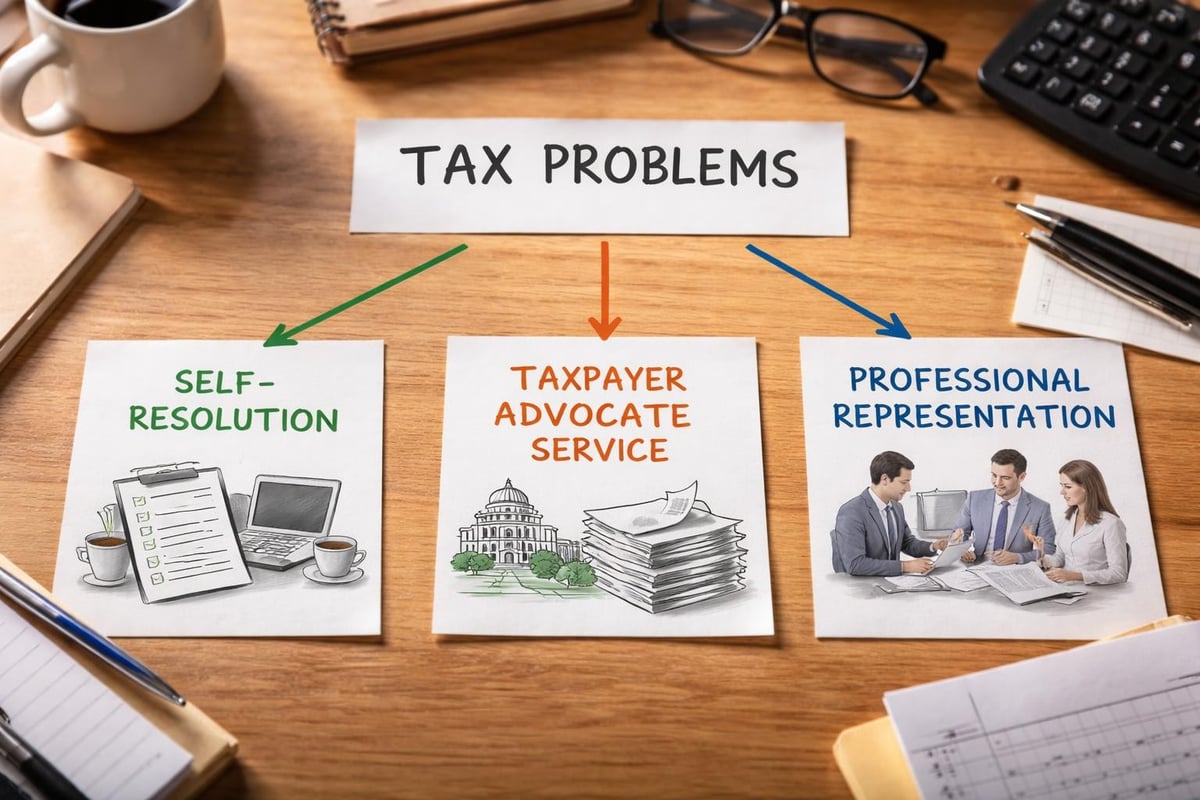
Professional Representation
For serious tax problems, professional representation isn't a luxury-it's a necessity. Tax attorneys, CPAs, and enrolled agents can represent you before the IRS, but they bring different strengths to the table.
Tax attorneys excel at:
- Complex legal issues involving tax law interpretation
- Negotiating settlements and offers in compromise
- Representing clients in Tax Court
- Providing attorney-client privilege protection
- Handling criminal tax matters
When you're facing significant IRS issues, the investment in professional help typically pays for itself through better outcomes and peace of mind.
Strategies for Resolving Tax Debt
If you owe the IRS money, you have more options than you might think. The key is choosing the right strategy for your situation.
Payment Plans and Installment Agreements
Not everyone can write a check for their entire tax debt, and the IRS knows this. Installment agreements let you pay over time, typically up to 72 months for individuals. The IRS offers several types:
- Guaranteed Installment Agreement: For debts under $10,000
- Streamlined Installment Agreement: For debts up to $50,000
- Partial Payment Installment Agreement: When you can't pay the full amount before the collection statute expires
- Non-streamlined agreements: For larger debts requiring financial disclosure
The application process is relatively straightforward for smaller debts, but larger balances require detailed financial information. Setting up proper payment arrangements stops most collection actions and prevents new liens from being filed.
Offer in Compromise
An offer in compromise lets you settle tax debt for less than you owe. It sounds too good to be true, but it's a legitimate program for taxpayers who genuinely can't pay their full tax liability. The IRS considers:
- Your income and earning potential
- Your expenses and necessary living costs
- Your asset equity
- Your ability to pay over the remaining collection period
The acceptance rate hovers around 40%, meaning not everyone qualifies. The IRS evaluates offers based on doubt as to collectibility, doubt as to liability, or effective tax administration. Having professional help significantly increases your chances of acceptance.
Currently Not Collectible Status
Sometimes your financial situation is so dire that you can't afford to pay anything toward tax debt. In these cases, the IRS may grant Currently Not Collectible (CNC) status. This temporarily halts collection activities while you get back on your feet.
To qualify, you must demonstrate that paying would create economic hardship. The IRS will review your income, expenses, and assets. While in CNC status:
- The IRS stops levies and garnishments
- Interest and penalties continue to accrue
- The collection statute continues running
- You must file all future returns on time and pay any new balances
Understanding Currently Not Collectible status can provide crucial breathing room when you're facing financial catastrophe.
Preventing Future Tax Problems
The best way to deal with tax problems is preventing them in the first place. A few smart habits can save you tremendous headaches down the road.
Avoiding Bad Tax Habits
Many tax problems stem from preventable mistakes. Common bad tax habits include:
- Disorganized recordkeeping: Missing receipts mean lost deductions and potential audit problems
- Procrastination: Waiting until the last minute increases errors and stress
- Ignoring estimated tax payments: Self-employed individuals often underpay throughout the year
- Mixing personal and business expenses: Creates documentation nightmares and audit risk
- Failing to report all income: The IRS receives copies of your 1099s and W-2s
Breaking these habits requires creating systems that work for you. Whether it's a dedicated folder for tax documents or quarterly calendar reminders for estimated payments, small changes prevent big problems.
Working with Tax Professionals Proactively
You don't need to wait until you have tax problems to work with a tax professional. Proactive tax planning can:
- Minimize your tax liability legally
- Ensure compliance with changing tax laws
- Identify deductions and credits you're missing
- Structure transactions for optimal tax treatment
- Prepare you for major life changes affecting taxes
A tax return consultation before filing can catch errors that would otherwise trigger notices or audits. Think of it as preventive maintenance for your tax situation.
Special Situations Creating Tax Problems
Certain life circumstances create unique tax problems that require specialized knowledge to resolve properly.
Innocent Spouse Relief
What happens when your spouse or ex-spouse created tax problems that affect you? Innocent spouse relief provides protection in three forms:
- Classic innocent spouse relief: For understatement of tax on a joint return
- Separation of liability relief: Allocates additional tax to the spouse who earned the income
- Equitable relief: Catch-all for situations not covered by the other two types
To qualify, you must prove you didn't know (and had no reason to know) about the understatement or underpayment. The IRS considers factors like financial control, education, and whether you benefited from the unpaid taxes.
Cryptocurrency Tax Issues
Cryptocurrency creates tax problems many investors don't anticipate. The IRS treats crypto as property, meaning:
- Every trade is a taxable event
- Mining income is taxable when received
- Receiving crypto for services is taxable income
- Failing to report can trigger audits and penalties
If you've traded cryptocurrency without reporting it, you're facing potential tax problems. A cryptocurrency tax attorney can help you come into compliance, potentially avoiding criminal prosecution for willful evasion.
Investment Mistakes
Even sophisticated investors make tax mistakes with investments. Common issues include:
- Failing to harvest tax losses before year-end
- Ignoring wash sale rules when rebuying sold securities
- Overlooking the net investment income tax
- Missing opportunities for tax-loss carryforwards
- Incorrectly calculating basis in inherited property
These mistakes can cost thousands in unnecessary taxes or create tax problems when the IRS catches the errors.
Understanding Your Rights and Protections
When dealing with tax problems, knowing your rights levels the playing field. The Taxpayer Bill of Rights includes ten fundamental protections.
You have the right to:
- Be informed about tax laws and IRS procedures
- Quality service from the IRS
- Pay only the correct amount of tax
- Challenge the IRS's position and be heard
- Appeal IRS decisions to an independent forum
- Finality in tax matters
- Privacy and confidentiality
- Professional and courteous treatment
- Representation by a qualified professional
- A fair and just tax system
These aren't just nice principles; they're enforceable rights. If the IRS violates them, you can seek relief through the Taxpayer Advocate Service or other channels.
Taking Action on Tax Problems Today
The worst thing you can do when facing tax problems is nothing. Ignoring IRS notices doesn't make them disappear; it eliminates options and increases what you'll ultimately pay. Every day you delay gives penalties and interest more time to accumulate.
Start by organizing what you have. Gather all IRS notices, tax returns, and financial documents. Read the notices carefully to understand deadlines and what the IRS is requesting. If the deadline has passed or is approaching quickly, that's your first priority.
Consider your situation honestly. Can you resolve this yourself, or do you need professional help? Simple payment plans for smaller debts might be manageable on your own. Complex situations involving audits, large debts, business issues, or potential criminal exposure require professional representation.
Remember that the IRS deals with millions of taxpayers facing similar problems. They have programs and procedures specifically designed to help people resolve tax debt and compliance issues. You're not asking for a favor; you're utilizing legitimate programs within the tax code.
Tax problems don't have to control your life or keep you awake at night. Whether you're dealing with unfiled returns, mounting tax debt, wage garnishment, or any other IRS challenge, solutions exist when you take timely action. The Law Offices of Darrin T. Mish, P.A. has spent over 32 years helping taxpayers just like you resolve even the most complex tax situations. With free consultations and personalized strategies tailored to your unique circumstances, we can guide you from crisis to resolution. Don't let tax problems define your future-contact Law Offices of Darrin T. Mish, P.A. today to explore your options and start fresh.