

I hear from people every week who think their tax problem is the end of the world. It usually isn't. I'm Darrin Mish. I've resolved over $100 million in tax debt for clients. Here's what you should know.
I'm Darrin Mish. Tampa tax attorney, 32 years in, more than $100 million in IRS debt resolved. What follows isn't theory. It's what I've actually watched work.
An IRS Letter 566 correspondence audit means the IRS is questioning specific items on your return and wants proof by mail. It is the opening letter of an audit, not a bill and not a final decision.
You have a deadline. You have a right to disagree. And in most cases, you can handle this without anyone ever sitting across a table from you. Here is how to read the letter, build the response, and avoid the mistakes that turn a small question into a large assessment.
What Is an IRS Letter 566?
An IRS Letter 566 is the initial contact letter in a correspondence examination, telling you the IRS has questions about your return and needs documents to resolve them. It also goes by Letter 566-S, and the Taxpayer Advocate Service describes it as an initial contact letter.
A correspondence audit is the lightest form of IRS examination. Everything happens by mail or through the IRS upload tool. No agent visits your home, and no one asks you to come in. The IRS picks one or a few items, often credits, deductions, or income that did not match its records, and asks you to prove them.
The letter will list the tax year, the items under review, the documents requested, and a response date. Read all four. Most mistakes I see start with someone skimming past one of them.
You may also hear people say "CP566." The letter number you will actually see on the page is 566. Either way, the letter is a request for information, and it is the start of an audit, so treat it that way.
Will the IRS Send a Letter If You Are Being Audited?
Yes. The IRS starts audits with a letter sent by mail, never by phone call, email, text message, or social media message. If someone calls claiming to be the IRS and says you are under audit, hang up. Real audits begin on paper.
The letter arrives at the address on your most recent return, or the last address the IRS has on file. That matters if you moved. A notice sent to an old address still counts as notice, and the clock still runs. If you changed addresses after filing, check the mail at the old one and file a change of address with the IRS.
How did you get picked? Usually a computer scoring system flagged something. Sometimes the numbers did not match what employers or banks reported. For a closer look at selection, see what triggers most IRS audits in 2026 and how the IRS chooses who to audit.
How Does an IRS Letter 566 Correspondence Audit Work?
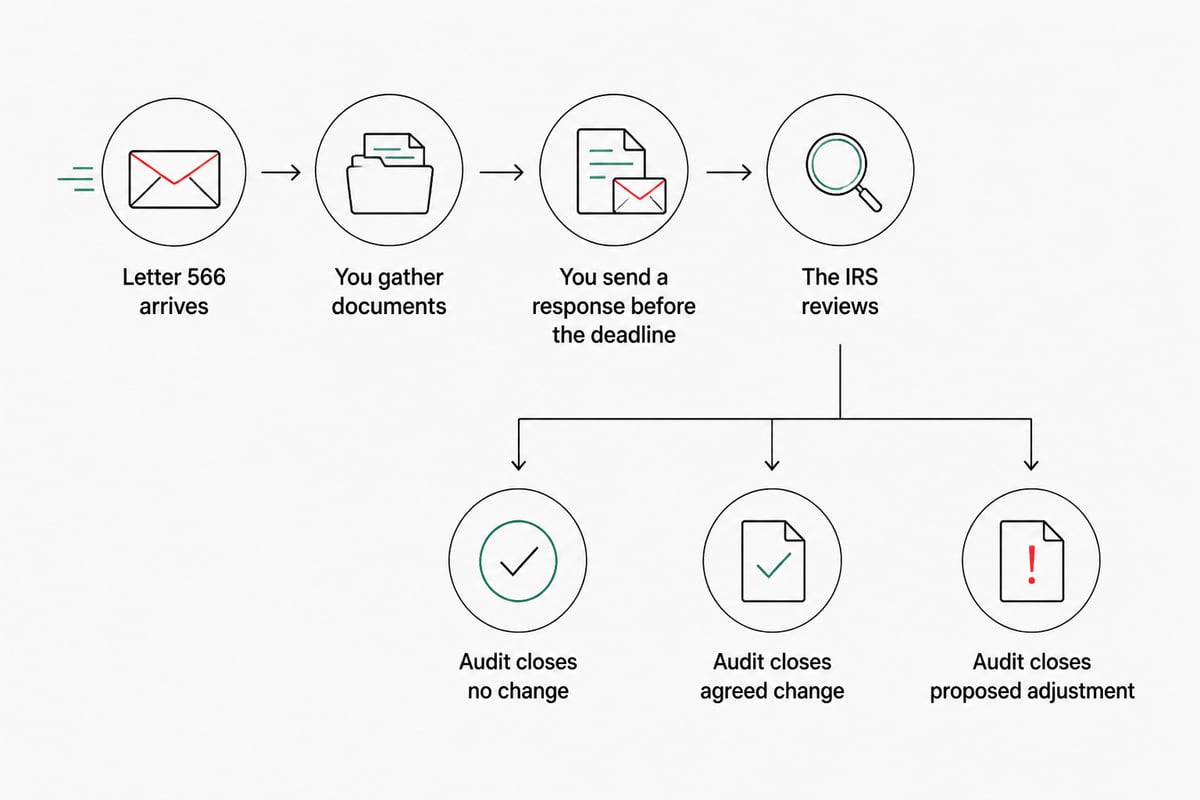
An IRS Letter 566 correspondence audit works as a paper exchange: the IRS asks, you answer with documents, and an examiner decides whether the return stands. It moves in a predictable order.
- The IRS sends Letter 566 identifying the items and the documents wanted.
- You respond by the date on the letter with records and a short explanation.
- An examiner reviews your package. This can take weeks or months.
- The IRS closes the audit or proposes changes. A closing with no change is the best outcome. A proposed change comes in a follow-up letter that explains the adjustment and your options.
Two things about this process surprise people. First, the examiner works only from what you send. Whatever is not in the package does not exist. Second, you are not stuck with the first deadline if you genuinely need time. The IRS's internal procedures in IRM 4.19.13 cover how examiners handle responses and extensions for certain document requests, which is why a timely, documented request for more time is better than silence.
How fast the IRS replies varies widely. If you want a sense of the waiting game, I covered IRS audit by mail response time in a separate piece.
Letter 566 vs. a CP2000 Notice
A CP2000 is not an audit, while a Letter 566 is. That difference changes your strategy.
| Letter 566 | CP2000 | |
|---|---|---|
| What it is | Start of a correspondence audit | Automated proposed adjustment |
| Trigger | Examination of selected items | Mismatch between your return and third-party reports |
| What the IRS wants | Documents proving items on your return | Agreement or a disagreement with a reason |
| Who reviews it | An examiner | An automated unit, then a person if you disagree |
People confuse the two constantly, and sending a CP2000-style reply to a Letter 566 gets you nowhere. If you are unsure which one you hold, the difference between a CP2000 and an audit is worth a few minutes before you write anything.
How Do You Respond to an IRS Letter 566?
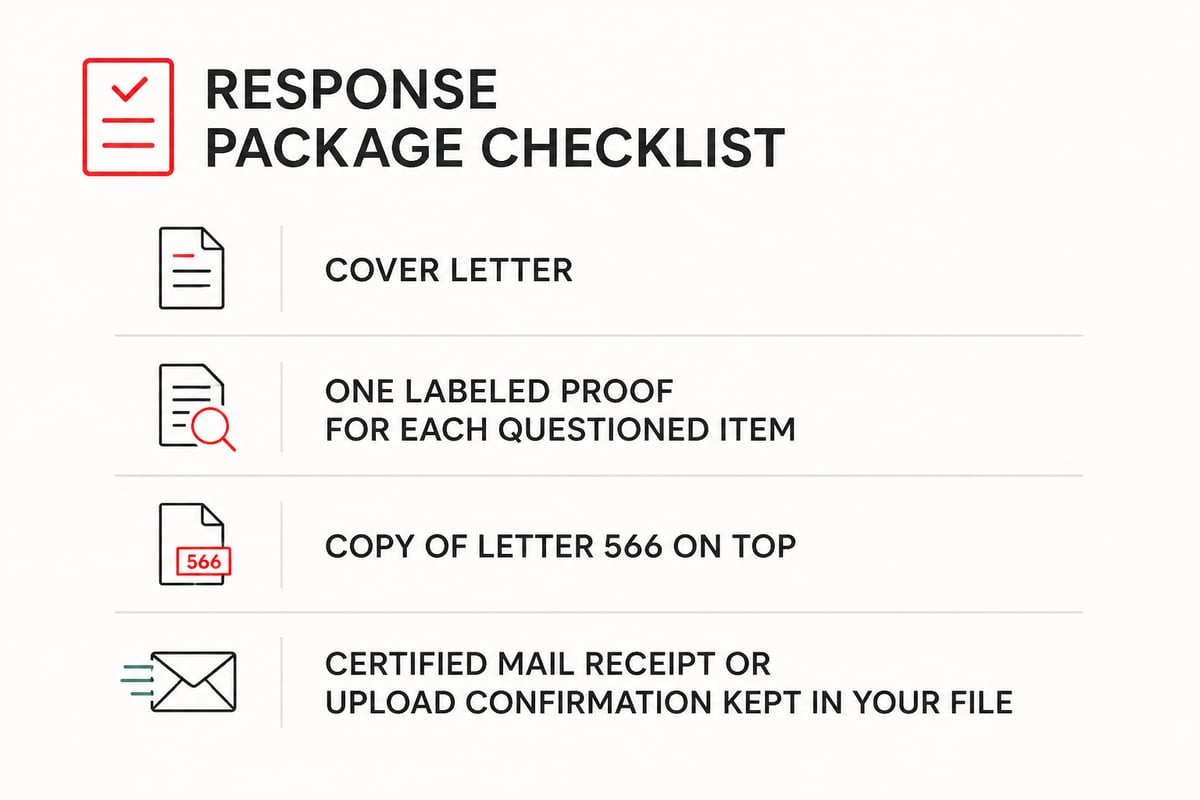
You respond to an IRS Letter 566 by sending the requested records, organized and labeled, before the deadline on the letter. Do not call first and improvise. Build the package, then send it.
Read the letter line by line
Highlight the tax year, each item questioned, each document requested, and the response date. Write the date on your calendar the same day. If the letter lists three items, your response must address three items.
Gather proof for exactly what they asked
The IRS says to identify the specific disputed items, gather supporting records such as receipts or bank statements, and explain each disagreement, according to its correspondence examination guidance. Match each item to its proof. Typical pairings:
- Business expenses: receipts, invoices, bank and card statements showing payment
- Charitable gifts: written acknowledgments from the charity, plus proof of payment
- Dependents or credits: school, medical, or residency records that show who lived where and for how long
- Income questions: 1099s, deposit records, and a written reconciliation of any difference
Write a short cover letter
Keep it plain. State your name, tax year, and the last four digits of your Social Security number. List each item, say what you are sending for it, and point to the page. If you disagree with part of the IRS's view, say so in a sentence and attach the support. Skip the story of your year and the complaints about the IRS.
Send it a way you can prove
The IRS accepts correspondence exam documents through the Document Upload Tool or by mail to the address on the letter, per the IRS guidance linked above. If you mail it, use certified mail with a return receipt and keep a full copy of everything. If you upload, save the confirmation.
What Mistakes Hurt You in a Correspondence Audit?
The mistakes that hurt most are missing the deadline, sending too much, and sending too little. Each one is avoidable.
Ignoring the letter. Silence is treated as agreement. If you do not respond, the IRS can propose changes based on what it already has, and those changes usually favor the IRS.
Burying the examiner in paper. A shoebox dump signals nothing is organized. The examiner has a small window per case. Give them one clear proof per item.
Sending proof for the wrong thing. Answer the items listed, not the ones you wish they asked about.
Guessing at numbers. Reconstructed estimates without records look like what they are. If a record is gone, ask the bank, the payroll provider, or the charity for a copy and say so in your cover letter.
Volunteering information. Answer the question asked. Do not add commentary about other years, other income, or other deductions. A correspondence audit can widen if you hand the examiner a reason.
Calling the examiner to talk it through. A phone conversation is not privileged when you have no attorney. Everything you say to the IRS can be used. This is one reason people retain counsel, because attorney-client privilege protects what you tell your lawyer, which is not true of a CPA.
A related case is the earned income credit, where the documentation burden is heavy. If that is your issue, read about an EITC correspondence audit in Florida.

What Happens After You Respond?
After you respond, the IRS reviews your package and sends one of three results: no change, an agreed change, or a proposed adjustment you can dispute. Expect to wait. Silence for weeks is normal and does not mean anything is wrong.
If the audit closes with no change, you get a letter saying so, and you keep that letter forever. If the examiner proposes changes you agree with, you sign and pay. If you disagree, you have options, and the next letter will explain them.
You can request a conference with the examiner's manager or go to the IRS Independent Office of Appeals. If the IRS issues a notice of deficiency, you generally have 90 days from the date of the notice to petition the Tax Court, or 150 days if the notice is addressed outside the United States, according to IRS Publication 556. That deadline is not flexible. Miss it and the assessment becomes final.
Another route exists even after an assessment. The IRS says audit reconsideration is available when you disagree with an audit assessment and the liability remains unpaid, among other qualifying circumstances. The IRS estimates a response within 30 days, but says processing can take longer. One limit to know: if you already paid the assessed tax, audit reconsideration is not how you get money back. You file Form 1040-X to claim a refund instead. All of this is laid out in the IRS's correspondence examination guidance, and the IRS has granted full relief in a large share of reconsideration cases, which I wrote about in this look at audit reconsideration results.
What If You Cannot Meet the Deadline?
If you cannot meet the deadline, ask for more time in writing before it passes, and say why. A request made on day 28 of a 30-day window is taken more seriously than one made on day 40.
Call the number on the letter or write to the address listed. Give a specific reason: records requested from a bank, a preparer who has moved, an illness, a business closure. Then follow up in writing and keep a log of every call, with the date, the name or ID number of the person, and what was said.
Do not assume the extension is granted until you have it in writing. Examiners can agree on the phone and the file can still show no response.
Sometimes the problem is not time but missing records. Missing records are often fixable. Bank statements, card statements, and third-party confirmations can often rebuild the picture. Where records truly do not exist, an attorney can sometimes negotiate what the IRS will accept as reasonable substitute proof.
When Should You Hire a Tax Attorney?
You should hire a tax attorney when the amount at stake is significant, when the audit touches business income, or when you are missing records you were expected to keep. A simple one-item letter about a missing form can be handled by you. A Letter 566 that questions several years, a business, cash income, or crypto should not be.
There is also a reason that has nothing to do with complexity. Once you retain counsel, all communications with the IRS go through the firm. You stop being the person answering every letter and phone call. That alone lowers the risk of saying something that widens the audit.
If you want help, IRS Audit Defense covers representation in correspondence, office, and field audits. For background on how to size up the options, read what to do when the IRS audits you and worried about an IRS audit? here are your legal options.
If you own rental property or a small building, you may also keep records across several entities, and organized books help every audit. For owners of boutique residential buildings in Melbourne, Australia, FlipStrata offers strata management that can keep building finances in order.
FAQ
What is a correspondence audit by the IRS?
A correspondence audit is an IRS examination handled entirely by mail or through the IRS upload tool. The IRS asks you to document specific items on your return, and an examiner decides from the records you send. It is the simplest type of audit, but it can still produce a tax bill.
What is a CP566 notice?
People use "CP566" to refer to IRS Letter 566, the initial contact letter in a correspondence audit. It tells you which items are under review, what documents to send, and the date your response is due. It is not a bill.
Does a correspondence audit mean I did something wrong?
No. Many audits start from a mismatch between your return and information the IRS received from employers or banks, or from a scoring system that flagged an item for review. A letter is a request for proof, not an accusation. Answer it accurately and on time.
Pull out the letter today, circle the response date, and start matching each questioned item to a record before you write a word. If the numbers are large, the records are thin, or the letter makes your stomach drop, bring in help before you answer anything. Our IRS Audit Defense work covers correspondence audits like this one, and the first conversation is free, so Let’s talk and let's talk about what the IRS is asking and how to answer it.