

Quick answer: IRS Innocent Spouse Relief separates one spouse from joint tax liability when the other spouse’s actions caused the underpayment. Three forms of relief under IRC §6015: traditional innocent spouse, separation of liability, and equitable relief. You file Form 8857 within 2 years of the IRS first attempting to collect from you. Common in divorce, hidden income, and abusive marriages.
I’m Darrin Mish. Tampa tax attorney, 32 years in, more than $100 million in IRS debt resolved. What follows isn’t theory – it’s what I’ve actually watched work.
When you file a joint tax return with your spouse, you're both equally responsible for the entire tax bill. But what happens when your spouse makes a mistake, commits fraud, or fails to report income without your knowledge? You might find yourself on the hook for taxes you didn't even know existed. That's where irs innocent spouse relief comes in, and understanding this option could save you from financial devastation.
Understanding the Basics of Joint Tax Liability
Let's talk about what happens when you sign that joint return. When you and your spouse file together, you're both signing up for "joint and several liability." Sounds complicated, right? It basically means the IRS can come after either one of you for the full amount owed.
Here's the reality: many couples file jointly without fully understanding this risk. You might have trusted your spouse to handle the finances, or maybe you signed the return without reading all the details. Now you're facing a massive tax bill for something you didn't do or didn't know about.
The good news? The IRS recognizes that sometimes it's unfair to hold both spouses responsible. That's exactly why innocent spouse relief exists. This provision can potentially release you from liability for your spouse's tax errors or fraud.
Three Types of IRS Innocent Spouse Relief
The IRS doesn't offer just one type of relief. There are actually three different paths you can take, and each one has specific requirements and situations where it applies best.
Traditional Innocent Spouse Relief
This is the original form of relief, and it applies when your spouse understated taxes on your joint return. Maybe they failed to report income, claimed false deductions, or made other errors that resulted in too little tax being calculated.
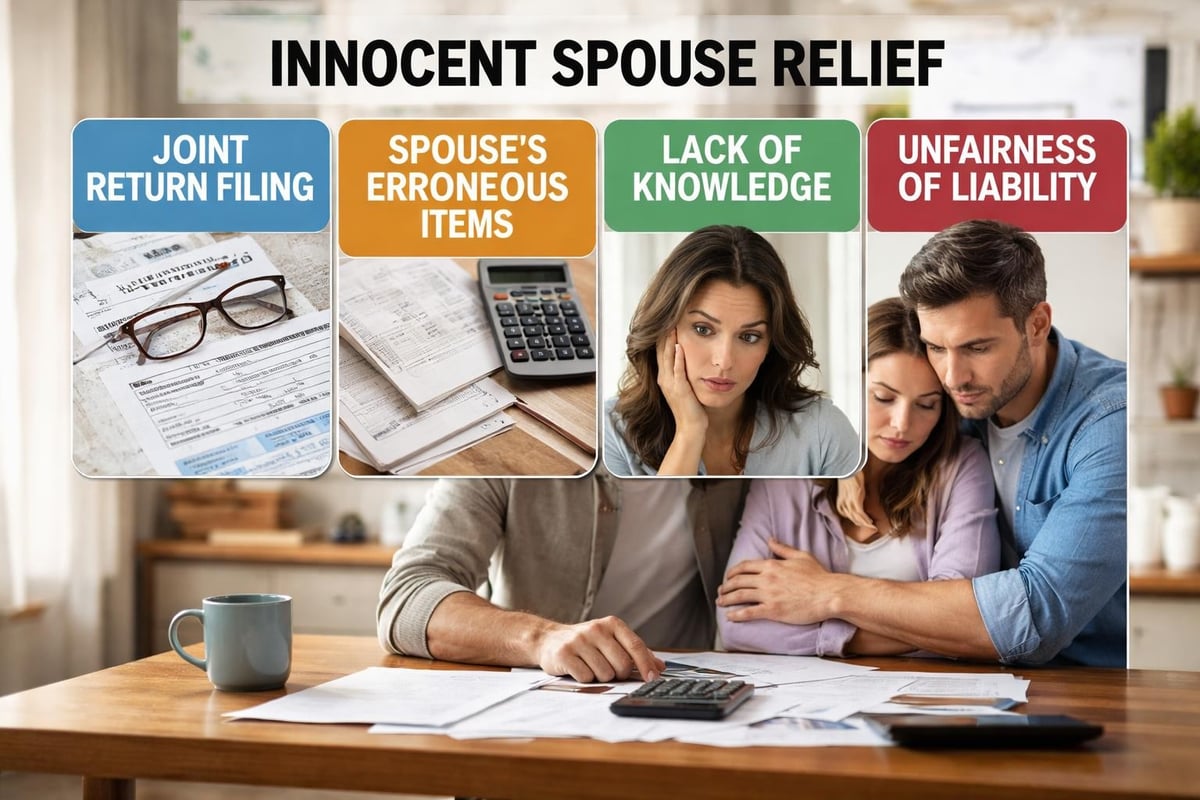
To qualify for traditional irs innocent spouse relief, you need to meet several conditions:
- You filed a joint return with an understatement of tax
- The understatement is attributable to your spouse's erroneous items
- You didn't know and had no reason to know about the understatement when you signed
- Considering all facts and circumstances, it would be unfair to hold you liable
The "no reason to know" requirement is crucial. The IRS examines your education level, involvement in business activities, and whether you benefited from the understated tax. If you lived a lavish lifestyle from unreported income, the IRS might question whether you truly didn't know.
Separation of Liability Relief
This option becomes available when you're divorced, legally separated, or haven't lived with your spouse for at least 12 months. Separation of liability relief essentially divides the tax debt between you and your spouse based on who's responsible for what.
The IRS allocates the understatement based on which spouse's items created the problem. If your ex-spouse failed to report their side business income, that portion of the tax debt gets allocated to them, not you.
Key eligibility requirements include:
- You're no longer married, legally separated, or living apart for 12+ months
- You filed a joint return
- An understatement of tax exists
One major advantage? You don't have to prove you didn't know about the understatement. However, there are disqualifying factors. If the IRS proves you had actual knowledge of the erroneous items, you won't qualify for relief on those items.
Equitable Relief
Sometimes you don't qualify for the first two types, but it still seems completely unfair for the IRS to collect from you. That's where equitable relief comes in as a safety net.
Equitable relief applies in two situations: when you have an understatement of tax (but don't qualify for the other two types) or when you have an underpayment. An underpayment happens when the tax was correctly calculated, but your spouse didn't pay it.
The IRS considers numerous factors when evaluating equitable relief requests:
| Factor | What the IRS Considers |
|---|---|
| Marital status | Whether you're still married or separated |
| Economic hardship | Your ability to pay based on income and assets |
| Knowledge | What you knew or should have known |
| Legal obligation | Who was legally obligated to pay |
| Significant benefit | Whether you benefited beyond normal support |
| Abuse | Whether you were abused or controlled by your spouse |
This is the most flexible form of irs innocent spouse relief, but it's also the most subjective. The IRS has considerable discretion in granting or denying these requests.
The Application Process: What You Need to Know
Ready to apply? You'll need to file Form 8857, Request for Innocent Spouse Relief. This isn't a simple form you can knock out in 15 minutes. It requires detailed information about your marriage, finances, and the tax issues involved.
Here's what you should prepare before starting:
- Complete copies of the tax returns in question
- Documentation of your financial situation during the tax years
- Evidence supporting your lack of knowledge (if applicable)
- Any documentation of separation or divorce
- Records showing who controlled household finances
- Evidence of abuse or financial control (if relevant)
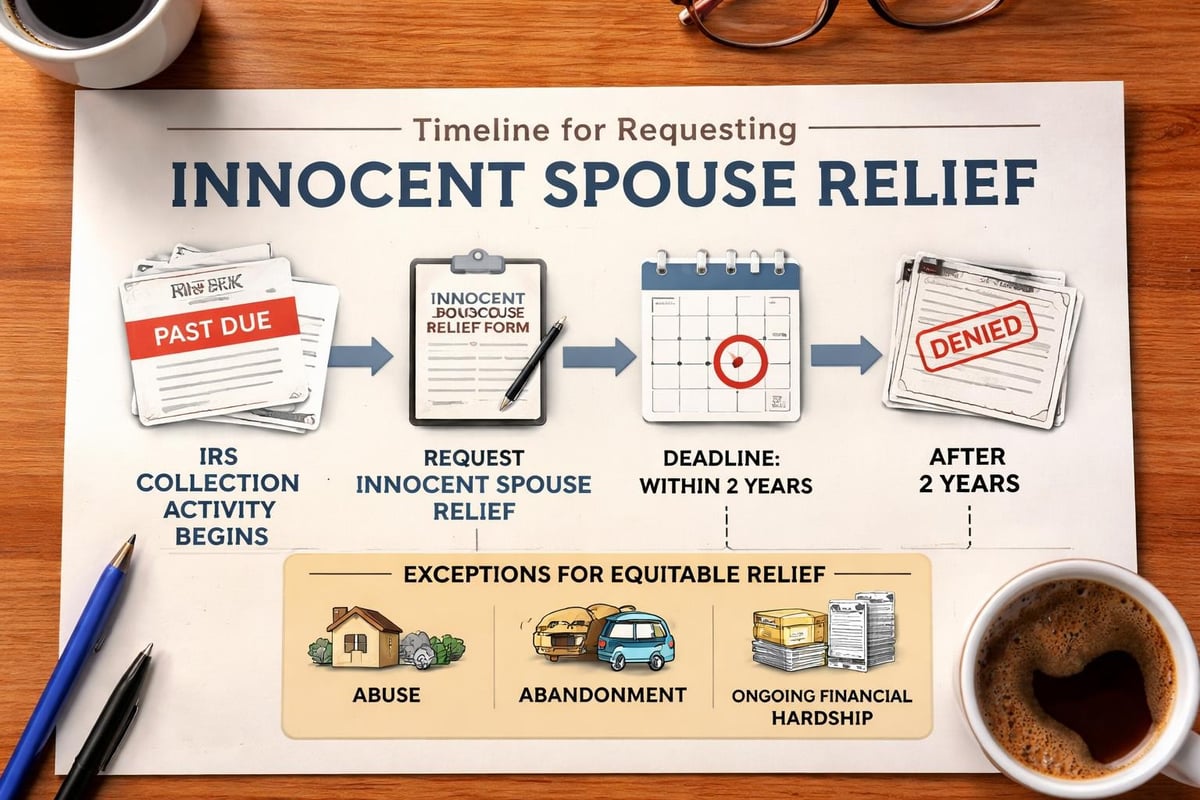
Timing matters significantly. For traditional innocent spouse relief and separation of liability, you generally must request relief no later than two years after the IRS first began collection activities against you. However, equitable relief has different timing rules that can be more forgiving.
You can request relief even if you've already paid the tax. The IRS might refund you if they approve your request. You can also request relief while the IRS is still determining your tax liability.
Common Situations That Qualify for Relief
Let me share some real-world scenarios where irs innocent spouse relief becomes essential. These situations happen more often than you'd think.
The Self-Employed Spouse: Your spouse runs their own business, handles all the bookkeeping, and prepares the tax return. You sign it trusting everything's correct. Later, you discover they underreported business income by $75,000. You had no involvement in the business and no way to know about the unreported income. This is a textbook case for relief.
The Secret Income: Your spouse has a side job or investment income they never told you about. They don't report it on your joint return. You find out years later when the IRS sends a notice. If you can prove you didn't know about this income, you've got a strong case.
The Fraudulent Deductions: Your spouse claims business expenses that don't exist or inflates charitable contributions. You had no knowledge they were doing this. Again, this could qualify you for relief.
Similar to situations where you might need help with other IRS tax problems, innocent spouse cases often involve complex financial situations that benefit from professional guidance.
What Happens After You File Form 8857?
The IRS doesn't make quick decisions on these requests. The process typically takes six months to a year, sometimes longer. During this time, the IRS will:
- Review your Form 8857 and supporting documentation
- Request additional information if needed
- Contact your spouse or former spouse for their input
- Analyze your financial situation during the relevant years
- Make a preliminary determination
Your spouse gets notified when you request relief. They have the right to participate in the process and can contest your request. This can make things awkward if you're still married or uncomfortable if you're dealing with an abusive ex.
Protecting Yourself During the Process
While the IRS reviews your request, collection activities might continue. However, you can request a Collection Due Process hearing if the IRS is taking enforcement action. This gives you additional rights to challenge the collection.
Steps to protect yourself:
- Keep detailed records of all IRS communications
- Document every interaction with IRS representatives
- Continue responding to IRS notices promptly
- Consider requesting a payment plan if you have other tax debts
- Don't ignore notices just because you filed for relief
Understanding how to settle IRS debt becomes crucial if you have tax liabilities beyond what you're requesting relief from.
When Relief Gets Denied: Your Options
Not every request for irs innocent spouse relief gets approved. The IRS might determine you don't meet the requirements, or they might find evidence that contradicts your claims.
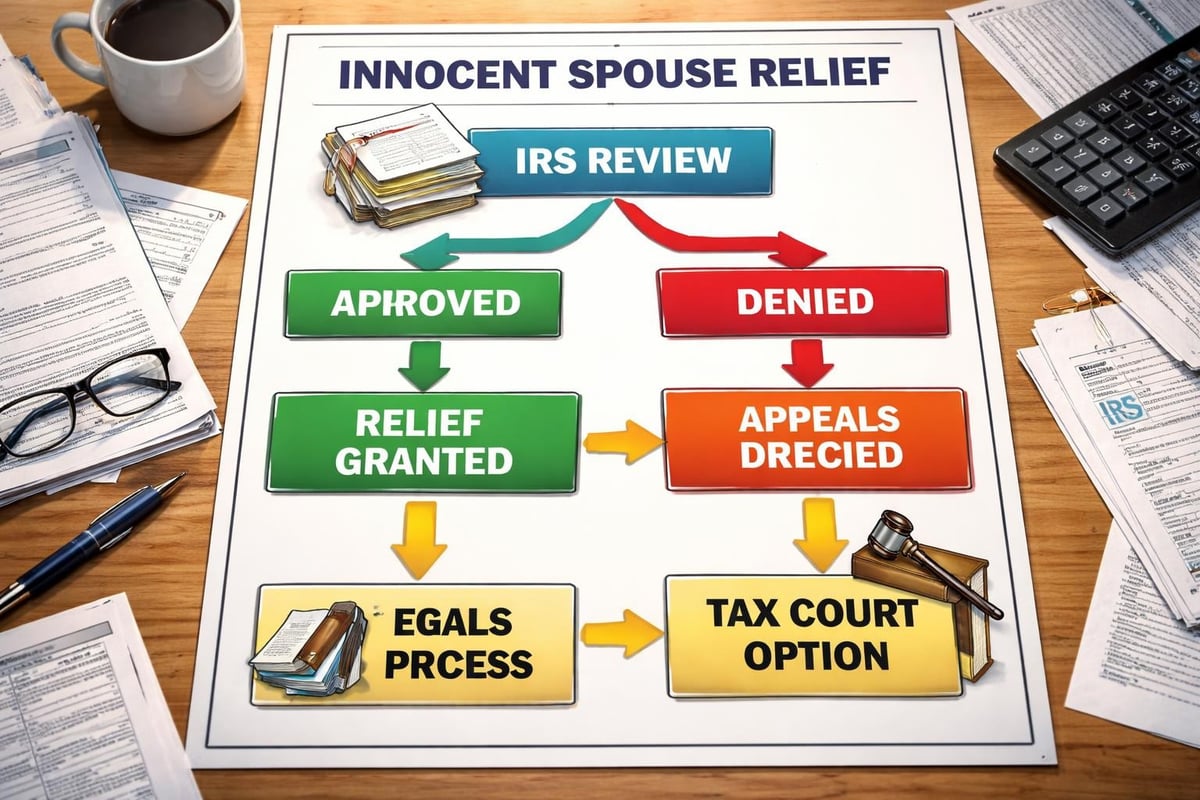
If your request is denied, you have appeal rights. You can request an Appeals Office review within 30 days of the denial. Appeals is an independent office within the IRS that takes a fresh look at your case.
Beyond Appeals, you can take your case to Tax Court. In fact, Tax Court is often the better option because:
| Appeals | Tax Court |
|---|---|
| Limited to reviewing IRS's decision | Can make independent determination |
| Less formal process | More formal legal proceedings |
| No new evidence typically | Can present new evidence |
| Faster resolution | Takes longer |
| No attorney required | Attorney strongly recommended |
Working with experienced professionals who understand tax debt solutions can significantly improve your chances of success, especially if you need to appeal.
Special Considerations for Abusive Relationships
The IRS recognizes that domestic abuse can affect a spouse's knowledge and ability to question tax issues. If you were in an abusive relationship, this factor weighs heavily in favor of granting relief.
You don't need a police report or protective order to claim abuse, though such documentation helps. The IRS considers emotional abuse, financial control, and psychological manipulation as forms of abuse relevant to innocent spouse determinations.
Evidence of abuse might include:
- Testimony from counselors, clergy, or social workers
- Medical records documenting injuries
- Court records of protective orders
- Witness statements from family or friends
- Your own detailed affidavit describing the abuse
The Taxpayer Advocate Service can be particularly helpful in these situations, providing additional support and advocacy.
Knowledge Standards: What Did You Know?
The "knowledge" element trips up many innocent spouse relief requests. The IRS doesn't just ask what you actually knew, they also examine what you should have known based on the circumstances.
Consider these scenarios. If your household income was $50,000 but you lived in a million-dollar home, the IRS questions whether you should have realized something was off. If you signed a return without reading it, the IRS might determine you had constructive knowledge of its contents.
However, the law has evolved over time. Thanks to changes in interpretation, the IRS now considers more nuanced factors. They look at your education level, involvement in financial matters, and whether your spouse took steps to conceal information from you.
Financial Impact and Life After Relief
Getting approved for irs innocent spouse relief can mean the difference between financial stability and bankruptcy. I've seen cases where individuals faced six-figure tax bills for a spouse's fraud, completely unaware of the wrongdoing.
Beyond the immediate financial relief, approval affects your credit, your ability to obtain future loans, and your peace of mind. The IRS removes tax liens related to the relieved liability, and you're no longer responsible for that portion of the debt.
Keep in mind that relief only applies to the specific tax years and issues you requested. If you have other tax years with joint returns, those liabilities remain unless you seek separate relief for them.
Comparing Relief Options
Choosing the right type of relief matters. Sometimes you might qualify for more than one type, and you need to evaluate which offers the best outcome.
| Relief Type | Best For | Key Advantage | Main Limitation |
|---|---|---|---|
| Traditional | Understatements you didn't know about | Complete relief possible | Strict knowledge requirement |
| Separation of Liability | Divorced or separated spouses | Don't need to prove unfairness | Must allocate the understatement |
| Equitable | When other relief doesn't fit | Most flexible | Most subjective decision |
For detailed guidance on all three approaches, IRS Publication 971 provides comprehensive examples and explanations.
Timing Strategies and Recent Changes
Recent developments have extended certain time limits for requesting relief. Previously, the two-year deadline was strictly enforced, but modifications now allow more flexibility for equitable relief requests.
The IRS has also streamlined some processing procedures in 2026, though cases still take considerable time to resolve. If you're facing IRS liens or other collection actions, timing your request strategically can provide important protections.
One crucial point: you can request relief even before the IRS assesses the tax. If you discover your spouse's error before the IRS does, filing Form 8857 proactively can prevent collection actions against you.
Working With Tax Professionals
Navigating irs innocent spouse relief without professional help is possible, but it's challenging. These cases involve complex legal standards, extensive documentation requirements, and strategic decisions about which relief to pursue.
Tax attorneys who specialize in IRS problems understand how to present your case most effectively. They know what evidence the IRS finds persuasive, how to address weaknesses in your claim, and when to push back against IRS positions.
The investment in professional representation often pays for itself. A successful relief request can save you tens or hundreds of thousands of dollars. Even partial relief significantly reduces your burden.
When considering whether you need representation, think about the complexity of your situation, the amount of money at stake, and your comfort level dealing with the IRS. Cases involving fraud allegations, significant unreported income, or denials that require appeal typically benefit most from professional guidance.
Understanding your options for irs innocent spouse relief represents the first step toward resolving unfair tax liability created by your spouse's actions. With three different types of relief available and specific requirements for each, determining your best path forward requires careful evaluation of your unique circumstances. The Law Offices of Darrin T. Mish, P.A. has over 32 years of experience helping taxpayers navigate innocent spouse relief claims, from initial filing through appeals and Tax Court if necessary. If you're facing tax liability for your spouse's errors or fraud, contact Law Offices of Darrin T. Mish, P.A. today for a free consultation to explore your relief options.
How to File for IRS Innocent Spouse Relief
- Step 1: Determine which type of relief applies Three forms under IRC §6015: traditional innocent spouse (§6015(b)), separation of liability (§6015(c)), or equitable relief (§6015(f)). Each has different qualifying tests. Most claimants pick more than one.
- Step 2: Confirm the IRS has tried to collect from you You generally must file Form 8857 within 2 years of the IRS’s first attempt to collect from you specifically. Note the date of the first IRS notice that named you.
- Step 3: Document the underpayment was attributable to your spouse Show the income, deduction, or credit that caused the underpayment came from your spouse’s activity. Bank records, tax returns, and correspondence help.
- Step 4: Show you didn’t know — and reasonably couldn’t have known Knowledge is the central battleground. Document your role in finances, education level, and exposure to the source of the issue. Spousal abuse cases get extra weight.
- Step 5: File Form 8857 (Request for Innocent Spouse Relief) Mail to the IRS Stop 840-F address. Include all supporting documentation in one packet. The IRS will notify your spouse, who has the right to participate.
- Step 6: Respond to IRS questions and appeal denials The IRS Innocent Spouse Unit reviews. If denied, you can appeal to the IRS Office of Appeals or Tax Court. Many cases settle at Appeals.