

Stop losing sleep over your tax situation. I'm Darrin Mish — a tax attorney in Tampa who's spent 32 years handling exactly this kind of problem. Here's what you need to know.
I'm Darrin Mish. Tampa tax attorney, 32 years in, more than $100 million in IRS debt resolved. What follows isn't theory. It's what I've actually watched work.
An IRS Form 4564 information document request, or IDR, is the IRS auditor's written list of records and answers they want from you, with a due date attached. It is not a bill, and it is not a penalty. But it is the clearest sign you are in an audit, and how you answer it shapes everything that comes next.
What Is an IRS Form 4564 Information Document Request?
Form 4564 is the form an IRS examiner uses to ask you, in writing, for specific documents, records, and explanations during an audit. The form lists each item the examiner wants, the tax year it relates to, and the date by which the IRS expects a reply.
Think of it as the examiner's shopping list. They have looked at your return, spotted items they want to verify, and put those items in writing. Each line is a separate request, and each one needs its own answer.
Here is what the form generally contains:
- Your name, taxpayer identification details, and the tax years under examination
- A numbered list of the documents or information requested
- The examiner's name and contact information
- A response due date
The IRS can open an audit several ways. IRS Publication 556 says returns may be selected through computerized screening, random sampling, or an income-document matching program. So receiving a Form 4564 does not mean the IRS thinks you did something wrong. It means your return landed in a pile and someone needs paper to close it out.
What Does the IRS Request During an Audit?
During an audit, the IRS asks for records that prove the numbers on your return: income, deductions, credits, and anything else that affects your tax. The examiner picks the categories based on what looks unusual or unsupported on your return.
For individuals, the list often includes:
- Bank and credit card statements for the year
- W-2s, 1099s, and other income reporting
- Receipts and logs backing up business or charitable deductions
- Mortgage interest, property tax, and medical expense records
- Documentation for dependents and credits claimed
For business owners and self-employed taxpayers, expect more:
- Profit and loss statements, general ledgers, and invoices
- Vehicle mileage logs and travel and meal records
- Payroll records and Forms 941, 940, and W-3
- Loan documents and records of owner draws or distributions
- Contracts, especially where worker classification is in question
Some requests are narrow, such as one receipt for one deduction. Others are broad, like all bank statements for twelve months. The broad ones are not always a bad sign. Examiners often use bank deposits to test whether reported income matches what actually came in.
What Should You Do the Day You Receive It?
Read the whole form, calendar the due date, and do not respond until you understand what each line asks for. Most of the damage I see in audits happens in the first week, when people either panic or ignore the form.
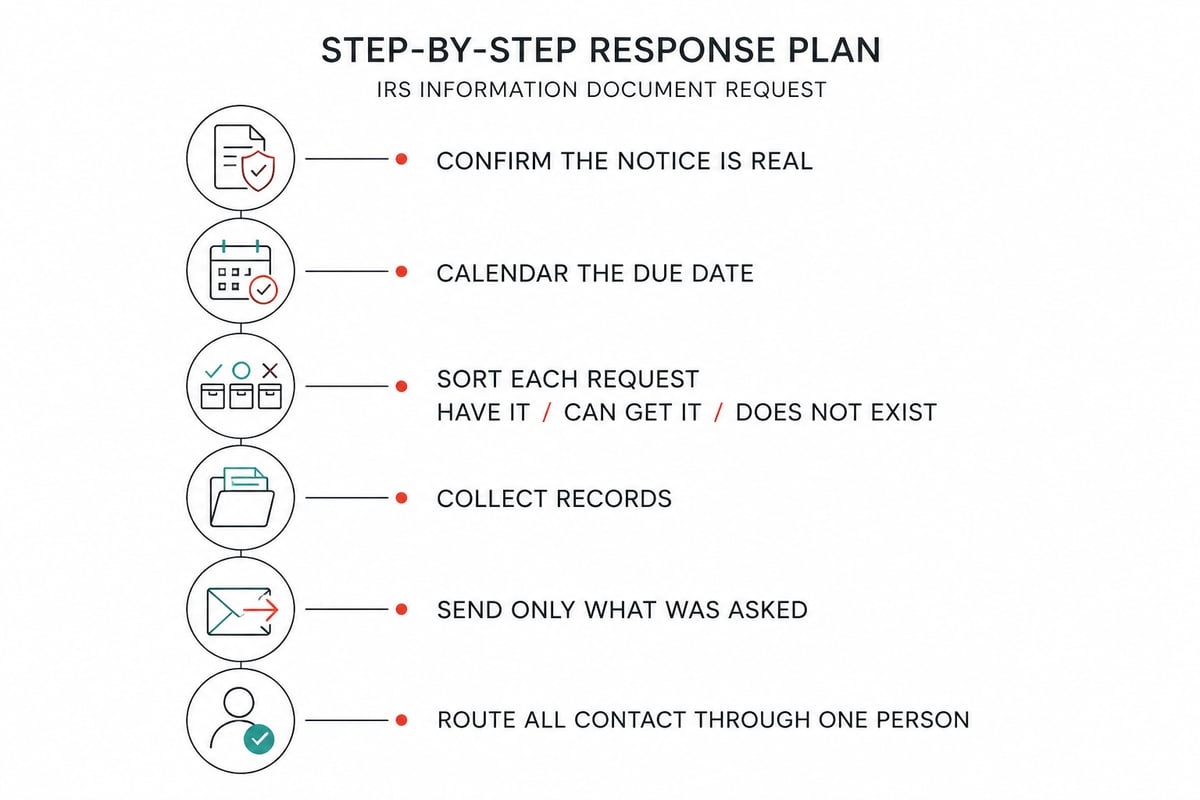
Follow these steps in order:
- Confirm it is real. Check that the examiner's name, address, and phone number match an IRS notice you can verify. Scams that imitate IRS paperwork are common, and the IRS scam warnings are worth a look if anything seems off.
- Mark the response date. Put it on your calendar with a reminder two weeks earlier.
- Sort the requests. Mark each line as "have it," "can get it," or "does not exist."
- Start collecting. Pull what you have first. Request bank statements and third-party records now, since they take time.
- Do not hand over more than asked. Answer the question on the form. Extra paper invites extra questions.
- Stop talking to the examiner informally. Phone calls and casual explanations create statements you cannot take back.
If you want a record of what the examiner is working from, the audit documentation article covers what should be in your file.
How Do You Respond to an IRS Information Document Request?
You respond in writing, item by item, matching your answers to the numbers on the form. Keep copies of everything, and send nothing you have not reviewed.
Here is how I want a response organized:
- Cover letter. Short and factual. List the item numbers you are answering and what you are enclosing.
- Numbered answers. Item 1 answer, then the supporting document. Item 2 answer, then its document. The examiner should never have to hunt.
- Clean copies. Send copies, not originals. Black out account numbers unrelated to the request when appropriate.
- Delivery proof. Use certified mail or the IRS-approved secure method, and keep the receipt.
What about an item you simply cannot produce? Say so plainly and explain why, in one or two sentences. A lost receipt is not a crime. A made-up or reconstructed receipt presented as original is a much bigger problem. If a record is gone, there may be other ways to prove the expense, such as bank records, third-party statements, or a reasonable written reconstruction labeled as such.
And never guess. If you are not sure what an item means, ask for clarification in writing, or have someone ask on your behalf.
Can You Get More Time to Answer?
Yes. You can ask the examiner for more time, and examiners may grant it when the request is reasonable and made before the due date. Ask early, in writing, and say specifically what you are still gathering.
Extensions are not unlimited. The Tax Procedure Center’s summary of the IRS manual says the LB&I IDR procedures allow one extension before enforcement begins. Those procedures apply to large business examinations, but they show how the IRS thinks about timing: a limited extension, not an open-ended delay.
Time limits also show up in the next stage of an audit. The Taxpayer Advocate Service says a 30-day letter gives you a chance to review proposed audit changes, and if you need more time you should call the number on the letter before the due date. Same rule applies here. Call before the deadline, not after.

What Happens If You Ignore the Form 4564 Request?
If you ignore it, the examiner can move to a summons and can propose changes to your return based only on what they already have. That usually means a bigger tax bill, plus penalties and interest, with no credit for deductions you could have proven.
Here is the usual path when an IDR goes unanswered:
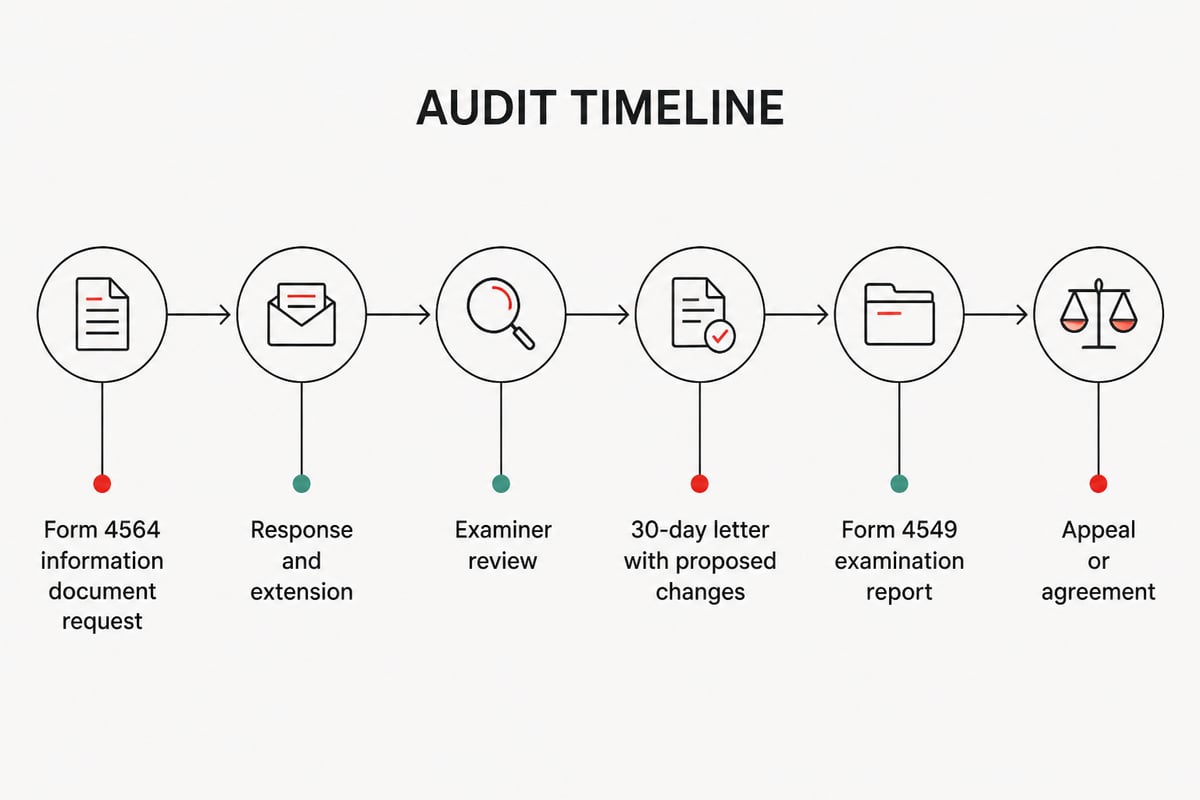
- The examiner sends a follow-up or delinquency notice.
- The IRS issues a summons, which is a legal demand for records or testimony.
- The examiner closes the audit and proposes adjustments based on their own view of your return.
- You receive an examination report. The Form 4549 examination report article explains how to disagree with it.
You can still dispute proposed changes. Publication 556 says taxpayers who disagree may appeal by following IRS procedures. But appealing after you stonewalled the examiner is harder than answering the first request properly.
Silence also looks bad. Examiners read non-response as either disorganization or something worse, and the audit often widens.
What Should You Never Put in Your Response?
Never put guesses, opinions about the law, speculation, or anything you cannot back up with a document. Your response should read like a clerk's inventory, not a confession.
The most common mistakes:
- Volunteering explanations nobody asked for
- Sending records for tax years not under audit
- Contradicting what your return said without understanding why
- Handing over tax preparer notes or personal communications
- Signing statements you have not read twice
This is where attorney involvement matters. Communications with an attorney are generally covered by attorney-client privilege, which a conversation with a CPA is not. If you tell your accountant something damaging, the IRS can try to reach it. Say it to your lawyer first.
When Does a Tax Attorney Make Sense?
Bring in an attorney when the request is broad, the dollars are high, the examiner asks about specific transactions or foreign accounts, or you are unsure whether something on the return was wrong. Early beats late every time.
Warning signs that call for help now:
- The IDR asks for bank statements across multiple years
- The examiner mentions unreported income or worker misclassification
- You have unfiled returns for other years
- You already owe back taxes and fear the audit will add to them
- The notice references a possible fraud penalty
Once you hire representation, the firm handles the communication. With the proper authorization, all communications with the IRS go through us, so the examiner stops calling you directly. The Form 2848 power of attorney is the document that makes that happen.
If you need defense through correspondence, office, or field examinations, our IRS Audit Defense service covers all three. We have handled IRS matters for 32 years, and Darrin holds an Avvo rating of 9.9 and a Martindale-Hubbell AV Preeminent rating.
How Can You Get a Copy of Your IRS Records?
You can request your own IRS records through a Freedom of Information Act request or by pulling transcripts, and doing so before you answer an IDR can help you see what the IRS already has. Knowing the examiner's information keeps you from contradicting it.
Two routes matter here. Transcripts show what was filed and reported under your number, including third-party income documents. A FOIA request can get you more of the file. Our articles on obtaining your IRS records under FOIA and making FOIA requests cover forms, fees, and exemptions.
One practical point. If a 1099 or W-2 was reported under your number and you did not include it, the examiner already knows. Find that out before you write your response, not after.
FAQ
Is Form 4564 the same as an audit notice?
No. The audit notice tells you an examination has started. Form 4564 is the examiner's list of what they want from you during it. You usually get the notice first, then one or more IDRs as the audit progresses.
Can I send my response electronically?
Sometimes. Ask the examiner what secure method they accept, and do not email sensitive records through ordinary email. Whatever method you use, keep proof of what you sent and when.
Can I file more than one response?
Yes. Many audits involve several rounds of requests. Answer each IDR fully and on time, and keep a log of what you sent so later requests do not create contradictions.
Your next step is simple: put the due date on your calendar today and photograph every page of the Form 4564 before touching anything else. If the request is broad or the stakes are high, bring in an attorney before you send a single page, because the first response sets the tone for the whole audit. Let's talk, and the Law Offices of Darrin T. Mish, P.A. offers a free consultation with no obligation, so you can find out where you stand before the deadline arrives.