

I hear from people every week who think their tax problem is the end of the world. It usually isn't. I'm Darrin Mish. I've resolved over $100 million in tax debt for clients. Here's what you should know.
I'm Darrin Mish. Tampa tax attorney, 32 years in, more than $100 million in IRS debt resolved. What follows isn't theory. It's what I've actually watched work.
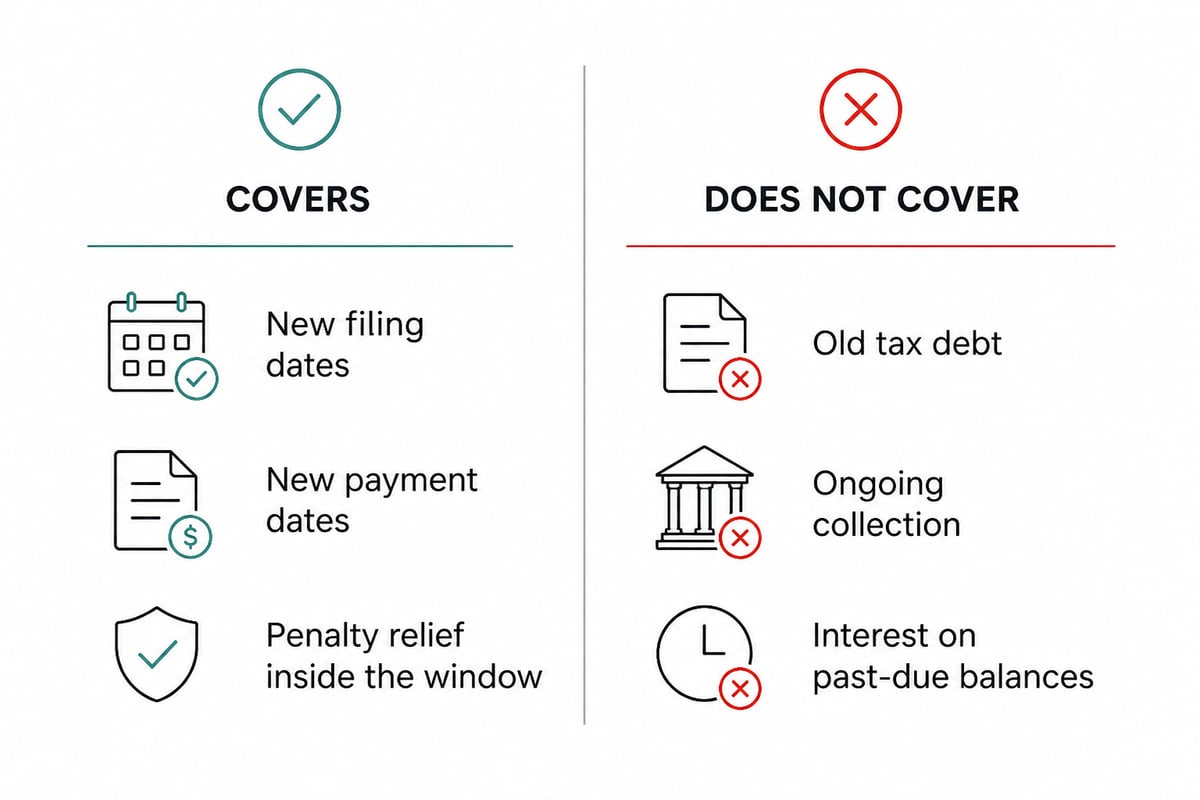
The IRS disaster postponement for a Florida hurricane applies to taxpayers in a county the IRS has designated, and it pushes covered filing and payment deadlines out to a new date. Taxpayers generally do not need to apply for it. But it only moves due dates. It does not erase tax you owe, and it does not stop interest on a balance that was already past due.
That second part is where people get hurt. A postponement is a calendar adjustment, not forgiveness.
How Does the IRS Disaster Postponement Work After a Florida Hurricane?
The IRS grants a postponement after a federally declared disaster by moving certain deadlines to a later date for everyone in the covered area. Once the IRS announces relief for specific counties, affected taxpayers get extra time to file returns, pay tax, and make certain other filings without penalties or interest for missing the original date.
Here is what happened with recent Florida storms. For Tropical Storm Debby, the IRS set February 3, 2025, as the postponed deadline for affected Florida taxpayers, covering certain deadlines from August 1, 2024, through before February 3, 2025. For Hurricane Helene, affected taxpayers in parts of Florida received a May 1, 2025, deadline for various federal returns and payments, and taxpayers previously covered by the Debby relief also received that deadline.
Notice the pattern. The IRS picks a window, picks counties, and picks one new deadline for everything inside the window. Your personal due date does not matter. The new date applies to anyone with a covered deadline that falls in the window.
I wrote about an older storm event years ago in a post on IRS relief after Hurricane Isaias.
Who Qualifies for IRS Disaster Postponement in Florida?
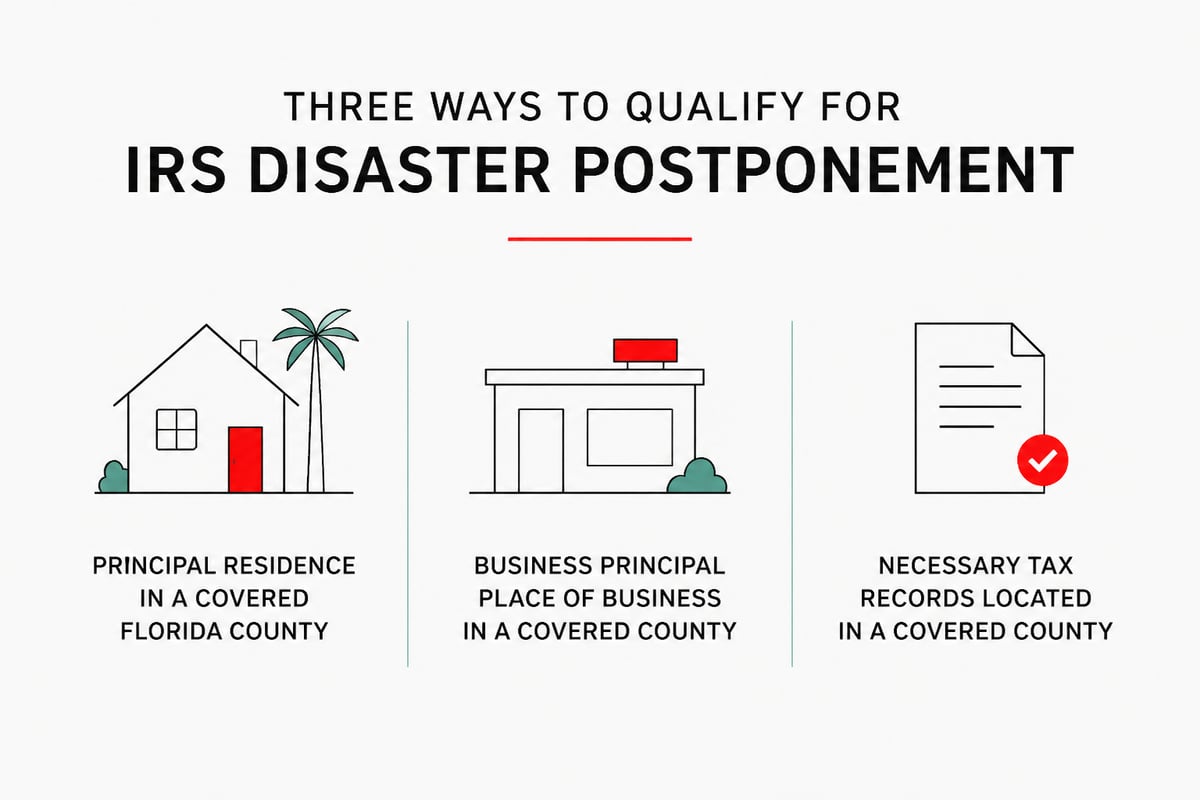
You qualify if your principal residence or principal place of business is in a county the IRS lists, or if you are a taxpayer elsewhere whose necessary tax records are in the covered area. Per the IRS, eligible taxpayers generally include individuals whose principal residence is in the disaster area, businesses and sole proprietors whose principal place of business is there, and taxpayers elsewhere whose necessary tax records are in the area.
Three groups come up most often:
- Residents. Your main home sits in a designated county. Seasonal residents and second-home owners usually do not count unless the home is their principal residence.
- Business owners. Your business's principal location is in a designated county, including sole proprietors and pass-through entities.
- Out-of-area taxpayers with records in the zone. Your accountant's office or your storage unit full of receipts is in a covered county, and the records are necessary to file or pay on time. The Taxpayer Advocate Service describes these eligibility paths as well.
Relief workers affiliated with a recognized government or philanthropic organization who are assisting in the covered area may also qualify.
The IRS can also treat people with a different address on file as covered. If your mailing address does not match where you actually live, you may need to call the IRS and have it sorted out. More on that below.
What Deadlines Does a Hurricane Postponement Actually Move?
A postponement can move income tax filing, tax payments, estimated tax payments, payroll and excise tax deposits, and certain retirement account and Tax Court-related deadlines that fall inside the relief window. The IRS announcement for each storm spells out exactly which ones, and it lists them by name.
Typical items covered include:
- Individual and business income tax returns and extensions.
- Estimated tax payments for individuals and corporations.
- Quarterly payroll and excise tax returns.
- Payroll and excise tax deposits, with a limit tied to the dates in the notice.
- IRA contribution and certain retirement plan deadlines.
The window is the part that trips people up. Relief covers deadlines that fall inside the window, not every deadline you will ever have. If your return was due in March and the window started in August, the postponement does not reach back and touch it.
Here is a short comparison of the two recent Florida examples from the IRS announcements, with the Helene window left to the notice itself:
| Storm | Postponed deadline | Window of covered deadlines |
|---|---|---|
| Tropical Storm Debby | February 3, 2025 | August 1, 2024, through before February 3, 2025 |
| Hurricane Helene | May 1, 2025 | Set in the IRS announcement for the covered counties |
For any storm, read the actual IRS notice for your county. The notice controls, not a news headline and not me.
Is There an Automatic Extension for Federally Declared Disasters?
Generally, if the IRS announces relief for your county, the postponement applies without a separate form. The IRS typically uses your address of record to identify covered taxpayers and applies relief to your account.
But automatic has an asterisk. The IRS can only apply relief to the address it has on file. If you moved, filed with a business address, or use a mailing service, the system may not tag you as covered. In that case, you call the number in the IRS announcement and tell them. Keep a note of the date, the agent ID, and what was said.
One more point. A federal disaster declaration alone does not trigger tax relief. The IRS makes its own announcement, and that announcement names the counties. Tax relief is announced separately and can arrive after the declaration. Do not assume you are covered until you see your county on the list.
Does a Postponement Wipe Out Interest and Penalties?
It waives late-filing and late-payment penalties and interest only for the covered deadlines, and only until the new date. It does not touch tax you already owed before the storm, and it does not stop collection on old debt.
Here is the distinction. Say you owed a balance from 2022 and the IRS was already working your case. The hurricane relief does not pause that. The IRS has easier ways to collect. Liens, levies, wage garnishments. A storm in your county does not cancel them, though you can ask for a collection hold based on hardship.
If you are in that spot, call me. For people dealing with old balances while rebuilding, I have helped through IRS Tax Debt Resolution, which covers installment agreements, Offers in Compromise, and currently not collectible status. Which one fits depends on your numbers, not your zip code.
And if an IRS lien already sits on your property, you may want to check how it shows up in public records. I covered that in a post on federal tax lien public record searches in Florida.
Are Hurricane Damage Repairs Tax Deductible?
Hurricane damage can produce a casualty loss deduction for qualifying losses from a federally declared disaster, and the rules limit how much you can claim. Repairs themselves are generally not deductible as repairs. The loss is measured by the drop in value or your adjusted basis, reduced by insurance reimbursements and subject to floors.
For personal-use property, the deduction is limited to losses from federally declared disasters, and you subtract any insurance or other reimbursement you receive or expect. You may be able to claim the loss on the return for the year the disaster hit, or elect to claim it on the prior year's return. IRS Publication 547 covers casualty losses and the calculation.
For a business, the picture is different. Damage to business property is treated under separate rules, and repairs to restore property to its pre-storm condition may be deductible expenses, while improvements get capitalized. That line is hard to draw without the paperwork, which is why the next section matters.

What Records Should You Gather Before and After a Storm?
Gather proof of what you owned, what it was worth, and what it cost to fix, and keep it somewhere that is not in the flood zone. Photos, insurance claims, contractor invoices, and copies of past returns are the backbone of any casualty loss claim or late-filing explanation.
A basic checklist:
- Photos and video of the property before and after the damage.
- Insurance policy, claim number, and every payment letter.
- Contractor estimates and paid invoices.
- Prior-year tax returns and any IRS notices.
- Business records: payroll reports, bank statements, accounting backups.
The short version is to store digital copies off-site before storm season, not after.
If you want a backup plan for the other side of recovery, review your coverage too. For a straightforward look at policy options, Trutela Insurance is an independent insurance agency offering auto, home, life, and business insurance, and a policy review before hurricane season is easier than one after a loss.
What If You Already Owe the IRS and a Storm Hits?
A hurricane does not freeze old tax debt, but it gives you a legitimate reason to ask for patience, and the IRS has procedures for hardship. If you are already in collection, tell the IRS your location, your damage, and your records situation as early as possible.
Practical moves, in order:
- Confirm your county is on the IRS relief list. If it is, your covered deadlines moved.
- Check whether your old balance is in a collection phase. Look at your notices. If you hold a final notice, a levy or garnishment can still happen.
- Ask for a temporary collection hold. The IRS can place an account in a hold status when you cannot pay because of hardship.
- Do not ignore notices because of the storm. Response deadlines on notices outside the relief window do not stop.
- Get representation so the IRS talks to your lawyer, not you. Once retained, all communications with the IRS go through the firm, which matters when your mail is going to a damaged house. A Form 2848 is how that authorization works, and I explain it in a post on IRS Form 2848.
Rare is the person who regrets responding early. Common is the person who waited until the levy hit.
Do You Still Need to File If You Think You Qualify?
Yes, if you want certainty. Filing and paying by the postponed date protects you completely, and filing earlier when you can is fine. The point of the relief is more time, not a reason to skip the return.
The biggest risk I see is people assuming they are covered, missing the new date, and discovering the county was never on the list, or the deadline in question fell outside the window. Verify first. Then calendar the new date on paper and in your phone.
If you have several unfiled years sitting in a drawer, a storm does not change that picture, and the statute of limitations does not work the way people hope. I explain how that works in a post on unfiled tax returns and the statute of limitations.
If you run a business and want help keeping your website current while you rebuild, RankPill is an AI SEO tool that plans, writes, and publishes articles to your website.
FAQ
Is October 15 the tax extension deadline?
For most individuals, an extension to file generally moves the filing deadline to October 15, though any tax owed was still due by the original April date. When a disaster postponement applies to your county, the postponed date from the IRS announcement can replace both dates for covered deadlines.
How long is Florida's tax free holiday in 2026?
That is a state sales tax matter, not an IRS one, and it is outside this article's scope. Check the Florida Department of Revenue for the current schedule. It has no connection to federal disaster postponement.
Does the postponement apply if I live elsewhere but my records are in Florida?
It can. If the necessary records to file or pay are located in a covered county, you may qualify even if your home is elsewhere. You will likely need to call the IRS at the number in the announcement so it can flag your account.
Your next step is to pull up the IRS announcement for your county, confirm the new deadline in writing, and calendar it today. If you also have an old balance, a notice you have not answered, or a collection threat that a storm did not stop, let's talk. Schedule Your Free Consultation with the Law Offices of Darrin T. Mish, P.A. by reaching out through the firm's contact page, and I will tell you where you stand before the next deadline does.