

After 32 years of IRS work — and more than $100 million in resolved tax debt — I've seen just about every version of the problem you're dealing with. I'm Darrin Mish, a tax attorney in Tampa. Here's what you should know.
I'm Darrin Mish. Tampa tax attorney, 32 years in, more than $100 million in IRS debt resolved. What follows isn't theory. It's what I've actually watched work.
You opened a letter from the IRS marked CP71C and the phrase "annual reminder" jumped out alongside a balance due. That's not a collection notice in the urgent sense, but it's not junk mail either. The IRS CP71C annual reminder balance due shows up once a year, by law, to tell you that you owe money under a payment plan or after a previous assessment. It's required. It's routine. And it carries weight you shouldn't ignore.
What the IRS CP71C Annual Reminder Balance Due Actually Tells You
The CP71C is a statutorily mandated annual notice. Congress requires the IRS to send it under Internal Revenue Code section 7524, which directs the agency to issue yearly reminders whenever you carry a balance. The notice summarizes your total debt, any accrued interest and penalties since the last notice, and your payment status.
If you're on an installment agreement, the CP71C confirms what you owe and that your plan remains active. If you defaulted or never set up a plan, it warns you the balance is growing and the IRS can take enforcement action. The notice is clean, formulaic, and unemotional. It does not threaten levy or lien in bold type. It just restates the facts annually.
That calm tone misleads some people into inaction. Don't mistake a quiet letter for a harmless one.
Who Receives the IRS CP71C Annual Reminder Balance Due
You get this notice if you carry any unpaid tax balance into a new calendar year and either have an installment agreement in place or previously agreed to a resolution that left a balance outstanding. The IRS also sends it if you owe but haven't arranged anything and the debt remains on the books past April of the year following the tax year at issue.
- Taxpayers with active installment agreements
- Taxpayers who partially paid but left a balance
- Taxpayers who owe and haven't contacted the IRS yet
- Anyone subject to certification for seriously delinquent tax debt
That last category is the one that catches people off guard every year in my office.

Why the Annual Reminder Matters for Your Passport
The CP71C references "seriously delinquent tax debt" and potential certification to the State Department. Under 26 U.S.C. § 7345, the IRS must certify taxpayers who owe more than a threshold amount (adjusted for inflation, currently around $62,000 in combined assessed tax, penalties, and interest) and have either a notice of federal tax lien filed or a levy issued.
Once certified, the State Department can deny your passport application or revoke your existing passport. That's not a bluff or a far-off consequence. The Taxpayer Advocate Service has documented thousands of cases where taxpayers learned about certification only when trying to board an international flight or renew a passport for work travel.
The CP71C often includes a checkbox or paragraph explaining that your debt may qualify for certification. If you see that language, the IRS is telling you the clock is running. You're not certified yet (you'd receive a separate CP508C for that), but you're in the zone.
How Certification Happens and What Stops It
Certification is administrative, not judicial. The IRS sends your name, Social Security number, and debt amount to State. State adds you to a list. No court hearing, no appeal before it happens.
But you can reverse it or prevent it. The IRS will not certify you, or will reverse certification, if you meet any of these conditions:
| Condition | Effect on Certification |
|---|---|
| Installment agreement in good standing | Prevents or reverses |
| Offer in Compromise pending or accepted | Prevents or reverses |
| Collection Due Process hearing requested timely | Suspends certification |
| Innocent spouse relief pending | May prevent depending on circumstances |
| Bankruptcy case open | Automatic stay prevents |
| Debt below threshold (currently ~$62,000) | Ineligible for certification |
If your CP71C shows a balance near or above the threshold, getting into an installment agreement before certification is the simplest fix. The IRS accepts streamlined agreements up to $50,000 without requiring a financial statement. Once you're paying, you're off the certification list.
I've walked clients through this dozens of times. The IRS doesn't broadcast the relief options on the notice. You have to ask.
What You Should Do When You Receive the IRS CP71C Annual Reminder Balance Due
Read the full notice. Match the balance shown against your own records. The IRS sometimes applies payments incorrectly or fails to credit an amended return. If the balance is wrong, you'll need account transcripts to prove it.
If the balance is accurate, you have three basic paths: pay in full, set up a payment plan, or dispute the underlying liability.
Paying in Full or Setting Up an Installment Agreement
Paying in full stops interest and penalties immediately. If you can't pay all at once, an installment agreement locks in a monthly payment and keeps the IRS from levying your bank account or wages while you're current. The IRS Fresh Start program expanded access to these agreements and raised the streamlined threshold, which means most individuals can get a plan online or over the phone in minutes.
You apply through IRS.gov using the Online Payment Agreement tool or by calling the number on your CP71C. If you owe more than $50,000, you'll need to submit Form 433-F (Collection Information Statement) and provide bank statements, pay stubs, and proof of expenses. The IRS will calculate your reasonable collection potential and propose a monthly payment.
Once the agreement is active, you'll keep receiving the CP71C each year as a reminder of your remaining balance. That's normal. As long as you pay on time every month, the IRS won't escalate collection.
Disputing the Balance or Requesting Penalty Abatement
If you believe the underlying tax assessment is wrong, you can request audit reconsideration or file an amended return. If penalties make up a large portion of the balance, you can request first-time penalty abatement or reasonable cause abatement. The CP71C itself doesn't give you appeal rights (it's an informational notice, not a determination), but you can still dispute the debt through normal IRS channels.
First-time abatement is available if you've filed and paid on time for the past three years and have no prior abatements on record. The IRS usually grants it over the phone. Reasonable cause requires a written explanation and supporting documents (illness, disaster, bad advice from a tax professional, etc.).
Penalty abatement can cut your balance by 20 to 40 percent in some cases. That might drop you below the certification threshold or make a lump-sum payment feasible.

How the IRS CP71C Annual Reminder Balance Due Fits Into the Collection Timeline
The CP71C is not a demand for immediate payment. It's a status update. The IRS already assessed the tax (through your filed return, an audit adjustment, or a substitute return they filed for you). The assessment created the legal debt. The CP71C reminds you it exists.
If you ignore it, the IRS doesn't instantly seize assets. They have broader powers (lien filing, levy, wage garnishment), but those take separate notices and waiting periods. The CP71C by itself doesn't trigger a countdown to enforcement. It just keeps you informed.
That said, ignoring the CP71C for multiple years builds interest and penalties that compound monthly. I've seen balances double over a decade of inaction. The longer you wait, the fewer options you have.
How Interest and Penalties Accumulate
The IRS charges interest on unpaid tax from the original due date until you pay in full. The rate adjusts quarterly and compounds daily. As of 2026, the individual rate hovers around 8 percent annually (the federal short-term rate plus 3 percent). Failure-to-pay penalty adds 0.5 percent per month (capped at 25 percent of the unpaid tax). If you have a payment plan, the failure-to-pay penalty drops to 0.25 percent per month while the agreement is active.
Here's what that looks like over time:
| Balance | Interest (8%/year) | Penalty (0.25%/month in plan) | Total Added Per Year |
|---|---|---|---|
| $30,000 | $2,400 | $900 | $3,300 |
| $60,000 | $4,800 | $1,800 | $6,600 |
| $100,000 | $8,000 | $3,000 | $11,000 |
These numbers explain why a $40,000 debt from 2020 shows up as $58,000 on your 2026 CP71C even if you haven't ignored notices or skipped payments. Interest alone adds thousands every year. The math is relentless.
When to Bring in a Tax Attorney After Receiving a CP71C
Most people can handle a CP71C on their own if the balance is straightforward and they can afford the monthly payment the IRS proposes. You don't need representation to set up a $200-a-month installment agreement on a $15,000 debt.
You do need help if any of these apply:
- The balance exceeds $100,000
- You can't afford the IRS's proposed payment
- The IRS filed a substitute return and the balance includes tax you don't actually owe
- You're facing passport revocation or already received a CP508C
- You want to negotiate an Offer in Compromise
- The debt includes payroll tax from a business you owned
- You're married and believe you qualify for innocent spouse relief
An attorney can review your account transcripts, identify procedural errors, request penalty abatement, negotiate a partial-pay installment agreement (where the IRS accepts less than the full balance over time), or prepare an Offer in Compromise. We can also request a Collection Due Process hearing if the IRS threatens levy, which suspends collection and gives you a chance to argue in front of an independent appeals officer.
After 32 years, I can tell you that the clients who get the best outcomes are the ones who act when the balance is manageable and before the IRS files a lien or levies their accounts. The CP71C is your annual window to do that.
What Happens If You Ignore the IRS CP71C Annual Reminder Balance Due
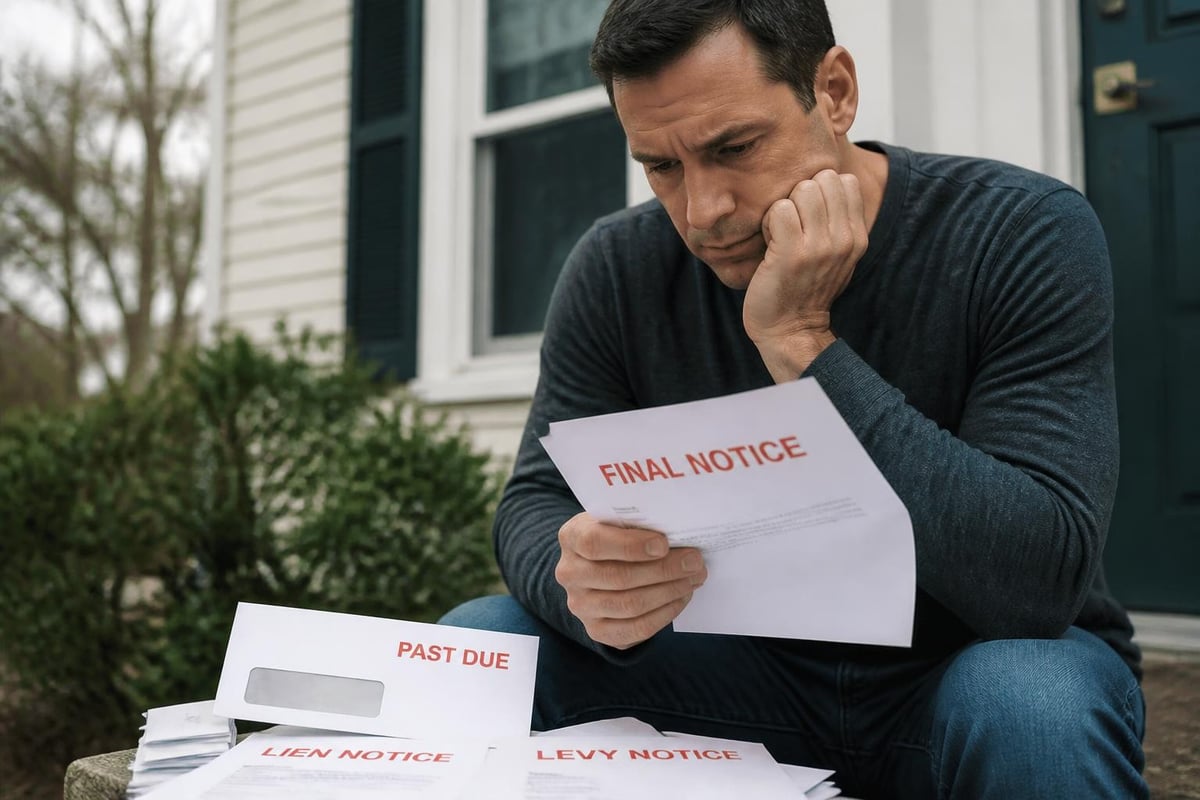
Nothing immediate. The IRS won't garnish your wages the day after the notice date. But ignoring multiple CP71C notices over several years eventually leads to enforcement. The IRS files a Notice of Federal Tax Lien, which becomes public record and tanks your credit. They issue a levy on your bank account or paycheck, taking the funds without further warning. They certify your debt to State, and you lose your passport.
I've represented clients who thought the annual reminder was like a student loan statement, something you acknowledge and move on from. Then they tried to refinance a mortgage and discovered a $90,000 tax lien from five ignored CP71C notices. Or they booked a trip to Europe and got flagged at passport renewal because of certification.
The IRS doesn't call, doesn't send a second reminder mid-year (that's part of what the Taxpayer Advocate has criticized about the current notice regime), and doesn't escalate tone. They just proceed methodically.
How Recent IRS Modernization Efforts Affect the CP71C Process
The GAO has pushed the IRS to improve notice clarity and offer digital response options for common notices, including annual reminders like the CP71C. As of 2026, you can view your CP71C online through your IRS account and respond electronically in many cases (setting up a payment plan, disputing a balance, uploading documents). That's faster than mailing forms and waiting eight weeks for the IRS to process them.
The IRS also cross-references CP71C notices with certification status more reliably now. If you're close to the threshold, the notice will flag it. That wasn't always the case. TIGTA has audited the certification process and found that early implementation had gaps, but recent oversight tightened the controls. The system is more accurate, which means fewer surprises, but also fewer errors working in your favor.
Legislative Background and Why Congress Required the CP71C
The annual reminder requirement dates to the late 1990s as part of the IRS Restructuring and Reform Act. Congress wanted taxpayers to receive at least one clear, annual statement of what they owe, especially if they're on a long-term payment plan. The idea was transparency: no hidden debt, no surprise balances.
The passport certification provision came later, in 2015, as part of the FAST Act, a highway funding bill. Congress needed revenue and decided that taxpayers with large unpaid balances shouldn't be able to travel internationally until they resolved their debt. The CP71C became the IRS's statutory vehicle for warning people before certification happened.
You can argue the policy. I've seen it derail business owners who travel for work and had no idea their accountant missed an estimated payment years earlier. But the law is clear, and the IRS enforces it mechanically.
Your Options Beyond the Installment Agreement
If an installment agreement doesn't work because your monthly payment would exceed what you can afford, you have other tools. An Offer in Compromise lets you settle the debt for less than the full amount if you can prove you can't pay in full over the remaining collection statute (usually ten years from assessment). The IRS looks at your income, expenses, and assets and calculates your reasonable collection potential. If that amount is less than the balance, they may accept a lump sum or short-term payment plan.
Currently Not Collectible status is another option if you're unemployed, on a fixed income, or facing financial hardship. The IRS suspends collection for a period (usually reviewed annually), though interest and penalties continue to accrue. It's a pause, not a forgiveness, but it keeps the IRS from levying your accounts while you get back on your feet.
Innocent spouse relief applies if you filed jointly and your spouse (or ex-spouse) underreported income or claimed bogus deductions without your knowledge. The IRS can remove your liability for the portion attributable to your spouse's actions. The process is slow and requires detailed documentation, but it's the right tool if the debt isn't actually yours.
Bankruptcy discharges some income tax debts if they meet the timing requirements (generally, the tax is from a return due at least three years ago, filed at least two years ago, and assessed at least 240 days ago). Not all tax debt qualifies, and payroll taxes never do, but Chapter 7 or Chapter 13 can wipe out old individual income tax in the right circumstances.
Practical Steps You Can Take This Week
Pull your IRS account transcript online or by calling 800-908-9946. The transcript shows every notice the IRS sent, every payment you made, and the current balance broken down by tax, penalty, and interest. Compare it to your CP71C. If the numbers don't match, you have a dispute.
Check whether you're in an installment agreement. If you set one up years ago and forgot about it, the CP71C confirms it's still active. If you defaulted (missed a payment or didn't file a recent return), the notice will say so. You can reinstate most agreements by paying the missed amount and calling the IRS to confirm.
Review your passport status if your balance is above $60,000. Log into your State Department account or check your passport expiration date. If you have international travel planned, don't wait until the week before your trip to address a potential certification issue.
Calculate how much interest you're accruing monthly. Multiply your balance by 0.08, divide by 12. That's your approximate monthly interest charge. Add the failure-to-pay penalty (0.25 percent per month if you're in a payment plan, 0.5 percent if you're not). If those numbers are higher than your monthly payment, your balance is growing. You need to adjust your plan or find another resolution.
Request penalty abatement if you've been compliant for three years. Call the number on the CP71C and ask for first-time abatement. The IRS will check your history while you're on the phone and remove failure-to-pay and failure-to-file penalties if you qualify. That's often a 25 to 40 percent reduction in your balance with a five-minute call.
Why You Shouldn't Panic but Also Shouldn't Ignore the Notice
The IRS CP71C annual reminder balance due is not a crisis. It's a scheduled, bureaucratic update. But it's also evidence that the clock is running on a debt that won't go away on its own. The IRS has ten years from assessment to collect (the collection statute), and they will use every month of it if you let them.
I've worked with taxpayers who ignored the CP71C for a decade and then panicked when the IRS levied their retirement account six months before the statute expired. The IRS doesn't forgive balances because you didn't open the mail. They just collect.
On the other hand, I've also worked with people who received the CP71C, called the same day, set up a payment plan, and never heard from the IRS again except for the annual reminder confirming everything was on track. The difference between those outcomes is action, not luck.
You don't need to hire anyone to respond to a CP71C if your situation is simple. But if the balance is large, the circumstances are complicated, or you're facing certification, you need someone who understands the IRS playbook and can negotiate on your terms. Let's talk.
The IRS CP71C annual reminder balance due is your annual checkpoint, not a threat, but ignoring it lets interest and penalties compound while enforcement options narrow. For 32 years, I've helped taxpayers turn these notices into manageable payment plans, penalty abatements, or settlements that keep the IRS from seizing assets or revoking passports. If your balance is growing or you're not sure what to do next, Law Offices of Darrin T. Mish, P.A. offers free consultations and works with clients nationwide.