

The tax-relief industry loves to make IRS problems sound impossible without them. They're not. I'm Darrin Mish. I've been representing taxpayers before the IRS for 32 years. Let me explain how this actually works.
I'm Darrin Mish. Tampa tax attorney, 32 years in, more than $100 million in IRS debt resolved. What follows isn't theory. It's what I've actually watched work.
The irs 10 year collection statute csed is the most misunderstood deadline in tax law. You've probably heard the IRS has ten years to collect your tax debt, and that's basically true. But the reality is messier. The clock stops, resets, gets extended, and sometimes the IRS just miscalculates. Understanding the Collection Statute Expiration Date matters because it's the difference between decades of wage garnishments and a debt that simply vanishes.
What the IRS 10 Year Collection Statute CSED Actually Means
The Collection Statute Expiration Date is the last day the IRS can legally enforce collection of a tax debt. 26 U.S.C. § 6502 gives the IRS ten years from the date of assessment to collect. After that date, the debt is legally uncollectible. The IRS must stop all levies, release all liens, and write off the balance.
Assessment is the technical trigger. That's when the IRS formally records your tax liability in its system, not when you filed or when you owed. For most people, assessment happens within weeks of filing a return. For some, it happens years later after an audit or when the IRS files a substitute return on your behalf.
The ten years starts ticking the day after assessment. If your 2020 tax return was assessed on April 15, 2021, your CSED is April 15, 2031. Simple math. Except it's rarely simple.
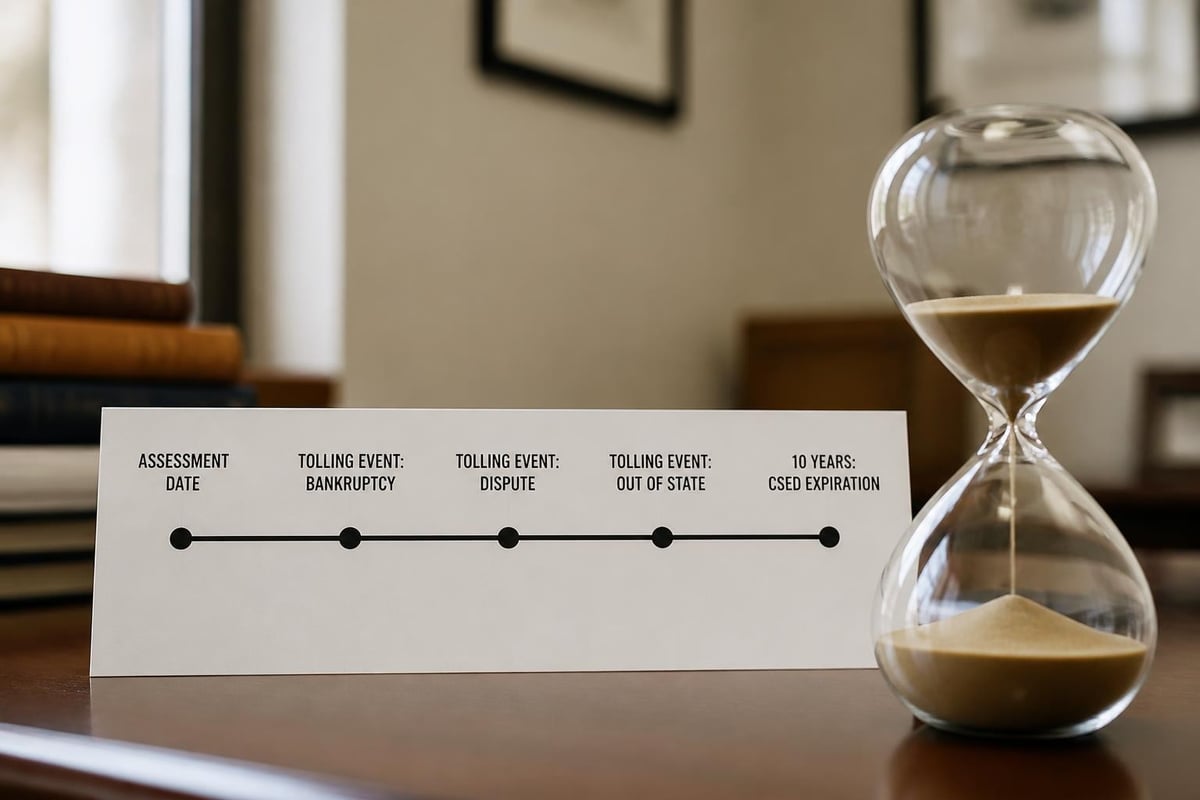
How Assessment Date Sets the Clock
You can find your assessment date on your IRS account transcript, specifically the Account Transcript (not the Tax Return Transcript). Look for the line that says "150" under the Transaction Code column. That date next to the 150 code is your assessment date.
Most taxpayers assume the IRS assessed their tax the day they filed. Close, but not exact. The IRS typically processes returns and makes assessments within 8 to 12 weeks of filing. For e-filed returns, it's faster. For paper returns, slower. Audited returns can take years to assess.
Key assessment scenarios:
- Self-filed return: Usually assessed within 3 weeks of IRS acceptance
- Audited return: Assessed when you sign the audit agreement or when the appeals period expires
- Substitute for Return (SFR): Assessed after the IRS files a return on your behalf and the notice period runs
- Amended return showing more tax: New assessment date for the additional amount
The IRS explains the collection timeline on its website, but the official explanation glosses over how many things toll or suspend the CSED. That's where taxpayers get trapped.
What Tolls or Extends the IRS 10 Year Collection Statute CSED
Tolling means the clock stops. The CSED gets pushed out day-for-day by the length of the tolling event, plus an additional period in some cases. These aren't rare exceptions. They're routine collection interactions that can add five, seven, even ten years to your CSED without you noticing.
Offers in Compromise
When you submit an Offer in Compromise, the CSED is tolled while the IRS processes your application. That includes the time the offer is pending, the 30-day appeal period if rejected, and any time spent in appeals. If the whole process takes 18 months (common), your CSED extends by 18 months.
The IRS also tacks on an extra 30 days beyond the resolution date. So an offer that takes 400 days to reject will toll your CSED by 430 days. Multiply that by two or three offers, and you've added years.
Collection Due Process Hearings
Request a Collection Due Process (CDP) hearing after a lien or levy notice, and the CSED stops. The tolling lasts from the date you file the CDP request until the appeals officer issues a determination, plus 90 days if you petition Tax Court. A hearing that drags 14 months and then gets litigated will toll the CSED nearly two years.
I've seen taxpayers request CDP hearings specifically to buy time, not realizing they're also buying the IRS more time. It's a trade-off. Sometimes worth it to stop a levy. Sometimes a mistake that keeps a dying debt alive.
Installment Agreements
When you apply for an installment agreement, the CSED is tolled during the application period. But here's the part that surprises people: if the IRS rejects your proposed payment plan, the tolling period can still be substantial. Application plus any appeal easily hits 60 to 90 days.
Once an installment agreement is approved, it doesn't toll the CSED unless you default and request reinstatement. At that point, the reinstatement request tolls the clock again.
| Tolling Event | Typical Duration | Extra Days Added |
|---|---|---|
| Offer in Compromise | 12–24 months | +30 days |
| CDP Hearing (no Tax Court) | 6–14 months | None |
| CDP Hearing (with Tax Court) | 18–36 months | +90 days |
| Installment Agreement Request | 30–90 days | None |
| Bankruptcy (Ch. 7) | 4–6 months | +6 months |
| Bankruptcy (Ch. 13) | 36–60 months | +6 months |
Bankruptcy
Bankruptcy is the biggest CSED extension. When you file bankruptcy, the automatic stay halts all IRS collection. The CSED is tolled for the entire time your case is open, plus six months after discharge or dismissal. A three-year Chapter 13 case will extend your CSED by 3.5 years.
For some taxpayers, that's a worthy trade. Bankruptcy discharges other debts, and the IRS gets pushed back. But if your only major debt is IRS and your CSED is already close, bankruptcy can be a tactical mistake.

Living Outside the United States
If you live outside the U.S. for six continuous months or more, the CSED is tolled for that period. The IRS treats your absence as making you unavailable for collection. Move abroad for two years, and the IRS gains two more years to collect.
This catches expats off guard. You think you're waiting out the statute in another country. The IRS is just pausing the clock.
Innocent Spouse Relief and Litigation
Filing a request for innocent spouse relief tolls the CSED while the IRS considers your case and during any subsequent appeals. If you petition Tax Court, the tolling continues until the case closes, plus 60 days.
The Taxpayer Advocate has detailed guidance on how these tolling events stack. The problem is most taxpayers don't read it until they're shocked to learn their 2016 debt is still collectible in 2029.
How the IRS Miscalculates Your CSED
The IRS is supposed to track your CSED automatically in its systems. It doesn't always get it right. A Treasury Inspector General audit found errors in CSED calculations, particularly when multiple tolling events overlap or when manual adjustments are required.
Common errors include:
- Tolling periods counted twice when cases transfer between IRS units
- Failure to remove tolling after a CDP case or offer is closed
- Incorrect assessment dates when amended returns or audit adjustments are involved
- System glitches that don't update the CSED after bankruptcy discharge
You can request a CSED calculation from the IRS, but the letter you get back is often just a printout from the same flawed system. To verify it, you need your Account Transcript, a timeline of every tolling event, and often a manual recalculation.
What to Do If the IRS Gets Your CSED Wrong
If the IRS tries to collect after your CSED has expired, you file a claim for refund of any amounts collected and demand the IRS abate the balance. You'll need documentation: transcripts showing the assessment date, proof of every tolling event (offer letters, CDP hearing notices, bankruptcy docket), and your own calculation.
I've submitted CSED disputes where the IRS initially insisted the debt was still good, then reversed after we produced a timeline they couldn't refute. It takes persistence. The IRS doesn't volunteer CSED expirations. You have to prove it.
Strategies When Your CSED Is Close
If your CSED is within two years, your strategy shifts. You're no longer trying to settle the debt or negotiate. You're trying not to toll the statute. Every interaction with the IRS is a potential trap.
Avoid Tolling Events
Don't file an Offer in Compromise if your CSED is 18 months away. Don't request a CDP hearing unless you're facing imminent levy and you've calculated that the tolling won't push your CSED past your ability to wait. Don't file bankruptcy unless the non-tax debt justifies it.
In some cases, the best move is to do nothing. Let the IRS send notices. Let them threaten. If they levy your wages, you deal with the levy without tolling the CSED. If they file a lien, you let it sit. Liens don't toll the statute. They're just a cloud on your credit.
Currently Not Collectible Status
Requesting Currently Not Collectible (CNC) status does not toll the CSED. If you're financially unable to pay and your CSED is near, CNC can be a smart play. The IRS stops active collection, the CSED keeps running, and when it expires, the debt vanishes.
CNC requires proving financial hardship, but it's easier to qualify for than an Offer in Compromise and doesn't come with the tolling cost. For someone with 14 months left on their CSED and genuine inability to pay, it's often the right call.

Partial Payment Installment Agreements
A Partial Payment Installment Agreement (PPIA) is an installment plan where the IRS accepts monthly payments that won't pay the debt in full before the CSED expires. The IRS agrees to take what it can get before time runs out.
PPIAs don't toll the CSED. You make payments, the IRS gets something, and the balance disappears at expiration. The catch is the IRS reviews your financials every two years and can increase your payment if your situation improves.
For someone with three years left on a CSED and $80,000 in tax debt, a PPIA with $300/month payments means the IRS collects roughly $10,800 and the rest expires. That beats an Offer in Compromise that costs $15,000 and tolls the CSED by two years.
How Tax Professionals Use CSED Strategy
A competent tax attorney calculates your CSED before recommending any collection alternative. That calculation drives the entire strategy. If your CSED is eight years out, an Offer might make sense. If it's two years out, we're talking CNC or PPIA, not an Offer.
I pull transcripts, map every tolling event, and build a timeline. Then I tell you what the IRS will accept and what the tolling cost is. If the cost is too high, we pivot. The goal isn't just to resolve the debt. It's to resolve it without giving the IRS more time than necessary.
When CSED Strategy Goes Wrong
I've seen taxpayers extend their own CSEDs by five years because they filed multiple Offers in Compromise without understanding the tolling. I've seen bankruptcy attorneys file Chapter 13 cases without checking whether the tax debt would have expired during the plan. I've seen people request CDP hearings every year just to delay levy, not realizing they're also delaying expiration.
The worst case I handled: a taxpayer whose CSED was originally April 2018, but after three rejected offers, two CDP hearings, and a dismissed bankruptcy, the CSED was pushed to January 2025. Seven extra years of collectibility because no one did the math up front.
What Happens When the CSED Expires
When your CSED expires, the IRS must release any federal tax liens within 30 days. The balance on your account is marked as "fully expired." The IRS cannot levy, garnish, or file suit. If they've already seized funds or property, you can file a claim for return.
The debt doesn't disappear from your transcript immediately. It will still show the assessed balance, but the status will indicate it's unenforceable. The IRS is supposed to generate an automatic lien release and mail it to you. Sometimes they do. Sometimes you have to request it.
Credit Impact After CSED
The federal tax lien can remain on your credit report for up to seven years from the date it's released, not from the date it was filed. So if your CSED expires in 2026 and the lien is released in 2026, it can stay on your report until 2033. The unpaid balance itself isn't reported to credit bureaus (IRS debts generally aren't), but the lien is a public record.
Once the lien is released, you can dispute the credit report entry after seven years. Until then, it's valid reporting.
IRS Rarely Tells You
The IRS does not send a congratulatory letter when your CSED expires. You have to check your own transcripts. I've had clients call me panicked about a collections notice, only to discover the CSED had expired two months earlier and the notice was generated by a computer that hadn't updated.
If you receive a notice after your CSED, respond in writing with your CSED calculation and demand abatement. Don't ignore it. The IRS will continue collection unless you prove the statute ran.
The Role of Assessment in Unfiled Returns
If you haven't filed a return, the IRS can't assess the tax. No assessment means no CSED. The clock never starts. That's why unfiled tax returns don't age out. You can owe tax from 1995, and if you never filed, the IRS has forever to assess once they catch you.
The IRS does have a three-year statute of limitations on how far back they can audit and assess tax, but that only applies if you filed a return. No return, no limit. Once the IRS files a Substitute for Return on your behalf, they assess the tax, and the ten-year CSED begins.
Filing late is better than not filing. Even if you can't pay, filing starts the CSED clock. Not filing leaves you exposed indefinitely.
How Courts Treat CSED Disputes
When taxpayers litigate CSED disputes, courts strictly construe the statute. The IRS has to prove each tolling event and its duration. Taxpayers have to prove the CSED expired. Federal courts have examined how tolling applies when events overlap or when IRS records conflict with taxpayer evidence.
The burden is on the IRS to prove the debt is still within the CSED, but the burden is on you to raise the issue. If you don't assert the CSED defense, courts assume the debt is collectible.
Litigation over CSED is rare because most cases settle or the taxpayer lacks resources to fight. But when it happens, precision matters. One miscalculated tolling period, one missing document, and the case flips.
State Collection Statutes vs. Federal
States have their own collection statutes. Some are shorter than ten years. Some are longer. Some allow renewal or extension by filing a judgment. If you owe state tax in addition to federal, you're dealing with two separate clocks.
Florida, for example, has a 20-year statute on recorded judgments. California has a 20-year statute with renewal options. New York has a 20-year statute. If you're planning around the federal irs 10 year collection statute csed, don't forget your state may have a different rule.
Why CSED Knowledge Matters More in 2026
The IRS is more aggressive with automated collection in 2026 than it was a decade ago. Computer systems generate levies faster, issue liens sooner, and escalate cases with less human review. That means more tolling events triggered earlier in the collection cycle, which means longer effective collection periods.
At the same time, the IRS has a backlog from prior years and limited staffing. Cases sit unworked for months, then suddenly accelerate. Your CSED can be ticking down while your case gathers dust, or it can be tolled while you wait for a collections officer who never calls. The inconsistency is the risk.
Knowing your CSED gives you leverage. If a revenue officer proposes a payment plan that runs past your CSED, you counter with a PPIA. If the IRS threatens levy with 11 months left on your CSED, you consider CNC instead of an offer. The CSED is your negotiating position, but only if you know what it is.
The irs 10 year collection statute csed is your finish line, but only if you protect it. Tolling, extensions, and IRS errors can turn ten years into fifteen or twenty. The difference between waiting it out and giving the IRS more time is often one uninformed decision. The Law Offices of Darrin T. Mish, P.A. has spent 32 years calculating CSEDs, spotting tolling traps, and building strategies that don't hand the IRS free extensions. If you're trying to figure out where you stand or whether it's smarter to wait than to settle, let's talk: Law Offices of Darrin T. Mish, P.A.