

After 32 years of IRS work — and more than $100 million in resolved tax debt — I've seen just about every version of the problem you're dealing with. I'm Darrin Mish, a tax attorney in Tampa. Here's what you should know.
I'm Darrin Mish. Tampa tax attorney, 32 years in, more than $100 million in IRS debt resolved. What follows isn't theory – it's what I've actually watched work.
You paid the IRS. The balance is zero. But the federal tax lien is still on your credit report, crushing your score and blocking any chance at decent financing. The lien notice told every creditor you owed Uncle Sam, and now-months or years after you settled-it's still broadcasting that warning. That's where the form 12277 lien withdrawal application comes in.
Most people assume paying the debt makes the lien disappear automatically. It doesn't. The IRS releases the lien, which means they stop enforcing it, but the public record stays filed. That release doesn't erase the filing from courthouses or credit bureaus. Withdrawal does. It treats the lien as if it never existed.
What Form 12277 Actually Does
The official IRS Form 12277 is titled "Application for Withdrawal of Filed Form 668(Y), Notice of Federal Tax Lien." When the IRS approves a withdrawal, they pull the lien from public record and notify the three major credit bureaus. The filing gets removed, not just marked satisfied.
A release says "they paid, lien no longer enforceable." A withdrawal says "we're taking it back." The distinction matters when a lender pulls your credit or a title company searches county records.
Withdrawal doesn't erase the underlying tax debt from IRS transcripts. It removes the public notice. If you're applying for a mortgage in 2026, the lender won't see the lien filing. They might still see the tax debt itself if they pull IRS transcripts, but the lien-often the red flag that kills the deal-is gone.

Who Qualifies for Lien Withdrawal
The IRS doesn't grant withdrawals just because you ask. You need to meet specific criteria laid out in the Internal Revenue Manual. Four main paths exist, and most taxpayers fit into one or two.
Direct Debit Installment Agreement. If you owe $25,000 or less (including penalties and interest) and agree to pay via direct debit installment agreement, the IRS will withdraw the lien once you've made three consecutive payments. The agreement must be current, and the payments must clear without issue. This is the most common route I see clients take in 2026.
Full Payment. You paid the balance in full, and the lien is now released. You can request withdrawal if it's in your best interest and wouldn't hurt future IRS collections. "Best interest" usually means you need clean credit for a mortgage, business loan, or professional licensing.
Withdrawal After Offer in Compromise. If the IRS accepted your offer and you're compliant with filing and payment requirements, you can request withdrawal. The offer must be paid in full or you must be current on installment terms if the offer included those. Compliance means filing every required return on time going forward.
Premature or Procedural Error. The IRS filed the lien before giving you proper notice, or they filed it while your case was in bankruptcy stay, or they made another procedural mistake. These are rare but I've seen them. If you catch an error, document it and file Form 12277 immediately.
| Withdrawal Path | Key Requirement | Timeline |
|---|---|---|
| Direct Debit Installment Agreement | $25,000 or less, three consecutive payments | After third payment clears |
| Full Payment | Balance paid, lien released | Anytime after release |
| Offer in Compromise | Offer accepted and paid, compliance maintained | After offer terms met |
| Procedural Error | IRS filing mistake documented | As soon as error discovered |
How to Complete the Form 12277 Lien Withdrawal Application
The form itself runs two pages. It's simpler than most IRS paperwork, but every blank matters. I've seen applications denied because someone left a box unchecked or forgot to attach proof of payment.
Start with Section 1: taxpayer information. Name exactly as it appears on the lien notice. Social Security Number or Employer Identification Number. Current address. If the IRS has a different address on file, include both and explain.
Section 2 asks which tax periods you're addressing. List them exactly as shown on the lien notice-"Form 1040, December 31, 2022" not just "2022 taxes." If multiple years are grouped under one lien, list all of them. The IRS won't assume.
Section 3 is where you state your reason for withdrawal. Check the box that matches your situation: direct debit installment agreement, full payment, offer in compromise, or other. "Other" covers errors or unusual circumstances. If you check "other," attach a detailed explanation on a separate page.
Required Documentation
The form tells you what to attach, but here's what actually needs to be in the envelope based on your situation.
- Proof of payment: IRS account transcript showing zero balance, or your last payment confirmation if on installment agreement
- Installment agreement confirmation: Copy of your approved agreement letter and bank statements showing three direct debit withdrawals
- Offer acceptance letter: The IRS letter approving your offer and proof you've met the terms
- Lien release: Copy of the Certificate of Release (Form 668-Z) if you already received it
Don't send originals. Copies only. The IRS won't return documents. If you're mailing the application, send it certified mail with return receipt. You want proof they received it.

Where to File and What Happens Next
You don't send Form 12277 to the standard IRS mailing address. It goes to the Advisory Group that issued the lien. That office is listed on your lien notice (Form 668-Y). If you can't find the notice, call the IRS and ask for the Advisory Group that handles your case.
Some Advisory offices accept faxed applications. Most still require mail. As of 2026, electronic filing isn't available for Form 12277. I know, it's absurd given every other IRS form has moved online, but that's where we are.
Processing takes 30 to 45 days on average. I've seen it happen in two weeks. I've also seen it drag to 90 days when the IRS is backlogged. If you haven't heard anything after 60 days, call the Advisory Group directly. Have your case number ready.
When approved, the IRS sends you a letter confirming withdrawal and files the withdrawal with the same offices where they filed the original lien. They also notify credit bureaus, though getting the credit report updated can take another 30 days. Pull your credit report after 45 days to verify the lien is gone. If it's still there, dispute it with the bureaus and send them a copy of the withdrawal letter.
Common Mistakes That Delay or Kill Applications
Requesting withdrawal too early. You need to satisfy the qualifying condition first. If you're on a direct debit agreement, wait until three payments clear. If you paid in full, wait for the release. Filing early guarantees denial.
Incomplete payment records. The IRS wants to see that you're current. If you're on an installment plan, attach bank statements showing the debits. If you paid in full, include the account transcript showing zero balance. "I paid" isn't enough without documentation.
Wrong tax periods. The lien notice lists specific years and forms. Your withdrawal request must match exactly. If the lien covers 2021 and 2022, but you only list 2022, they'll reject it or ask for clarification, adding weeks to the process.
Missing signatures. Both spouses must sign if it's a joint tax liability. One signature on a joint debt means starting over.
I've seen taxpayers attach explanations trying to justify why they deserve withdrawal. Save it. The IRS doesn't care about hardship stories on Form 12277. They care about eligibility criteria. Meet the requirements, provide the documents, done.
When Withdrawal Gets Denied
The IRS denies withdrawal requests for three main reasons: you don't meet the criteria, you forgot documentation, or they believe withdrawal would hurt their collection ability.
That last one trips people up. Even if you paid in full, the IRS can deny withdrawal if they think it'll make future collection harder. Example: you owe payroll taxes for 2026 that aren't paid yet, and the 2024 lien-now satisfied-is the only public notice of your IRS debt. They might keep the lien in place as a warning to creditors.
If you're denied, the letter explains why. Read it carefully. Sometimes it's fixable-you just need to submit the missing document or wait until you've made more payments. Sometimes it's a substantive issue that requires appeal.
You can appeal a denial within 30 days. The appeal goes to the IRS Office of Appeals, and you'll eventually get a hearing with an appeals officer. I won't sugarcoat this: appeals take months and require you to prove the IRS got it wrong. If your case is marginal, think hard about whether the fight is worth it.
Withdrawal Versus Subordination and Discharge
Three tools exist to handle federal tax liens: withdrawal, subordination, and discharge. They're not interchangeable, and confusing them costs taxpayers thousands in missed opportunities.
Subordination lets another creditor move ahead of the IRS lien. You're refinancing your house, and the lender won't close unless their mortgage is in first position. The IRS agrees to subordinate their lien, meaning the lender gets paid first if you default. The lien stays filed. It just moves down in priority.
Discharge removes the lien from specific property. You're selling your house and need to transfer clean title. The IRS agrees to discharge the lien from that property in exchange for part or all of the sale proceeds. The lien remains on everything else you own.
Withdrawal removes the lien entirely from public record. It's the only option that truly cleans your credit and removes the filing from courthouse records. But it's also the hardest to get because the IRS gives up the most.
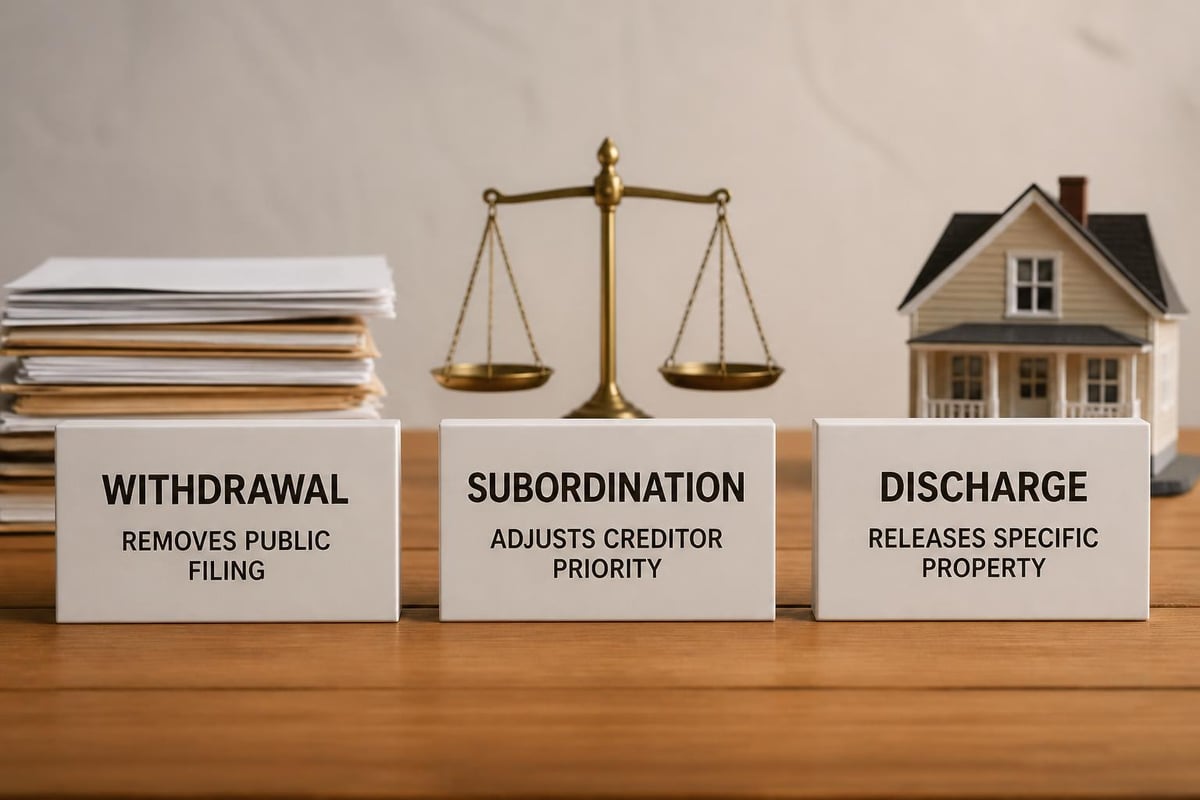
| Action | What It Does | When to Use It |
|---|---|---|
| Withdrawal | Removes lien from public record entirely | Debt satisfied or qualifying installment agreement in place |
| Subordination | Lets another creditor move ahead of IRS | Refinancing or new loan needed while debt still owed |
| Discharge | Removes lien from specific property only | Selling property to raise funds for IRS payment |
Most taxpayers need withdrawal after they've handled the debt. Subordination and discharge are tools you use while still paying. Understanding which applies to your situation determines whether additional IRS procedures are needed.
How Withdrawal Affects Your Credit Score
The lien filing itself typically drops your credit score 100 points or more when it hits. Withdrawal doesn't immediately restore those points. Your score recovers over time as the lien's absence allows positive payment history to carry more weight.
Credit bureaus treat withdrawn liens as if they never existed, which means they stop factoring into your score calculation. But if the lien was on your report for two years before withdrawal, those two years of damage already happened. Your score rebuilds as you maintain clean credit going forward.
Expect 6 to 12 months for significant recovery after withdrawal, assuming you're current on other debts and not adding new negatives. If the lien was the only major issue on your report, recovery happens faster. If you've got collections, late payments, or maxed cards, the lien withdrawal helps but it's not magic.
Mortgage lenders treat withdrawn liens differently than released liens. A release signals "they paid after we filed a lien," which still raises questions. Withdrawal removes the public record, so underwriters often don't see it unless they pull IRS transcripts directly. That difference matters when you're trying to qualify in 2026's tight lending environment.
Filing Form 12277 After an Installment Agreement
The direct debit installment agreement path is the most accessible route to lien withdrawal for most taxpayers. You owe $25,000 or less, you set up monthly payments through direct debit, and after three consecutive payments, you qualify.
Those three payments must clear without issue. If one bounces or you skip a month, the count resets. The IRS is precise about this. Three successful consecutive direct debits from your bank account. Not three months where you mailed checks. Not three payments that eventually cleared after your bank rejected the first attempt.
Once you've made the third payment and it's cleared, wait about 10 days for the IRS to process it internally. Then file your form 12277 lien withdrawal application with documentation showing all three debits. Attach your installment agreement letter and bank statements with the debits highlighted.
I've walked dozens of clients through this process. The IRS usually approves these applications within 30 days because the criteria are black and white. You either made three payments via direct debit or you didn't.
One catch: you must stay current on all filing requirements going forward. If you're on a 2024 installment agreement and you don't file your 2025 return on time, the agreement defaults and withdrawal approval gets yanked. The IRS is serious about compliance. One missed filing kills the deal.
Withdrawal After Paying the Debt in Full
You paid every cent. The IRS issued a Certificate of Release. The lien is no longer enforceable. But it's still on public record, tanking your credit and showing up in title searches.
File Form 12277 as soon as you receive the release. The longer the lien sits on your credit report-even after it's released-the more damage it does. Some taxpayers wait months or years, assuming the release is enough. It's not.
Attach the account transcript showing zero balance and a copy of the Certificate of Release. In Section 3, check the box for "satisfied" or "paid in full" and briefly state why withdrawal is in your best interest. "Need to obtain mortgage financing" or "professional licensing requires clean credit" both work.
The IRS evaluates whether withdrawal interferes with future collections. If you owe nothing and aren't likely to owe in the future, they usually approve. If you've got a history of repeated tax debt-paid 2022, racked up 2023, paid 2024, now owe for 2025-they might deny it, believing the lien serves as a public warning to creditors.
This is where your overall tax compliance history matters. A one-time debt that you paid? Withdrawal granted. A pattern of falling behind? Tougher sell.
Strategic Timing for Maximum Benefit
When you file matters almost as much as meeting the eligibility requirements. If you're about to apply for a mortgage, don't wait until you're in underwriting to file Form 12277. Start the process 90 days before you need clean credit. That gives the IRS time to process, credit bureaus time to update, and you time to fix any issues.
If you're on a direct debit agreement and month three falls in late May 2026, file the withdrawal application in early June. The IRS won't consider it until the payment clears and processes, but getting the application in queue saves time on the back end.
Same logic applies after paying in full. Don't wait for the perfect moment. File as soon as you receive the release. The withdrawal approval process runs parallel to credit report updates, so starting early means faster results.
For offers in compromise, timing depends on your offer terms. If you paid a lump sum offer, file immediately after the acceptance letter. If you're on installment terms for the offer, wait until you've completed those payments and confirmed compliance with all filing requirements.
What Happens If You Move or Change Banks
IRS correspondence about your withdrawal application goes to the address on Form 12277. If you move after filing but before approval, update your address with the IRS immediately. Use Form 8822 for individual taxpayers or Form 8822-B for businesses.
If you change banks while on a direct debit installment agreement, update your payment information through the IRS immediately. A failed direct debit because your old account closed resets your three-payment count and can default your entire agreement. Call the IRS or use their online payment system to switch accounts before the next scheduled debit.
I've seen taxpayers lose withdrawal eligibility because they switched banks, forgot to update the IRS, the debit failed, and by the time they sorted it out, they had to start the three-payment count over. Simple administrative task. Massive consequence.
The form 12277 lien withdrawal application removes the public filing that's killing your credit and blocking financial opportunities, but only if you meet specific IRS criteria and document it correctly. If you've paid your debt, set up a qualifying installment agreement, or accepted an offer in compromise, withdrawal is available-and worth pursuing. For 32 years, I've helped taxpayers navigate lien withdrawals, installment agreements, and every other IRS collection tool. Let's talk about getting that lien off your record and moving forward. Law Offices of Darrin T. Mish, P.A.