

If you're reading this, something about your tax situation has you worried. That's fair — the IRS is intimidating until you know how the rules actually work. I'm Darrin Mish, a Tampa tax attorney. I've handled cases like yours for 32 years. Let me walk you through it.
I'm Darrin Mish. Tampa tax attorney, 32 years in, more than $100 million in IRS debt resolved. What follows isn't theory – it's what I've actually watched work.
You opened your mailbox and found a CP2000 notice. Your stomach dropped. The IRS claims you owe money because information on your tax return doesn't match what they received from third parties. This isn't an audit, but it's still serious. Your cp2000 notice response determines whether you'll pay what you actually owe or get stuck with penalties and interest you could have avoided.
The notice looks intimidating with its dense paragraphs and confusing charts. But here's the reality: most CP2000 notices contain mistakes or incomplete information. The IRS computer system matched your Social Security number to income reports from employers, banks, and brokerages. When something didn't line up, they sent you this letter. They're not accusing you of fraud. They're asking you to explain.
What a CP2000 Notice Actually Means
The CP2000 is a proposed assessment, not a bill. The IRS thinks you underreported income or overstated deductions. They've calculated what they believe you owe, including penalties and interest. But they haven't made a final determination yet.
The Taxpayer Advocate Service explains that this notice gives you a chance to respond before the IRS takes collection action. You have 30 days from the notice date to reply, though the IRS will accept late responses in most cases.

The notice includes a response form with three basic options. You can agree with the proposed changes and pay. You can disagree and explain why. Or you can partially agree and dispute specific items.
Why the IRS Computer Got It Wrong
The matching system is automated. It compares your return against Forms W-2, 1099, 1098, and other third-party reports. When numbers don't match exactly, the computer flags your return.
Common errors include:
- 1099 income you already reported under a different category
- Gross proceeds from stock sales without accounting for your cost basis
- Retirement distributions you rolled over within 60 days
- Cryptocurrency transactions where you received a 1099-B but had offsetting losses
- Income reported by an ex-spouse on jointly-filed year returns after divorce
The IRS doesn't have context. They just see a 1099-NEC for $15,000 from a client and no matching Schedule C. They don't know you reported it as partnership income on Schedule E.
Reading Your CP2000 Notice Correctly
The notice shows three columns: what the IRS has on file, what you reported, and the difference. Don't panic at the total on page one. Work through each line item.
| Section | What to Check | Why It Matters |
|---|---|---|
| Income Comparison | Forms W-2, 1099-MISC, 1099-NEC, 1099-INT | Verify each form is yours and check if you already reported it differently |
| Tax Calculation | Proposed tax increase | Based on their adjustments, may be wrong if adjustments are wrong |
| Penalties | Accuracy-related penalty, interest | Automatically added, can be removed if you have reasonable cause |
Look at the Explanation of Changes section. This breaks down each discrepancy. The IRS lists the payer, type of income, and amount they think you missed.
Cross-reference these with your actual tax return. Pull out your filed Form 1040 and all schedules. Many CP2000 issues disappear when you realize you did report the income, just on a different line than the IRS expected.
The Response Form Inside Your Notice
The form at the back of your CP2000 has checkboxes. These aren't casual suggestions. Your selection determines what happens next.
Agreed: You're accepting the proposed changes. Sign the form, pay the amount due or request a payment plan, and mail it back. The IRS will process the adjustment and send you a revised tax bill.
Disagreed: You're disputing the entire notice. You must explain why in writing and provide documentation. The IRS will review your response and either accept it, modify the proposal, or issue a Statutory Notice of Deficiency.
Partially Agreed: You accept some changes but dispute others. This is the most common cp2000 notice response in my practice. You might agree that you missed one 1099 but dispute the penalty because you have reasonable cause.
Building Your CP2000 Notice Response
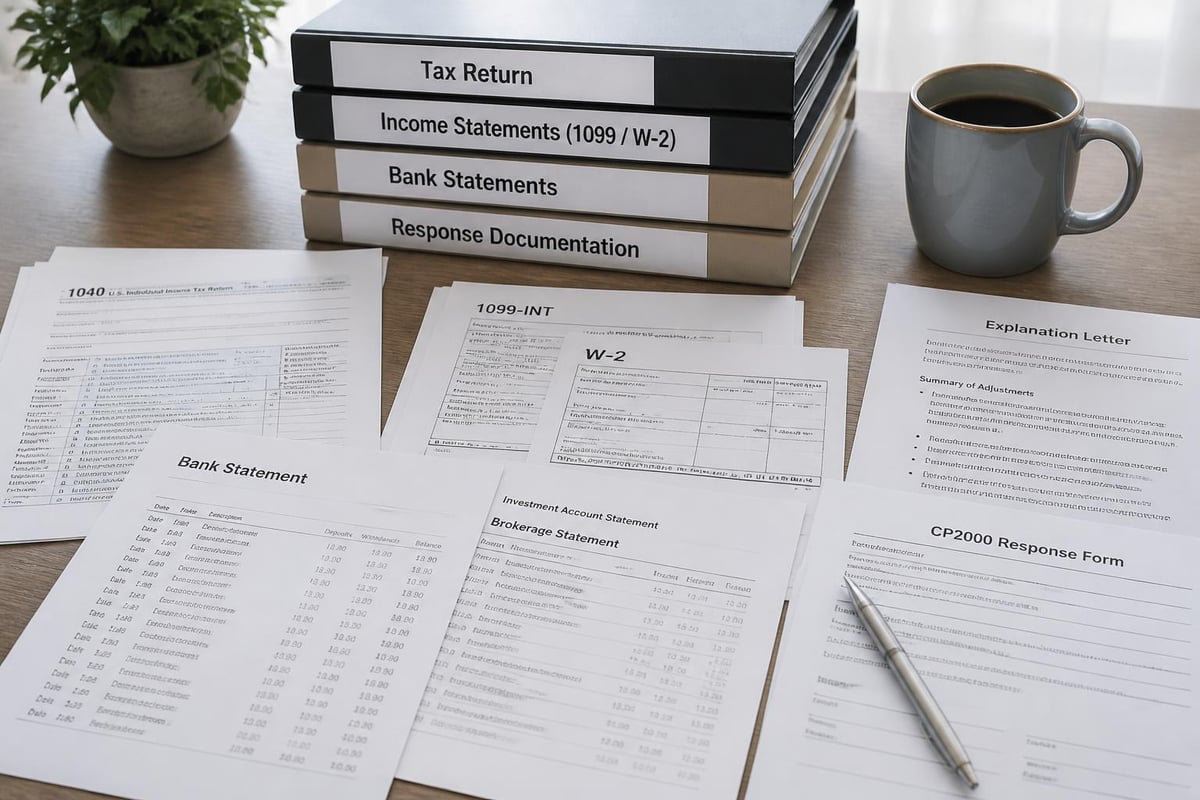
Start with documentation. Gather every Form 1099, W-2, 1098, and financial statement related to the disputed items. You need to prove what you actually earned and what you actually reported.
For unreported income you legitimately received, acknowledge it. Explain why you didn't report it originally. Maybe you never received the 1099, or you thought it was included in a consolidated statement.
For income the IRS incorrectly attributed to you, prove it wasn't yours. Common examples include 1099s issued to a business you sold, income paid to someone else with a similar name, or forms reporting the same income twice.
Before responding to your CP2000 notice, verify the payer information on each disputed form. Call the company that issued the 1099 if necessary.
Writing the Explanation That Works
Your written response should be direct and factual. The IRS agent reviewing your case has limited time. Make it easy for them to understand your position.
Format it like this:
- Introduction: Reference the notice number and tax year
- Item-by-item response: Address each discrepancy separately
- Supporting documentation: List what you're enclosing
- Conclusion: State clearly whether you agree, disagree, or partially agree
For each disputed item, explain:
- What the IRS claims you failed to report
- Why their information is incorrect or incomplete
- What you actually reported on your return
- Where on your return you reported it
Attach copies of your filed return, relevant schedules, corrected 1099s if the issuer made mistakes, and bank statements showing the actual income you received.
Common CP2000 Situations and How to Handle Them
Cryptocurrency reporting generates thousands of CP2000 notices annually. Exchanges report gross proceeds without your cost basis. The IRS sees $50,000 in crypto sales and assumes it's all taxable gain.
For cryptocurrency tax issues, you need to document your purchase price for each transaction. Provide exchange records showing what you paid for the crypto you sold. The IRS will recalculate based on actual gains.
Stock sales trigger similar issues. Your broker reports the sale proceeds but may not report cost basis, especially for shares purchased before 2011. You need brokerage statements showing the original purchase price and date.
Gig economy income from driving, freelancing, or online sales creates reporting mismatches. You might receive six different 1099-Ks and 1099-NECs totaling $75,000, but your actual net profit after expenses was $30,000.
The IRS doesn't automatically know about your business expenses. Your cp2000 notice response needs to include Schedule C showing gross receipts matching the 1099 totals and legitimate business deductions.
When You Actually Missed Income
Sometimes the CP2000 is right. You forgot a 1099, lost track of a side gig, or miscalculated investment income. Admit it.
The accuracy-related penalty (usually 20% of the tax underpayment) can be removed if you have reasonable cause. Reasonable cause means you made an honest mistake despite ordinary care.
Penalty abatement strategies work when you can show:
- The payer never sent you the 1099, or sent it to an old address
- You relied on bad advice from a tax preparer
- You experienced serious illness or family emergency during tax preparation
- The income amount was immaterial and you had no reason to know about it
Document your reasonable cause. Write a letter explaining the circumstances. Include medical records, proof of address change, or correspondence with the preparer if relevant.
The Timeline for Your CP2000 Notice Response
You have 30 days from the notice date to respond. Not 30 days from when you opened the envelope. The date is printed on the first page.
Missing this deadline won't kill your case. Legal experts recommend responding as soon as possible, but the IRS accepts late responses during the next several months.
What happens if you ignore it completely? After 60 days, the IRS sends a Statutory Notice of Deficiency. This gives you 90 days to petition Tax Court. If you miss that deadline, the assessment becomes final. The IRS can then proceed with tax liens, levies, and wage garnishment.
Where to Send Your Response
Mail everything to the address printed on your CP2000 response form. Each IRS campus processes notices for specific states. Sending it to the wrong location delays processing by weeks.
Use certified mail with return receipt. Keep copies of everything you send. The IRS loses mail sometimes, and you need proof you responded timely.
Include:
- Completed and signed response form
- Written explanation
- Supporting documents (copies, not originals)
- Payment if you're agreeing to some or all changes
What Happens After You Submit Your Response
The IRS has 60 to 120 days to review your cp2000 notice response. They'll send one of several letters depending on their decision.
Accepted: They agree with your explanation and close the case. You'll receive a letter stating no change to your return.
Partially accepted: They adjusted their proposal based on some of your arguments but still believe you owe something. You'll get a revised CP2000 with a new amount.
Rejected: They disagree with your response and proceed with the original assessment. You'll receive a Statutory Notice of Deficiency with 90 days to petition Tax Court.

If they request more information, provide it promptly. Missing a follow-up request can result in default assessment of the full proposed amount.
Negotiating Payment Options
When you agree with the CP2000 (fully or partially), you need to pay or arrange payment. The IRS offers several options beyond paying in full immediately.
Short-term payment plan: Up to 180 days to pay, minimal setup fee, no formal agreement needed. Request this on the response form or by calling the number on your notice.
Installment agreement: Monthly payments over 72 months or longer. Setting up an installment agreement requires financial disclosure if you owe more than $50,000.
Offer in Compromise: Settle for less than you owe based on inability to pay. This rarely applies to CP2000 assessments unless you have significant existing tax debt and limited assets.
The key is requesting payment arrangements before the assessment becomes final. Once the IRS files a notice of federal tax lien or issues a levy, your options narrow.
When Professional Help Makes Sense
Most straightforward CP2000 notices don't require an attorney. If the IRS missed income you legitimately reported elsewhere, you can handle the response yourself.
Consider consulting a tax attorney when:
- The proposed assessment exceeds $10,000
- You disagree with multiple items and need to build a complex argument
- The notice involves business income, cryptocurrency, or real estate transactions
- You missed income but have reasonable cause arguments for penalty abatement
- You can't afford the proposed assessment and need to negotiate payment terms
- You've already responded once and the IRS rejected your explanation
| Do It Yourself | Get Professional Help |
|---|---|
| Single missing 1099 you actually reported | Multiple discrepancies over several years |
| Simple math error or duplicate reporting | Complex basis calculations on investments |
| Small amounts under $5,000 | Proposed assessment over $25,000 |
| Clear documentation readily available | Need for expert testimony or technical arguments |
An experienced tax attorney knows how IRS examiners think. We understand which arguments work and which waste time. We can negotiate directly with the IRS, file penalty abatement requests, and protect you if the case escalates to Tax Court.
Mistakes That Make CP2000 Problems Worse
Ignoring the notice tops the list. I've seen clients bury these letters and hope they disappear. They don't. The IRS will assess the tax, add penalties and interest, and begin collection.
Sending incomplete responses wastes everyone's time. If you disagree with three items but only address one, the IRS will assess the other two.
Making emotional arguments instead of factual ones. The examiner doesn't care that you think the tax law is unfair or that you have financial hardship. Stick to whether the income was actually yours and whether you reported it correctly.
Failing to address penalties separately from the tax. Even if you owe the underlying tax, you can often get penalties removed with a reasonable cause statement.
Understanding what triggers IRS notices helps you respond appropriately. The system is looking for unreported income, not criminal tax evasion.
Preventing Future CP2000 Notices
The best cp2000 notice response is preventing the next one. Review these practices before filing your 2026 return.
Match your return to information returns: Before filing, gather all 1099s, W-2s, and 1098s. Compare the totals to what you're reporting. If you're missing a form, contact the payer.
Report gross income even when you have deductions: If you earned $50,000 in freelance income and had $30,000 in expenses, report the $50,000 as gross receipts on Schedule C and claim the expenses separately. Don't just report net income of $20,000.
Reconcile brokerage statements: Your Form 1099-B from your broker should match your Schedule D. If you sold stocks or crypto, verify the proceeds and cost basis line up.
Keep detailed records: Save receipts, bank statements, and contracts for at least three years. If you get a CP2000, you'll need to reconstruct what happened.
File on time: Late filers receive more scrutiny. The IRS assumes delayed returns contain errors or omissions.
For cryptocurrency taxes specifically, maintain transaction logs showing date acquired, purchase price, date sold, and sale price for every trade. The blockchain doesn't lie, and the IRS gets copies of your exchange activity.
Your cp2000 notice response determines whether this ends quickly or drags on for months with increasing penalties. Most notices resolve in your favor when you provide clear documentation and respond promptly. The IRS isn't trying to trick you; their computer just doesn't have the full story. If you're facing a complex CP2000 situation with substantial amounts at stake, or if the IRS rejected your initial response, Law Offices of Darrin T. Mish, P.A. offers free consultations to evaluate your case and develop a resolution strategy that protects your interests.