

I'm Darrin Mish. For 32 years I've practiced federal tax litigation — routine audits, Tax Court cases, and everything in between. If you're facing an IRS issue, here's what you need to know first.
I'm Darrin Mish. Tampa tax attorney, 32 years in, more than $100 million in IRS debt resolved. What follows isn't theory – it's what I've actually watched work.
You've built wealth in real estate. Now you want to sell one property and buy another without paying capital gains tax on the sale. That's a 1031 exchange under Internal Revenue Code section 1031, and yes, the IRS allows it. But the rules are strict, the deadlines are hard, and one mistake costs you the entire tax deferral. A 1031 exchange attorney helps you stay in bounds.
The statute itself is simple. Trade real property for like-kind real property, defer the tax. But execution is unforgiving. You have 45 days to identify replacement properties and 180 days to close. Miss either deadline by a single day and the IRS treats the whole transaction as a taxable sale. No extensions. No do-overs.
Why You Need a 1031 Exchange Attorney
Most real estate transactions give you room for negotiation, delays, amendments. A 1031 exchange does not. The moment you close on the sale of your relinquished property, the clock starts. You need every document, every party, and every deadline coordinated before you sell.
A 1031 exchange attorney reviews your transaction structure before you list the property. We confirm that your intended replacement property qualifies as like-kind. We draft the exchange agreement with your qualified intermediary. We review the purchase contract for your replacement property to make sure it doesn't accidentally trigger taxable boot or violate the strict timing rules.

The Qualified Intermediary Requirement
You cannot touch the sale proceeds. The IRS requires a qualified intermediary to hold the funds between the sale of your relinquished property and the purchase of your replacement property. If you receive the cash, even for a day, the exchange fails. You owe tax on the full gain.
Choosing the wrong intermediary creates risk. Some are insurance companies. Some are local title agencies. Some are national exchange firms. Each has different bonding, different insurance, and different financial stability. If your intermediary goes bankrupt or disappears with your funds, the IRS doesn't care. You still owe the tax, and you've lost your money.
A 1031 exchange attorney vets your intermediary before you engage them. We review their errors and omissions insurance, fidelity bonds, and financial statements. We confirm they segregate client funds and maintain adequate reserves. This isn't paranoia. I've seen intermediaries fold mid-exchange, and the taxpayer loses everything.
The 45-Day Identification Deadline
You have 45 calendar days from the close of your relinquished property to identify potential replacement properties in writing to your qualified intermediary. The IRS doesn't count business days. It counts every day, including weekends and holidays. Day 45 falls on a Sunday? Too bad. You needed to identify by Saturday.
The identification must be specific. You can't write "a property in Tampa." You need the street address or a legal description detailed enough that someone could locate the property without guessing. Ambiguous descriptions fail, and the IRS has ruled against taxpayers who thought close enough was good enough.
Three Identification Rules
The IRS gives you three ways to identify replacement properties. Pick the rule that fits your situation.
| Rule | What You Can Identify | Limitation |
|---|---|---|
| Three-Property Rule | Up to three properties of any value | No value cap |
| 200% Rule | Any number of properties | Total value can't exceed 200% of relinquished property value |
| 95% Rule | Any number of properties at any value | You must close on 95% of the identified value |
Most taxpayers use the three-property rule. It's clean. You identify three properties, close on one or more, and you're done. The 200% rule gives you more options if you're consolidating or diversifying. The 95% rule is dangerous. Miss the 95% threshold by a single dollar and the entire exchange collapses.
A tax attorney walks you through these rules during the pre-sale planning phase. We calculate the safe harbor limits based on your relinquished property's fair market value. We draft the identification letter. We make sure it's delivered to your intermediary on time, in the correct format, with the required signatures.
The 180-Day Exchange Period
You must close on your replacement property within 180 days of closing on your relinquished property. Or, if earlier, by the due date (including extensions) of your tax return for the year of the sale. Whichever comes first ends your exchange period.
This creates a trap for late-year sales. Sell your relinquished property on November 1, 2026, and your 180-day period ends on April 30, 2027. But your 2026 tax return is due April 15, 2027, without an extension. That cuts your exchange window to 165 days unless you file an extension. Even with an extension, you're capped at 180 days from the sale.
Financing Delays and Title Issues
Real estate closings delay. Appraisals take longer than expected. Lenders ask for more documentation. Title companies find unexpected liens or easements. Sellers get cold feet and renegotiate at the last minute. None of this matters to the IRS. Your 180-day deadline doesn't move.
A 1031 exchange attorney anticipates these delays. We build cushion into the timeline. We advise identifying backup properties so you're not locked into a single seller who might miss the closing date. We coordinate with your lender, title company, and intermediary to confirm everyone understands the hard deadline. We review the closing statement before you sign to confirm the exchange is structured correctly and no proceeds flow to you directly.
What Qualifies as Like-Kind Real Property
Before the 2017 Tax Cuts and Jobs Act, you could exchange almost any business or investment property. Cars, equipment, art, livestock. After 2018, like-kind exchanges only apply to real property. No personal property qualifies.
Real property means land and buildings. Rental homes, commercial buildings, raw land, industrial warehouses, apartment complexes. The IRS doesn't require the properties to be similar in quality, grade, or use. You can trade a single-family rental for an office building. You can trade improved property for raw land. You can trade one rental house for fractional interests in ten different properties.
Property That Doesn't Qualify
Your primary residence doesn't qualify. Vacation homes you use personally more than 14 days a year or 10% of rental days don't qualify. Property held primarily for resale (dealer property or fix-and-flip inventory) doesn't qualify. Foreign real property doesn't qualify for exchanges with U.S. real property under section 1031.
The IRS looks at intent and use, not just title. If you buy a rental property, live in it for two years, then try to exchange it, the Service can challenge whether it was held for investment. If you exchange into a property and immediately convert it to personal use, the IRS can disallow the exchange or tax the conversion as a sale.
A 1031 exchange attorney reviews your holding period and use for both the relinquished and replacement properties. We advise on safe harbors for rental use versus personal use. We structure your acquisition and disposition to support the investment character of the properties. This becomes critical if you're later audited.

Boot and Partial Taxable Exchanges
The goal of a 1031 exchange is full tax deferral. You trade property of equal or greater value, take on equal or greater debt, and recognize no gain. But exchanges rarely match perfectly. The difference is called boot, and boot is taxable.
Cash Boot and Mortgage Boot
Cash boot happens when you receive cash in addition to replacement property. Your relinquished property sells for $500,000, and your replacement property costs $450,000. That $50,000 difference is taxable cash boot. You'll pay capital gains tax on it.
Mortgage boot happens when you reduce debt in the exchange. You sell a property with a $200,000 mortgage and buy a replacement property with a $150,000 mortgage. The $50,000 debt reduction is treated as boot and taxed as gain, even if you didn't receive any cash.
| Item | Relinquished Property | Replacement Property | Result |
|---|---|---|---|
| Value | $500,000 | $500,000 | No cash boot |
| Debt | $200,000 | $150,000 | $50,000 mortgage boot (taxable) |
To avoid boot, your replacement property must be equal or greater in value, and you must maintain or increase your debt. A 1031 exchange attorney calculates your boot risk before you sell. We model different acquisition scenarios and show you exactly how much tax you'll owe if you don't reinvest all proceeds or take on sufficient replacement debt. We coordinate with your intermediary and lender to structure the financing correctly.
Reverse Exchanges and Improvement Exchanges
Sometimes you find the perfect replacement property before you've sold your relinquished property. Or you want to build improvements on the replacement property using sale proceeds. Both are possible, but both require specialized structures.
Reverse Exchange Structure
In a reverse exchange, your qualified intermediary buys and holds the replacement property (or sometimes the relinquished property) until you close the sale. This is called an exchange accommodation titleholder arrangement. The intermediary takes title for up to 180 days while you sell your relinquished property and complete the exchange.
Reverse exchanges cost more. The intermediary needs financing or you need to park significant funds with them. They carry property tax, insurance, and liability risk. The property sits in an LLC controlled by the intermediary, not you. Title companies and lenders dislike reverse exchanges because the ownership structure is temporary and complex.
A 1031 exchange attorney structures the reverse exchange documents before you make an offer on the replacement property. We draft the exchange accommodation agreement, the parking arrangement, and the title transfer documents. We coordinate with the intermediary's counsel, your lender, and the seller's attorney to make sure everyone understands the timeline and structure. Reverse exchanges fail when parties don't understand their roles and deadlines.
Improvement or Build-to-Suit Exchanges
You sell a $600,000 rental property and want to buy a $400,000 lot and build a $200,000 improvement on it within the 180-day exchange period. That's an improvement exchange. Your intermediary buys the lot, hires the contractor, manages the construction, and deeds the improved property to you before the 180-day deadline.
Improvement exchanges rarely work cleanly. Construction delays, permit issues, weather, and labor shortages push timelines. If the improvements aren't complete by day 180, you only defer tax on the completed value. You'll recognize taxable boot on any unused proceeds.
The IRS regulations and guidance on improvement exchanges are detailed and strict. We plan these transactions with significant time cushion. We require detailed construction schedules, fixed-price contracts, and performance bonds from contractors. Even then, improvement exchanges carry more risk than straight swaps.
Reporting Your Exchange to the IRS
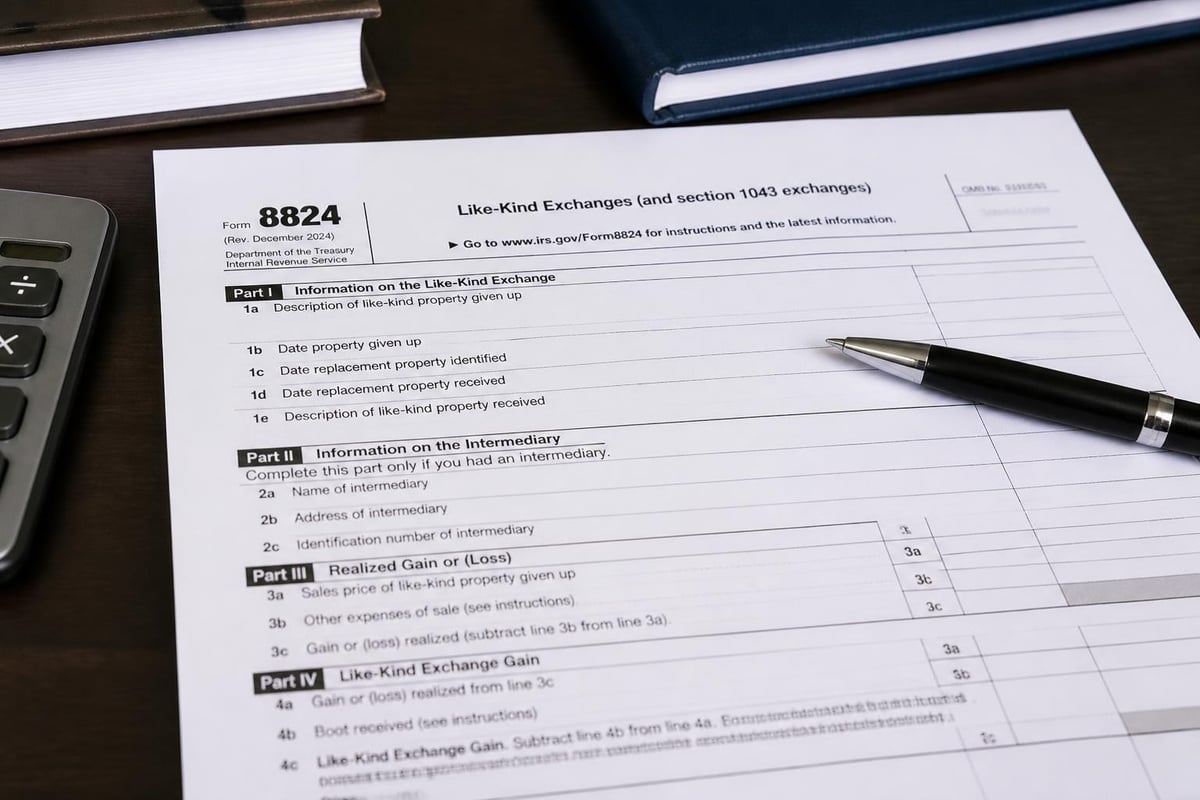
Every 1031 exchange must be reported on your tax return using Form 8824. You file it for the year in which you transferred the relinquished property, even if you don't close on the replacement property until the following year. The form reports the dates, property descriptions, intermediary information, and gain computation.
Common Reporting Mistakes
Taxpayers underreport boot or fail to attach Form 8824 entirely. Some report the exchange as a sale and repurchase on Schedule D, which disqualifies the exchange. Others fail to carry forward the deferred gain and adjusted basis to the replacement property, creating errors in future years when they sell or depreciate the property.
If you received boot, you recognize gain up to the amount of boot. That gain is reportable on Schedule D or Form 4797 depending on the character of the property. If you claimed depreciation on the relinquished property, part of the gain may be recaptured as ordinary income under section 1250 or section 1245.
A 1031 exchange attorney coordinates with your CPA to complete Form 8824 correctly. We provide the basis calculation, gain computation, and exchange documentation your CPA needs to prepare the return. We review the completed return before filing to confirm the exchange is properly reported and the deferred gain is correctly reflected in the replacement property's basis. Mistakes here invite IRS audits, and unwinding a failed exchange after the fact is expensive or impossible.
When the Exchange Fails
The IRS doesn't send you a notice saying your exchange failed. You file your return, report the exchange on Form 8824, and hope. Months or years later, the Service audits the return and disallows the exchange. Now you owe tax, interest, and potentially penalties on the full gain.
Missed Deadlines and Disqualified Property
The most common failure is a blown deadline. You identified the replacement property on day 46 instead of day 45. You closed on day 181 instead of day 180. The IRS has no discretion. The statute says 45 and 180. Miss by an hour and the exchange fails.
The second most common failure is disqualified property. You exchanged into a property you intended to use as a vacation home. You swapped land you were holding for development and resale. You traded U.S. real estate for foreign real estate. Each of these disqualifies the exchange, and the IRS assesses tax on the full gain plus interest from the original due date of the return.
Penalties for negligence or substantial understatement can add another 20% to 40% of the tax. If the IRS determines you knew the exchange didn't qualify and reported it anyway, you're looking at accuracy-related penalties and possible fraud charges. At that point, you need a tax attorney to negotiate penalty abatement or an Offer in Compromise if you can't pay the assessed tax and penalties.
Related-Party Exchanges and Anti-Abuse Rules
The IRS allows exchanges between related parties, but the rules are tighter. If you exchange property with your spouse, child, parent, sibling, or controlled entity, both parties must hold the property for at least two years after the exchange. Sell earlier and the exchange is disallowed retroactively.
Why the Two-Year Holding Period Exists
Congress added the related-party rule to stop tax-free cash-out schemes. You exchange your appreciated property to your brother for his property. He immediately sells your property to a third party for cash and gives you the proceeds. Without the holding requirement, you just converted a taxable sale into a tax-free exchange and cashed out.
The two-year holding period prevents this. If either party disposes of the property within two years, both parties recognize the original deferred gain. The IRS treats the exchange as if it never happened. Exceptions exist for death, involuntary conversions, and certain non-tax-avoidance transactions, but the burden of proof is on you.
A 1031 exchange attorney structures related-party exchanges with the holding period and documentation required to survive IRS scrutiny. We draft agreements preventing early disposition. We advise on the exceptions and safe harbors. We document the business purpose for the exchange so it doesn't look like a cash-out scheme if the IRS questions it later.
Working with a 1031 Exchange Attorney Before You List
The time to involve a 1031 exchange attorney is before you list your relinquished property, not after you've accepted an offer. Once you're under contract, your options narrow. The purchase agreement controls the closing date, and you've lost negotiating room to structure the exchange correctly.
Pre-Sale Exchange Planning Checklist
We start by confirming your property qualifies as investment or business-use real estate. We review your holding period and rental activity. We identify any personal use that might disqualify the property. We discuss your goals for the replacement property-value range, location, debt level, and timeline.
- Confirm property qualifies for like-kind exchange treatment under IRC section 1031
- Vet qualified intermediary for financial stability, insurance, and client fund segregation
- Review financing options for replacement property to avoid mortgage boot
- Draft identification strategy using three-property, 200%, or 95% rule
- Build timeline with cushion for delays and coordination with lenders, title companies, intermediaries
We coordinate with your qualified intermediary before you sign the listing agreement. We review the intermediary's exchange agreement and confirm it protects your rights if they fail to perform. We add exchange language to your purchase and sale agreement so the buyer and closing agent know this is a 1031 transaction.
We calculate the value and debt you need in your replacement property to defer all gain. We discuss backup properties in case your first choice falls through. We build a timeline that accounts for identification deadlines, closing deadlines, financing delays, and your tax return due date. We coordinate with your CPA to confirm the exchange fits your overall tax strategy and won't create unexpected issues in other areas.
This front-end planning prevents back-end disasters. I've never seen a well-planned 1031 exchange fail. I've seen dozens of last-minute, poorly structured exchanges collapse because no one understood the rules until it was too late.
Policy Debate and Legislative Risk
Section 1031 has been a target for repeal or limitation in nearly every tax reform proposal for the past decade. The Congressional Research Service and various policy groups argue that 1031 exchanges primarily benefit high-income taxpayers and real estate investors, creating inequity in the tax code. Proposals to limit exchanges to $500,000 or $1 million of deferred gain appear in budget discussions regularly.
The Tax Foundation’s analysis of recent administration budget proposals shows 1031 exchanges as a potential revenue raiser. Eliminating or capping the deferral would generate billions in tax revenue over ten years. Real estate industry groups argue that 1031 exchanges promote capital formation, property improvement, and economic activity. The debate continues.
For now, section 1031 remains in the code. But legislative risk is real. If you're planning a large exchange, consider the possibility that the rules could change mid-transaction. A law passed after you sell but before you close on replacement property could apply retroactively or create transition issues. A 1031 exchange attorney monitors proposed legislation and advises clients on timing risk when reforms are pending.
A 1031 exchange defers tax. It doesn't forgive it. Eventually you sell or die, and the tax comes due unless you keep exchanging or your heirs get a stepped-up basis. But deferral is powerful, and done correctly, it works. For 32 years I've helped clients navigate these exchanges, and the ones who plan early and follow the rules walk away with their tax deferral intact. Let's talk if you're planning an exchange and want it done right-Law Offices of Darrin T. Mish, P.A. offers free consultations and works with clients nationwide.